JYOTI BARIK
ROLL NO : 16DM041
CONTENT
Introduction
Types of leverage
Example
Conclusion
INTRODUCTION
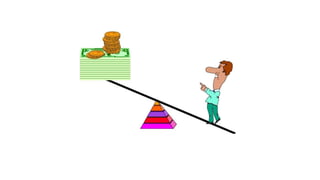
• In financial management, the term “leverage” is used to describe the
firm’s ability to use fixed cost assets or funds to increase the return
to it’s owners.
• James Horne has defined leverage as “the employment of an asset
or sources of funds for which the firm has to pay a fixed cost or fixed
return.”
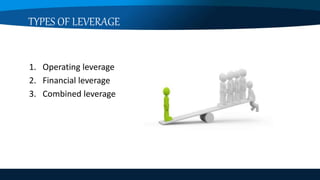
TYPES OF LEVERAGE
1. Operating leverage
2. Financial leverage
3. Combined leverage
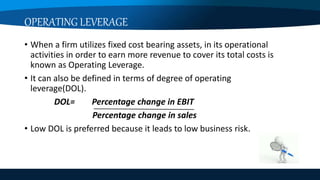
OPERATING LEVERAGE
• When a firm utilizes fixed cost bearing assets, in its operational
activities in order to earn more revenue to cover its total costs is
known as Operating Leverage.
• It can also be defined in terms of degree of operating
leverage(DOL).
DOL= Percentage change in EBIT
Percentage change in sales
• Low DOL is preferred because it leads to low business risk.
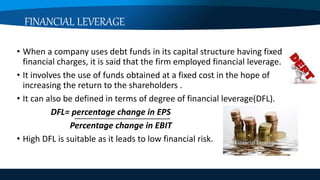
FINANCIAL LEVERAGE
• When a company uses debt funds in its capital structure having fixed
financial charges, it is said that the firm employed financial leverage.
• It involves the use of funds obtained at a fixed cost in the hope of
increasing the return to the shareholders .
• It can also be defined in terms of degree of financial leverage(DFL).
DFL= percentage change in EPS
Percentage change in EBIT
• High DFL is suitable as it leads to low financial risk.
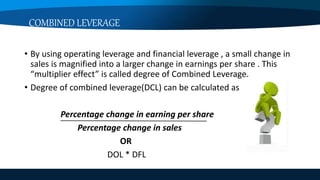
COMBINED LEVERAGE
• By using operating leverage and financial leverage , a small change in
sales is magnified into a larger change in earnings per share . This
“multiplier effect” is called degree of Combined Leverage.
• Degree of combined leverage(DCL) can be calculated as
Percentage change in earning per share
Percentage change in sales
OR
DOL * DFL
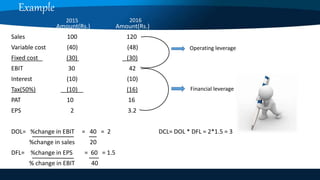
Example
Amount(Rs.) Amount(Rs.)
Sales 100 120
Variable cost (40) (48)
Fixed cost (30) (30)
EBIT 30 42
Interest (10) (10)
Tax(50%) (10) (16)
PAT 10 16
EPS 2 3.2
DOL= %change in EBIT = 40 = 2 DCL= DOL * DFL = 2*1.5 = 3
%change in sales 20
DFL= %change in EPS = 60 = 1.5
% change in EBIT 40
Operating leverage
Financial leverage
2015 2016
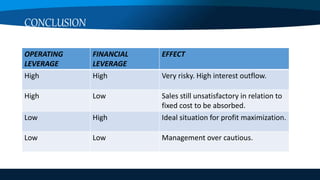
CONCLUSION
OPERATING
LEVERAGE
FINANCIAL
LEVERAGE
EFFECT
High High Very risky. High interest outflow.
High Low Sales still unsatisfactory in relation to
fixed cost to be absorbed.
Low High Ideal situation for profit maximization.
Low Low Management over cautious.
Leverage

Leverage

  • 1.
  • 2.
  • 5.
    INTRODUCTION • In financialmanagement, the term “leverage” is used to describe the firm’s ability to use fixed cost assets or funds to increase the return to it’s owners. • James Horne has defined leverage as “the employment of an asset or sources of funds for which the firm has to pay a fixed cost or fixed return.”
  • 6.
    TYPES OF LEVERAGE 1.Operating leverage 2. Financial leverage 3. Combined leverage
  • 7.
    OPERATING LEVERAGE • Whena firm utilizes fixed cost bearing assets, in its operational activities in order to earn more revenue to cover its total costs is known as Operating Leverage. • It can also be defined in terms of degree of operating leverage(DOL). DOL= Percentage change in EBIT Percentage change in sales • Low DOL is preferred because it leads to low business risk.
  • 8.
    FINANCIAL LEVERAGE • Whena company uses debt funds in its capital structure having fixed financial charges, it is said that the firm employed financial leverage. • It involves the use of funds obtained at a fixed cost in the hope of increasing the return to the shareholders . • It can also be defined in terms of degree of financial leverage(DFL). DFL= percentage change in EPS Percentage change in EBIT • High DFL is suitable as it leads to low financial risk.
  • 9.
    COMBINED LEVERAGE • Byusing operating leverage and financial leverage , a small change in sales is magnified into a larger change in earnings per share . This “multiplier effect” is called degree of Combined Leverage. • Degree of combined leverage(DCL) can be calculated as Percentage change in earning per share Percentage change in sales OR DOL * DFL
  • 10.
    Example Amount(Rs.) Amount(Rs.) Sales 100120 Variable cost (40) (48) Fixed cost (30) (30) EBIT 30 42 Interest (10) (10) Tax(50%) (10) (16) PAT 10 16 EPS 2 3.2 DOL= %change in EBIT = 40 = 2 DCL= DOL * DFL = 2*1.5 = 3 %change in sales 20 DFL= %change in EPS = 60 = 1.5 % change in EBIT 40 Operating leverage Financial leverage 2015 2016
  • 11.
    CONCLUSION OPERATING LEVERAGE FINANCIAL LEVERAGE EFFECT High High Veryrisky. High interest outflow. High Low Sales still unsatisfactory in relation to fixed cost to be absorbed. Low High Ideal situation for profit maximization. Low Low Management over cautious.