SUBMITTED BY:
PIYALI DASGUPTA
Meaning of leverage
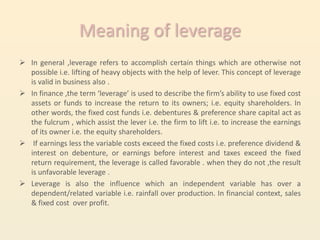
 In general ,leverage refers to accomplish certain things which are otherwise not
  possible i.e. lifting of heavy objects with the help of lever. This concept of leverage
  is valid in business also .
 In finance ,the term ‘leverage’ is used to describe the firm’s ability to use fixed cost
  assets or funds to increase the return to its owners; i.e. equity shareholders. In
  other words, the fixed cost funds i.e. debentures & preference share capital act as
  the fulcrum , which assist the lever i.e. the firm to lift i.e. to increase the earnings
  of its owner i.e. the equity shareholders.
 If earnings less the variable costs exceed the fixed costs i.e. preference dividend &
  interest on debenture, or earnings before interest and taxes exceed the fixed
  return requirement, the leverage is called favorable . when they do not ,the result
  is unfavorable leverage .
 Leverage is also the influence which an independent variable has over a
  dependent/related variable i.e. rainfall over production. In financial context, sales
  & fixed cost over profit.
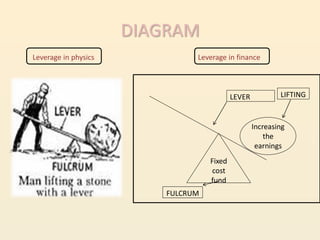
DIAGRAM
Leverage in physics             Leverage in finance


                                            LEVER           LIFTING


                                                    Increasing
                                                        the
                                                     earnings
                                    Fixed
                                    cost
                                    fund
                          FULCRUM
TYPES OF LEVERAGE
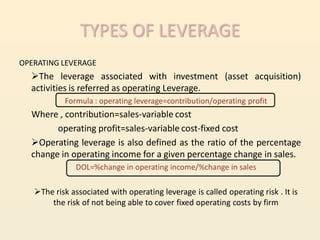
OPERATING LEVERAGE
  The leverage associated with investment (asset acquisition)
  activities is referred as operating Leverage.
           Formula : operating leverage=contribution/operating profit
  Where , contribution=sales-variable cost
        operating profit=sales-variable cost-fixed cost
  Operating leverage is also defined as the ratio of the percentage
  change in operating income for a given percentage change in sales.
               DOL=%change in operating income/%change in sales

   The risk associated with operating leverage is called operating risk . It is
       the risk of not being able to cover fixed operating costs by firm
ILLUSTRATION
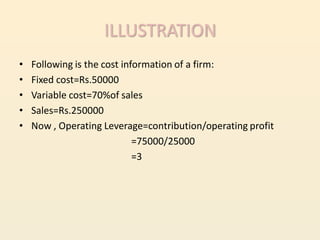
•   Following is the cost information of a firm:
•   Fixed cost=Rs.50000
•   Variable cost=70%of sales
•   Sales=Rs.250000
•   Now , Operating Leverage=contribution/operating profit
                             =75000/25000
                             =3
BREAK EVEN ANALYSIS

 A break-even analysis shows the relationship between the
  costs and profits with sales volume.

 The sales volume which equates total revenue with related
  costs and results in neither profit nor loss is called the break –
  even volume or point.

 At break – even point the fixed costs are fully recovered , any
  increase in sales beyond this level will increase profit.
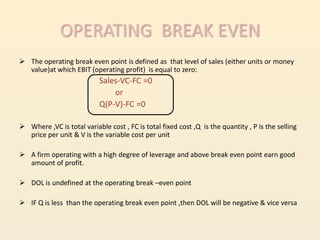
OPERATING BREAK EVEN
 The operating break even point is defined as that level of sales (either units or money
  value)at which EBIT (operating profit) is equal to zero:
                           Sales-VC-FC =0
                               or
                           Q(P-V)-FC =0

 Where ,VC is total variable cost , FC is total fixed cost ,Q is the quantity , P is the selling
  price per unit & V is the variable cost per unit

 A firm operating with a high degree of leverage and above break even point earn good
  amount of profit.

 DOL is undefined at the operating break –even point

 IF Q is less than the operating break even point ,then DOL will be negative & vice versa
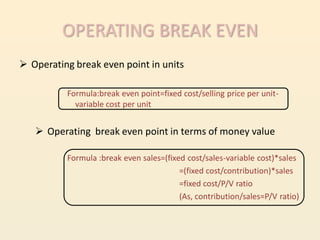
OPERATING BREAK EVEN
 Operating break even point in units

          Formula:break even point=fixed cost/selling price per unit-
            variable cost per unit


    Operating break even point in terms of money value

          Formula :break even sales=(fixed cost/sales-variable cost)*sales
                                         =(fixed cost/contribution)*sales
                                         =fixed cost/P/V ratio
                                         (As, contribution/sales=P/V ratio)
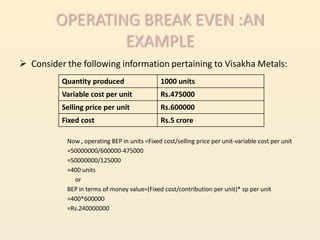
OPERATING BREAK EVEN :AN
                EXAMPLE
 Consider the following information pertaining to Visakha Metals:
          Quantity produced                   1000 units
          Variable cost per unit              Rs.475000
          Selling price per unit              Rs.600000
          Fixed cost                          Rs.5 crore

           Now , operating BEP in units =Fixed cost/selling price per unit-variable cost per unit
           =50000000/600000-475000
           =50000000/125000
           =400 units
             or
           BEP in terms of money value=(Fixed cost/contribution per unit)* sp per unit
           =400*600000
           =Rs.240000000
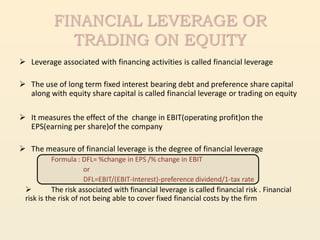
FINANCIAL LEVERAGE OR
            TRADING ON EQUITY
 Leverage associated with financing activities is called financial leverage

 The use of long term fixed interest bearing debt and preference share capital
  along with equity share capital is called financial leverage or trading on equity

 It measures the effect of the change in EBIT(operating profit)on the
  EPS(earning per share)of the company

 The measure of financial leverage is the degree of financial leverage
         Formula : DFL= %change in EPS /% change in EBIT
                   or
                   DFL=EBIT/(EBIT-Interest)-preference dividend/1-tax rate
          The risk associated with financial leverage is called financial risk . Financial
 risk is the risk of not being able to cover fixed financial costs by the firm
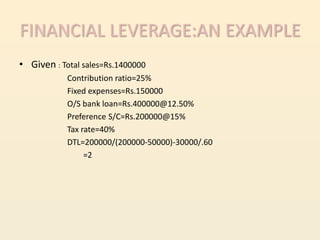
FINANCIAL LEVERAGE:AN EXAMPLE
• Given : Total sales=Rs.1400000
            Contribution ratio=25%
            Fixed expenses=Rs.150000
            O/S bank loan=Rs.400000@12.50%
            Preference S/C=Rs.200000@15%
            Tax rate=40%
            DTL=200000/(200000-50000)-30000/.60
                 =2
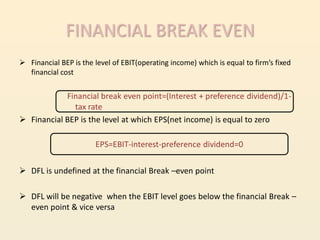
FINANCIAL BREAK EVEN
 Financial BEP is the level of EBIT(operating income) which is equal to firm’s fixed
  financial cost


            Financial break even point=(Interest + preference dividend)/1-
              tax rate
 Financial BEP is the level at which EPS(net income) is equal to zero

                       EPS=EBIT-interest-preference dividend=0

 DFL is undefined at the financial Break –even point

 DFL will be negative when the EBIT level goes below the financial Break –
  even point & vice versa
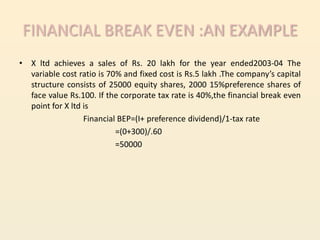
FINANCIAL BREAK EVEN :AN EXAMPLE
•    X ltd achieves a sales of Rs. 20 lakh for the year ended2003-04 The
     variable cost ratio is 70% and fixed cost is Rs.5 lakh .The company’s capital
     structure consists of 25000 equity shares, 2000 15%preference shares of
     face value Rs.100. If the corporate tax rate is 40%,the financial break even
     point for X ltd is
                     Financial BEP=(I+ preference dividend)/1-tax rate
                              =(0+300)/.60
                              =50000
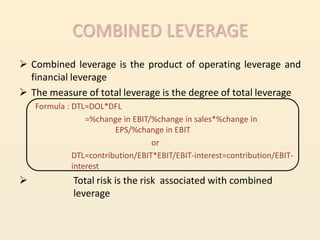
COMBINED LEVERAGE
 Combined leverage is the product of operating leverage and
  financial leverage
 The measure of total leverage is the degree of total leverage
    Formula : DTL=DOL*DFL
                  =%change in EBIT/%change in sales*%change in
                         EPS/%change in EBIT
                                   or
              DTL=contribution/EBIT*EBIT/EBIT-interest=contribution/EBIT-
              interest
             Total risk is the risk associated with combined
              leverage
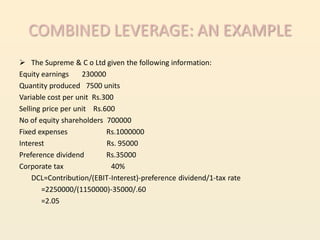
COMBINED LEVERAGE: AN EXAMPLE
 The Supreme & C o Ltd given the following information:
Equity earnings     230000
Quantity produced 7500 units
Variable cost per unit Rs.300
Selling price per unit Rs.600
No of equity shareholders 700000
Fixed expenses             Rs.1000000
Interest                   Rs. 95000
Preference dividend        Rs.35000
Corporate tax               40%
    DCL=Contribution/(EBIT-Interest)-preference dividend/1-tax rate
        =2250000/(1150000)-35000/.60
        =2.05
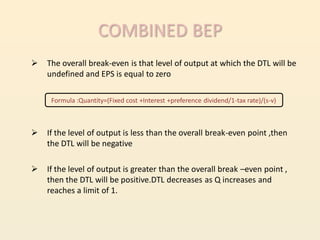
COMBINED BEP
   The overall break-even is that level of output at which the DTL will be
    undefined and EPS is equal to zero

     Formula :Quantity=(Fixed cost +Interest +preference dividend/1-tax rate)/(s-v)


   If the level of output is less than the overall break-even point ,then
    the DTL will be negative

   If the level of output is greater than the overall break –even point ,
    then the DTL will be positive.DTL decreases as Q increases and
    reaches a limit of 1.
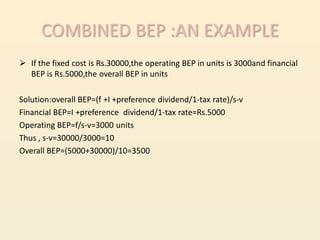
COMBINED BEP :AN EXAMPLE
 If the fixed cost is Rs.30000,the operating BEP in units is 3000and financial
  BEP is Rs.5000,the overall BEP in units

Solution:overall BEP=(f +I +preference dividend/1-tax rate)/s-v
Financial BEP=I +preference dividend/1-tax rate=Rs.5000
Operating BEP=f/s-v=3000 units
Thus , s-v=30000/3000=10
Overall BEP=(5000+30000)/10=3500

Leverage

  • 1.
  • 2.
    Meaning of leverage In general ,leverage refers to accomplish certain things which are otherwise not possible i.e. lifting of heavy objects with the help of lever. This concept of leverage is valid in business also .  In finance ,the term ‘leverage’ is used to describe the firm’s ability to use fixed cost assets or funds to increase the return to its owners; i.e. equity shareholders. In other words, the fixed cost funds i.e. debentures & preference share capital act as the fulcrum , which assist the lever i.e. the firm to lift i.e. to increase the earnings of its owner i.e. the equity shareholders.  If earnings less the variable costs exceed the fixed costs i.e. preference dividend & interest on debenture, or earnings before interest and taxes exceed the fixed return requirement, the leverage is called favorable . when they do not ,the result is unfavorable leverage .  Leverage is also the influence which an independent variable has over a dependent/related variable i.e. rainfall over production. In financial context, sales & fixed cost over profit.
  • 3.
    DIAGRAM Leverage in physics Leverage in finance LEVER LIFTING Increasing the earnings Fixed cost fund FULCRUM
  • 4.
    TYPES OF LEVERAGE OPERATINGLEVERAGE The leverage associated with investment (asset acquisition) activities is referred as operating Leverage. Formula : operating leverage=contribution/operating profit Where , contribution=sales-variable cost operating profit=sales-variable cost-fixed cost Operating leverage is also defined as the ratio of the percentage change in operating income for a given percentage change in sales. DOL=%change in operating income/%change in sales The risk associated with operating leverage is called operating risk . It is the risk of not being able to cover fixed operating costs by firm
  • 5.
    ILLUSTRATION • Following is the cost information of a firm: • Fixed cost=Rs.50000 • Variable cost=70%of sales • Sales=Rs.250000 • Now , Operating Leverage=contribution/operating profit =75000/25000 =3
  • 6.
    BREAK EVEN ANALYSIS A break-even analysis shows the relationship between the costs and profits with sales volume.  The sales volume which equates total revenue with related costs and results in neither profit nor loss is called the break – even volume or point.  At break – even point the fixed costs are fully recovered , any increase in sales beyond this level will increase profit.
  • 7.
    OPERATING BREAK EVEN The operating break even point is defined as that level of sales (either units or money value)at which EBIT (operating profit) is equal to zero: Sales-VC-FC =0 or Q(P-V)-FC =0  Where ,VC is total variable cost , FC is total fixed cost ,Q is the quantity , P is the selling price per unit & V is the variable cost per unit  A firm operating with a high degree of leverage and above break even point earn good amount of profit.  DOL is undefined at the operating break –even point  IF Q is less than the operating break even point ,then DOL will be negative & vice versa
  • 8.
    OPERATING BREAK EVEN Operating break even point in units Formula:break even point=fixed cost/selling price per unit- variable cost per unit  Operating break even point in terms of money value Formula :break even sales=(fixed cost/sales-variable cost)*sales =(fixed cost/contribution)*sales =fixed cost/P/V ratio (As, contribution/sales=P/V ratio)
  • 9.
    OPERATING BREAK EVEN:AN EXAMPLE  Consider the following information pertaining to Visakha Metals: Quantity produced 1000 units Variable cost per unit Rs.475000 Selling price per unit Rs.600000 Fixed cost Rs.5 crore Now , operating BEP in units =Fixed cost/selling price per unit-variable cost per unit =50000000/600000-475000 =50000000/125000 =400 units or BEP in terms of money value=(Fixed cost/contribution per unit)* sp per unit =400*600000 =Rs.240000000
  • 10.
    FINANCIAL LEVERAGE OR TRADING ON EQUITY  Leverage associated with financing activities is called financial leverage  The use of long term fixed interest bearing debt and preference share capital along with equity share capital is called financial leverage or trading on equity  It measures the effect of the change in EBIT(operating profit)on the EPS(earning per share)of the company  The measure of financial leverage is the degree of financial leverage Formula : DFL= %change in EPS /% change in EBIT or DFL=EBIT/(EBIT-Interest)-preference dividend/1-tax rate  The risk associated with financial leverage is called financial risk . Financial risk is the risk of not being able to cover fixed financial costs by the firm
  • 11.
    FINANCIAL LEVERAGE:AN EXAMPLE •Given : Total sales=Rs.1400000 Contribution ratio=25% Fixed expenses=Rs.150000 O/S bank loan=Rs.400000@12.50% Preference S/C=Rs.200000@15% Tax rate=40% DTL=200000/(200000-50000)-30000/.60 =2
  • 12.
    FINANCIAL BREAK EVEN Financial BEP is the level of EBIT(operating income) which is equal to firm’s fixed financial cost Financial break even point=(Interest + preference dividend)/1- tax rate  Financial BEP is the level at which EPS(net income) is equal to zero EPS=EBIT-interest-preference dividend=0  DFL is undefined at the financial Break –even point  DFL will be negative when the EBIT level goes below the financial Break – even point & vice versa
  • 13.
    FINANCIAL BREAK EVEN:AN EXAMPLE • X ltd achieves a sales of Rs. 20 lakh for the year ended2003-04 The variable cost ratio is 70% and fixed cost is Rs.5 lakh .The company’s capital structure consists of 25000 equity shares, 2000 15%preference shares of face value Rs.100. If the corporate tax rate is 40%,the financial break even point for X ltd is Financial BEP=(I+ preference dividend)/1-tax rate =(0+300)/.60 =50000
  • 14.
    COMBINED LEVERAGE  Combinedleverage is the product of operating leverage and financial leverage  The measure of total leverage is the degree of total leverage Formula : DTL=DOL*DFL =%change in EBIT/%change in sales*%change in EPS/%change in EBIT or DTL=contribution/EBIT*EBIT/EBIT-interest=contribution/EBIT- interest  Total risk is the risk associated with combined leverage
  • 15.
    COMBINED LEVERAGE: ANEXAMPLE  The Supreme & C o Ltd given the following information: Equity earnings 230000 Quantity produced 7500 units Variable cost per unit Rs.300 Selling price per unit Rs.600 No of equity shareholders 700000 Fixed expenses Rs.1000000 Interest Rs. 95000 Preference dividend Rs.35000 Corporate tax 40% DCL=Contribution/(EBIT-Interest)-preference dividend/1-tax rate =2250000/(1150000)-35000/.60 =2.05
  • 16.
    COMBINED BEP  The overall break-even is that level of output at which the DTL will be undefined and EPS is equal to zero Formula :Quantity=(Fixed cost +Interest +preference dividend/1-tax rate)/(s-v)  If the level of output is less than the overall break-even point ,then the DTL will be negative  If the level of output is greater than the overall break –even point , then the DTL will be positive.DTL decreases as Q increases and reaches a limit of 1.
  • 17.
    COMBINED BEP :ANEXAMPLE  If the fixed cost is Rs.30000,the operating BEP in units is 3000and financial BEP is Rs.5000,the overall BEP in units Solution:overall BEP=(f +I +preference dividend/1-tax rate)/s-v Financial BEP=I +preference dividend/1-tax rate=Rs.5000 Operating BEP=f/s-v=3000 units Thus , s-v=30000/3000=10 Overall BEP=(5000+30000)/10=3500