CHIMC Presented By: Akhilesh Chawda LEVERAGE
What is Leverage?
 
 
TYPES OF LEVERAGE Operating Leverage- Affects a firm’s Business Risk. Financial Leverage-Affects a firm’s Financial Risk Combined Leverage.
The variability or uncertainty of a firm’s operating income (EBIT).  Affected by: Affected By:  Sales volume variability, Competition, Cost variability, Product diversification, Product demand Operating Leverage.  Business Risk
EBIT Operating Leverage
The variability or uncertainty of a firm’s earnings per share (EPS) and the increased probability of insolvency that arises when a firm uses  financial leverage Financial Risk
EPS Financial Leverage
Indifference Point Quantity { Total  Revenue Total Cost = Fixed FC Break- even point } Q 1 + - EBIT
With high Operating leverage, an increase in sales produces a relatively larger increase in operating income.
Sales -  variable costs -   fixed  costs  operating income -   interest  EBT -   taxes Net Income }  contribution margin EBT (1 - t) = Net Income,  so, Net Income / (1 - t) = EBT Analytical Income Statement
Operating Leverage : By using fixed operating costs, a small change in sales   revenue is magnified into a larger change in operating income. This “multiplier effect” is called the degree of Operating Leverage. Degree of Operating Leverage (DOL)
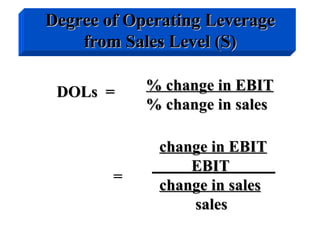
DOLs  =  % change in EBIT % change in sales change in EBIT EBIT change in sales sales = Degree of Operating Leverage from Sales Level (S)
If DOL=2, then a 1% 1%  increase in sales will result 2% in a increase in operating income (EBIT). What does this tell us? Stock- holders EBIT EPS Sales
Financial Leverage:  By using fixed cost financing, a small change in operating income is magnified into a larger change in earnings per share. This “multiplier effect” is called the degree of Financial Leverage. Degree of Financial Leverage (DFL)
DFL  =  % change in  EPS % change in EBIT change in  EPS EPS change in EBIT EBIT = Degree of Financial Leverage
If DFL=3,  then a 1% increase in operating income will result in a 3% increase in earnings per share. What does this tell us? Stock- holders EBIT EPS Sales
Combined Leverage:  By using  operating leverage  and  financial leverage , a small change in sales is magnified into a larger change in earnings per share. This “multiplier effect” is called degree of Combined Leverage. Degree of Combined Leverage (DCL)
DCL  =  DOL  x  DFL  % change in  EPS % change in Sales = change in  EPS EPS change in Sales Sales = Degree of Combined Leverage
Leverage Sales EBIT EPS DOL DFL DCL
THANK YOU ……….

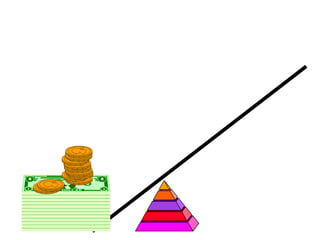
Leverage n finance, gearing is borrowing money to supplement existing funds for investment in such a way that the potential positive or negative outcome is magnified and/or enhanced

  • 1.
    CHIMC Presented By:Akhilesh Chawda LEVERAGE
  • 2.
  • 3.
  • 4.
  • 5.
    TYPES OF LEVERAGEOperating Leverage- Affects a firm’s Business Risk. Financial Leverage-Affects a firm’s Financial Risk Combined Leverage.
  • 6.
    The variability oruncertainty of a firm’s operating income (EBIT). Affected by: Affected By: Sales volume variability, Competition, Cost variability, Product diversification, Product demand Operating Leverage. Business Risk
  • 7.
  • 8.
    The variability oruncertainty of a firm’s earnings per share (EPS) and the increased probability of insolvency that arises when a firm uses financial leverage Financial Risk
  • 9.
  • 10.
    Indifference Point Quantity{ Total Revenue Total Cost = Fixed FC Break- even point } Q 1 + - EBIT
  • 11.
    With high Operatingleverage, an increase in sales produces a relatively larger increase in operating income.
  • 12.
    Sales - variable costs - fixed costs operating income - interest EBT - taxes Net Income } contribution margin EBT (1 - t) = Net Income, so, Net Income / (1 - t) = EBT Analytical Income Statement
  • 13.
    Operating Leverage :By using fixed operating costs, a small change in sales revenue is magnified into a larger change in operating income. This “multiplier effect” is called the degree of Operating Leverage. Degree of Operating Leverage (DOL)
  • 14.
    DOLs = % change in EBIT % change in sales change in EBIT EBIT change in sales sales = Degree of Operating Leverage from Sales Level (S)
  • 15.
    If DOL=2, thena 1% 1% increase in sales will result 2% in a increase in operating income (EBIT). What does this tell us? Stock- holders EBIT EPS Sales
  • 16.
    Financial Leverage: By using fixed cost financing, a small change in operating income is magnified into a larger change in earnings per share. This “multiplier effect” is called the degree of Financial Leverage. Degree of Financial Leverage (DFL)
  • 17.
    DFL = % change in EPS % change in EBIT change in EPS EPS change in EBIT EBIT = Degree of Financial Leverage
  • 18.
    If DFL=3, then a 1% increase in operating income will result in a 3% increase in earnings per share. What does this tell us? Stock- holders EBIT EPS Sales
  • 19.
    Combined Leverage: By using operating leverage and financial leverage , a small change in sales is magnified into a larger change in earnings per share. This “multiplier effect” is called degree of Combined Leverage. Degree of Combined Leverage (DCL)
  • 20.
    DCL = DOL x DFL % change in EPS % change in Sales = change in EPS EPS change in Sales Sales = Degree of Combined Leverage
  • 21.
    Leverage Sales EBITEPS DOL DFL DCL
  • 22.