By
Dheeraj
 A loan is a type of debt. Like all
  debt instruments, a loan entails
  the redistribution of financial
  assets over time, between the
  lender and the borrower.
 In a loan, the borrower initially
  receives or borrows an amount
  of money, called the principal,
  from the lender, and is obligated
  to pay back or repay an equal
  amount of money to the lender
  at a later time. Typically, the
  money is paid back in regular
  installments, or partial
  repayments; in an annuity, each
  installment is the same amount.
 (A)loans and advances can be arranged from banks in keeping
  with the flexibility in business operations. Traders may borrow
  money for day to day financial needs availing of the facility of
  cash credit, bank overdraft and discounting of bills. The
  amount raised as loan may be repaid within a short period to
  suit the convenience of the borrower. Thus business may be run
  efficiently with borrowed funds from banks for financing its
  working capital requirements.
 (B) loans and advances are utilized for making payment of
  current liabilities, wage and salaries of employees, and also the
  tax liability of business.
 (C) loans and advances from banks are found to be
  'economical' for traders and businessmen, because banks
  charge a reasonable rate of interest on such loans/advances.
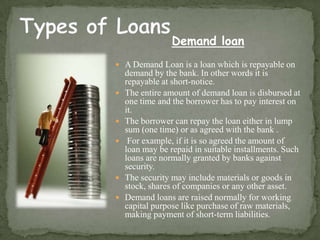
Demand loan
 A Demand Loan is a loan which is repayable on
    demand by the bank. In other words it is
    repayable at short-notice.
   The entire amount of demand loan is disbursed at
    one time and the borrower has to pay interest on
    it.
   The borrower can repay the loan either in lump
    sum (one time) or as agreed with the bank .
    For example, if it is so agreed the amount of
    loan may be repaid in suitable installments. Such
    loans are normally granted by banks against
    security.
   The security may include materials or goods in
    stock, shares of companies or any other asset.
   Demand loans are raised normally for working
    capital purpose like purchase of raw materials,
    making payment of short-term liabilities.
Medium and long term loans are called term loans. Term loans are
granted for more than a year and payment of such loans is spread over a
longer period. Term loan is required for the purpose of starting a new
business activity renovation, modernization, expansion of existing units,
purchase of their land for setting up a factory, construction, of factory
building or purchase of other immovable assets. These loans are generally
secured against the mortgage of land, plant and machinery, building and the
like.
Unsecured
                                         Secured
 Unsecured loans are those loans
  which are not covered by the         Secured loans are those which are
  security of tangible assets. Such     granted against the security of
  loans are granted to                  tangible assets, like stock in trade
                                        and immovable property. Thus,
  firms/institutions against the        while granting loan against the
  personal security of the owner,       security of some assets, a charge is
  manager or director.                  created over the assets of the
                                        borrower in favor of the bank. This
                                        enables the bank to recover the
                                        dues from the customer out of the
                                        sale proceeds of the assets in case
                                        the borrower fails to repay the
                                        loan.
The advances can be classified two categories
• Loans, cash credits and overdrafts.
• Bills discounted and purchased.
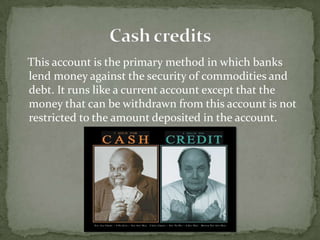
This account is the primary method in which banks
lend money against the security of commodities and
debt. It runs like a current account except that the
money that can be withdrawn from this account is not
restricted to the amount deposited in the account.
Overdrafts
The word overdraft means the act of
overdrawing from a bank account. In other
words, the account holder withdraws more
money from a bank account than has been
deposited in it..


 Bills discounted and
       purchased

Bank takes the bill drawn by borrower on
his(borrower's) customer and pay him
immediately deducting some amount as
discount/commission
 (I) FILLING UP OF LOAN APPLICATION FORM


 (II) SUBMISSION OF FORM ALONG WITH DOCUMENTS


 (III) SANCTIONING OF LOAN


 (IV) EXECUTING THE AGREEMENT


 (V) ARRANGEMENT OF SECURITY FOR LOAN
DATA
    ANALYSIS
        &
INTERPRETATION
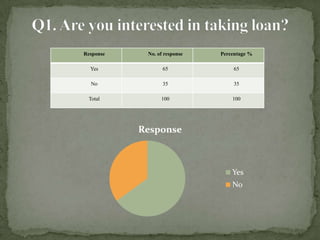
Response    No. of response   Percentage %

  Yes             65              65

  No              35              35

 Total           100              100


           Response


                                  Yes
                                  No
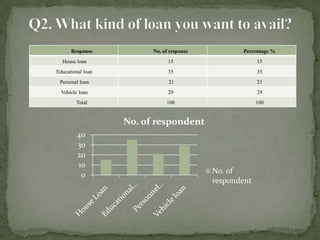
Response           No. of response          Percentage %
  House loan                   15                       15
Educational loan               35                       35
 Personal loan                 21                       21
  Vehicle loan                 29                       29
        Total                 100                       100


                   No. of respondent
         40
         30
         20
         10
          0                                No. of
                                           respondent
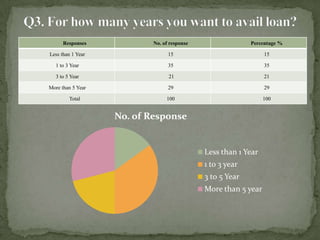
Responses            No. of response                 Percentage %

Less than 1 Year                 15                             15

   1 to 3 Year                   35                             35

   3 to 5 Year                   21                             21

More than 5 Year                 29                             29

         Total                  100                             100


                   No. of Response


                                             Less than 1 Year
                                             1 to 3 year
                                             3 to 5 Year
                                             More than 5 year
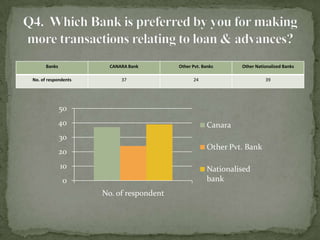
Banks            CANARA Bank       Other Pvt. Banks      Other Nationalized Banks

No. of respondents         37                  24                        39


              50
              40                                      Canara
              30
                                                      Other Pvt. Bank
              20
              10                                      Nationalised
              0                                       bank
                     No. of respondent
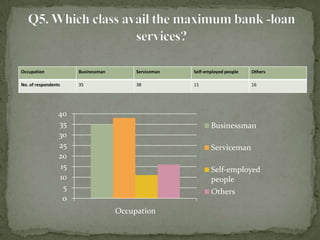
Occupation             Businessman        Serviceman   Self-employed people   Others

No. of respondents     35                 38           11                     16


                 40
                 35                                           Businessman
                 30
                 25                                           Serviceman
                 20
                  15                                          Self-employed
                 10                                           people
                   5                                          Others
                   0
                                     Occupation
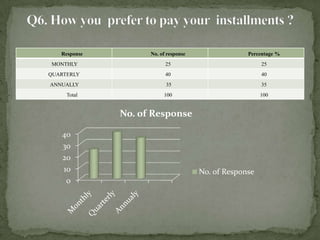
Response         No. of response                Percentage %
MONTHLY                   25                            25
QUARTERLY                 40                            40
ANNUALLY                  35                            35
     Total               100                            100


              No. of Response

   40
   30
   20
   10                                 No. of Response
    0
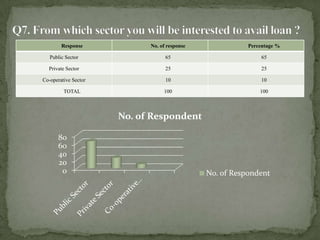
Response            No. of response              Percentage %

   Public Sector                  65                          65

  Private Sector                  25                          25

Co-operative Sector               10                         10

         TOTAL                   100                         100


                      No. of Respondent

      80
      60
      40
      20
       0                                      No. of Respondent
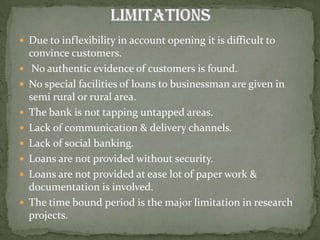
 Due to inflexibility in account opening it is difficult to
    convince customers.
    No authentic evidence of customers is found.
   No special facilities of loans to businessman are given in
    semi rural or rural area.
   The bank is not tapping untapped areas.
   Lack of communication & delivery channels.
   Lack of social banking.
   Loans are not provided without security.
   Loans are not provided at ease lot of paper work &
    documentation is involved.
   The time bound period is the major limitation in research
    projects.
 More customer convenience
 Services for businessmen
 Service for Self employed & Serviceman’s
 Rural Banking
 Social Banking
 The cutthroat competition of 21st century
  demands not just a satisfied but delighted
  customer as a key to success in a service
  industry.
 Strength, Weakness, Opportunities, threat
  analysis are apply in the bank to do the
  work more efficiently.
 Also, improved advertising
  efforts, embracement of latest
  technology, more and more awareness
  about internet banking thus facilitating
  customers while providing solutions at
  their convenience and easy reach.
Loans and advances

Loans and advances

  • 1.
  • 2.
     A loanis a type of debt. Like all debt instruments, a loan entails the redistribution of financial assets over time, between the lender and the borrower.  In a loan, the borrower initially receives or borrows an amount of money, called the principal, from the lender, and is obligated to pay back or repay an equal amount of money to the lender at a later time. Typically, the money is paid back in regular installments, or partial repayments; in an annuity, each installment is the same amount.
  • 3.
     (A)loans andadvances can be arranged from banks in keeping with the flexibility in business operations. Traders may borrow money for day to day financial needs availing of the facility of cash credit, bank overdraft and discounting of bills. The amount raised as loan may be repaid within a short period to suit the convenience of the borrower. Thus business may be run efficiently with borrowed funds from banks for financing its working capital requirements.  (B) loans and advances are utilized for making payment of current liabilities, wage and salaries of employees, and also the tax liability of business.  (C) loans and advances from banks are found to be 'economical' for traders and businessmen, because banks charge a reasonable rate of interest on such loans/advances.
  • 4.
    Demand loan  ADemand Loan is a loan which is repayable on demand by the bank. In other words it is repayable at short-notice.  The entire amount of demand loan is disbursed at one time and the borrower has to pay interest on it.  The borrower can repay the loan either in lump sum (one time) or as agreed with the bank .  For example, if it is so agreed the amount of loan may be repaid in suitable installments. Such loans are normally granted by banks against security.  The security may include materials or goods in stock, shares of companies or any other asset.  Demand loans are raised normally for working capital purpose like purchase of raw materials, making payment of short-term liabilities.
  • 5.
    Medium and longterm loans are called term loans. Term loans are granted for more than a year and payment of such loans is spread over a longer period. Term loan is required for the purpose of starting a new business activity renovation, modernization, expansion of existing units, purchase of their land for setting up a factory, construction, of factory building or purchase of other immovable assets. These loans are generally secured against the mortgage of land, plant and machinery, building and the like.
  • 6.
    Unsecured Secured  Unsecured loans are those loans which are not covered by the  Secured loans are those which are security of tangible assets. Such granted against the security of loans are granted to tangible assets, like stock in trade and immovable property. Thus, firms/institutions against the while granting loan against the personal security of the owner, security of some assets, a charge is manager or director. created over the assets of the borrower in favor of the bank. This enables the bank to recover the dues from the customer out of the sale proceeds of the assets in case the borrower fails to repay the loan.
  • 7.
    The advances canbe classified two categories • Loans, cash credits and overdrafts. • Bills discounted and purchased.
  • 8.
    This account isthe primary method in which banks lend money against the security of commodities and debt. It runs like a current account except that the money that can be withdrawn from this account is not restricted to the amount deposited in the account.
  • 9.
    Overdrafts The word overdraftmeans the act of overdrawing from a bank account. In other words, the account holder withdraws more money from a bank account than has been deposited in it.. Bills discounted and purchased Bank takes the bill drawn by borrower on his(borrower's) customer and pay him immediately deducting some amount as discount/commission
  • 10.
     (I) FILLINGUP OF LOAN APPLICATION FORM  (II) SUBMISSION OF FORM ALONG WITH DOCUMENTS  (III) SANCTIONING OF LOAN  (IV) EXECUTING THE AGREEMENT  (V) ARRANGEMENT OF SECURITY FOR LOAN
  • 11.
    DATA ANALYSIS & INTERPRETATION
  • 12.
    Response No. of response Percentage % Yes 65 65 No 35 35 Total 100 100 Response Yes No
  • 13.
    Response No. of response Percentage % House loan 15 15 Educational loan 35 35 Personal loan 21 21 Vehicle loan 29 29 Total 100 100 No. of respondent 40 30 20 10 0 No. of respondent
  • 14.
    Responses No. of response Percentage % Less than 1 Year 15 15 1 to 3 Year 35 35 3 to 5 Year 21 21 More than 5 Year 29 29 Total 100 100 No. of Response Less than 1 Year 1 to 3 year 3 to 5 Year More than 5 year
  • 15.
    Banks CANARA Bank Other Pvt. Banks Other Nationalized Banks No. of respondents 37 24 39 50 40 Canara 30 Other Pvt. Bank 20 10 Nationalised 0 bank No. of respondent
  • 16.
    Occupation Businessman Serviceman Self-employed people Others No. of respondents 35 38 11 16 40 35 Businessman 30 25 Serviceman 20 15 Self-employed 10 people 5 Others 0 Occupation
  • 17.
    Response No. of response Percentage % MONTHLY 25 25 QUARTERLY 40 40 ANNUALLY 35 35 Total 100 100 No. of Response 40 30 20 10 No. of Response 0
  • 18.
    Response No. of response Percentage % Public Sector 65 65 Private Sector 25 25 Co-operative Sector 10 10 TOTAL 100 100 No. of Respondent 80 60 40 20 0 No. of Respondent
  • 19.
     Due toinflexibility in account opening it is difficult to convince customers.  No authentic evidence of customers is found.  No special facilities of loans to businessman are given in semi rural or rural area.  The bank is not tapping untapped areas.  Lack of communication & delivery channels.  Lack of social banking.  Loans are not provided without security.  Loans are not provided at ease lot of paper work & documentation is involved.  The time bound period is the major limitation in research projects.
  • 20.
     More customerconvenience  Services for businessmen  Service for Self employed & Serviceman’s  Rural Banking  Social Banking
  • 21.
     The cutthroatcompetition of 21st century demands not just a satisfied but delighted customer as a key to success in a service industry.  Strength, Weakness, Opportunities, threat analysis are apply in the bank to do the work more efficiently.  Also, improved advertising efforts, embracement of latest technology, more and more awareness about internet banking thus facilitating customers while providing solutions at their convenience and easy reach.