LESSON PLAN
NAME OF TEACHER: A.K.GUPTA
SUBJECT: Chemistry
UNIT: 12-Organic Chemistry –Some Basic Principles & Techniques
TOPIC: Qualitative Analysis of Organic Compound
SUBTOPIC: Test of Elements present in Organic compounds
COMPETENCY DESIRED : at the end of this subtopic the pupil should be able to write the reactions involved
in the qualitative analysis of organic compounds.
INTRODUCTION TO THE LESSON:
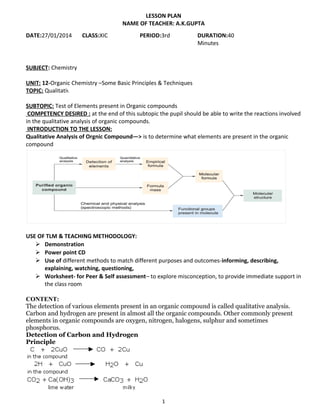
Qualitative Analysis of Orgnic Compound—> is to determine what elements are present in the organic
compound
USE OF TLM & TEACHING METHODOLOGY:
 Demonstration
 Power point CD
 Use of different methods to match different purposes and outcomes-informing, describing,
explaining, watching, questioning,
 Worksheet- for Peer & Self assessment– to explore misconception, to provide immediate support in
the class room
CONTENT:
The detection of various elements present in an organic compound is called qualitative analysis.
Carbon and hydrogen are present in almost all the organic compounds. Other commonly present
elements in organic compounds are oxygen, nitrogen, halogens, sulphur and sometimes
phosphorus.
Detection of Carbon and Hydrogen
Principle
1
DATE:27/01/2014 CLASS:XIC PERIOD:3rd DURATION:40
Minutes
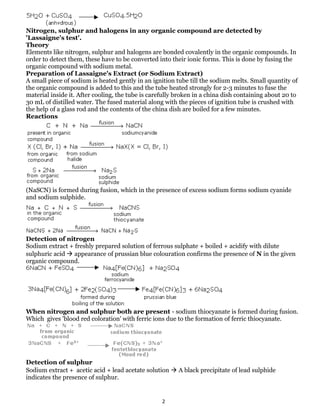
Nitrogen, sulphur and halogens in any organic compound are detected by
'Lassaigne's test'.
Theory
Elements like nitrogen, sulphur and halogens are bonded covalently in the organic compounds. In
order to detect them, these have to be converted into their ionic forms. This is done by fusing the
organic compound with sodium metal.
Preparation of Lassaigne's Extract (or Sodium Extract)
A small piece of sodium is heated gently in an ignition tube till the sodium melts. Small quantity of
the organic compound is added to this and the tube heated strongly for 2-3 minutes to fuse the
material inside it. After cooling, the tube is carefully broken in a china dish containing about 20 to
30 mL of distilled water. The fused material along with the pieces of ignition tube is crushed with
the help of a glass rod and the contents of the china dish are boiled for a few minutes.
Reactions
(NaSCN) is formed during fusion, which in the presence of excess sodium forms sodium cyanide
and sodium sulphide.
Detection of nitrogen
Sodium extract + freshly prepared solution of ferrous sulphate + boiled + acidify with dilute
sulphuric acid  appearance of prussian blue colouration confirms the presence of N in the given
organic compound.
When nitrogen and sulphur both are present - sodium thiocyanate is formed during fusion.
Which gives 'blood red coloration' with ferric ions due to the formation of ferric thiocyanate.
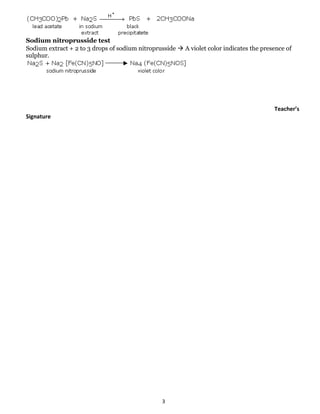
Detection of sulphur
Sodium extract + acetic acid + lead acetate solution  A black precipitate of lead sulphide
indicates the presence of sulphur.
2
Sodium nitroprusside test
Sodium extract + 2 to 3 drops of sodium nitroprusside  A violet color indicates the presence of
sulphur.
Teacher’s
Signature
3

Lesson plan Class XI Chemistry CBSE Topic Lassaigne's Test

  • 1.
    LESSON PLAN NAME OFTEACHER: A.K.GUPTA SUBJECT: Chemistry UNIT: 12-Organic Chemistry –Some Basic Principles & Techniques TOPIC: Qualitative Analysis of Organic Compound SUBTOPIC: Test of Elements present in Organic compounds COMPETENCY DESIRED : at the end of this subtopic the pupil should be able to write the reactions involved in the qualitative analysis of organic compounds. INTRODUCTION TO THE LESSON: Qualitative Analysis of Orgnic Compound—> is to determine what elements are present in the organic compound USE OF TLM & TEACHING METHODOLOGY:  Demonstration  Power point CD  Use of different methods to match different purposes and outcomes-informing, describing, explaining, watching, questioning,  Worksheet- for Peer & Self assessment– to explore misconception, to provide immediate support in the class room CONTENT: The detection of various elements present in an organic compound is called qualitative analysis. Carbon and hydrogen are present in almost all the organic compounds. Other commonly present elements in organic compounds are oxygen, nitrogen, halogens, sulphur and sometimes phosphorus. Detection of Carbon and Hydrogen Principle 1 DATE:27/01/2014 CLASS:XIC PERIOD:3rd DURATION:40 Minutes
  • 2.
    Nitrogen, sulphur andhalogens in any organic compound are detected by 'Lassaigne's test'. Theory Elements like nitrogen, sulphur and halogens are bonded covalently in the organic compounds. In order to detect them, these have to be converted into their ionic forms. This is done by fusing the organic compound with sodium metal. Preparation of Lassaigne's Extract (or Sodium Extract) A small piece of sodium is heated gently in an ignition tube till the sodium melts. Small quantity of the organic compound is added to this and the tube heated strongly for 2-3 minutes to fuse the material inside it. After cooling, the tube is carefully broken in a china dish containing about 20 to 30 mL of distilled water. The fused material along with the pieces of ignition tube is crushed with the help of a glass rod and the contents of the china dish are boiled for a few minutes. Reactions (NaSCN) is formed during fusion, which in the presence of excess sodium forms sodium cyanide and sodium sulphide. Detection of nitrogen Sodium extract + freshly prepared solution of ferrous sulphate + boiled + acidify with dilute sulphuric acid  appearance of prussian blue colouration confirms the presence of N in the given organic compound. When nitrogen and sulphur both are present - sodium thiocyanate is formed during fusion. Which gives 'blood red coloration' with ferric ions due to the formation of ferric thiocyanate. Detection of sulphur Sodium extract + acetic acid + lead acetate solution  A black precipitate of lead sulphide indicates the presence of sulphur. 2
  • 3.
    Sodium nitroprusside test Sodiumextract + 2 to 3 drops of sodium nitroprusside  A violet color indicates the presence of sulphur. Teacher’s Signature 3