
PRACTICAL ORGANIC IDENTIFICATION
By
Lec.Mzgin Mohammed Ayoob
Mzgin.Ayoob@su.edu.krd
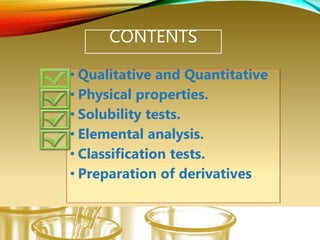
CONTENTS
• Qualitative and Quantitative
• Physical properties.
• Solubility tests.
• Elemental analysis.
• Classification tests.
• Preparation of derivatives
• Qualitative analysis of an organic
compound is
 to determine what elements are
present in the compound
Qualitative Analysis of an
Organic Compound
Carbon and Hydrogen
• Tests for carbon and hydrogen in an
organic compound are usually
unnecessary
 an organic compound must
contain carbon and hydrogen
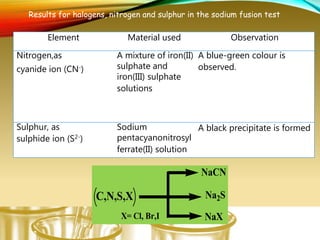
Halogens, Nitrogen and Sulphur
• Halogens, nitrogen and sulphur in organic
compounds can be detected
 by performing the sodium fusion test
CONTENTS
• Qualitative and Quantitative
• Physical properties.
• Solubility tests.
• Elemental analysis.
• Classification tests.
• Preparation of derivatives
• The physical properties of a compound
include its colour, odour, density, solubility,
melting point and boiling point
• The physical properties of a compound
depend on its molecular structure
Structural Information from
Physical Properties
Structural Information from Physical
Properties
• e.g.
 Hydrocarbons have low densities,
often about 0.8 g cm–3
 Compounds with functional groups
have higher densities
CONTENTS
• Qualitative and Quantitative
• Physical properties.
• Solubility tests.
• Elemental analysis.
• Classification tests.
• Preparation of derivatives
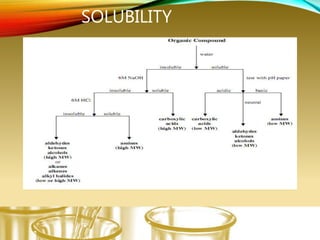
SOLUBILITY
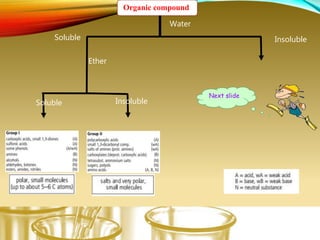
Organic compound
Water
Soluble Insoluble
Soluble Insoluble
Ether
Next slide
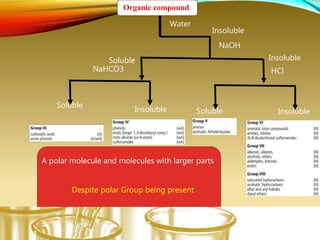
Organic compound
Water
Insoluble
Soluble
NaOH
Soluble
HCl
Insoluble
NaHCO3
Insoluble
Soluble
A polar molecule and molecules with larger parts
Despite polar Group being present
Insoluble
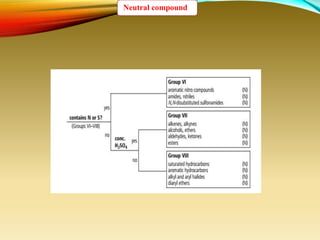
Neutral compound
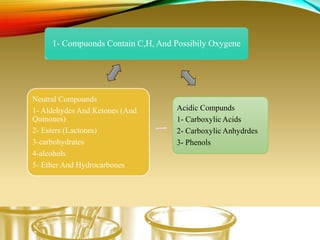
1- Compuonds Contain C,H, And Possibily Oxygene
Acidic Compunds
1- Carboxylic Acids
2- Carboxylic Anhydrdes
3- Phenols
Neutral Compounds
1- Aldehydes And Ketones (And
Quinones)
2- Esters (Lactones)
3-carbohydrates
4-alcohols
5- Ether And Hydrocarbones
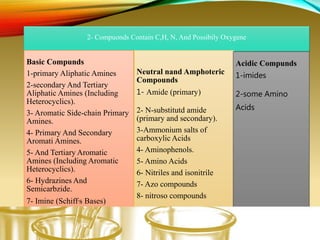
2- Compuonds Contain C,H, N, And Possibily Oxygene
Basic Compunds
1-primary Aliphatic Amines
2-secondary And Tertiary
Aliphatic Amines (Including
Heterocyclics).
3- Aromatic Side-chain Primary
Amines.
4- Primary And Secondary
Aromati Amines.
5- And Tertiary Aromatic
Amines (Including Aromatic
Heterocyclics).
6- Hydrazines And
Semicarbzide.
7- Imine (Schiff,s Bases)
Neutral nand Amphoteric
Compounds
1- Amide (primary)
2- N-substitutd amide
(primary and secondary).
3-Ammonium salts of
carboxylic Acids
4- Aminophenols.
5- Amino Acids
6- Nitriles and isonitrile
7- Azo compounds
8- nitroso compounds
Acidic Compunds
1-imides
2-some Amino
Acids
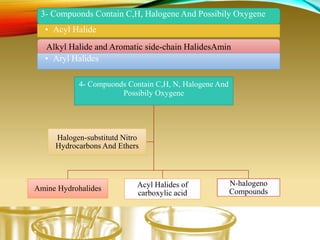
3- Compuonds Contain C,H, Halogene And Possibily Oxygene
• Acyl Halide
Alkyl Halide and Aromatic side-chain HalidesAmin
• Aryl Halides
4- Compuonds Contain C,H, N, Halogene And
Possibily Oxygene
Amine Hydrohalides Acyl Halides of
carboxylic acid
N-halogeno
Compounds
Halogen-substitutd Nitro
Hydrocarbons And Ethers
CONTENTS
• Qualitative and Quantitative
• Physical properties.
• Solubility tests.
• Elemental analysis.
• Classification tests.
• Preparation of derivatives
Halogens, Nitrogen and Sulphur
• The compound under test is
 fused with a small piece of sodium
metal in a small combustion tube
 heated strongly
• The products of the test are extracted with
water and then analyzed
Halogens, Nitrogen and Sulphur
• During sodium fusion,
 halogens in the organic compound is
converted to sodium halides
 nitrogen in the organic compound is
converted to sodium cyanide
 sulphur in the organic compound is
converted to sodium sulphide
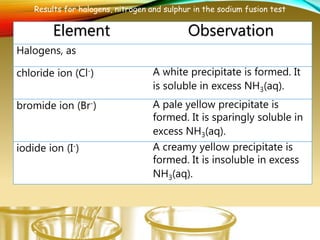
Element Observation
Halogens, as
chloride ion (Cl-) A white precipitate is formed. It
is soluble in excess NH3(aq).
bromide ion (Br-) A pale yellow precipitate is
formed. It is sparingly soluble in
excess NH3(aq).
iodide ion (I-) A creamy yellow precipitate is
formed. It is insoluble in excess
NH3(aq).
Results for halogens, nitrogen and sulphur in the sodium fusion test
Element Material used Observation
Nitrogen,as
cyanide ion (CN-)
A mixture of iron(II)
sulphate and
iron(III) sulphate
solutions
A blue-green colour is
observed.
Sulphur, as
sulphide ion (S2-)
Sodium
pentacyanonitrosyl
ferrate(II) solution
A black precipitate is formed
C,N,S,X
X= Cl, Br,I
NaCN
Na2S
NaX
CONTENTS
• Qualitative and Quantitative
• Physical properties.
• Solubility tests.
• Elemental analysis.
• Classification tests.
• Preparation of derivatives
Structural Information from Chemical
Properties
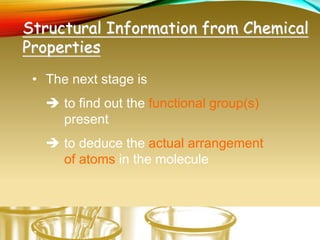
• The next stage is
 to find out the functional group(s)
present
 to deduce the actual arrangement
of atoms in the molecule
Organic
compound
Test Observation
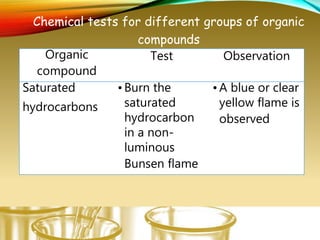
Saturated
hydrocarbons
•Burn the
saturated
hydrocarbon
in a non-
luminous
Bunsen flame
•A blue or clear
yellow flame is
observed
Chemical tests for different groups of organic
compounds
Organic
compound
Test Observation
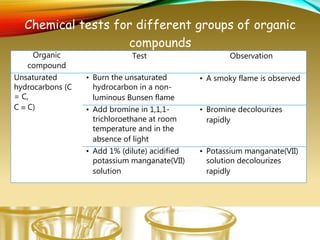
Unsaturated
hydrocarbons (C
= C,
C  C)
• Burn the unsaturated
hydrocarbon in a non-
luminous Bunsen flame
• A smoky flame is observed
• Add bromine in 1,1,1-
trichloroethane at room
temperature and in the
absence of light
• Bromine decolourizes
rapidly
• Add 1% (dilute) acidified
potassium manganate(VII)
solution
• Potassium manganate(VII)
solution decolourizes
rapidly
Chemical tests for different groups of organic
compounds
Organic
compound
Test Observation
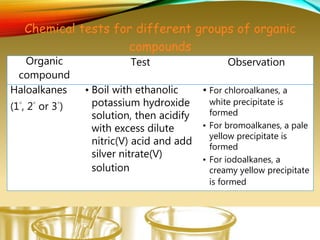
Haloalkanes
(1°, 2° or 3°)
• Boil with ethanolic
potassium hydroxide
solution, then acidify
with excess dilute
nitric(V) acid and add
silver nitrate(V)
solution
• For chloroalkanes, a
white precipitate is
formed
• For bromoalkanes, a pale
yellow precipitate is
formed
• For iodoalkanes, a
creamy yellow precipitate
is formed
Chemical tests for different groups of organic
compounds
Organic
compound
Test Observation
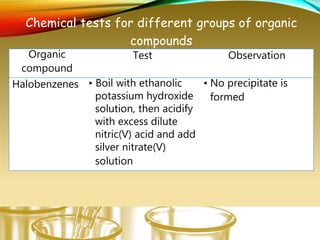
Halobenzenes • Boil with ethanolic
potassium hydroxide
solution, then acidify
with excess dilute
nitric(V) acid and add
silver nitrate(V)
solution
• No precipitate is
formed
Chemical tests for different groups of organic
compounds
Chemical tests for different groups of organic compounds
Organic
compound
Test Observation
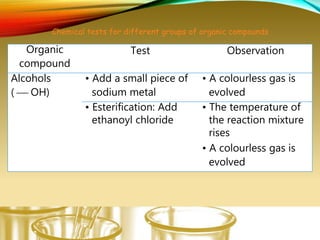
Alcohols
(  OH)
• Add a small piece of
sodium metal
• A colourless gas is
evolved
• Esterification: Add
ethanoyl chloride
• The temperature of
the reaction mixture
rises
• A colourless gas is
evolved
Chemical tests for different groups of organic compounds
Organic
compound
Test Observation
Alcohols
(  OH)
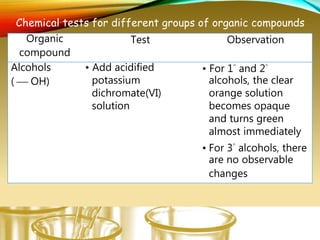
• Add acidified
potassium
dichromate(VI)
solution
• For 1° and 2°
alcohols, the clear
orange solution
becomes opaque
and turns green
almost immediately
• For 3° alcohols, there
are no observable
changes
Chemical tests for different groups of organic compounds
Organic
compound
Test Observation
Alcohols
(  OH)
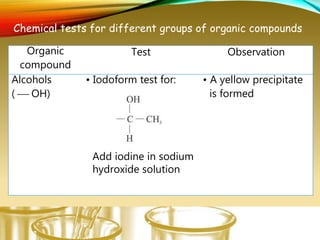
• Iodoform test for:
Add iodine in sodium
hydroxide solution
• A yellow precipitate
is formed
Chemical tests for different groups of organic compounds
Organic
compound
Test Observation
Alcohols
(  OH)
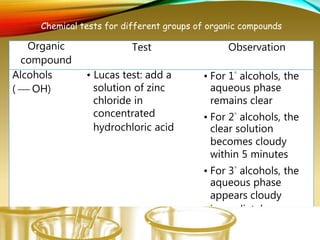
• Lucas test: add a
solution of zinc
chloride in
concentrated
hydrochloric acid
• For 1° alcohols, the
aqueous phase
remains clear
• For 2° alcohols, the
clear solution
becomes cloudy
within 5 minutes
• For 3° alcohols, the
aqueous phase
appears cloudy
immediately
Chemical tests for different groups of organic compounds
Organic
compound
Test Observation
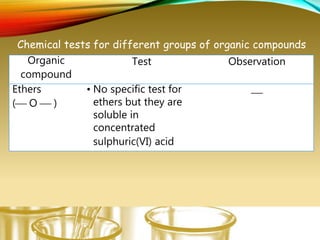
Ethers
( O  )
• No specific test for
ethers but they are
soluble in
concentrated
sulphuric(VI) acid

Organic
compound
Test Observation
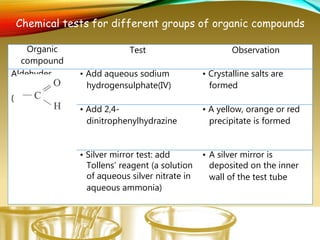
Aldehydes
( )
• Add aqueous sodium
hydrogensulphate(IV)
• Crystalline salts are
formed
• Add 2,4-
dinitrophenylhydrazine
• A yellow, orange or red
precipitate is formed
• Silver mirror test: add
Tollens’ reagent (a solution
of aqueous silver nitrate in
aqueous ammonia)
• A silver mirror is
deposited on the inner
wall of the test tube
Chemical tests for different groups of organic compounds
Organic
compound
Test Observation
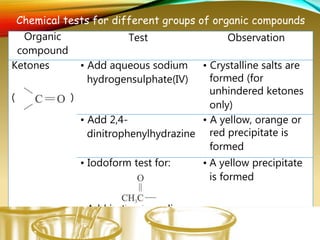
Ketones
( )
• Add aqueous sodium
hydrogensulphate(IV)
• Crystalline salts are
formed (for
unhindered ketones
only)
• Add 2,4-
dinitrophenylhydrazine
• A yellow, orange or
red precipitate is
formed
• Iodoform test for:
Add iodine in sodium
hydroxide solution
• A yellow precipitate
is formed
Chemical tests for different groups of organic compounds
Organic
compound
Test Observation
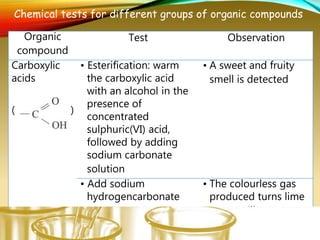
Carboxylic
acids
( )
• Esterification: warm
the carboxylic acid
with an alcohol in the
presence of
concentrated
sulphuric(VI) acid,
followed by adding
sodium carbonate
solution
• A sweet and fruity
smell is detected
• Add sodium
hydrogencarbonate
• The colourless gas
produced turns lime
water milky
Chemical tests for different groups of organic compounds
Organic
compound
Test Observation
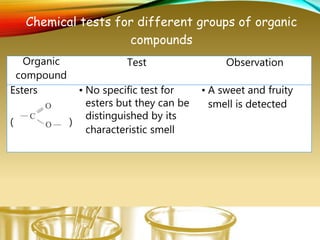
Esters
( )
• No specific test for
esters but they can be
distinguished by its
characteristic smell
• A sweet and fruity
smell is detected
Chemical tests for different groups of organic
compounds
Organic
compound
Test Observation
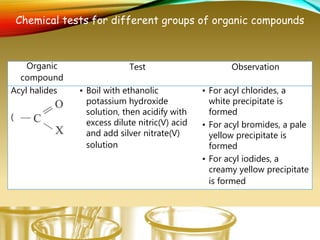
Acyl halides
( )
• Boil with ethanolic
potassium hydroxide
solution, then acidify with
excess dilute nitric(V) acid
and add silver nitrate(V)
solution
• For acyl chlorides, a
white precipitate is
formed
• For acyl bromides, a pale
yellow precipitate is
formed
• For acyl iodides, a
creamy yellow precipitate
is formed
Chemical tests for different groups of organic compounds
Organic
compound
Test Observation
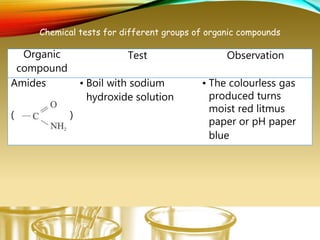
Amides
( )
• Boil with sodium
hydroxide solution
• The colourless gas
produced turns
moist red litmus
paper or pH paper
blue
Chemical tests for different groups of organic compounds
Organic
compound
Test Observation
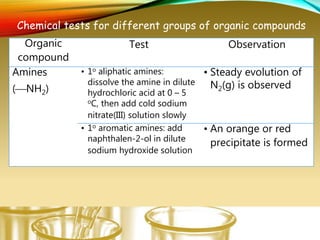
Amines
(NH2)
• 1o aliphatic amines:
dissolve the amine in dilute
hydrochloric acid at 0 – 5
oC, then add cold sodium
nitrate(III) solution slowly
• Steady evolution of
N2(g) is observed
• 1o aromatic amines: add
naphthalen-2-ol in dilute
sodium hydroxide solution
• An orange or red
precipitate is formed
Chemical tests for different groups of organic compounds
Organic
compound
Test Observation
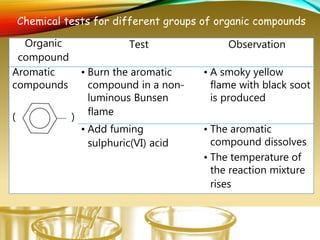
Aromatic
compounds
( )
• Burn the aromatic
compound in a non-
luminous Bunsen
flame
• A smoky yellow
flame with black soot
is produced
• Add fuming
sulphuric(VI) acid
• The aromatic
compound dissolves
• The temperature of
the reaction mixture
rises
Chemical tests for different groups of organic compounds
CONTENTS
• Qualitative and Quantitative
• Physical properties.
• Solubility tests.
• Elemental analysis.
• Classification tests.
• Preparation of derivatives
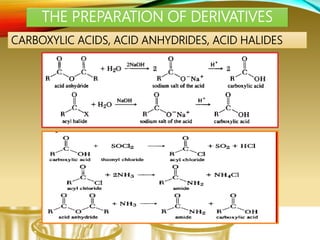
THE PREPARATION OF DERIVATIVES
CARBOXYLIC ACIDS, ACID ANHYDRIDES, ACID HALIDES
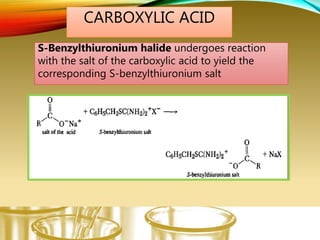
CARBOXYLIC ACID
S-Benzylthiuronium halide undergoes reaction
with the salt of the carboxylic acid to yield the
corresponding S-benzylthiuronium salt
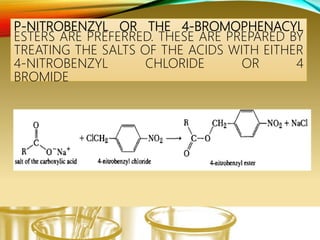
P-NITROBENZYL OR THE 4-BROMOPHENACYL
ESTERS ARE PREFERRED. THESE ARE PREPARED BY
TREATING THE SALTS OF THE ACIDS WITH EITHER
4-NITROBENZYL CHLORIDE OR 4
BROMIDE
ALCOHOLS
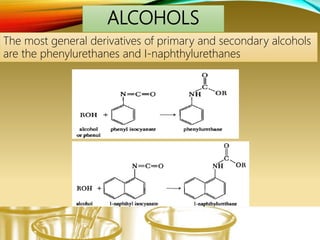
The most general derivatives of primary and secondary alcohols
are the phenylurethanes and I-naphthylurethanes
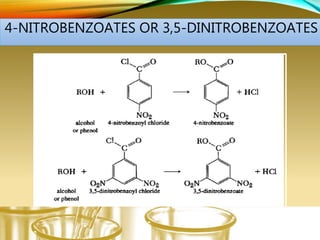
4-NITROBENZOATES OR 3,5-DINITROBENZOATES
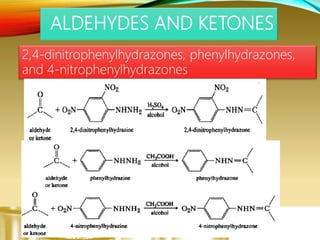
ALDEHYDES AND KETONES
2,4-dinitrophenylhydrazones, phenylhydrazones,
and 4-nitrophenylhydrazones
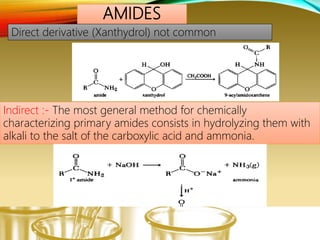
AMIDES
Indirect :- The most general method for chemically
characterizing primary amides consists in hydrolyzing them with
alkali to the salt of the carboxylic acid and ammonia.
Direct derivative (Xanthydrol) not common
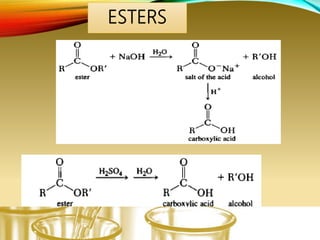
ESTERS
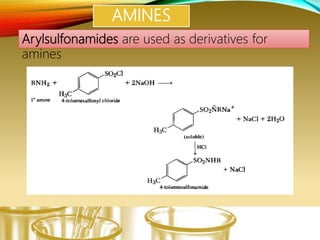
AMINES
Arylsulfonamides are used as derivatives for
amines
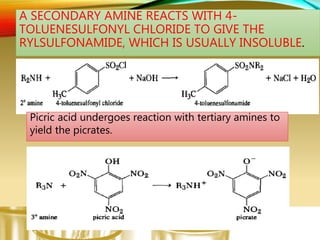
A SECONDARY AMINE REACTS WITH 4-
TOLUENESULFONYL CHLORIDE TO GIVE THE
RYLSULFONAMIDE, WHICH IS USUALLY INSOLUBLE.
Picric acid undergoes reaction with tertiary amines to
yield the picrates.
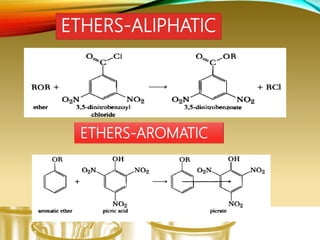
ETHERS-ALIPHATIC
ETHERS-AROMATIC
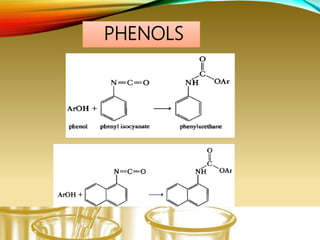
PHENOLS
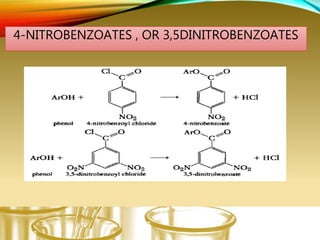
4-NITROBENZOATES , OR 3,5DINITROBENZOATES
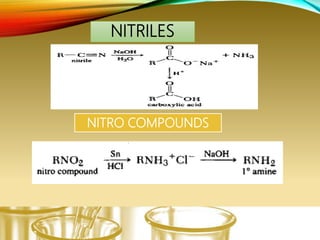
NITRILES
NITRO COMPOUNDS
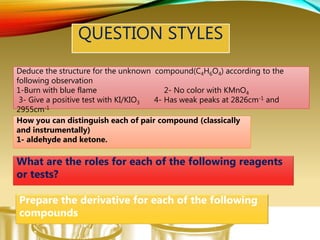
QUESTION STYLES
Deduce the structure for the unknown compound(C4H6O4) according to the
following observation
1-Burn with blue flame 2- No color with KMnO4
3- Give a positive test with KI/KIO3 4- Has weak peaks at 2826cm-1 and
2955cm-1
How you can distinguish each of pair compound (classically
and instrumentally)
1- aldehyde and ketone.
What are the roles for each of the following reagents
or tests?
Prepare the derivative for each of the following
compounds
CONTENTS
• Qualitative and Quantitative
• Physical properties.
• Solubility tests.
• Elemental analysis.
• Classification tests.
• Preparation of derivatives
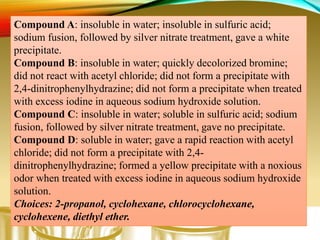
Compound A: insoluble in water; insoluble in sulfuric acid;
sodium fusion, followed by silver nitrate treatment, gave a white
precipitate.
Compound B: insoluble in water; quickly decolorized bromine;
did not react with acetyl chloride; did not form a precipitate with
2,4-dinitrophenylhydrazine; did not form a precipitate when treated
with excess iodine in aqueous sodium hydroxide solution.
Compound C: insoluble in water; soluble in sulfuric acid; sodium
fusion, followed by silver nitrate treatment, gave no precipitate.
Compound D: soluble in water; gave a rapid reaction with acetyl
chloride; did not form a precipitate with 2,4-
dinitrophenylhydrazine; formed a yellow precipitate with a noxious
odor when treated with excess iodine in aqueous sodium hydroxide
solution.
Choices: 2-propanol, cyclohexane, chlorocyclohexane,
cyclohexene, diethyl ether.
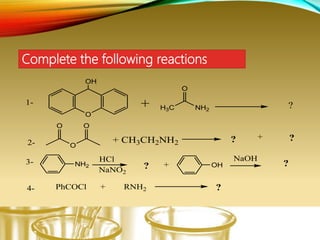
Complete the following reactions
O
+ H3C NH2
O
OH
?
2-
O
O
O
+ CH3CH2NH2 ? ?+
3- HCl
NaNO2
+ OH? ?
NaOH
4-
NH2
PhCOCl + RNH2 ?
1-
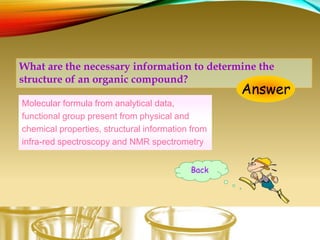
What are the necessary information to determine the
structure of an organic compound?
Answer
Molecular formula from analytical data,
functional group present from physical and
chemical properties, structural information from
infra-red spectroscopy and NMR spectrometry
Back
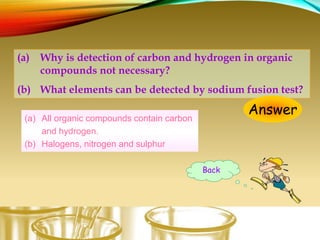
(a) Why is detection of carbon and hydrogen in organic
compounds not necessary?
(b) What elements can be detected by sodium fusion test?
Answer(a) All organic compounds contain carbon
and hydrogen.
(b) Halogens, nitrogen and sulphur
Back
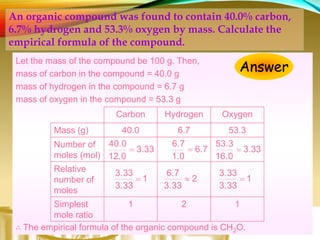
Let the mass of the compound be 100 g. Then,
mass of carbon in the compound = 40.0 g
mass of hydrogen in the compound = 6.7 g
mass of oxygen in the compound = 53.3 g
∴ The empirical formula of the organic compound is CH2O.
Carbon Hydrogen Oxygen
Mass (g) 40.0 6.7 53.3
Number of
moles (mol)
Relative
number of
moles
Simplest
mole ratio
1 2 1
33.3
12.0
40.0
 7.6
1.0
6.7
 33.3
16.0
53.3

1
3.33
3.33
 2
3.33
6.7
 1
3.33
3.33

An organic compound was found to contain 40.0% carbon,
6.7% hydrogen and 53.3% oxygen by mass. Calculate the
empirical formula of the compound.
Answer
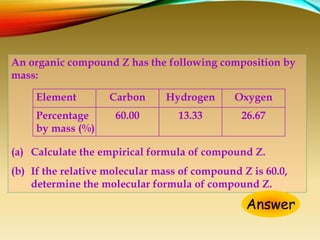
An organic compound Z has the following composition by
mass:
(a) Calculate the empirical formula of compound Z.
(b) If the relative molecular mass of compound Z is 60.0,
determine the molecular formula of compound Z.
Answer
Element Carbon Hydrogen Oxygen
Percentage
by mass (%)
60.00 13.33 26.67
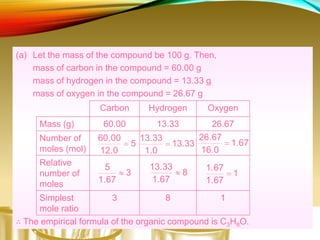
(a) Let the mass of the compound be 100 g. Then,
mass of carbon in the compound = 60.00 g
mass of hydrogen in the compound = 13.33 g
mass of oxygen in the compound = 26.67 g
∴ The empirical formula of the organic compound is C3H8O.
Carbon Hydrogen Oxygen
Mass (g) 60.00 13.33 26.67
Number of
moles (mol)
Relative
number of
moles
Simplest
mole ratio
3 8 1
5
12.0
60.00
 33.13
1.0
13.33
 67.1
16.0
26.67

8
1.67
13.33
 1
1.67
1.67
3
1.67
5

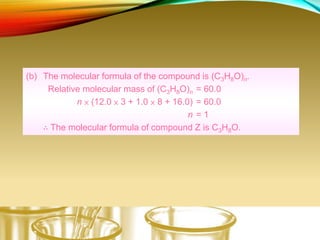
(b) The molecular formula of the compound is (C3H8O)n.
Relative molecular mass of (C3H8O)n = 60.0
n × (12.0 × 3 + 1.0 × 8 + 16.0) = 60.0
n = 1
∴ The molecular formula of compound Z is C3H8O.
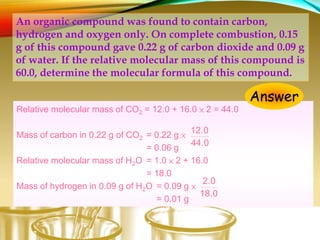
Relative molecular mass of CO2 = 12.0 + 16.0 × 2 = 44.0
Mass of carbon in 0.22 g of CO2 = 0.22 g ×
= 0.06 g
Relative molecular mass of H2O = 1.0 × 2 + 16.0
= 18.0
Mass of hydrogen in 0.09 g of H2O = 0.09 g ×
= 0.01 g
Mass of oxygen in the compound = (0.15 – 0.06 – 0.01) g
= 0.08 g
44.0
12.0
18.0
2.0
An organic compound was found to contain carbon,
hydrogen and oxygen only. On complete combustion, 0.15
g of this compound gave 0.22 g of carbon dioxide and 0.09 g
of water. If the relative molecular mass of this compound is
60.0, determine the molecular formula of this compound.
Answer
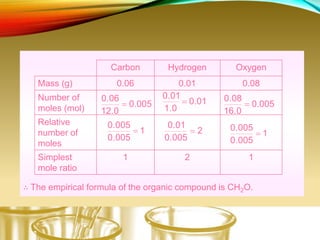
∴ The empirical formula of the organic compound is CH2O.
Carbon Hydrogen Oxygen
Mass (g) 0.06 0.01 0.08
Number of
moles (mol)
Relative
number of
moles
Simplest
mole ratio
1 2 1
005.0
12.0
0.06
 01.0
1.0
0.01
 005.0
16.0
0.08

2
0.005
0.01
 1
0.005
0.005
1
0.005
0.005

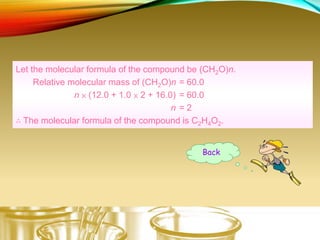
Let the molecular formula of the compound be (CH2O)n.
Relative molecular mass of (CH2O)n = 60.0
n × (12.0 + 1.0 × 2 + 16.0) = 60.0
n = 2
∴ The molecular formula of the compound is C2H4O2.
Back
Why does the solubility of amines in water decrease in the order:
1o amines > 2o amines > 3o amines?
Answer
The solubility of primary and secondary amines is
higher than that of tertiary amines because tertiary
amines cannot form hydrogen bonds between
water molecules. On the other hand, the solubility
of primary amines is higher than that of secondary
amines because primary amines form a greater
number of hydrogen bonds with water molecules
than secondary amines.
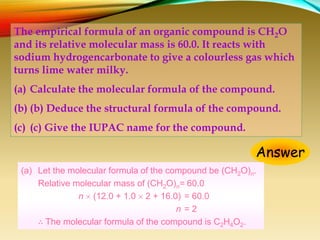
The empirical formula of an organic compound is CH2O
and its relative molecular mass is 60.0. It reacts with
sodium hydrogencarbonate to give a colourless gas which
turns lime water milky.
(a) Calculate the molecular formula of the compound.
(b) (b) Deduce the structural formula of the compound.
(c) (c) Give the IUPAC name for the compound.
Answer
(a) Let the molecular formula of the compound be (CH2O)n.
Relative molecular mass of (CH2O)n= 60.0
n  (12.0 + 1.0  2 + 16.0) = 60.0
n = 2
∴ The molecular formula of the compound is C2H4O2.
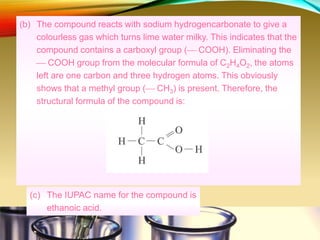
(b) The compound reacts with sodium hydrogencarbonate to give a
colourless gas which turns lime water milky. This indicates that the
compound contains a carboxyl group ( COOH). Eliminating the
 COOH group from the molecular formula of C2H4O2, the atoms
left are one carbon and three hydrogen atoms. This obviously
shows that a methyl group ( CH3) is present. Therefore, the
structural formula of the compound is:
(c) The IUPAC name for the compound is
ethanoic acid.
Thank you
Any Questions

Organic identification

  • 1.
    PRACTICAL ORGANIC IDENTIFICATION By Lec.MzginMohammed Ayoob Mzgin.Ayoob@su.edu.krd
  • 2.
    CONTENTS • Qualitative andQuantitative • Physical properties. • Solubility tests. • Elemental analysis. • Classification tests. • Preparation of derivatives
  • 3.
    • Qualitative analysisof an organic compound is  to determine what elements are present in the compound Qualitative Analysis of an Organic Compound
  • 4.
    Carbon and Hydrogen •Tests for carbon and hydrogen in an organic compound are usually unnecessary  an organic compound must contain carbon and hydrogen
  • 5.
    Halogens, Nitrogen andSulphur • Halogens, nitrogen and sulphur in organic compounds can be detected  by performing the sodium fusion test
  • 6.
    CONTENTS • Qualitative andQuantitative • Physical properties. • Solubility tests. • Elemental analysis. • Classification tests. • Preparation of derivatives
  • 7.
    • The physicalproperties of a compound include its colour, odour, density, solubility, melting point and boiling point • The physical properties of a compound depend on its molecular structure Structural Information from Physical Properties
  • 8.
    Structural Information fromPhysical Properties • e.g.  Hydrocarbons have low densities, often about 0.8 g cm–3  Compounds with functional groups have higher densities
  • 9.
    CONTENTS • Qualitative andQuantitative • Physical properties. • Solubility tests. • Elemental analysis. • Classification tests. • Preparation of derivatives
  • 10.
  • 11.
  • 12.
    Organic compound Water Insoluble Soluble NaOH Soluble HCl Insoluble NaHCO3 Insoluble Soluble A polarmolecule and molecules with larger parts Despite polar Group being present Insoluble
  • 13.
  • 14.
    1- Compuonds ContainC,H, And Possibily Oxygene Acidic Compunds 1- Carboxylic Acids 2- Carboxylic Anhydrdes 3- Phenols Neutral Compounds 1- Aldehydes And Ketones (And Quinones) 2- Esters (Lactones) 3-carbohydrates 4-alcohols 5- Ether And Hydrocarbones
  • 15.
    2- Compuonds ContainC,H, N, And Possibily Oxygene Basic Compunds 1-primary Aliphatic Amines 2-secondary And Tertiary Aliphatic Amines (Including Heterocyclics). 3- Aromatic Side-chain Primary Amines. 4- Primary And Secondary Aromati Amines. 5- And Tertiary Aromatic Amines (Including Aromatic Heterocyclics). 6- Hydrazines And Semicarbzide. 7- Imine (Schiff,s Bases) Neutral nand Amphoteric Compounds 1- Amide (primary) 2- N-substitutd amide (primary and secondary). 3-Ammonium salts of carboxylic Acids 4- Aminophenols. 5- Amino Acids 6- Nitriles and isonitrile 7- Azo compounds 8- nitroso compounds Acidic Compunds 1-imides 2-some Amino Acids
  • 16.
    3- Compuonds ContainC,H, Halogene And Possibily Oxygene • Acyl Halide Alkyl Halide and Aromatic side-chain HalidesAmin • Aryl Halides 4- Compuonds Contain C,H, N, Halogene And Possibily Oxygene Amine Hydrohalides Acyl Halides of carboxylic acid N-halogeno Compounds Halogen-substitutd Nitro Hydrocarbons And Ethers
  • 17.
    CONTENTS • Qualitative andQuantitative • Physical properties. • Solubility tests. • Elemental analysis. • Classification tests. • Preparation of derivatives
  • 18.
    Halogens, Nitrogen andSulphur • The compound under test is  fused with a small piece of sodium metal in a small combustion tube  heated strongly • The products of the test are extracted with water and then analyzed
  • 19.
    Halogens, Nitrogen andSulphur • During sodium fusion,  halogens in the organic compound is converted to sodium halides  nitrogen in the organic compound is converted to sodium cyanide  sulphur in the organic compound is converted to sodium sulphide
  • 20.
    Element Observation Halogens, as chlorideion (Cl-) A white precipitate is formed. It is soluble in excess NH3(aq). bromide ion (Br-) A pale yellow precipitate is formed. It is sparingly soluble in excess NH3(aq). iodide ion (I-) A creamy yellow precipitate is formed. It is insoluble in excess NH3(aq). Results for halogens, nitrogen and sulphur in the sodium fusion test
  • 21.
    Results for halogens,nitrogen and sulphur in the sodium fusion test Element Material used Observation Nitrogen,as cyanide ion (CN-) A mixture of iron(II) sulphate and iron(III) sulphate solutions A blue-green colour is observed. Sulphur, as sulphide ion (S2-) Sodium pentacyanonitrosyl ferrate(II) solution A black precipitate is formed C,N,S,X X= Cl, Br,I NaCN Na2S NaX
  • 22.
    CONTENTS • Qualitative andQuantitative • Physical properties. • Solubility tests. • Elemental analysis. • Classification tests. • Preparation of derivatives
  • 23.
    Structural Information fromChemical Properties • The next stage is  to find out the functional group(s) present  to deduce the actual arrangement of atoms in the molecule
  • 24.
    Organic compound Test Observation Saturated hydrocarbons •Burn the saturated hydrocarbon ina non- luminous Bunsen flame •A blue or clear yellow flame is observed Chemical tests for different groups of organic compounds
  • 25.
    Organic compound Test Observation Unsaturated hydrocarbons (C =C, C  C) • Burn the unsaturated hydrocarbon in a non- luminous Bunsen flame • A smoky flame is observed • Add bromine in 1,1,1- trichloroethane at room temperature and in the absence of light • Bromine decolourizes rapidly • Add 1% (dilute) acidified potassium manganate(VII) solution • Potassium manganate(VII) solution decolourizes rapidly Chemical tests for different groups of organic compounds
  • 26.
    Organic compound Test Observation Haloalkanes (1°, 2°or 3°) • Boil with ethanolic potassium hydroxide solution, then acidify with excess dilute nitric(V) acid and add silver nitrate(V) solution • For chloroalkanes, a white precipitate is formed • For bromoalkanes, a pale yellow precipitate is formed • For iodoalkanes, a creamy yellow precipitate is formed Chemical tests for different groups of organic compounds
  • 27.
    Organic compound Test Observation Halobenzenes •Boil with ethanolic potassium hydroxide solution, then acidify with excess dilute nitric(V) acid and add silver nitrate(V) solution • No precipitate is formed Chemical tests for different groups of organic compounds
  • 28.
    Chemical tests fordifferent groups of organic compounds Organic compound Test Observation Alcohols (  OH) • Add a small piece of sodium metal • A colourless gas is evolved • Esterification: Add ethanoyl chloride • The temperature of the reaction mixture rises • A colourless gas is evolved
  • 29.
    Chemical tests fordifferent groups of organic compounds Organic compound Test Observation Alcohols (  OH) • Add acidified potassium dichromate(VI) solution • For 1° and 2° alcohols, the clear orange solution becomes opaque and turns green almost immediately • For 3° alcohols, there are no observable changes
  • 30.
    Chemical tests fordifferent groups of organic compounds Organic compound Test Observation Alcohols (  OH) • Iodoform test for: Add iodine in sodium hydroxide solution • A yellow precipitate is formed
  • 31.
    Chemical tests fordifferent groups of organic compounds Organic compound Test Observation Alcohols (  OH) • Lucas test: add a solution of zinc chloride in concentrated hydrochloric acid • For 1° alcohols, the aqueous phase remains clear • For 2° alcohols, the clear solution becomes cloudy within 5 minutes • For 3° alcohols, the aqueous phase appears cloudy immediately
  • 32.
    Chemical tests fordifferent groups of organic compounds Organic compound Test Observation Ethers ( O  ) • No specific test for ethers but they are soluble in concentrated sulphuric(VI) acid 
  • 33.
    Organic compound Test Observation Aldehydes ( ) •Add aqueous sodium hydrogensulphate(IV) • Crystalline salts are formed • Add 2,4- dinitrophenylhydrazine • A yellow, orange or red precipitate is formed • Silver mirror test: add Tollens’ reagent (a solution of aqueous silver nitrate in aqueous ammonia) • A silver mirror is deposited on the inner wall of the test tube Chemical tests for different groups of organic compounds
  • 34.
    Organic compound Test Observation Ketones ( ) •Add aqueous sodium hydrogensulphate(IV) • Crystalline salts are formed (for unhindered ketones only) • Add 2,4- dinitrophenylhydrazine • A yellow, orange or red precipitate is formed • Iodoform test for: Add iodine in sodium hydroxide solution • A yellow precipitate is formed Chemical tests for different groups of organic compounds
  • 35.
    Organic compound Test Observation Carboxylic acids ( ) •Esterification: warm the carboxylic acid with an alcohol in the presence of concentrated sulphuric(VI) acid, followed by adding sodium carbonate solution • A sweet and fruity smell is detected • Add sodium hydrogencarbonate • The colourless gas produced turns lime water milky Chemical tests for different groups of organic compounds
  • 36.
    Organic compound Test Observation Esters ( ) •No specific test for esters but they can be distinguished by its characteristic smell • A sweet and fruity smell is detected Chemical tests for different groups of organic compounds
  • 37.
    Organic compound Test Observation Acyl halides () • Boil with ethanolic potassium hydroxide solution, then acidify with excess dilute nitric(V) acid and add silver nitrate(V) solution • For acyl chlorides, a white precipitate is formed • For acyl bromides, a pale yellow precipitate is formed • For acyl iodides, a creamy yellow precipitate is formed Chemical tests for different groups of organic compounds
  • 38.
    Organic compound Test Observation Amides ( ) •Boil with sodium hydroxide solution • The colourless gas produced turns moist red litmus paper or pH paper blue Chemical tests for different groups of organic compounds
  • 39.
    Organic compound Test Observation Amines (NH2) • 1oaliphatic amines: dissolve the amine in dilute hydrochloric acid at 0 – 5 oC, then add cold sodium nitrate(III) solution slowly • Steady evolution of N2(g) is observed • 1o aromatic amines: add naphthalen-2-ol in dilute sodium hydroxide solution • An orange or red precipitate is formed Chemical tests for different groups of organic compounds
  • 40.
    Organic compound Test Observation Aromatic compounds ( ) •Burn the aromatic compound in a non- luminous Bunsen flame • A smoky yellow flame with black soot is produced • Add fuming sulphuric(VI) acid • The aromatic compound dissolves • The temperature of the reaction mixture rises Chemical tests for different groups of organic compounds
  • 41.
    CONTENTS • Qualitative andQuantitative • Physical properties. • Solubility tests. • Elemental analysis. • Classification tests. • Preparation of derivatives
  • 42.
    THE PREPARATION OFDERIVATIVES CARBOXYLIC ACIDS, ACID ANHYDRIDES, ACID HALIDES
  • 43.
    CARBOXYLIC ACID S-Benzylthiuronium halideundergoes reaction with the salt of the carboxylic acid to yield the corresponding S-benzylthiuronium salt
  • 44.
    P-NITROBENZYL OR THE4-BROMOPHENACYL ESTERS ARE PREFERRED. THESE ARE PREPARED BY TREATING THE SALTS OF THE ACIDS WITH EITHER 4-NITROBENZYL CHLORIDE OR 4 BROMIDE
  • 45.
    ALCOHOLS The most generalderivatives of primary and secondary alcohols are the phenylurethanes and I-naphthylurethanes
  • 46.
  • 47.
    ALDEHYDES AND KETONES 2,4-dinitrophenylhydrazones,phenylhydrazones, and 4-nitrophenylhydrazones
  • 48.
    AMIDES Indirect :- Themost general method for chemically characterizing primary amides consists in hydrolyzing them with alkali to the salt of the carboxylic acid and ammonia. Direct derivative (Xanthydrol) not common
  • 49.
  • 50.
    AMINES Arylsulfonamides are usedas derivatives for amines
  • 51.
    A SECONDARY AMINEREACTS WITH 4- TOLUENESULFONYL CHLORIDE TO GIVE THE RYLSULFONAMIDE, WHICH IS USUALLY INSOLUBLE. Picric acid undergoes reaction with tertiary amines to yield the picrates.
  • 52.
  • 53.
  • 54.
    4-NITROBENZOATES , OR3,5DINITROBENZOATES
  • 55.
  • 56.
    QUESTION STYLES Deduce thestructure for the unknown compound(C4H6O4) according to the following observation 1-Burn with blue flame 2- No color with KMnO4 3- Give a positive test with KI/KIO3 4- Has weak peaks at 2826cm-1 and 2955cm-1 How you can distinguish each of pair compound (classically and instrumentally) 1- aldehyde and ketone. What are the roles for each of the following reagents or tests? Prepare the derivative for each of the following compounds
  • 57.
    CONTENTS • Qualitative andQuantitative • Physical properties. • Solubility tests. • Elemental analysis. • Classification tests. • Preparation of derivatives
  • 58.
    Compound A: insolublein water; insoluble in sulfuric acid; sodium fusion, followed by silver nitrate treatment, gave a white precipitate. Compound B: insoluble in water; quickly decolorized bromine; did not react with acetyl chloride; did not form a precipitate with 2,4-dinitrophenylhydrazine; did not form a precipitate when treated with excess iodine in aqueous sodium hydroxide solution. Compound C: insoluble in water; soluble in sulfuric acid; sodium fusion, followed by silver nitrate treatment, gave no precipitate. Compound D: soluble in water; gave a rapid reaction with acetyl chloride; did not form a precipitate with 2,4- dinitrophenylhydrazine; formed a yellow precipitate with a noxious odor when treated with excess iodine in aqueous sodium hydroxide solution. Choices: 2-propanol, cyclohexane, chlorocyclohexane, cyclohexene, diethyl ether.
  • 59.
    Complete the followingreactions O + H3C NH2 O OH ? 2- O O O + CH3CH2NH2 ? ?+ 3- HCl NaNO2 + OH? ? NaOH 4- NH2 PhCOCl + RNH2 ? 1-
  • 60.
    What are thenecessary information to determine the structure of an organic compound? Answer Molecular formula from analytical data, functional group present from physical and chemical properties, structural information from infra-red spectroscopy and NMR spectrometry Back
  • 61.
    (a) Why isdetection of carbon and hydrogen in organic compounds not necessary? (b) What elements can be detected by sodium fusion test? Answer(a) All organic compounds contain carbon and hydrogen. (b) Halogens, nitrogen and sulphur Back
  • 62.
    Let the massof the compound be 100 g. Then, mass of carbon in the compound = 40.0 g mass of hydrogen in the compound = 6.7 g mass of oxygen in the compound = 53.3 g ∴ The empirical formula of the organic compound is CH2O. Carbon Hydrogen Oxygen Mass (g) 40.0 6.7 53.3 Number of moles (mol) Relative number of moles Simplest mole ratio 1 2 1 33.3 12.0 40.0  7.6 1.0 6.7  33.3 16.0 53.3  1 3.33 3.33  2 3.33 6.7  1 3.33 3.33  An organic compound was found to contain 40.0% carbon, 6.7% hydrogen and 53.3% oxygen by mass. Calculate the empirical formula of the compound. Answer
  • 63.
    An organic compoundZ has the following composition by mass: (a) Calculate the empirical formula of compound Z. (b) If the relative molecular mass of compound Z is 60.0, determine the molecular formula of compound Z. Answer Element Carbon Hydrogen Oxygen Percentage by mass (%) 60.00 13.33 26.67
  • 64.
    (a) Let themass of the compound be 100 g. Then, mass of carbon in the compound = 60.00 g mass of hydrogen in the compound = 13.33 g mass of oxygen in the compound = 26.67 g ∴ The empirical formula of the organic compound is C3H8O. Carbon Hydrogen Oxygen Mass (g) 60.00 13.33 26.67 Number of moles (mol) Relative number of moles Simplest mole ratio 3 8 1 5 12.0 60.00  33.13 1.0 13.33  67.1 16.0 26.67  8 1.67 13.33  1 1.67 1.67 3 1.67 5 
  • 65.
    (b) The molecularformula of the compound is (C3H8O)n. Relative molecular mass of (C3H8O)n = 60.0 n × (12.0 × 3 + 1.0 × 8 + 16.0) = 60.0 n = 1 ∴ The molecular formula of compound Z is C3H8O.
  • 66.
    Relative molecular massof CO2 = 12.0 + 16.0 × 2 = 44.0 Mass of carbon in 0.22 g of CO2 = 0.22 g × = 0.06 g Relative molecular mass of H2O = 1.0 × 2 + 16.0 = 18.0 Mass of hydrogen in 0.09 g of H2O = 0.09 g × = 0.01 g Mass of oxygen in the compound = (0.15 – 0.06 – 0.01) g = 0.08 g 44.0 12.0 18.0 2.0 An organic compound was found to contain carbon, hydrogen and oxygen only. On complete combustion, 0.15 g of this compound gave 0.22 g of carbon dioxide and 0.09 g of water. If the relative molecular mass of this compound is 60.0, determine the molecular formula of this compound. Answer
  • 67.
    ∴ The empiricalformula of the organic compound is CH2O. Carbon Hydrogen Oxygen Mass (g) 0.06 0.01 0.08 Number of moles (mol) Relative number of moles Simplest mole ratio 1 2 1 005.0 12.0 0.06  01.0 1.0 0.01  005.0 16.0 0.08  2 0.005 0.01  1 0.005 0.005 1 0.005 0.005 
  • 68.
    Let the molecularformula of the compound be (CH2O)n. Relative molecular mass of (CH2O)n = 60.0 n × (12.0 + 1.0 × 2 + 16.0) = 60.0 n = 2 ∴ The molecular formula of the compound is C2H4O2. Back
  • 69.
    Why does thesolubility of amines in water decrease in the order: 1o amines > 2o amines > 3o amines? Answer The solubility of primary and secondary amines is higher than that of tertiary amines because tertiary amines cannot form hydrogen bonds between water molecules. On the other hand, the solubility of primary amines is higher than that of secondary amines because primary amines form a greater number of hydrogen bonds with water molecules than secondary amines.
  • 70.
    The empirical formulaof an organic compound is CH2O and its relative molecular mass is 60.0. It reacts with sodium hydrogencarbonate to give a colourless gas which turns lime water milky. (a) Calculate the molecular formula of the compound. (b) (b) Deduce the structural formula of the compound. (c) (c) Give the IUPAC name for the compound. Answer (a) Let the molecular formula of the compound be (CH2O)n. Relative molecular mass of (CH2O)n= 60.0 n  (12.0 + 1.0  2 + 16.0) = 60.0 n = 2 ∴ The molecular formula of the compound is C2H4O2.
  • 71.
    (b) The compoundreacts with sodium hydrogencarbonate to give a colourless gas which turns lime water milky. This indicates that the compound contains a carboxyl group ( COOH). Eliminating the  COOH group from the molecular formula of C2H4O2, the atoms left are one carbon and three hydrogen atoms. This obviously shows that a methyl group ( CH3) is present. Therefore, the structural formula of the compound is: (c) The IUPAC name for the compound is ethanoic acid.
  • 72.