Ethers,
Epoxides,
and Sulfides
Md. Saiful Islam
Dept. of Pharmaceutical Sciences
North South University
Facebook Group: Pharmacy Universe
• An ether has two organic groups (alkyl, aryl, or vinyl)
bonded to the same oxygen atom, R–O–R′
• Diethyl ether is used industrially as a solvent
• Tetrahydrofuran (THF) is a solvent that is a cyclic
ether
• Thiols (R–S–H) and sulfides (R–S–R′) are sulfur (for
oxygen) analogs of alcohols and ethers
Names and Properties of
Ethers
• Simple ethers are named by identifying the two
organic substituents and adding the word ether
• If other functional groups are present, the ether part
is considered an alkoxy substituent
• R–O–R ~ tetrahedral bond angle (112° in dimethyl
ether)
• Oxygen is sp3
-hybridized
• Oxygen atom gives ethers a slight dipole moment
Synthesis of Ethers
• Diethyl ether prepared industrially by
sulfuric acid–catalyzed dehydration of
ethanol – also with other primary alcohols
The Williamson Ether
Synthesis
• Reaction of metal alkoxides and primary alkyl halides
and tosylates
• Best method for the preparation of ethers
• Alkoxides prepared by reaction of an alcohol with a
strong base such as sodium hydride, NaH
Silver Oxide-Catalyzed Ether
Formation
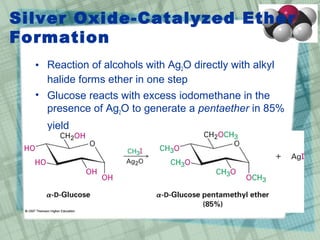
• Reaction of alcohols with Ag2O directly with alkyl
halide forms ether in one step
• Glucose reacts with excess iodomethane in the
presence of Ag2O to generate a pentaether in 85%
yield
Alkoxymercuration of
Alkenes
• React alkene with an alcohol and mercuric acetate or
trifluoroacetate
• Demercuration with NaBH4 yields an ether
• Overall Markovnikov addition of alcohol to alkene
Bimolecular Dehydration of
Alcohols
• Industrial method, not good lab synthesis.
• If temperature is too high, alkene forms.
8
=>
H O CH2CH3CH3CH2 O H CH3CH2 O CH2CH3+
H2SO4
140°C
Reactions of Ethers: Acidic
Cleavage
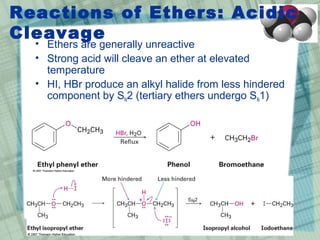
• Ethers are generally unreactive
• Strong acid will cleave an ether at elevated
temperature
• HI, HBr produce an alkyl halide from less hindered
component by SN2 (tertiary ethers undergo SN1)
9
Reactions of Ethers:
Claisen Rearrangement
• Specific to allyl aryl ethers, ArOCH2CH=CH2
• Heating to 200–250°C leads to an o-allylphenol
• Result is alkylation of the phenol in an ortho position
Claisen Rearrangement
Mechanism
• Concerted pericyclic 6-electron, 6-membered ring
transition state
• Mechanism consistent with 14
C labeling
Cyclic Ethers: Epoxides
• Cyclic ethers behave like acyclic ethers, except if ring is
3-membered
• Dioxane and tetrahydrofuran are used as solvents
Preparation of Epoxides Using a
Peroxyacid
• Treat an alkene with a peroxyacid
13
Epoxides from
Halohydrins
• Addition of HO-X to an alkene gives a halohydrin
• Treatment of a halohydrin with base gives an epoxide
• Intramolecular Williamson ether synthesis
Ring Opening in Acid
• Trans diol formed in water solvent.
15
• Alkoxy alcohol formed in alcohol solvent.
• 1,2-Dihalide formed with HI or HBr. =>
H
O
H
H
+
, H2O
H
HO H
OH
H
O
H
H
+
, CH3OH
H
HO H
OCH3
Orientation of Epoxide
Opening
• Base attacks the least hindered carbon.
16
• In acid, the nucleophile attacks the protonated
epoxide at the most substituted carbon.
CH3CH2OH
HC CH2
CH3
OH
OCH2CH3
_
HC CH2
CH3
O
OCH2CH3OCH2CH3
HC CH2
CH3
O
=>
HC CH2
OHH3C
OCH2CH3
+
HC CH2
OHH3C
OCH2CH3H
CH3CH2OH
+
HC CH2
CH3
O
H
Thiols and Sulfides
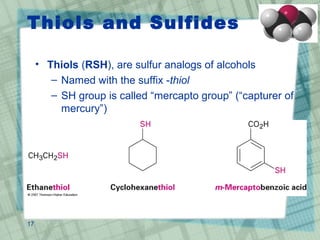
• Thiols (RSH), are sulfur analogs of alcohols
– Named with the suffix -thiol
– SH group is called “mercapto group” (“capturer of
mercury”)
17
Thiols: Formation and
Reaction
• From alkyl halides by displacement with a sulfur
nucleophile such as –
SH
– The alkylthiol product can undergo further reaction
with the alkyl halide to give a symmetrical sulfide,
giving a poorer yield of the thiol
Sulfides
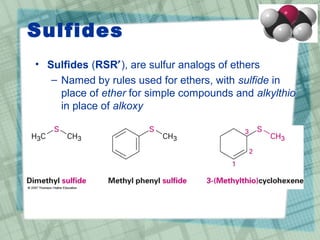
• Sulfides (RSR′), are sulfur analogs of ethers
– Named by rules used for ethers, with sulfide in
place of ether for simple compounds and alkylthio
in place of alkoxy
Using Thiourea to Form
Alkylthiols
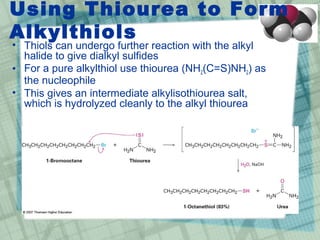
• Thiols can undergo further reaction with the alkyl
halide to give dialkyl sulfides
• For a pure alkylthiol use thiourea (NH2(C=S)NH2) as
the nucleophile
• This gives an intermediate alkylisothiourea salt,
which is hydrolyzed cleanly to the alkyl thiourea
Oxidation of Thiols to
Disulfides
• Reaction of an alkyl thiol (RSH) with bromine or iodine gives a
disulfide (RSSR)
• The thiol is oxidized in the process and the halogen is reduced
Sulfides
• Thiolates (RS−
) are formed by the reaction of a thiol
with a base
• Thiolates react with primary or secondary alkyl halide
to give sulfides (RSR’)
• Thiolates are excellent nucleophiles and react with
many electrophiles
Sulfides as
Nucleophiles
• Sulfur compounds are more nucleophilic than their
oxygen-compound analogs
– 3p electrons valence electrons (on S) are less
tightly held than 2p electrons (on O)
• Sulfides react with primary alkyl halides (SN2) to give
trialkylsulfonium salts (R3S+
)
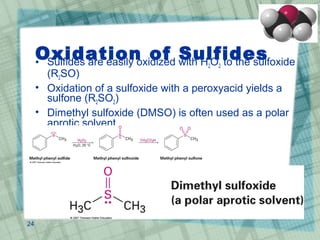
Oxidation of Sulfides• Sulfides are easily oxidized with H2O2 to the sulfoxide
(R2SO)
• Oxidation of a sulfoxide with a peroxyacid yields a
sulfone (R2SO2)
• Dimethyl sulfoxide (DMSO) is often used as a polar
aprotic solvent
24

Ethers, Epoxides and Sulfides

  • 1.
    Ethers, Epoxides, and Sulfides Md. SaifulIslam Dept. of Pharmaceutical Sciences North South University Facebook Group: Pharmacy Universe
  • 2.
    • An etherhas two organic groups (alkyl, aryl, or vinyl) bonded to the same oxygen atom, R–O–R′ • Diethyl ether is used industrially as a solvent • Tetrahydrofuran (THF) is a solvent that is a cyclic ether • Thiols (R–S–H) and sulfides (R–S–R′) are sulfur (for oxygen) analogs of alcohols and ethers
  • 3.
    Names and Propertiesof Ethers • Simple ethers are named by identifying the two organic substituents and adding the word ether • If other functional groups are present, the ether part is considered an alkoxy substituent • R–O–R ~ tetrahedral bond angle (112° in dimethyl ether) • Oxygen is sp3 -hybridized • Oxygen atom gives ethers a slight dipole moment
  • 4.
    Synthesis of Ethers •Diethyl ether prepared industrially by sulfuric acid–catalyzed dehydration of ethanol – also with other primary alcohols
  • 5.
    The Williamson Ether Synthesis •Reaction of metal alkoxides and primary alkyl halides and tosylates • Best method for the preparation of ethers • Alkoxides prepared by reaction of an alcohol with a strong base such as sodium hydride, NaH
  • 6.
    Silver Oxide-Catalyzed Ether Formation •Reaction of alcohols with Ag2O directly with alkyl halide forms ether in one step • Glucose reacts with excess iodomethane in the presence of Ag2O to generate a pentaether in 85% yield
  • 7.
    Alkoxymercuration of Alkenes • Reactalkene with an alcohol and mercuric acetate or trifluoroacetate • Demercuration with NaBH4 yields an ether • Overall Markovnikov addition of alcohol to alkene
  • 8.
    Bimolecular Dehydration of Alcohols •Industrial method, not good lab synthesis. • If temperature is too high, alkene forms. 8 => H O CH2CH3CH3CH2 O H CH3CH2 O CH2CH3+ H2SO4 140°C
  • 9.
    Reactions of Ethers:Acidic Cleavage • Ethers are generally unreactive • Strong acid will cleave an ether at elevated temperature • HI, HBr produce an alkyl halide from less hindered component by SN2 (tertiary ethers undergo SN1) 9
  • 10.
    Reactions of Ethers: ClaisenRearrangement • Specific to allyl aryl ethers, ArOCH2CH=CH2 • Heating to 200–250°C leads to an o-allylphenol • Result is alkylation of the phenol in an ortho position
  • 11.
    Claisen Rearrangement Mechanism • Concertedpericyclic 6-electron, 6-membered ring transition state • Mechanism consistent with 14 C labeling
  • 12.
    Cyclic Ethers: Epoxides •Cyclic ethers behave like acyclic ethers, except if ring is 3-membered • Dioxane and tetrahydrofuran are used as solvents
  • 13.
    Preparation of EpoxidesUsing a Peroxyacid • Treat an alkene with a peroxyacid 13
  • 14.
    Epoxides from Halohydrins • Additionof HO-X to an alkene gives a halohydrin • Treatment of a halohydrin with base gives an epoxide • Intramolecular Williamson ether synthesis
  • 15.
    Ring Opening inAcid • Trans diol formed in water solvent. 15 • Alkoxy alcohol formed in alcohol solvent. • 1,2-Dihalide formed with HI or HBr. => H O H H + , H2O H HO H OH H O H H + , CH3OH H HO H OCH3
  • 16.
    Orientation of Epoxide Opening •Base attacks the least hindered carbon. 16 • In acid, the nucleophile attacks the protonated epoxide at the most substituted carbon. CH3CH2OH HC CH2 CH3 OH OCH2CH3 _ HC CH2 CH3 O OCH2CH3OCH2CH3 HC CH2 CH3 O => HC CH2 OHH3C OCH2CH3 + HC CH2 OHH3C OCH2CH3H CH3CH2OH + HC CH2 CH3 O H
  • 17.
    Thiols and Sulfides •Thiols (RSH), are sulfur analogs of alcohols – Named with the suffix -thiol – SH group is called “mercapto group” (“capturer of mercury”) 17
  • 18.
    Thiols: Formation and Reaction •From alkyl halides by displacement with a sulfur nucleophile such as – SH – The alkylthiol product can undergo further reaction with the alkyl halide to give a symmetrical sulfide, giving a poorer yield of the thiol
  • 19.
    Sulfides • Sulfides (RSR′),are sulfur analogs of ethers – Named by rules used for ethers, with sulfide in place of ether for simple compounds and alkylthio in place of alkoxy
  • 20.
    Using Thiourea toForm Alkylthiols • Thiols can undergo further reaction with the alkyl halide to give dialkyl sulfides • For a pure alkylthiol use thiourea (NH2(C=S)NH2) as the nucleophile • This gives an intermediate alkylisothiourea salt, which is hydrolyzed cleanly to the alkyl thiourea
  • 21.
    Oxidation of Thiolsto Disulfides • Reaction of an alkyl thiol (RSH) with bromine or iodine gives a disulfide (RSSR) • The thiol is oxidized in the process and the halogen is reduced
  • 22.
    Sulfides • Thiolates (RS− )are formed by the reaction of a thiol with a base • Thiolates react with primary or secondary alkyl halide to give sulfides (RSR’) • Thiolates are excellent nucleophiles and react with many electrophiles
  • 23.
    Sulfides as Nucleophiles • Sulfurcompounds are more nucleophilic than their oxygen-compound analogs – 3p electrons valence electrons (on S) are less tightly held than 2p electrons (on O) • Sulfides react with primary alkyl halides (SN2) to give trialkylsulfonium salts (R3S+ )
  • 24.
    Oxidation of Sulfides•Sulfides are easily oxidized with H2O2 to the sulfoxide (R2SO) • Oxidation of a sulfoxide with a peroxyacid yields a sulfone (R2SO2) • Dimethyl sulfoxide (DMSO) is often used as a polar aprotic solvent 24