SYSTEMATIC ANALYSIS
SANDEEP KR YADAV
B.Sc. (HONS.) CHEMISTRY
RAMJAS COLLEGE
UNIVERSITY OF DELHI
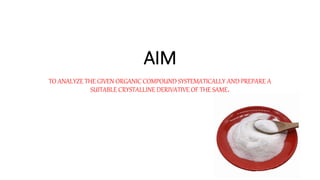
AIM
TO ANALYZE THE GIVEN ORGANIC COMPOUND SYSTEMATICALLY AND PREPARE A
SUITABLE CRYSTALLINE DERIVATIVE OF THE SAME.
PRELIMINARY ANALYSIS
Serial
No.
EXPERIMENT OBSERVATION INFERENCE
1 PHYSICAL STATE SOLID CARBOXYLIC ACIDS, AMIDES, CARBOHYDRATES,
PHENOLS,NITROAMINES MAY BE PRESENT
2 COLOUR COLOURLESS SIMPLE AMIDES, CARBOHYDRATES, ACIDS MAY BE PRESENT
3 ODOUR ODOURLESS CARBOHYDRATES, ACIDS, AMIDES MAY BE PRESENT
4 IGNITION TEST
A small amount
of organic
compound is
taken on a
spatula and is
introduced in
blue flame.
Sooty flame is
observed
The compound is aromatic
SOLUBILITY TEST
• A SMALL AMOUNT OF ORGANIC COMPOUND IS TAKEN AND ITS
SOLUBILITY IS CHECKED IN FOLLOWING SOLVENTS.
Serial
No.
EXPERIMENT OBSERVATION INFERENCE
1 COLD WATER SPARINGLY
SOLUBLE
ACIDS, AMIDES,
CARBOHYDRATES MAY BE
PRESENT
2 HOT WATER SOLUBLE ACIDS, AMIDES MAY BE
PRESENT
3 SODIUM
BICARBONATE
SOLUTION
INSOLUBLE CARBOXYLIC ACIDS MAY BE
ABSENT
4 DILUTE SODIUM
HYDROXIDE
INSOLUBLE CARBOXYLIC ACIDS, PHENOLS
MAY BE ABSENT
5 DILUTE
HYDROCHLORIC ACID
INSOLUBLE AMINES MAY BE ABSENT
6 CONCENTRATED
SULPHURIC ACID
INSOLUBLE AROMATIC HYDROCARBONS
MAY BE ABSENT
TEST FOR UNSATURATION
Serial No. EXPERIMENT OBSERVATION INFERENCE
1 BAEYER’S TEST
Small amount of given compound is taken
and dissolved in water and few drops of
dilute Na2CO3 is added followed by addition
of 1-2 % aqueous KMnO4 solution dropwise
with continuous shaking
No discharge of purple
colour
The compound does not
contain unsaturation
2 BROMINE SOLUTION TEST
To an aqueous solution of given compound ,
2% bromine water solution is added
dropwise with continuous shaking.
No discharge of brown
colour
The compound does not
contain saturation
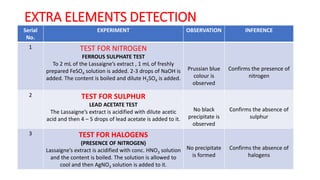
EXTRA ELEMENTS DETECTION
Serial
No.
EXPERIMENT OBSERVATION INFERENCE
1 TEST FOR NITROGEN
FERROUS SULPHATE TEST
To 2 mL of the Lassaigne’s extract , 1 mL of freshly
prepared FeSO4 solution is added. 2-3 drops of NaOH is
added. The content is boiled and dilute H2SO4 is added.
Prussian blue
colour is
observed
Confirms the presence of
nitrogen
2 TEST FOR SULPHUR
LEAD ACETATE TEST
The Lassaigne’s extract is acidified with dilute acetic
acid and then 4 – 5 drops of lead acetate is added to it.
No black
precipitate is
observed
Confirms the absence of
sulphur
3 TEST FOR HALOGENS
(PRESENCE OF NITROGEN)
Lassaigne’s extract is acidified with conc. HNO3 solution
and the content is boiled. The solution is allowed to
cool and then AgNO3 solution is added to it.
No precipitate
is formed
Confirms the absence of
halogens
REACTIONS INVOLVED
DETECTION OF NITROGEN
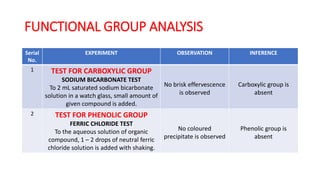
FUNCTIONAL GROUP ANALYSIS
Serial
No.
EXPERIMENT OBSERVATION INFERENCE
1 TEST FOR CARBOXYLIC GROUP
SODIUM BICARBONATE TEST
To 2 mL saturated sodium bicarbonate
solution in a watch glass, small amount of
given compound is added.
No brisk effervescence
is observed
Carboxylic group is
absent
2 TEST FOR PHENOLIC GROUP
FERRIC CHLORIDE TEST
To the aqueous solution of organic
compound, 1 – 2 drops of neutral ferric
chloride solution is added with shaking.
No coloured
precipitate is observed
Phenolic group is
absent
Serial
No.
EXPERIMENT OBSERVATION INFERENCE
3 TEST FOR ALCOHOLIC GROUP
CERRIC AMMONIUM NITRATE TEST
To the aqueous solution of the given
compound, 2 – 3 drops of ceric
ammonium nitrate reagent is added.
No blood red
colouration is
observed
Alcoholic group is
absent
4 TEST FOR CARBONYL GROUP
DNP TEST
To the aqueous solution of organic
compound, 6-7 mL of DNP reagent is
added with continuous shaking. It is
allowed to stand for 5-10 minutes. Then, it
is warmed on boiling water bath and is
cooled to room temperature.
No yellow or orange
precipitate is
observed
Carbonyl group is
absent
Serial
No.
EXPERIMENT OBSERVATION INFERENCE
5 TEST FOR AMIDE GROUP
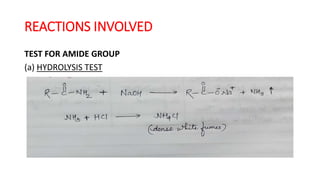
(a) HYDROLYSIS TEST
In a test tube small amount of given organic
compound is taken and 6-7 mL of 10% NaOH is
added. The mixture is boiled. A rod dipped in
conc. HCl is brought to the mouth of the test
tube.
Smell of NH3
observed.
Dense white
fumes observed.
Confirms the presence of
amide group
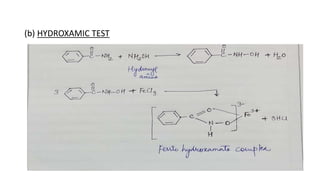
(b) HYDROXAMIC TEST
A pinch of given compound is taken and 3-4 mL
of hydroxylamine hydrochloride solution in
ethanol is added. The mixture is boiled for 2-3
minutes. It is cooled and 4-5 mL of freshly
prepared ferric chloride solution is added.
Change of red
colour to violet
is observed
Confirms the presence of
amide group
REACTIONS INVOLVED
TEST FOR AMIDE GROUP
(a) HYDROLYSIS TEST
(b) HYDROXAMIC TEST
DETERMINATION OF PHYSICAL CONSTANT
THE MELTING POINT OF GIVEN COMPOUND IS FOUND TO BE 128 ◦C
USING MELTING POINT APPARATUS.
LIST OF PROBABLE COMPOUNDS
The given compound contains amide functional group and has melting
point 128 ◦C , it could be :-
Sl
No.
Name of the compound Literature melting
point
Name of the
derivative
Literature melting point of
the derivative
1 benzamide 128 ◦C Hydrolysis-
Benzoic acid
121 ◦C
PREPARATION OF DERIVATIVE
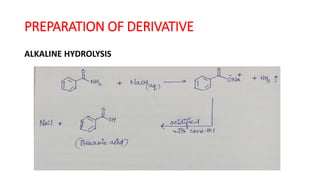
ALKALINE HYDROLYSIS
1 gram of given compound and 20 mL of 10% NaOH solution are taken in a
boiling tube fitted with an air condenser. Pumic stones are added and it is
refluxed over a wire gauge for 30 minutes till no more ammonia is evolved. It
is tested using red litmus paper. After removing the condenser , it is heated
for another 5-6 minutes. The boiling tube is cooled and conc. HCl is added.
The solution is filtered to get crystals. The crystals obtained is recrystallized
using hot water and melting point of recrystallized product is determined.
Name of the derivative is BENZOIC ACID.
It has melting point 121◦C.
Literature melting point is 121◦C.
PREPARATION OF DERIVATIVE
ALKALINE HYDROLYSIS
RESULT
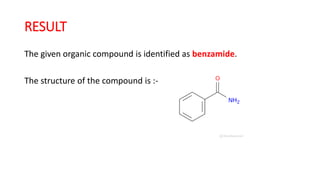
The given organic compound is identified as benzamide.
The structure of the compound is :-

Benzamide

  • 1.
    SYSTEMATIC ANALYSIS SANDEEP KRYADAV B.Sc. (HONS.) CHEMISTRY RAMJAS COLLEGE UNIVERSITY OF DELHI
  • 2.
    AIM TO ANALYZE THEGIVEN ORGANIC COMPOUND SYSTEMATICALLY AND PREPARE A SUITABLE CRYSTALLINE DERIVATIVE OF THE SAME.
  • 3.
    PRELIMINARY ANALYSIS Serial No. EXPERIMENT OBSERVATIONINFERENCE 1 PHYSICAL STATE SOLID CARBOXYLIC ACIDS, AMIDES, CARBOHYDRATES, PHENOLS,NITROAMINES MAY BE PRESENT 2 COLOUR COLOURLESS SIMPLE AMIDES, CARBOHYDRATES, ACIDS MAY BE PRESENT 3 ODOUR ODOURLESS CARBOHYDRATES, ACIDS, AMIDES MAY BE PRESENT 4 IGNITION TEST A small amount of organic compound is taken on a spatula and is introduced in blue flame. Sooty flame is observed The compound is aromatic
  • 4.
    SOLUBILITY TEST • ASMALL AMOUNT OF ORGANIC COMPOUND IS TAKEN AND ITS SOLUBILITY IS CHECKED IN FOLLOWING SOLVENTS. Serial No. EXPERIMENT OBSERVATION INFERENCE 1 COLD WATER SPARINGLY SOLUBLE ACIDS, AMIDES, CARBOHYDRATES MAY BE PRESENT 2 HOT WATER SOLUBLE ACIDS, AMIDES MAY BE PRESENT 3 SODIUM BICARBONATE SOLUTION INSOLUBLE CARBOXYLIC ACIDS MAY BE ABSENT 4 DILUTE SODIUM HYDROXIDE INSOLUBLE CARBOXYLIC ACIDS, PHENOLS MAY BE ABSENT 5 DILUTE HYDROCHLORIC ACID INSOLUBLE AMINES MAY BE ABSENT 6 CONCENTRATED SULPHURIC ACID INSOLUBLE AROMATIC HYDROCARBONS MAY BE ABSENT
  • 5.
    TEST FOR UNSATURATION SerialNo. EXPERIMENT OBSERVATION INFERENCE 1 BAEYER’S TEST Small amount of given compound is taken and dissolved in water and few drops of dilute Na2CO3 is added followed by addition of 1-2 % aqueous KMnO4 solution dropwise with continuous shaking No discharge of purple colour The compound does not contain unsaturation 2 BROMINE SOLUTION TEST To an aqueous solution of given compound , 2% bromine water solution is added dropwise with continuous shaking. No discharge of brown colour The compound does not contain saturation
  • 6.
    EXTRA ELEMENTS DETECTION Serial No. EXPERIMENTOBSERVATION INFERENCE 1 TEST FOR NITROGEN FERROUS SULPHATE TEST To 2 mL of the Lassaigne’s extract , 1 mL of freshly prepared FeSO4 solution is added. 2-3 drops of NaOH is added. The content is boiled and dilute H2SO4 is added. Prussian blue colour is observed Confirms the presence of nitrogen 2 TEST FOR SULPHUR LEAD ACETATE TEST The Lassaigne’s extract is acidified with dilute acetic acid and then 4 – 5 drops of lead acetate is added to it. No black precipitate is observed Confirms the absence of sulphur 3 TEST FOR HALOGENS (PRESENCE OF NITROGEN) Lassaigne’s extract is acidified with conc. HNO3 solution and the content is boiled. The solution is allowed to cool and then AgNO3 solution is added to it. No precipitate is formed Confirms the absence of halogens
  • 7.
  • 8.
    FUNCTIONAL GROUP ANALYSIS Serial No. EXPERIMENTOBSERVATION INFERENCE 1 TEST FOR CARBOXYLIC GROUP SODIUM BICARBONATE TEST To 2 mL saturated sodium bicarbonate solution in a watch glass, small amount of given compound is added. No brisk effervescence is observed Carboxylic group is absent 2 TEST FOR PHENOLIC GROUP FERRIC CHLORIDE TEST To the aqueous solution of organic compound, 1 – 2 drops of neutral ferric chloride solution is added with shaking. No coloured precipitate is observed Phenolic group is absent
  • 9.
    Serial No. EXPERIMENT OBSERVATION INFERENCE 3TEST FOR ALCOHOLIC GROUP CERRIC AMMONIUM NITRATE TEST To the aqueous solution of the given compound, 2 – 3 drops of ceric ammonium nitrate reagent is added. No blood red colouration is observed Alcoholic group is absent 4 TEST FOR CARBONYL GROUP DNP TEST To the aqueous solution of organic compound, 6-7 mL of DNP reagent is added with continuous shaking. It is allowed to stand for 5-10 minutes. Then, it is warmed on boiling water bath and is cooled to room temperature. No yellow or orange precipitate is observed Carbonyl group is absent
  • 10.
    Serial No. EXPERIMENT OBSERVATION INFERENCE 5TEST FOR AMIDE GROUP (a) HYDROLYSIS TEST In a test tube small amount of given organic compound is taken and 6-7 mL of 10% NaOH is added. The mixture is boiled. A rod dipped in conc. HCl is brought to the mouth of the test tube. Smell of NH3 observed. Dense white fumes observed. Confirms the presence of amide group (b) HYDROXAMIC TEST A pinch of given compound is taken and 3-4 mL of hydroxylamine hydrochloride solution in ethanol is added. The mixture is boiled for 2-3 minutes. It is cooled and 4-5 mL of freshly prepared ferric chloride solution is added. Change of red colour to violet is observed Confirms the presence of amide group
  • 11.
    REACTIONS INVOLVED TEST FORAMIDE GROUP (a) HYDROLYSIS TEST
  • 12.
  • 13.
    DETERMINATION OF PHYSICALCONSTANT THE MELTING POINT OF GIVEN COMPOUND IS FOUND TO BE 128 ◦C USING MELTING POINT APPARATUS. LIST OF PROBABLE COMPOUNDS The given compound contains amide functional group and has melting point 128 ◦C , it could be :- Sl No. Name of the compound Literature melting point Name of the derivative Literature melting point of the derivative 1 benzamide 128 ◦C Hydrolysis- Benzoic acid 121 ◦C
  • 14.
    PREPARATION OF DERIVATIVE ALKALINEHYDROLYSIS 1 gram of given compound and 20 mL of 10% NaOH solution are taken in a boiling tube fitted with an air condenser. Pumic stones are added and it is refluxed over a wire gauge for 30 minutes till no more ammonia is evolved. It is tested using red litmus paper. After removing the condenser , it is heated for another 5-6 minutes. The boiling tube is cooled and conc. HCl is added. The solution is filtered to get crystals. The crystals obtained is recrystallized using hot water and melting point of recrystallized product is determined. Name of the derivative is BENZOIC ACID. It has melting point 121◦C. Literature melting point is 121◦C.
  • 15.
  • 16.
    RESULT The given organiccompound is identified as benzamide. The structure of the compound is :-