Dr.P.GOVINDARAJ
Associate Professor & Head , Department of Chemistry
SAIVA BHANU KSHATRIYA COLLEGE
ARUPPUKOTTAI - 626101
Virudhunagar District, Tamil Nadu, India
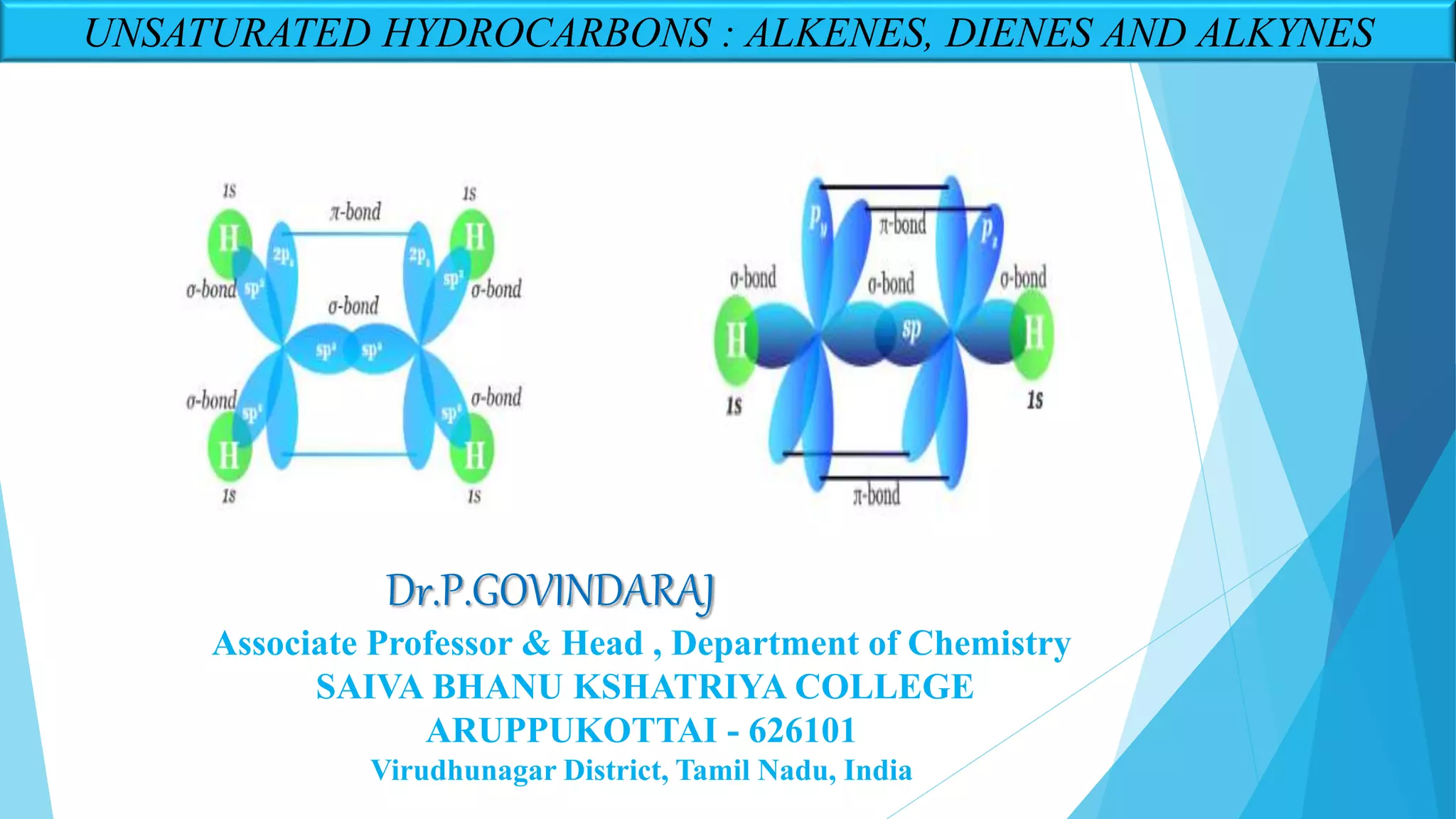
UNSATURATED HYDROCARBONS : ALKENES, DIENES AND ALKYNES
Definition:
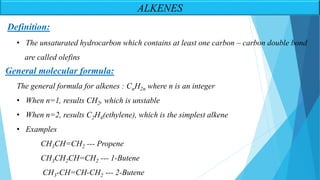
• The unsaturated hydrocarbon which contains at least one carbon – carbon double bond
are called olefins
The general formula for alkenes : CnH2n where n is an integer
• When n=1, results CH2, which is unstable
• When n=2, results C2H4(ethylene), which is the simplest alkene
• Examples
CH3CH=CH2 --- Propene
CH3CH2CH=CH2 --- 1-Butene
CH3-CH=CH-CH2 --- 2-Butene
General molecular formula:
ALKENES
Preparation of Alkenes:
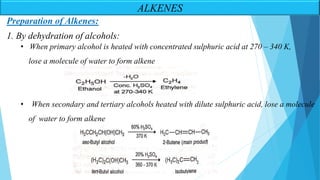
• When primary alcohol is heated with concentrated sulphuric acid at 270 – 340 K,
lose a molecule of water to form alkene
• When secondary and tertiary alcohols heated with dilute sulphuric acid, lose a molecule
of water to form alkene
1. By dehydration of alcohols:
ALKENES
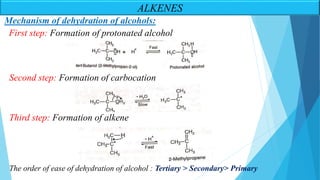
Mechanism of dehydration of alcohols:
First step: Formation of protonated alcohol
Second step: Formation of carbocation
Third step: Formation of alkene
The order of ease of dehydration of alcohol : Tertiary > Secondary> Primary
ALKENES
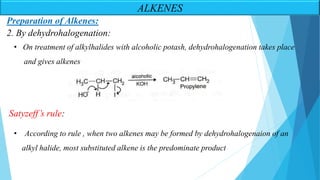
Preparation of Alkenes:
• On treatment of alkylhalides with alcoholic potash, dehydrohalogenation takes place
and gives alkenes
• According to rule , when two alkenes may be formed by dehydrohalogenaion of an
alkyl halide, most substituted alkene is the predominate product
2. By dehydrohalogenation:
Satyzeff’s rule:
ALKENES
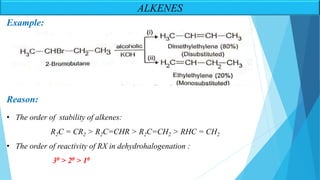
Example:
Reason:
• The order of stability of alkenes:
R2C = CR2 > R2C=CHR > R2C=CH2 > RHC = CH2
• The order of reactivity of RX in dehydrohalogenation :
30 > 20 > 10
ALKENES
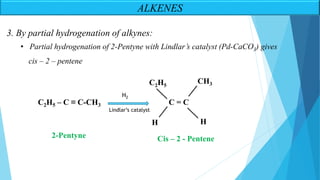
• Partial hydrogenation of 2-Pentyne with Lindlar’s catalyst (Pd-CaCO3) gives
cis – 2 – pentene
3. By partial hydrogenation of alkynes:
C2H5 – C ≡ C-CH3 C = C
H
H
C2H5
CH3
H2
Lindlar’s catalyst
2-Pentyne Cis – 2 - Pentene
ALKENES
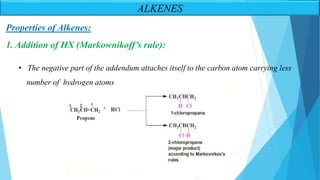
• The negative part of the addendum attaches itself to the carbon atom carrying less
number of hydrogen atoms
1. Addition of HX (Markownikoff’s rule):
Properties of Alkenes:
ALKENES
ALKENES
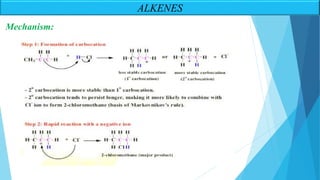
Mechanism:
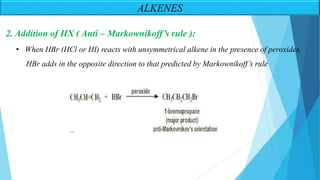
• When HBr (HCl or HI) reacts with unsymmetrical alkene in the presence of peroxides,
HBr adds in the opposite direction to that predicted by Markownikoff’s rule
2. Addition of HX ( Anti – Markownikoff’s rule ):
ALKENES
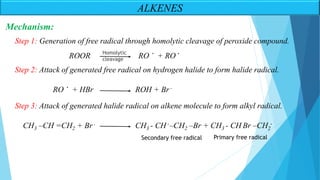
Step 1: Generation of free radical through homolytic cleavage of peroxide compound.
Step 2: Attack of generated free radical on hydrogen halide to form halide radical.
RO
. + HBr ROH + Br .
Step 3: Attack of generated halide radical on alkene molecule to form alkyl radical.
CH3 –CH =CH2 + Br . CH3 - CH .–CH2 –Br + CH3 - CH Br –CH2
.
ROOR RO
. + RO
.
Homolytic
cleavage
Primary free radical
Secondary free radical
ALKENES
Mechanism:
Step 4: Since Secondary free radical is more stable than primary free radical, it will be formed
predominately and will react with another molecule of HBr to yield the anti –
markownikoff’s product as major product
• The resulted bromine radical will further react with another molecule of propylene to
continue the chain
CH3 - CH .–CH2 –Br + HBr CH3CH2CH2Br + Br .
1-Bromopropane
[Major product]
ALKENES
3.Addition of halogen:
• Bromine and chlorine undergoes electrophilic addition readily to alkene to
form dihaloalkanes
• In this reaction bromine will be decolourised and this test is used to detect unsaturation
ALKENES
ALKENES
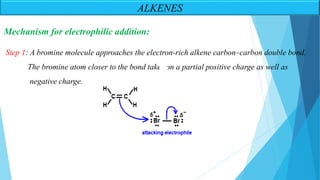
Mechanism for electrophilic addition:
Step 1: A bromine molecule approaches the electron-rich alkene carbon–carbon double bond.
The bromine atom closer to the bond takes on a partial positive charge as well as
negative charge.
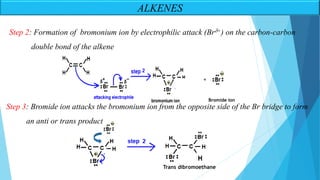
Step 2: Formation of bromonium ion by electrophilic attack (Br+) on the carbon-carbon
double bond of the alkene
ALKENES
+
Bromide ion
Step 3: Bromide ion attacks the bromonium ion from the opposite side of the Br bridge to form
an anti or trans product
Trans dibromoethane
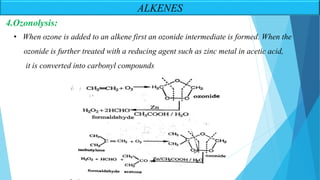
4.Ozonolysis:
• When ozone is added to an alkene first an ozonide intermediate is formed. When the
ozonide is further treated with a reducing agent such as zinc metal in acetic acid,
it is converted into carbonyl compounds
ALKENES
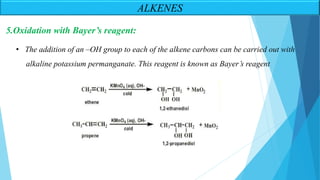
5.Oxidation with Bayer’s reagent:
• The addition of an –OH group to each of the alkene carbons can be carried out with
alkaline potassium permanganate. This reagent is known as Bayer’s reagent
ALKENES
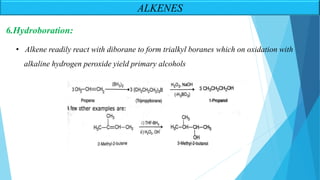
6.Hydroboration:
• Alkene readily react with diborane to form trialkyl boranes which on oxidation with
alkaline hydrogen peroxide yield primary alcohols
ALKENES
Compounds containing two double bonds are called dienes
Example: H2C=CH-CH=CH2 [1,3 - butadiene]
General formula : CnH2n-2
Types of dienes:
Depending on the relative location of the double bonds, dienes can be divided into
three types
1. Cumulated dienes
2. Conjugated dienes
3. Isolated dienes
Definition:
DIENES
• Dienes in which two double bonds are shared by a common carbon atom are called
cumulated dienes
Example: H2C=C=CH2 [Propadiene]
1.Cumulated dienes:
• Dienes in which two double bonds are separated by one single bond are called
conjugated dienes
Example: H2C=CH-CH=CH2 [1,3 - butadiene]
2.Conjugated dienes:
DIENES
• Dienes in which two double bonds are separated by two or more single bonds are called
Isolated dienes
Example: H2C=CH-CH2-CH2-CH=CH2 [1,5 - Hexadiene]
3.Isolated dienes:
• By dehydrogenation of alkene (1-Butene) by passing the vapour over heated catalyst. Cr2O3
on alumina support at 800-900 K
Preparation of dienes from alkene:
H2C=CH-CH2-CH3 H2C=CH-CH=CH2
Cr2O3 /Alumina
800 – 900 K
1-Butene 1,3 -Butadiene
DIENES
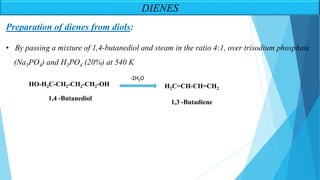
• By passing a mixture of 1,4-butanediol and steam in the ratio 4:1, over trisodium phosphate
(Na3PO4) and H3PO4 (20%) at 540 K
Preparation of dienes from diols:
HO-H2C-CH2-CH2-CH2-OH H2C=CH-CH=CH2
-2H2O
1,4 -Butanediol
1,3 -Butadiene
DIENES
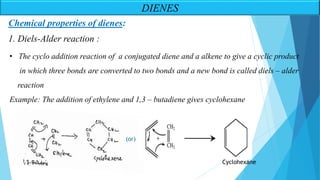
• The cyclo addition reaction of a conjugated diene and a alkene to give a cyclic product
in which three bonds are converted to two bonds and a new bond is called diels – alder
reaction
Example: The addition of ethylene and 1,3 – butadiene gives cyclohexane
Chemical properties of dienes:
1. Diels-Alder reaction :
DIENES
Cyclohexane
(or)
ALKYNES
Definition:
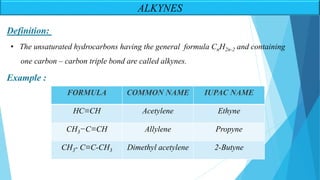
• The unsaturated hydrocarbons having the general formula CnH2n-2 and containing
one carbon – carbon triple bond are called alkynes.
Example :
FORMULA COMMON NAME IUPAC NAME
HC≡CH Acetylene Ethyne
CH3−C≡CH Allylene Propyne
CH3- C≡C-CH3 Dimethyl acetylene 2-Butyne
ALKYNES
Preparation of Alkynes:
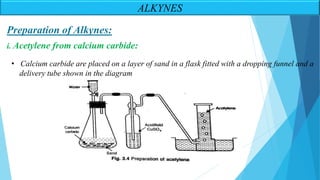
i. Acetylene from calcium carbide:
• Calcium carbide are placed on a layer of sand in a flask fitted with a dropping funnel and a
delivery tube shown in the diagram
ALKYNES
• Water is dropped from the dropping funnel and acetylene is formed
• The evolved acetylene is purified by pubbling it through acidified copper sulphate and
collected over water
CaC2 + 2H2O Ca(OH)2 + HC≡CH
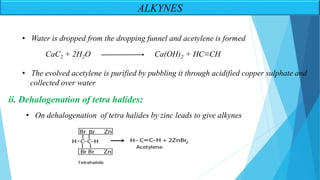
ii. Dehalogenation of tetra halides:
• On dehalogenation of tetra halides by zinc leads to give alkynes
ALKYNES
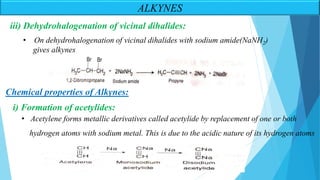
iii) Dehydrohalogenation of vicinal dihalides:
• On dehydrohalogenation of vicinal dihalides with sodium amide(NaNH2)
gives alkynes
Chemical properties of Alkynes:
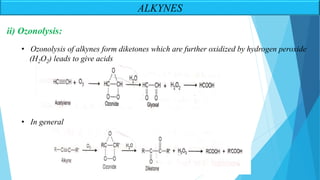
i) Formation of acetylides:
• Acetylene forms metallic derivatives called acetylide by replacement of one or both
hydrogen atoms with sodium metal. This is due to the acidic nature of its hydrogen atoms
ALKYNES
ii) Ozonolysis:
• Ozonolysis of alkynes form diketones which are further oxidized by hydrogen peroxide
(H2O2) leads to give acids
• In general
ALKYNES
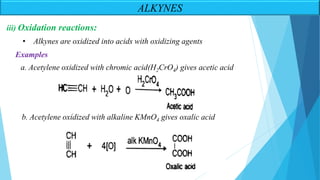
iii) Oxidation reactions:
• Alkynes are oxidized into acids with oxidizing agents
Examples
b. Acetylene oxidized with alkaline KMnO4 gives oxalic acid
a. Acetylene oxidized with chromic acid(H2CrO4) gives acetic acid
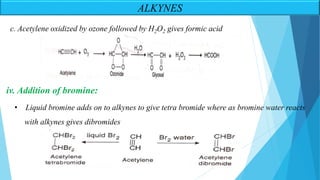
ALKYNES
iv. Addition of bromine:
• Liquid bromine adds on to alkynes to give tetra bromide where as bromine water reacts
with alkynes gives dibromides
c. Acetylene oxidized by ozone followed by H2O2 gives formic acid
THANK YOU

Alkenes and alkynes

  • 1.
    Dr.P.GOVINDARAJ Associate Professor &Head , Department of Chemistry SAIVA BHANU KSHATRIYA COLLEGE ARUPPUKOTTAI - 626101 Virudhunagar District, Tamil Nadu, India UNSATURATED HYDROCARBONS : ALKENES, DIENES AND ALKYNES
  • 2.
    Definition: • The unsaturatedhydrocarbon which contains at least one carbon – carbon double bond are called olefins The general formula for alkenes : CnH2n where n is an integer • When n=1, results CH2, which is unstable • When n=2, results C2H4(ethylene), which is the simplest alkene • Examples CH3CH=CH2 --- Propene CH3CH2CH=CH2 --- 1-Butene CH3-CH=CH-CH2 --- 2-Butene General molecular formula: ALKENES
  • 3.
    Preparation of Alkenes: •When primary alcohol is heated with concentrated sulphuric acid at 270 – 340 K, lose a molecule of water to form alkene • When secondary and tertiary alcohols heated with dilute sulphuric acid, lose a molecule of water to form alkene 1. By dehydration of alcohols: ALKENES
  • 4.
    Mechanism of dehydrationof alcohols: First step: Formation of protonated alcohol Second step: Formation of carbocation Third step: Formation of alkene The order of ease of dehydration of alcohol : Tertiary > Secondary> Primary ALKENES
  • 5.
    Preparation of Alkenes: •On treatment of alkylhalides with alcoholic potash, dehydrohalogenation takes place and gives alkenes • According to rule , when two alkenes may be formed by dehydrohalogenaion of an alkyl halide, most substituted alkene is the predominate product 2. By dehydrohalogenation: Satyzeff’s rule: ALKENES
  • 6.
    Example: Reason: • The orderof stability of alkenes: R2C = CR2 > R2C=CHR > R2C=CH2 > RHC = CH2 • The order of reactivity of RX in dehydrohalogenation : 30 > 20 > 10 ALKENES
  • 7.
    • Partial hydrogenationof 2-Pentyne with Lindlar’s catalyst (Pd-CaCO3) gives cis – 2 – pentene 3. By partial hydrogenation of alkynes: C2H5 – C ≡ C-CH3 C = C H H C2H5 CH3 H2 Lindlar’s catalyst 2-Pentyne Cis – 2 - Pentene ALKENES
  • 8.
    • The negativepart of the addendum attaches itself to the carbon atom carrying less number of hydrogen atoms 1. Addition of HX (Markownikoff’s rule): Properties of Alkenes: ALKENES
  • 9.
  • 10.
    • When HBr(HCl or HI) reacts with unsymmetrical alkene in the presence of peroxides, HBr adds in the opposite direction to that predicted by Markownikoff’s rule 2. Addition of HX ( Anti – Markownikoff’s rule ): ALKENES
  • 11.
    Step 1: Generationof free radical through homolytic cleavage of peroxide compound. Step 2: Attack of generated free radical on hydrogen halide to form halide radical. RO . + HBr ROH + Br . Step 3: Attack of generated halide radical on alkene molecule to form alkyl radical. CH3 –CH =CH2 + Br . CH3 - CH .–CH2 –Br + CH3 - CH Br –CH2 . ROOR RO . + RO . Homolytic cleavage Primary free radical Secondary free radical ALKENES Mechanism:
  • 12.
    Step 4: SinceSecondary free radical is more stable than primary free radical, it will be formed predominately and will react with another molecule of HBr to yield the anti – markownikoff’s product as major product • The resulted bromine radical will further react with another molecule of propylene to continue the chain CH3 - CH .–CH2 –Br + HBr CH3CH2CH2Br + Br . 1-Bromopropane [Major product] ALKENES
  • 13.
    3.Addition of halogen: •Bromine and chlorine undergoes electrophilic addition readily to alkene to form dihaloalkanes • In this reaction bromine will be decolourised and this test is used to detect unsaturation ALKENES
  • 14.
    ALKENES Mechanism for electrophilicaddition: Step 1: A bromine molecule approaches the electron-rich alkene carbon–carbon double bond. The bromine atom closer to the bond takes on a partial positive charge as well as negative charge.
  • 15.
    Step 2: Formationof bromonium ion by electrophilic attack (Br+) on the carbon-carbon double bond of the alkene ALKENES + Bromide ion Step 3: Bromide ion attacks the bromonium ion from the opposite side of the Br bridge to form an anti or trans product Trans dibromoethane
  • 16.
    4.Ozonolysis: • When ozoneis added to an alkene first an ozonide intermediate is formed. When the ozonide is further treated with a reducing agent such as zinc metal in acetic acid, it is converted into carbonyl compounds ALKENES
  • 17.
    5.Oxidation with Bayer’sreagent: • The addition of an –OH group to each of the alkene carbons can be carried out with alkaline potassium permanganate. This reagent is known as Bayer’s reagent ALKENES
  • 18.
    6.Hydroboration: • Alkene readilyreact with diborane to form trialkyl boranes which on oxidation with alkaline hydrogen peroxide yield primary alcohols ALKENES
  • 19.
    Compounds containing twodouble bonds are called dienes Example: H2C=CH-CH=CH2 [1,3 - butadiene] General formula : CnH2n-2 Types of dienes: Depending on the relative location of the double bonds, dienes can be divided into three types 1. Cumulated dienes 2. Conjugated dienes 3. Isolated dienes Definition: DIENES
  • 20.
    • Dienes inwhich two double bonds are shared by a common carbon atom are called cumulated dienes Example: H2C=C=CH2 [Propadiene] 1.Cumulated dienes: • Dienes in which two double bonds are separated by one single bond are called conjugated dienes Example: H2C=CH-CH=CH2 [1,3 - butadiene] 2.Conjugated dienes: DIENES
  • 21.
    • Dienes inwhich two double bonds are separated by two or more single bonds are called Isolated dienes Example: H2C=CH-CH2-CH2-CH=CH2 [1,5 - Hexadiene] 3.Isolated dienes: • By dehydrogenation of alkene (1-Butene) by passing the vapour over heated catalyst. Cr2O3 on alumina support at 800-900 K Preparation of dienes from alkene: H2C=CH-CH2-CH3 H2C=CH-CH=CH2 Cr2O3 /Alumina 800 – 900 K 1-Butene 1,3 -Butadiene DIENES
  • 22.
    • By passinga mixture of 1,4-butanediol and steam in the ratio 4:1, over trisodium phosphate (Na3PO4) and H3PO4 (20%) at 540 K Preparation of dienes from diols: HO-H2C-CH2-CH2-CH2-OH H2C=CH-CH=CH2 -2H2O 1,4 -Butanediol 1,3 -Butadiene DIENES
  • 23.
    • The cycloaddition reaction of a conjugated diene and a alkene to give a cyclic product in which three bonds are converted to two bonds and a new bond is called diels – alder reaction Example: The addition of ethylene and 1,3 – butadiene gives cyclohexane Chemical properties of dienes: 1. Diels-Alder reaction : DIENES Cyclohexane (or)
  • 24.
    ALKYNES Definition: • The unsaturatedhydrocarbons having the general formula CnH2n-2 and containing one carbon – carbon triple bond are called alkynes. Example : FORMULA COMMON NAME IUPAC NAME HC≡CH Acetylene Ethyne CH3−C≡CH Allylene Propyne CH3- C≡C-CH3 Dimethyl acetylene 2-Butyne
  • 25.
    ALKYNES Preparation of Alkynes: i.Acetylene from calcium carbide: • Calcium carbide are placed on a layer of sand in a flask fitted with a dropping funnel and a delivery tube shown in the diagram
  • 26.
    ALKYNES • Water isdropped from the dropping funnel and acetylene is formed • The evolved acetylene is purified by pubbling it through acidified copper sulphate and collected over water CaC2 + 2H2O Ca(OH)2 + HC≡CH ii. Dehalogenation of tetra halides: • On dehalogenation of tetra halides by zinc leads to give alkynes
  • 27.
    ALKYNES iii) Dehydrohalogenation ofvicinal dihalides: • On dehydrohalogenation of vicinal dihalides with sodium amide(NaNH2) gives alkynes Chemical properties of Alkynes: i) Formation of acetylides: • Acetylene forms metallic derivatives called acetylide by replacement of one or both hydrogen atoms with sodium metal. This is due to the acidic nature of its hydrogen atoms
  • 28.
    ALKYNES ii) Ozonolysis: • Ozonolysisof alkynes form diketones which are further oxidized by hydrogen peroxide (H2O2) leads to give acids • In general
  • 29.
    ALKYNES iii) Oxidation reactions: •Alkynes are oxidized into acids with oxidizing agents Examples b. Acetylene oxidized with alkaline KMnO4 gives oxalic acid a. Acetylene oxidized with chromic acid(H2CrO4) gives acetic acid
  • 30.
    ALKYNES iv. Addition ofbromine: • Liquid bromine adds on to alkynes to give tetra bromide where as bromine water reacts with alkynes gives dibromides c. Acetylene oxidized by ozone followed by H2O2 gives formic acid
  • 31.