Photoelectric EffectPhotoelectric Effect
(How Einstein really became famous!)(How Einstein really became famous!)
A.K.Gupta, PGT Chemistry, KVS ZIETA.K.Gupta, PGT Chemistry, KVS ZIET
BhubaneswaerBhubaneswaer
Photoelectric EffectPhotoelectric Effect
Metal Foil
A.K.Gupta, PGT Chemistry, KVS ZIET
Bhubaneswaer
PhotoelectricPhotoelectric EffectEffect
Metal FoilA.K.Gupta, PGT Chemistry, KVS ZIET
Bhubaneswaer
PhotoelectricPhotoelectric EffectEffect
 AsAs blueblue light strikes the metal foil,light strikes the metal foil, electronselectrons
are ejectedare ejected..
A.K.Gupta, PGT Chemistry, KVS ZIET
Bhubaneswaer
Let red light fall on the surfaceLet red light fall on the surface
of the metalof the metal
What do you observe?
A.K.Gupta, PGT Chemistry, KVS ZIET
Bhubaneswaer
PhotoelectricPhotoelectric EffectEffect
 WhenWhen redred light hits the metal foil, the foillight hits the metal foil, the foil
does not emit electrons.does not emit electrons.
 Blue light has more energy thanBlue light has more energy than redred light.light.
 How could we get more energy into the redHow could we get more energy into the red
light?light?
 Try increasing the brightness (intensity).Try increasing the brightness (intensity).
A.K.Gupta, PGT Chemistry, KVS ZIET
Bhubaneswaer
PhotoelectricPhotoelectric EffectEffect
What do you observe?
A.K.Gupta, PGT Chemistry, KVS ZIET
Bhubaneswaer
PhotoelectricPhotoelectric EffectEffect
 Well, that didn’t work!Well, that didn’t work!
 Maybe its still not bright enough.Maybe its still not bright enough.
A.K.Gupta, PGT Chemistry, KVS ZIET
Bhubaneswaer
PhotoelectricPhotoelectric EffectEffect
What do you observe now?
A.K.Gupta, PGT Chemistry, KVS ZIET
Bhubaneswaer
PhotoelectricPhotoelectric EffectEffect
►It is still not working.It is still not working.
►Can you guess what happens with brighterCan you guess what happens with brighter
(intense)(intense) blueblue light?light?
A.K.Gupta, PGT Chemistry, KVS ZIET
Bhubaneswaer
PhotoelectricPhotoelectric EffectEffect
What do you observe?
A.K.Gupta, PGT Chemistry, KVS ZIET
Bhubaneswaer
PhotoelectricPhotoelectric EffectEffect
►More blue lightMore blue light cause emission ofcause emission of moremore
electronselectrons, but, but that doesn’t work with redthat doesn’t work with red..
A.K.Gupta, PGT Chemistry, KVS ZIET
Bhubaneswaer
PhotoelectricPhotoelectric EffectEffect
A.K.Gupta, PGT Chemistry, KVS ZIET
Bhubaneswaer
Summary of the resultSummary of the result
 1.The electrons are ejected as soon as light strikes on
the metal, i.e.; there is no time lag between strike of light
and ejection of electron.
 2.The number of electrons emitted is proportional to the
intensity (brightness) of the light.
3.For each metal there is a characteristic minimum
frequency ( threshold frequency, v0) below which
photoelectric effect is not observed.
4.at a frequency v > v0 , the ejected electrons come out
with certain kinetic energy. The kinetic energy of these
electrons increase with increase of frequency of the light
used.
A.K.Gupta, PGT Chemistry, KVS ZIET
Bhubaneswaer
 Wave theory is unable to explain theseWave theory is unable to explain these
phenomena, as the energy depends on thephenomena, as the energy depends on the
intensity (brightness)intensity (brightness)
According to wave theory bright red lightAccording to wave theory bright red light
should work!should work!
BUT IT DOESN’T!BUT IT DOESN’T!
A.K.Gupta, PGT Chemistry, KVS ZIET
Bhubaneswaer
Einstein's ExplanationEinstein's Explanation
Einstein said that light travels in tinyEinstein said that light travels in tiny
packets called “packets called “quantaquanta” .” .
The energyThe energy of each quanta is given byof each quanta is given by
equation.equation.
E=hvE=hv00
EnergyEnergy
Planck’s constantPlanck’s constant
frequencyfrequency
A.K.Gupta, PGT Chemistry, KVS ZIET
Bhubaneswaer
PhotoelectricPhotoelectric EffectEffect
►Each metal has a minimum energy neededEach metal has a minimum energy needed
for an electron to be emitted.for an electron to be emitted.
►This is known as theThis is known as the work function,work function,
W(=hvW(=hv00 ).).
►So, for an electron to be emitted, the energySo, for an electron to be emitted, the energy
of the photon,of the photon, hvhv, must be greater than the, must be greater than the
work function,work function, W(=hvW(=hv00))..
►The excess energy is theThe excess energy is the kinetic energy, Ekinetic energy, E
of the emitted electron.of the emitted electron.A.K.Gupta, PGT Chemistry, KVS ZIET
Bhubaneswaer
PhotoelectricPhotoelectric EffectEffect
EINSTEIN’S PHOTOELECTRIC EQUATION:-EINSTEIN’S PHOTOELECTRIC EQUATION:-
E= hv-W
=hv-hv0
A.K.Gupta, PGT Chemistry, KVS ZIET
Bhubaneswaer
ApplicationsApplications
► The Photoelectric effect has numerous applications, for exampleThe Photoelectric effect has numerous applications, for example
night vision devices take advantage of the effect. Photons enteringnight vision devices take advantage of the effect. Photons entering
the device strike a plate which causes electrons to be emitted, thesethe device strike a plate which causes electrons to be emitted, these
pass through a disk consisting of millions of channels, the currentpass through a disk consisting of millions of channels, the current
through these are amplified and directed towards a fluorescentthrough these are amplified and directed towards a fluorescent
screen which glows when electrons hit it. Image converters, imagescreen which glows when electrons hit it. Image converters, image
intensifiers, television camera tubes, and image storage tubes alsointensifiers, television camera tubes, and image storage tubes also
take advantage of the point-by-point emission of thetake advantage of the point-by-point emission of the
photocathode. In these devices an optical image incident on aphotocathode. In these devices an optical image incident on a
semitransparent photocathode is used to transform the light imagesemitransparent photocathode is used to transform the light image
into aninto an ““electron image.electron image.”” The electrons released by each elementThe electrons released by each element
of the photoemitter are focused by an electron-optical device ontoof the photoemitter are focused by an electron-optical device onto
a fluorescent screen, reconverting it in the process again into ana fluorescent screen, reconverting it in the process again into an
optical imageoptical image
A.K.Gupta, PGT Chemistry, KVS ZIET
Bhubaneswaer
Applications: Night Vision DeviceApplications: Night Vision Device
http://www.lancs.ac.uk/ug/jacksom2/A.K.Gupta, PGT Chemistry, KVS ZIET
Bhubaneswaer
Photoelectric Smoke DetectorPhotoelectric Smoke Detector
Source: http://www.bassburglaralarms.com/images_products/d350rpl_addressable_duct_smoke_detector_b10685.jpg
A.K.Gupta, PGT Chemistry, KVS ZIET
Bhubaneswaer
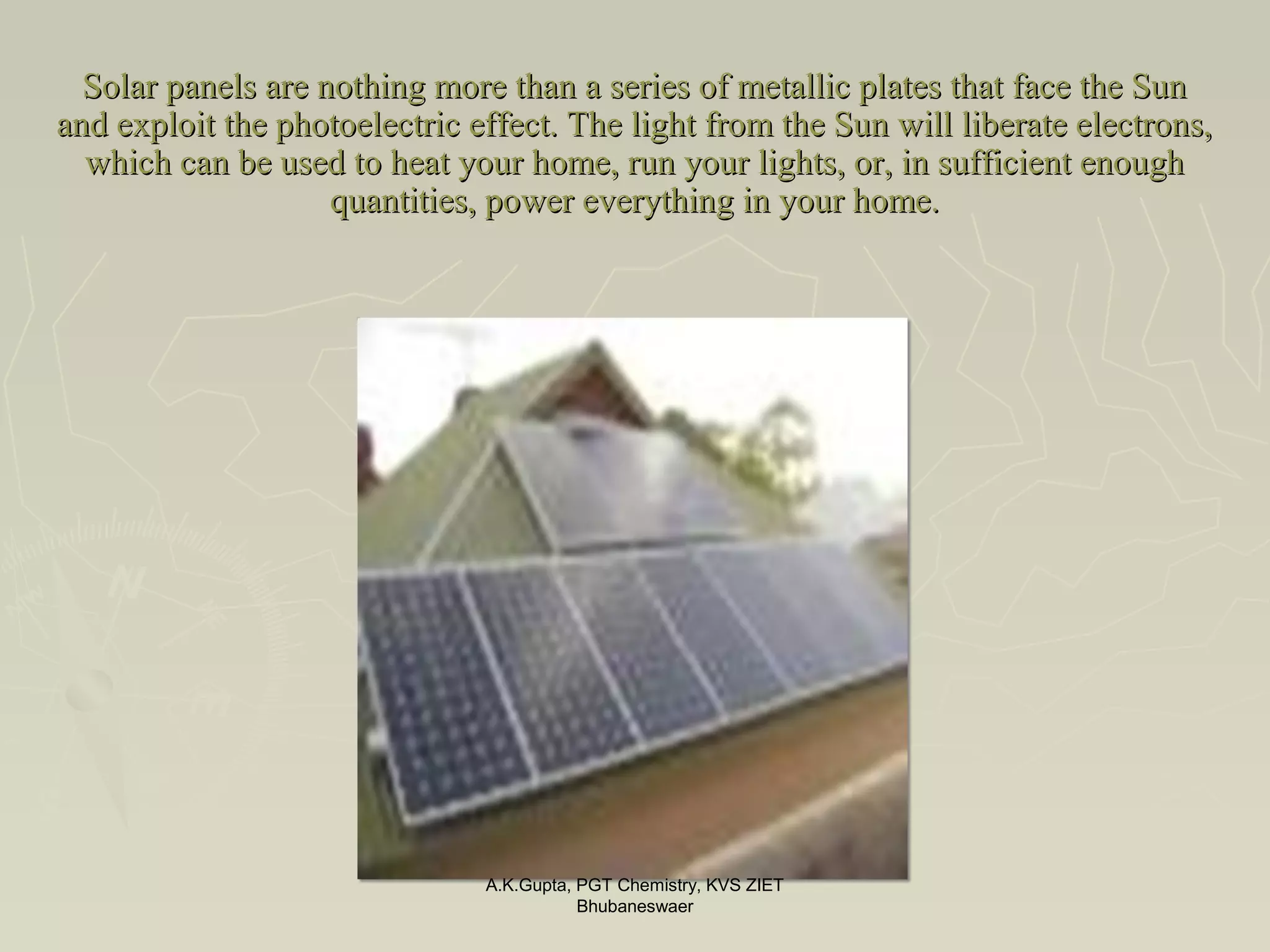
Solar panels are nothing more than a series of metallic plates that face the SunSolar panels are nothing more than a series of metallic plates that face the Sun
and exploit the photoelectric effect. The light from the Sun will liberate electrons,and exploit the photoelectric effect. The light from the Sun will liberate electrons,
which can be used to heat your home, run your lights, or, in sufficient enoughwhich can be used to heat your home, run your lights, or, in sufficient enough
quantities, power everything in your home.quantities, power everything in your home.
A.K.Gupta, PGT Chemistry, KVS ZIET
Bhubaneswaer
ThanksThanks
Amar, Francois G.Amar, Francois G. The Photoelectric EffectThe Photoelectric Effect. 25 Sep 2003. Section of Chemistry 121 for fall 03. 11. 25 Sep 2003. Section of Chemistry 121 for fall 03. 11
May 2006 <http://chemistry.umeche.maine.edu/~amar/fall2003/photoelectric.html>May 2006 <http://chemistry.umeche.maine.edu/~amar/fall2003/photoelectric.html>
Blawn, Jeramy R. and Colwell, Catharine H.Blawn, Jeramy R. and Colwell, Catharine H. Physics Lab: Photoelectric EffectPhysics Lab: Photoelectric Effect. 10 Jun 2003.. 10 Jun 2003.
Mainland High School: Online Physics Labs. 11 May 20006Mainland High School: Online Physics Labs. 11 May 20006
<http://online.cctt.org/physicslab/content/PhyAPB/lessonnotes/dualnature/photoelectric.asp><http://online.cctt.org/physicslab/content/PhyAPB/lessonnotes/dualnature/photoelectric.asp>
Helmenstine, Anne Marie.Helmenstine, Anne Marie. Photoelectric & Ionization Smoke DetectorPhotoelectric & Ionization Smoke Detector. 25 Feb 2006. About.com.. 25 Feb 2006. About.com.
11 May 2006 <http://chemistry.about.com/cs/howthingswork/a/aa071401a.htm>11 May 2006 <http://chemistry.about.com/cs/howthingswork/a/aa071401a.htm>
Einstein, Albert. “Concerning an Heuristic Point of View Toward the Emission andEinstein, Albert. “Concerning an Heuristic Point of View Toward the Emission and
Transformation of Light.”Transformation of Light.” American Journal Of PhysicsAmerican Journal Of Physics 5 May 1965: 137.5 May 1965: 137.
Nave, Rod.Nave, Rod. HyperPhysicsHyperPhysics. 19 Aug. 2000. Georgia State University. 06 May 2006. 19 Aug. 2000. Georgia State University. 06 May 2006
<http://hyperphysics.phy-astr.gsu.edu/hbase/hframe.html> .<http://hyperphysics.phy-astr.gsu.edu/hbase/hframe.html> .
Thornton T., Stephen, and Rex, Andrew.Thornton T., Stephen, and Rex, Andrew. Modern Physics for Scientists and EngineersModern Physics for Scientists and Engineers. Canada :. Canada :
Thomson Brooks/Core, 2006Thomson Brooks/Core, 2006
Photoelectric EffectPhotoelectric Effect. 24 Apr. 2006. Wikipedia Free Encyclopedia. 05 May 2006.. 24 Apr. 2006. Wikipedia Free Encyclopedia. 05 May 2006.
<http://en.wikipedia.org/wiki/Photoelectric_effect>.<http://en.wikipedia.org/wiki/Photoelectric_effect>.
A.K.Gupta, PGT Chemistry, KVS ZIET
Bhubaneswaer

Photoelectric Effect

  • 1.
    Photoelectric EffectPhotoelectric Effect (HowEinstein really became famous!)(How Einstein really became famous!) A.K.Gupta, PGT Chemistry, KVS ZIETA.K.Gupta, PGT Chemistry, KVS ZIET BhubaneswaerBhubaneswaer
  • 2.
    Photoelectric EffectPhotoelectric Effect MetalFoil A.K.Gupta, PGT Chemistry, KVS ZIET Bhubaneswaer
  • 3.
  • 4.
    PhotoelectricPhotoelectric EffectEffect  AsAsblueblue light strikes the metal foil,light strikes the metal foil, electronselectrons are ejectedare ejected.. A.K.Gupta, PGT Chemistry, KVS ZIET Bhubaneswaer
  • 5.
    Let red lightfall on the surfaceLet red light fall on the surface of the metalof the metal What do you observe? A.K.Gupta, PGT Chemistry, KVS ZIET Bhubaneswaer
  • 6.
    PhotoelectricPhotoelectric EffectEffect  WhenWhenredred light hits the metal foil, the foillight hits the metal foil, the foil does not emit electrons.does not emit electrons.  Blue light has more energy thanBlue light has more energy than redred light.light.  How could we get more energy into the redHow could we get more energy into the red light?light?  Try increasing the brightness (intensity).Try increasing the brightness (intensity). A.K.Gupta, PGT Chemistry, KVS ZIET Bhubaneswaer
  • 7.
    PhotoelectricPhotoelectric EffectEffect What doyou observe? A.K.Gupta, PGT Chemistry, KVS ZIET Bhubaneswaer
  • 8.
    PhotoelectricPhotoelectric EffectEffect  Well,that didn’t work!Well, that didn’t work!  Maybe its still not bright enough.Maybe its still not bright enough. A.K.Gupta, PGT Chemistry, KVS ZIET Bhubaneswaer
  • 9.
    PhotoelectricPhotoelectric EffectEffect What doyou observe now? A.K.Gupta, PGT Chemistry, KVS ZIET Bhubaneswaer
  • 10.
    PhotoelectricPhotoelectric EffectEffect ►It isstill not working.It is still not working. ►Can you guess what happens with brighterCan you guess what happens with brighter (intense)(intense) blueblue light?light? A.K.Gupta, PGT Chemistry, KVS ZIET Bhubaneswaer
  • 11.
    PhotoelectricPhotoelectric EffectEffect What doyou observe? A.K.Gupta, PGT Chemistry, KVS ZIET Bhubaneswaer
  • 12.
    PhotoelectricPhotoelectric EffectEffect ►More bluelightMore blue light cause emission ofcause emission of moremore electronselectrons, but, but that doesn’t work with redthat doesn’t work with red.. A.K.Gupta, PGT Chemistry, KVS ZIET Bhubaneswaer
  • 13.
  • 14.
    Summary of theresultSummary of the result  1.The electrons are ejected as soon as light strikes on the metal, i.e.; there is no time lag between strike of light and ejection of electron.  2.The number of electrons emitted is proportional to the intensity (brightness) of the light. 3.For each metal there is a characteristic minimum frequency ( threshold frequency, v0) below which photoelectric effect is not observed. 4.at a frequency v > v0 , the ejected electrons come out with certain kinetic energy. The kinetic energy of these electrons increase with increase of frequency of the light used. A.K.Gupta, PGT Chemistry, KVS ZIET Bhubaneswaer
  • 15.
     Wave theoryis unable to explain theseWave theory is unable to explain these phenomena, as the energy depends on thephenomena, as the energy depends on the intensity (brightness)intensity (brightness) According to wave theory bright red lightAccording to wave theory bright red light should work!should work! BUT IT DOESN’T!BUT IT DOESN’T! A.K.Gupta, PGT Chemistry, KVS ZIET Bhubaneswaer
  • 16.
    Einstein's ExplanationEinstein's Explanation Einsteinsaid that light travels in tinyEinstein said that light travels in tiny packets called “packets called “quantaquanta” .” . The energyThe energy of each quanta is given byof each quanta is given by equation.equation. E=hvE=hv00 EnergyEnergy Planck’s constantPlanck’s constant frequencyfrequency A.K.Gupta, PGT Chemistry, KVS ZIET Bhubaneswaer
  • 17.
    PhotoelectricPhotoelectric EffectEffect ►Each metalhas a minimum energy neededEach metal has a minimum energy needed for an electron to be emitted.for an electron to be emitted. ►This is known as theThis is known as the work function,work function, W(=hvW(=hv00 ).). ►So, for an electron to be emitted, the energySo, for an electron to be emitted, the energy of the photon,of the photon, hvhv, must be greater than the, must be greater than the work function,work function, W(=hvW(=hv00)).. ►The excess energy is theThe excess energy is the kinetic energy, Ekinetic energy, E of the emitted electron.of the emitted electron.A.K.Gupta, PGT Chemistry, KVS ZIET Bhubaneswaer
  • 18.
    PhotoelectricPhotoelectric EffectEffect EINSTEIN’S PHOTOELECTRICEQUATION:-EINSTEIN’S PHOTOELECTRIC EQUATION:- E= hv-W =hv-hv0 A.K.Gupta, PGT Chemistry, KVS ZIET Bhubaneswaer
  • 19.
    ApplicationsApplications ► The Photoelectriceffect has numerous applications, for exampleThe Photoelectric effect has numerous applications, for example night vision devices take advantage of the effect. Photons enteringnight vision devices take advantage of the effect. Photons entering the device strike a plate which causes electrons to be emitted, thesethe device strike a plate which causes electrons to be emitted, these pass through a disk consisting of millions of channels, the currentpass through a disk consisting of millions of channels, the current through these are amplified and directed towards a fluorescentthrough these are amplified and directed towards a fluorescent screen which glows when electrons hit it. Image converters, imagescreen which glows when electrons hit it. Image converters, image intensifiers, television camera tubes, and image storage tubes alsointensifiers, television camera tubes, and image storage tubes also take advantage of the point-by-point emission of thetake advantage of the point-by-point emission of the photocathode. In these devices an optical image incident on aphotocathode. In these devices an optical image incident on a semitransparent photocathode is used to transform the light imagesemitransparent photocathode is used to transform the light image into aninto an ““electron image.electron image.”” The electrons released by each elementThe electrons released by each element of the photoemitter are focused by an electron-optical device ontoof the photoemitter are focused by an electron-optical device onto a fluorescent screen, reconverting it in the process again into ana fluorescent screen, reconverting it in the process again into an optical imageoptical image A.K.Gupta, PGT Chemistry, KVS ZIET Bhubaneswaer
  • 20.
    Applications: Night VisionDeviceApplications: Night Vision Device http://www.lancs.ac.uk/ug/jacksom2/A.K.Gupta, PGT Chemistry, KVS ZIET Bhubaneswaer
  • 21.
    Photoelectric Smoke DetectorPhotoelectricSmoke Detector Source: http://www.bassburglaralarms.com/images_products/d350rpl_addressable_duct_smoke_detector_b10685.jpg A.K.Gupta, PGT Chemistry, KVS ZIET Bhubaneswaer
  • 22.
    Solar panels arenothing more than a series of metallic plates that face the SunSolar panels are nothing more than a series of metallic plates that face the Sun and exploit the photoelectric effect. The light from the Sun will liberate electrons,and exploit the photoelectric effect. The light from the Sun will liberate electrons, which can be used to heat your home, run your lights, or, in sufficient enoughwhich can be used to heat your home, run your lights, or, in sufficient enough quantities, power everything in your home.quantities, power everything in your home. A.K.Gupta, PGT Chemistry, KVS ZIET Bhubaneswaer
  • 23.
    ThanksThanks Amar, Francois G.Amar,Francois G. The Photoelectric EffectThe Photoelectric Effect. 25 Sep 2003. Section of Chemistry 121 for fall 03. 11. 25 Sep 2003. Section of Chemistry 121 for fall 03. 11 May 2006 <http://chemistry.umeche.maine.edu/~amar/fall2003/photoelectric.html>May 2006 <http://chemistry.umeche.maine.edu/~amar/fall2003/photoelectric.html> Blawn, Jeramy R. and Colwell, Catharine H.Blawn, Jeramy R. and Colwell, Catharine H. Physics Lab: Photoelectric EffectPhysics Lab: Photoelectric Effect. 10 Jun 2003.. 10 Jun 2003. Mainland High School: Online Physics Labs. 11 May 20006Mainland High School: Online Physics Labs. 11 May 20006 <http://online.cctt.org/physicslab/content/PhyAPB/lessonnotes/dualnature/photoelectric.asp><http://online.cctt.org/physicslab/content/PhyAPB/lessonnotes/dualnature/photoelectric.asp> Helmenstine, Anne Marie.Helmenstine, Anne Marie. Photoelectric & Ionization Smoke DetectorPhotoelectric & Ionization Smoke Detector. 25 Feb 2006. About.com.. 25 Feb 2006. About.com. 11 May 2006 <http://chemistry.about.com/cs/howthingswork/a/aa071401a.htm>11 May 2006 <http://chemistry.about.com/cs/howthingswork/a/aa071401a.htm> Einstein, Albert. “Concerning an Heuristic Point of View Toward the Emission andEinstein, Albert. “Concerning an Heuristic Point of View Toward the Emission and Transformation of Light.”Transformation of Light.” American Journal Of PhysicsAmerican Journal Of Physics 5 May 1965: 137.5 May 1965: 137. Nave, Rod.Nave, Rod. HyperPhysicsHyperPhysics. 19 Aug. 2000. Georgia State University. 06 May 2006. 19 Aug. 2000. Georgia State University. 06 May 2006 <http://hyperphysics.phy-astr.gsu.edu/hbase/hframe.html> .<http://hyperphysics.phy-astr.gsu.edu/hbase/hframe.html> . Thornton T., Stephen, and Rex, Andrew.Thornton T., Stephen, and Rex, Andrew. Modern Physics for Scientists and EngineersModern Physics for Scientists and Engineers. Canada :. Canada : Thomson Brooks/Core, 2006Thomson Brooks/Core, 2006 Photoelectric EffectPhotoelectric Effect. 24 Apr. 2006. Wikipedia Free Encyclopedia. 05 May 2006.. 24 Apr. 2006. Wikipedia Free Encyclopedia. 05 May 2006. <http://en.wikipedia.org/wiki/Photoelectric_effect>.<http://en.wikipedia.org/wiki/Photoelectric_effect>. A.K.Gupta, PGT Chemistry, KVS ZIET Bhubaneswaer