Biodiversity
LESSON #18
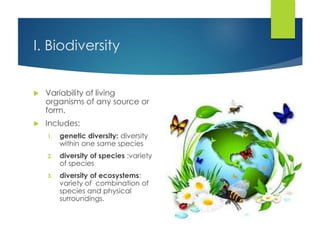
I. Biodiversity
 Variability of living
organisms of any source or
form.
 Includes:
1. genetic diversity: diversity
within one same species
2. diversity of species :variety
of species
3. diversity of ecosystems:
variety of combination of
species and physical
surroundings.
I.1. Genetic diversity
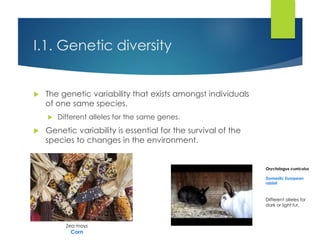
 The genetic variability that exists amongst individuals
of one same species.
 Different alleles for the same genes.
 Genetic variability is essential for the survival of the
species to changes in the environment.
Oryctolagus cuniculus
Domestic European
rabbit
Different alleles for
dark or light fur.
Zea mays
Corn
Lucanus cervus
I.2 Diversity of species
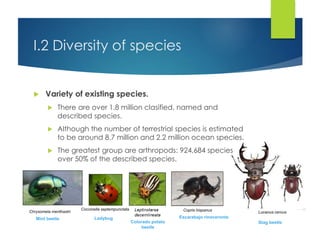
 Variety of existing species.
 There are over 1.8 million clasified, named and
described species.
 Although the number of terrestrial species is estimated
to be around 8.7 million and 2.2 million ocean species.
 The greatest group are arthropods: 924,684 species
over 50% of the described species.
Stag beetle
Copris hispanus
Escarabajo rinoceronte
Colorado potato
beetle
Coccinella septempunctata
Ladybug
Chrysomela menthastri
Mint beetle
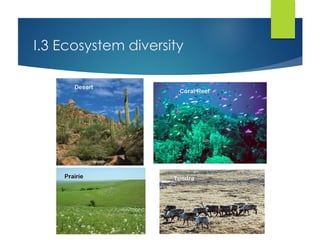
I.3 Ecosystem diversity
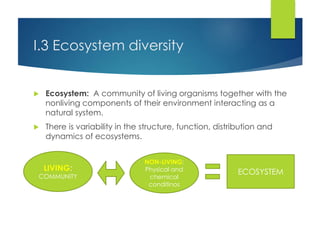
 Ecosystem: A community of living organisms together with the
nonliving components of their environment interacting as a
natural system.
 There is variability in the structure, function, distribution and
dynamics of ecosystems.
ECOSYSTEMLIVING:
COMMUNITY
NON-LIVING:
Physical and
chemical
conditinos
I.3 Ecosystem diversity
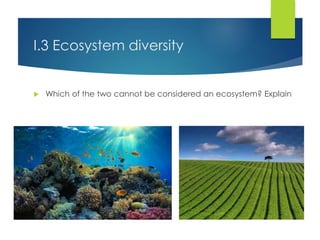
 Which of the two cannot be considered an ecosystem? Explain
Living components of an
Ecosystem
 Community: group of populations living in an ecosystem.
 Population: group of organisms of the same species living in one same habitat.
 Species: group of individuals with common characteristics which can reproduce
and have fertile offspring.
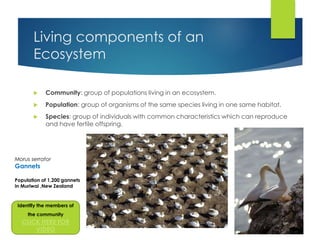
Morus serrator
Gannets
Population of 1,200 gannets
in Muriwai ,New Zealand
Identify the members of
the community
CLICK HERE FOR
VIDEO

Lesson 22 biodiversity

  • 1.
  • 2.
    I. Biodiversity  Variabilityof living organisms of any source or form.  Includes: 1. genetic diversity: diversity within one same species 2. diversity of species :variety of species 3. diversity of ecosystems: variety of combination of species and physical surroundings.
  • 3.
    I.1. Genetic diversity The genetic variability that exists amongst individuals of one same species.  Different alleles for the same genes.  Genetic variability is essential for the survival of the species to changes in the environment. Oryctolagus cuniculus Domestic European rabbit Different alleles for dark or light fur. Zea mays Corn
  • 4.
    Lucanus cervus I.2 Diversityof species  Variety of existing species.  There are over 1.8 million clasified, named and described species.  Although the number of terrestrial species is estimated to be around 8.7 million and 2.2 million ocean species.  The greatest group are arthropods: 924,684 species over 50% of the described species. Stag beetle Copris hispanus Escarabajo rinoceronte Colorado potato beetle Coccinella septempunctata Ladybug Chrysomela menthastri Mint beetle
  • 5.
    I.3 Ecosystem diversity Ecosystem: A community of living organisms together with the nonliving components of their environment interacting as a natural system.  There is variability in the structure, function, distribution and dynamics of ecosystems. ECOSYSTEMLIVING: COMMUNITY NON-LIVING: Physical and chemical conditinos
  • 6.
  • 7.
    I.3 Ecosystem diversity Which of the two cannot be considered an ecosystem? Explain
  • 8.
    Living components ofan Ecosystem  Community: group of populations living in an ecosystem.  Population: group of organisms of the same species living in one same habitat.  Species: group of individuals with common characteristics which can reproduce and have fertile offspring. Morus serrator Gannets Population of 1,200 gannets in Muriwai ,New Zealand Identify the members of the community CLICK HERE FOR VIDEO

Editor's Notes

  • #4 Zea mays:  large grain plant domesticated by indigenous peoples in Mesoamerica in prehistoric times. The leafy stalk produces ears which contain the grain, which are seeds called kernels. Maize kernels are often used in cooking as a starch. The six major types of maize aredent, flint, pod, popcorn, flour, and sweet. Prior to their domestication, maize plants only grew small, one-inch long corn cobs, and only one per plant. Many centuries of artificial selection by the indigenous people of the Americas resulted in the development of maize plants capable of growing several cobs per plant that were usually several inches long each. They are of various colors: blackish, bluish-gray, purple, green, red, white and yellow. When ground into flour, maize yields more flour with much less bran than wheat does. It lacks the protein gluten of wheat and, therefore, makes baked goods with poor rising capability. A genetic variant that accumulates more sugar and less starch in the ear is consumed as a vegetable and is called sweet corn. Young ears can be consumed raw, with the cob and silk, but as the plant matures (usually during the summer months), the cob becomes tougher and the silk dries to inedibility. By the end of the growing season, the kernels dry out and become difficult to chew without cooking them tender first in boiling water.
  • #5 Lucanus cervus: Ciervo volante. Greatest beetle in Europe. Su tamaño total varía entre los 3 y 9 cm en los machos y los 2,8 y 5,4 cm en las hembras. Presentan un notable dimorfismo sexual; los machos son mayores que las hembras y poseen las mandíbulas mucho más desarrolladas que utilizan para la lucha; tienen una forma que recuerda los cuernos de un ciervo, de donde deriva su nombre común. Copris hispanus: Escarabajo rinoceronte. Dichos cuernos están, en general, mucho más desarrollados en los machos, ya que los utilizan en sus luchas para conseguir pareja. Leptinotarsa decemlineata: Escarabajo de la patata. L. decemlineata es una importante plaga sobre todo en el cultivo de patata. También puede ocasionar daños en plantas de tomate y de berenjena. Tanto las larvas como los adultos se alimentan de las hojas y pueden llegar a eliminar totalmente las plantas. Losinsecticidas son actualmente el principal método de control de este escarabajo en plantaciones comerciales. Sin embargo, muchos insecticidas no producen un buen resultado en su control debido a la resistencia a los tóxicos de esta especie y a la rapidez con la que pueden desarrollar resistencia a ellos. Esta especie ha desarrollado resistencia a la mayoría de los insecticidas normalmente utilizados. La gran fecundidad de esta especie, normalmente le ayuda a soportar la presión de sus enemigos naturales. Aun así, en determinados casos, sus enemigos naturales pueden mantener las poblaciones de L. decemlineta bajas, de modo que los daños económicos causados no sean elevados. Beauveria bassiana es un hongo patógeno que puede infectar a un amplio rango de insectos incluyendo L. decemlineta. Es probablemente el enemigo natural más ampliamente utilizado en su control, presentándose en formulaciones comerciales que permiten que pueda ser utilizado en los equipos convencionales de tratamientos agrícolas Chrysomela menthastri: Escarabajo de la menta.
  • #9 Gannets hunt fish by diving from a height into the sea and pursuing their prey underwater. Gannets have a number of adaptations which enable them to do this: no external nostrils, they are located inside the mouth instead; air sacs in the face and chest under the skin which act like bubble wrapping, cushioning the impact with the water; positioning of the eyes far enough forward on the face for binocular vision, allowing them to judge distances accurately. Gannets can dive from a height of 30 metres (98 ft), achieving speeds of 100 kilometres per hour (62 mph) as they strike the water, enabling them to catch fish much deeper than most airborne birds. The gannet's supposed capacity for eating large quantities of fish has led to "gannet" becoming a disapproving description of somebody who eats excessively, similar to "glutton". About 1,200 pairs of gannets nest in Muruwaivhere from August to March each year