Presented by:
• Taseer Raza
• 17-CE-93
• Civil Engineering Department
BIODIVERSITY
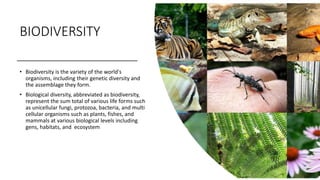
• Biodiversity is the variety of the world's
organisms, including their genetic diversity and
the assemblage they form.
• Biological diversity, abbreviated as biodiversity,
represent the sum total of various life forms such
as unicellular fungi, protozoa, bacteria, and multi
cellular organisms such as plants, fishes, and
mammals at various biological levels including
gens, habitats, and ecosystem
HISTORY OF
BIODIVERSITY
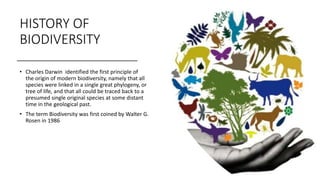
• Charles Darwin identified the first principle of
the origin of modern biodiversity, namely that all
species were linked in a single great phylogeny, or
tree of life, and that all could be traced back to a
presumed single original species at some distant
time in the geological past.
• The term Biodiversity was first coined by Walter G.
Rosen in 1986
HISTORY OF BIODIVERSITY
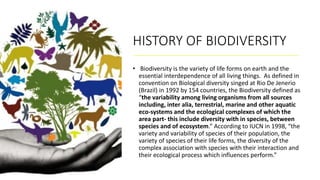
• Biodiversity is the variety of life forms on earth and the
essential interdependence of all living things. As defined in
convention on Biological diversity singed at Rio De Jenerio
(Brazil) in 1992 by 154 countries, the Biodiversity defined as
“the variability among living organisms from all sources
including, inter alia, terrestrial, marine and other aquatic
eco-systems and the ecological complexes of which the
area part- this include diversity with in species, between
species and of ecosystem.” According to IUCN in 1998, “the
variety and variability of species of their population, the
variety of species of their life forms, the diversity of the
complex association with species with their interaction and
their ecological process which influences perform.”
TYPES OF
BIODIVERSITY
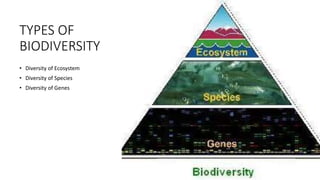
• Diversity of Ecosystem
• Diversity of Species
• Diversity of Genes
TYPES OF
BIODIVERSITY
• GENETIC DIVERSITY
 It refers to the total genetic information contained
in the genes of individuals of plants , animals and
microorganisms.
 The genes found in organisms can form enormous
number of combinations each of which gives rise
to some variability.
 Genes are the basic units of hereditary
information transmitted from one generation to
other.
TYPES OF
BIODIVERSITY
• GENETIC DIVERSITY
 When the genes within the same species show
different versions due to new combinations, it is
called genetic variability.
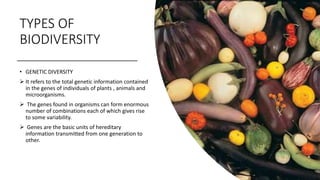
 For example, all rice varieties belong to the
species Oryza sativa, but there are thousands of
wild and cultivated varieties of rice which show
variations at the genetic level and differ in their
color, size, shape, aroma and nutrient content of
the grain. This is the genetic diversity of rice.
TYPES OF
BIODIVERSITY
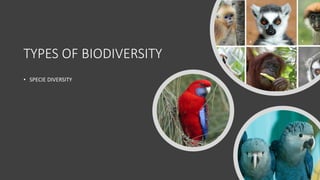
• SPECIE DIVERSITY
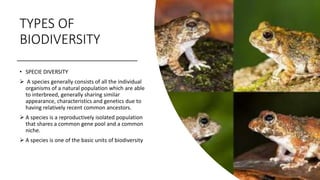
 A species generally consists of all the individual
organisms of a natural population which are able
to interbreed, generally sharing similar
appearance, characteristics and genetics due to
having relatively recent common ancestors.
 A species is a reproductively isolated population
that shares a common gene pool and a common
niche.
 A species is one of the basic units of biodiversity
TYPES OF BIODIVERSITY
• SPECIE DIVERSITY
TYPES OF
BIODIVERSITY
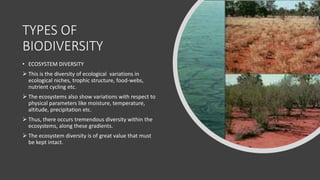
• ECOSYSTEM DIVERSITY
 This is the diversity of ecological variations in
ecological niches, trophic structure, food-webs,
nutrient cycling etc.
 The ecosystems also show variations with respect to
physical parameters like moisture, temperature,
altitude, precipitation etc.
 Thus, there occurs tremendous diversity within the
ecosystems, along these gradients.
 The ecosystem diversity is of great value that must
be kept intact.
TYPES OF BIODIVERSITY
• ECOSYSTEM DIVERSITY
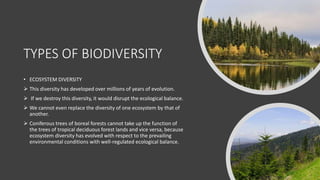
 This diversity has developed over millions of years of evolution.
 If we destroy this diversity, it would disrupt the ecological balance.
 We cannot even replace the diversity of one ecosystem by that of
another.
 Coniferous trees of boreal forests cannot take up the function of
the trees of tropical deciduous forest lands and vice versa, because
ecosystem diversity has evolved with respect to the prevailing
environmental conditions with well-regulated ecological balance.
IMPORTANCE OF
BIODIVERSITY
Our biodiversity is very important to the well-being of
our planet. Most cultures, at least at some time, have
recognized the importance of conserving natural
resources.
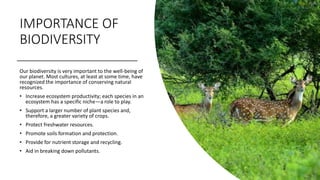
• Increase ecosystem productivity; each species in an
ecosystem has a specific niche—a role to play.
• Support a larger number of plant species and,
therefore, a greater variety of crops.
• Protect freshwater resources.
• Promote soils formation and protection.
• Provide for nutrient storage and recycling.
• Aid in breaking down pollutants.
IMPORTANCE OF
BIODIVERSITY
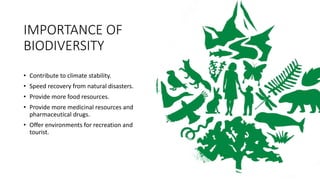
• Contribute to climate stability.
• Speed recovery from natural disasters.
• Provide more food resources.
• Provide more medicinal resources and
pharmaceutical drugs.
• Offer environments for recreation and
tourist.
CONCLUSION
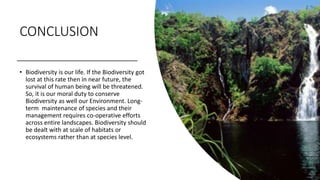
• Biodiversity is our life. If the Biodiversity got
lost at this rate then in near future, the
survival of human being will be threatened.
So, it is our moral duty to conserve
Biodiversity as well our Environment. Long-
term maintenance of species and their
management requires co-operative efforts
across entire landscapes. Biodiversity should
be dealt with at scale of habitats or
ecosystems rather than at species level.
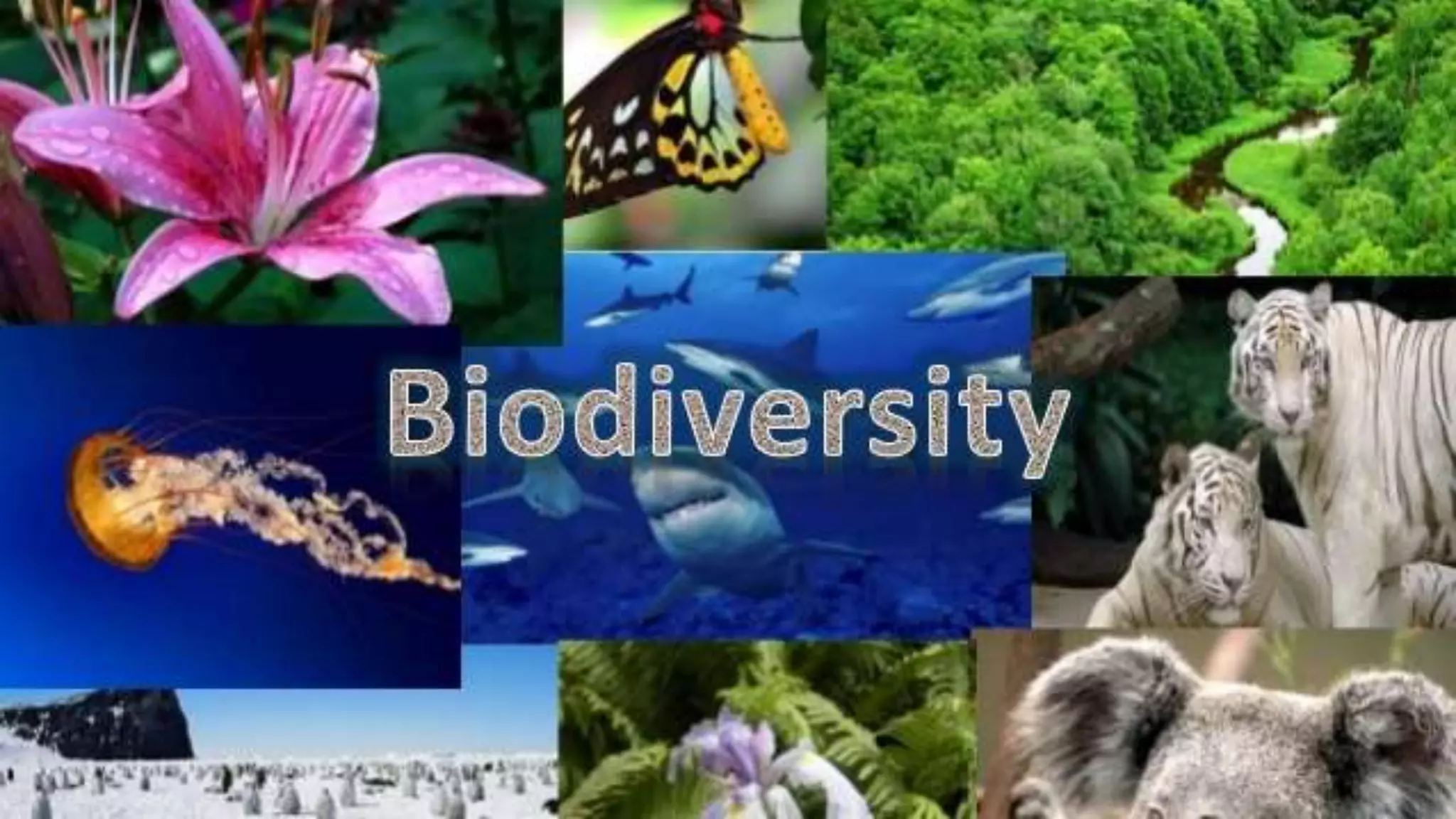
Biodiversity

Biodiversity

  • 2.
    Presented by: • TaseerRaza • 17-CE-93 • Civil Engineering Department
  • 3.
    BIODIVERSITY • Biodiversity isthe variety of the world's organisms, including their genetic diversity and the assemblage they form. • Biological diversity, abbreviated as biodiversity, represent the sum total of various life forms such as unicellular fungi, protozoa, bacteria, and multi cellular organisms such as plants, fishes, and mammals at various biological levels including gens, habitats, and ecosystem
  • 4.
    HISTORY OF BIODIVERSITY • CharlesDarwin identified the first principle of the origin of modern biodiversity, namely that all species were linked in a single great phylogeny, or tree of life, and that all could be traced back to a presumed single original species at some distant time in the geological past. • The term Biodiversity was first coined by Walter G. Rosen in 1986
  • 5.
    HISTORY OF BIODIVERSITY •Biodiversity is the variety of life forms on earth and the essential interdependence of all living things. As defined in convention on Biological diversity singed at Rio De Jenerio (Brazil) in 1992 by 154 countries, the Biodiversity defined as “the variability among living organisms from all sources including, inter alia, terrestrial, marine and other aquatic eco-systems and the ecological complexes of which the area part- this include diversity with in species, between species and of ecosystem.” According to IUCN in 1998, “the variety and variability of species of their population, the variety of species of their life forms, the diversity of the complex association with species with their interaction and their ecological process which influences perform.”
  • 6.
    TYPES OF BIODIVERSITY • Diversityof Ecosystem • Diversity of Species • Diversity of Genes
  • 7.
    TYPES OF BIODIVERSITY • GENETICDIVERSITY  It refers to the total genetic information contained in the genes of individuals of plants , animals and microorganisms.  The genes found in organisms can form enormous number of combinations each of which gives rise to some variability.  Genes are the basic units of hereditary information transmitted from one generation to other.
  • 8.
    TYPES OF BIODIVERSITY • GENETICDIVERSITY  When the genes within the same species show different versions due to new combinations, it is called genetic variability.  For example, all rice varieties belong to the species Oryza sativa, but there are thousands of wild and cultivated varieties of rice which show variations at the genetic level and differ in their color, size, shape, aroma and nutrient content of the grain. This is the genetic diversity of rice.
  • 9.
    TYPES OF BIODIVERSITY • SPECIEDIVERSITY  A species generally consists of all the individual organisms of a natural population which are able to interbreed, generally sharing similar appearance, characteristics and genetics due to having relatively recent common ancestors.  A species is a reproductively isolated population that shares a common gene pool and a common niche.  A species is one of the basic units of biodiversity
  • 10.
    TYPES OF BIODIVERSITY •SPECIE DIVERSITY
  • 11.
    TYPES OF BIODIVERSITY • ECOSYSTEMDIVERSITY  This is the diversity of ecological variations in ecological niches, trophic structure, food-webs, nutrient cycling etc.  The ecosystems also show variations with respect to physical parameters like moisture, temperature, altitude, precipitation etc.  Thus, there occurs tremendous diversity within the ecosystems, along these gradients.  The ecosystem diversity is of great value that must be kept intact.
  • 12.
    TYPES OF BIODIVERSITY •ECOSYSTEM DIVERSITY  This diversity has developed over millions of years of evolution.  If we destroy this diversity, it would disrupt the ecological balance.  We cannot even replace the diversity of one ecosystem by that of another.  Coniferous trees of boreal forests cannot take up the function of the trees of tropical deciduous forest lands and vice versa, because ecosystem diversity has evolved with respect to the prevailing environmental conditions with well-regulated ecological balance.
  • 13.
    IMPORTANCE OF BIODIVERSITY Our biodiversityis very important to the well-being of our planet. Most cultures, at least at some time, have recognized the importance of conserving natural resources. • Increase ecosystem productivity; each species in an ecosystem has a specific niche—a role to play. • Support a larger number of plant species and, therefore, a greater variety of crops. • Protect freshwater resources. • Promote soils formation and protection. • Provide for nutrient storage and recycling. • Aid in breaking down pollutants.
  • 14.
    IMPORTANCE OF BIODIVERSITY • Contributeto climate stability. • Speed recovery from natural disasters. • Provide more food resources. • Provide more medicinal resources and pharmaceutical drugs. • Offer environments for recreation and tourist.
  • 15.
    CONCLUSION • Biodiversity isour life. If the Biodiversity got lost at this rate then in near future, the survival of human being will be threatened. So, it is our moral duty to conserve Biodiversity as well our Environment. Long- term maintenance of species and their management requires co-operative efforts across entire landscapes. Biodiversity should be dealt with at scale of habitats or ecosystems rather than at species level.