Earth dynamics
Early theories: Continental Drift
The origin of Earth
• Earth increased its mass and started to create a gravitational force
which was also increasing.
• Great collisions with other orbiting planets created the Earths great
internal energy.
• Elements organized by densities due to the action of gravity upon
them and creating layers.
• Outer layer cooled and formed a crust.
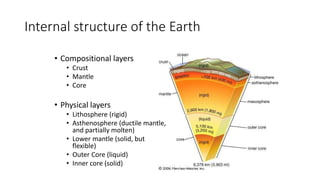
Internal structure of the Earth
• Compositional layers
• Crust
• Mantle
• Core
• Physical layers
• Lithosphere (rigid)
• Asthenosphere (ductile mantle,
and partially molten)
• Lower mantle (solid, but
flexible)
• Outer Core (liquid)
• Inner core (solid)
Movement of continents
Many people believed continents were fixed. However there was
controversy.
Do they move?
If they move….how and why do they move?
Continental movement
• Ice Age theory
• Continental Drift Theory –Early 1900s
• Plate tectonic theory - 20th century
Ice Age theory
Movement of continents
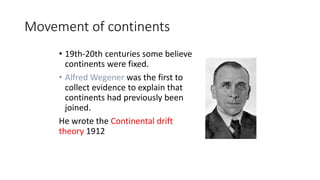
• 19th-20th centuries some believe
continents were fixed.
• Alfred Wegener was the first to
collect evidence to explain that
continents had previously been
joined.
He wrote the Continental drift
theory 1912
Continental drift theory
1. Continents are made of lighter crust.
2. This crust slides over a continous thicker layer.
3. This layer made up the ocean floor and continued under the
continents.
4. All continents were once joined into a supercontinent he named
Pangea.
Continental Drift theory
• Evidence:
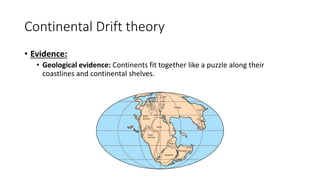
• Geological evidence: Continents fit together like a puzzle along their
coastlines and continental shelves.
Continental Drift theory
• Evidence:
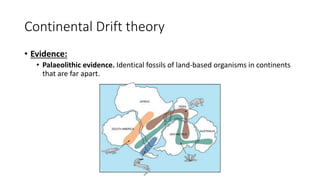
• Palaeolithic evidence. Identical fossils of land-based organisms in continents
that are far apart.
Continental Drift theory
• Evidence
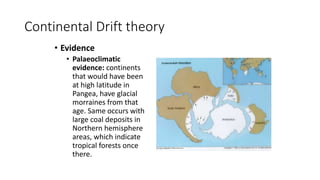
• Palaeoclimatic
evidence: continents
that would have been
at high latitude in
Pangea, have glacial
morraines from that
age. Same occurs with
large coal deposits in
Northern hemisphere
areas, which indicate
tropical forests once
there.
He didn’t clearly
explain HOW they
moved.

Earth dynamics

  • 1.
  • 2.
    The origin ofEarth • Earth increased its mass and started to create a gravitational force which was also increasing. • Great collisions with other orbiting planets created the Earths great internal energy. • Elements organized by densities due to the action of gravity upon them and creating layers. • Outer layer cooled and formed a crust.
  • 3.
    Internal structure ofthe Earth • Compositional layers • Crust • Mantle • Core • Physical layers • Lithosphere (rigid) • Asthenosphere (ductile mantle, and partially molten) • Lower mantle (solid, but flexible) • Outer Core (liquid) • Inner core (solid)
  • 4.
    Movement of continents Manypeople believed continents were fixed. However there was controversy. Do they move? If they move….how and why do they move? Continental movement • Ice Age theory • Continental Drift Theory –Early 1900s • Plate tectonic theory - 20th century
  • 5.
  • 6.
    Movement of continents •19th-20th centuries some believe continents were fixed. • Alfred Wegener was the first to collect evidence to explain that continents had previously been joined. He wrote the Continental drift theory 1912
  • 7.
    Continental drift theory 1.Continents are made of lighter crust. 2. This crust slides over a continous thicker layer. 3. This layer made up the ocean floor and continued under the continents. 4. All continents were once joined into a supercontinent he named Pangea.
  • 8.
    Continental Drift theory •Evidence: • Geological evidence: Continents fit together like a puzzle along their coastlines and continental shelves.
  • 9.
    Continental Drift theory •Evidence: • Palaeolithic evidence. Identical fossils of land-based organisms in continents that are far apart.
  • 10.
    Continental Drift theory •Evidence • Palaeoclimatic evidence: continents that would have been at high latitude in Pangea, have glacial morraines from that age. Same occurs with large coal deposits in Northern hemisphere areas, which indicate tropical forests once there.
  • 11.