Biodiversity
Sections 18.4. 16.4, and 30.1
• The word “diversity” is used in many
contexts.
• What is “genetic diversity” within a
species?
• What is meant by “species diversity”
within an ecosystem?
• Can there be genetic diversity within an
ecosystem?
W
O
R
K
T
O
G
E
T
H
E
R
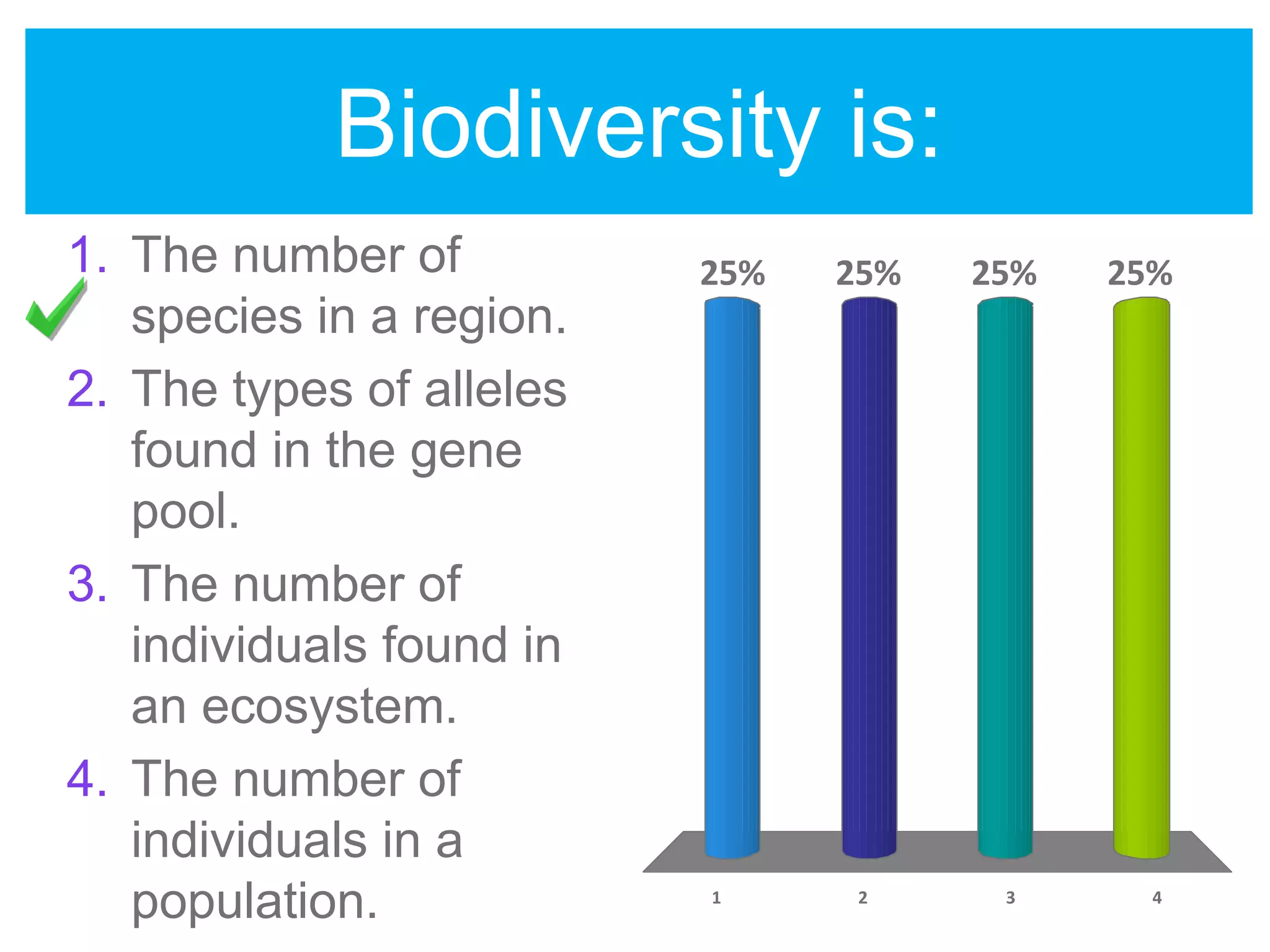
Biodiversity is:
1 2 3 4
25% 25%
25%
25%
1. The number of
species in a region.
2. The types of alleles
found in the gene
pool.
3. The number of
individuals found in
an ecosystem.
4. The number of
individuals in a
population.
Biodiversity
• The total number of species in a region
is known as biodiversity.
• Besides the number of species, the
numbers within each species is
important. If one population grows in size
and dominates an ecosystem, that
ecosystem can lose biodiversity.
Different areas of the world differ in their relative
amounts of biodiversity. Why?
Studying Biodiversity
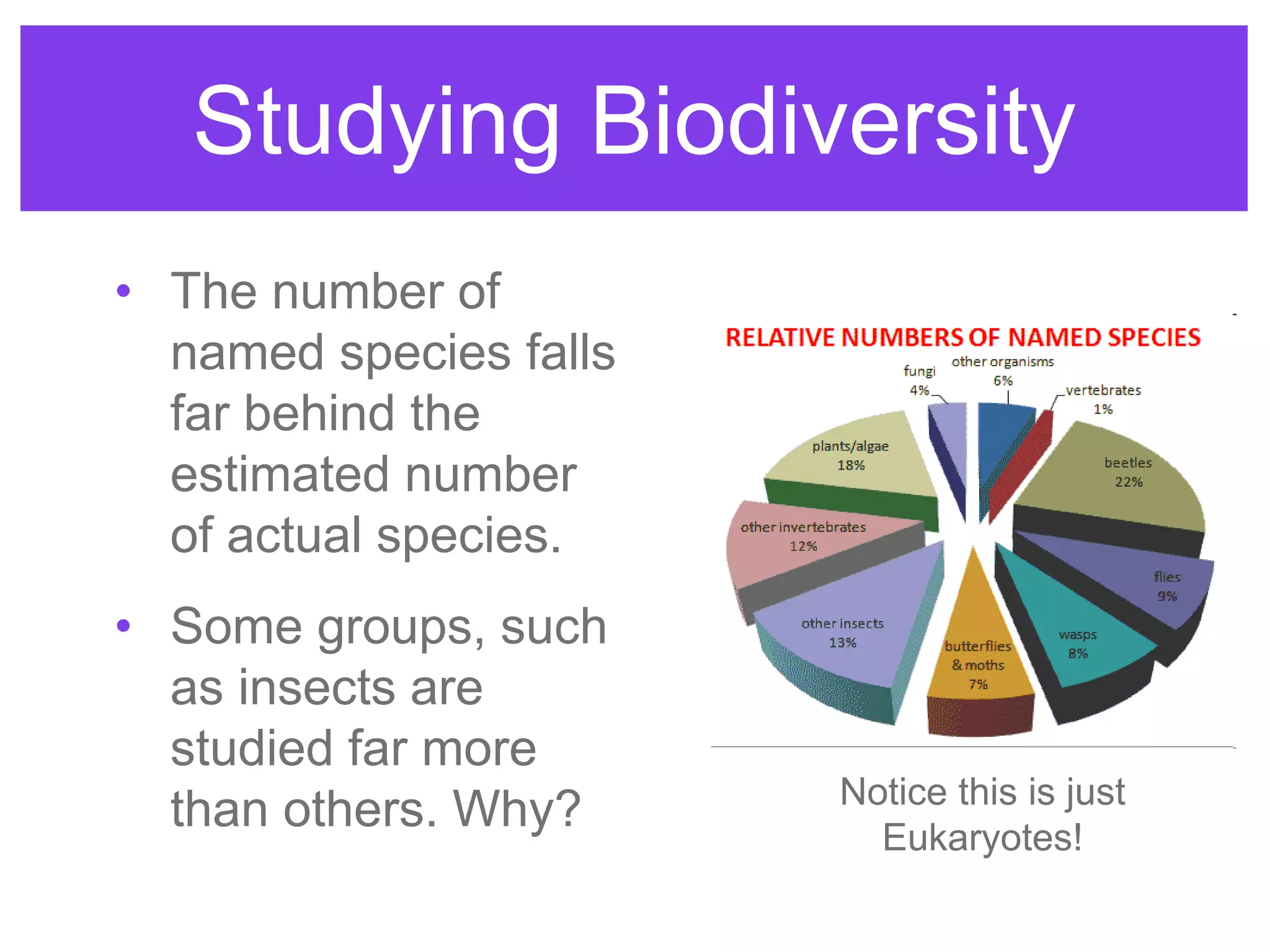
• The number of
named species falls
far behind the
estimated number
of actual species.
• Some groups, such
as insects are
studied far more
than others. Why? Notice this is just
Eukaryotes!
Estimates vary about the number of species yet to be
discovered and named, but it’s clear that we have a
long way to go!
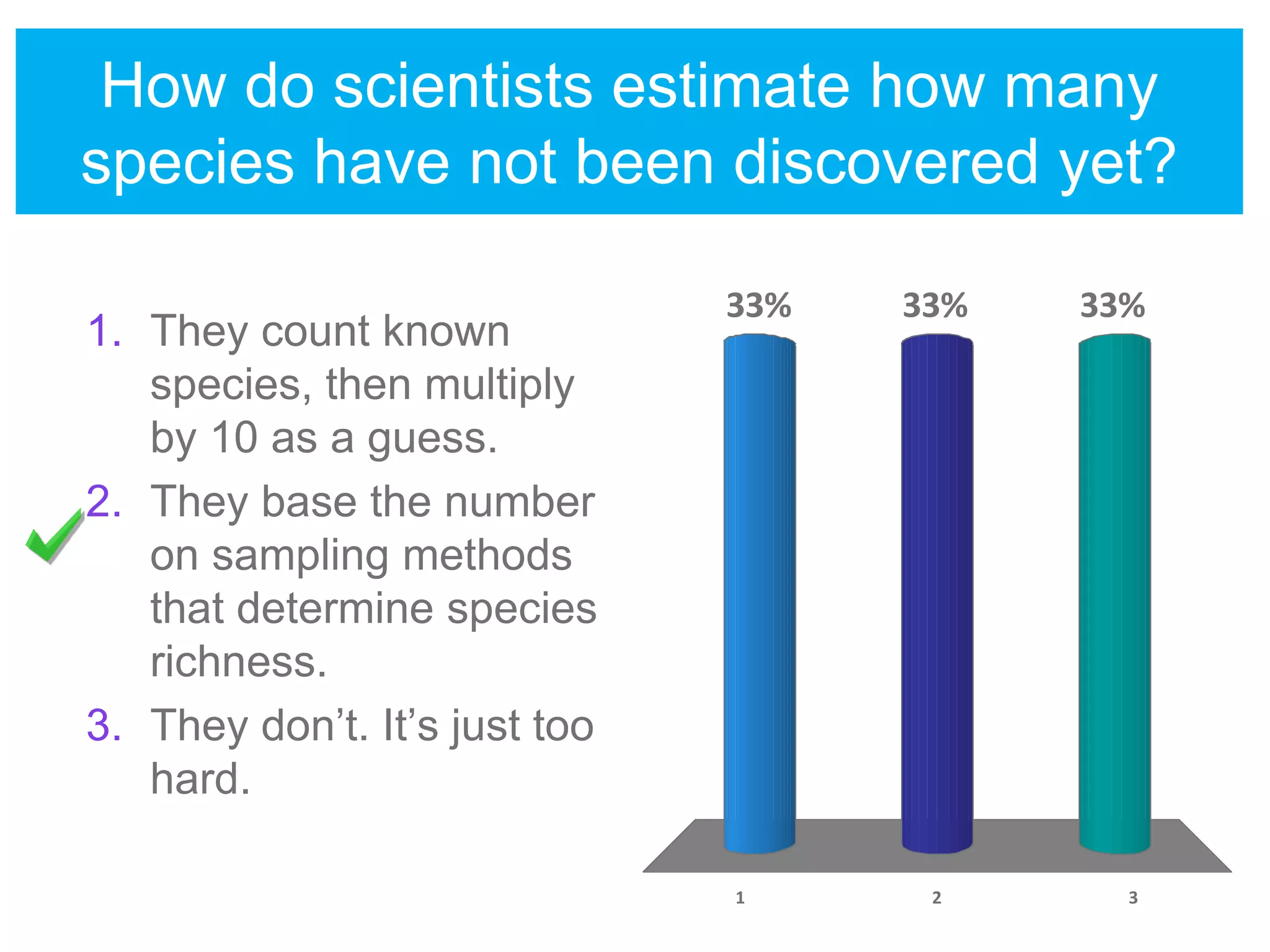
How do scientists estimate how many
species have not been discovered yet?
1 2 3
33% 33%
33%
1. They count known
species, then multiply
by 10 as a guess.
2. They base the number
on sampling methods
that determine species
richness.
3. They don’t. It’s just too
hard.
• Species richness:
the number of
species in a given
area.
• A species area
curve plots the
number of species
encountered as a
function of
sampling area
size.
• Species richness:
Often used to
describe species
within the same
trophic level.
• In many ecosystems,
most species are
present in small
numbers of
individuals. Only a few
species are present in
high numbers of
individuals.
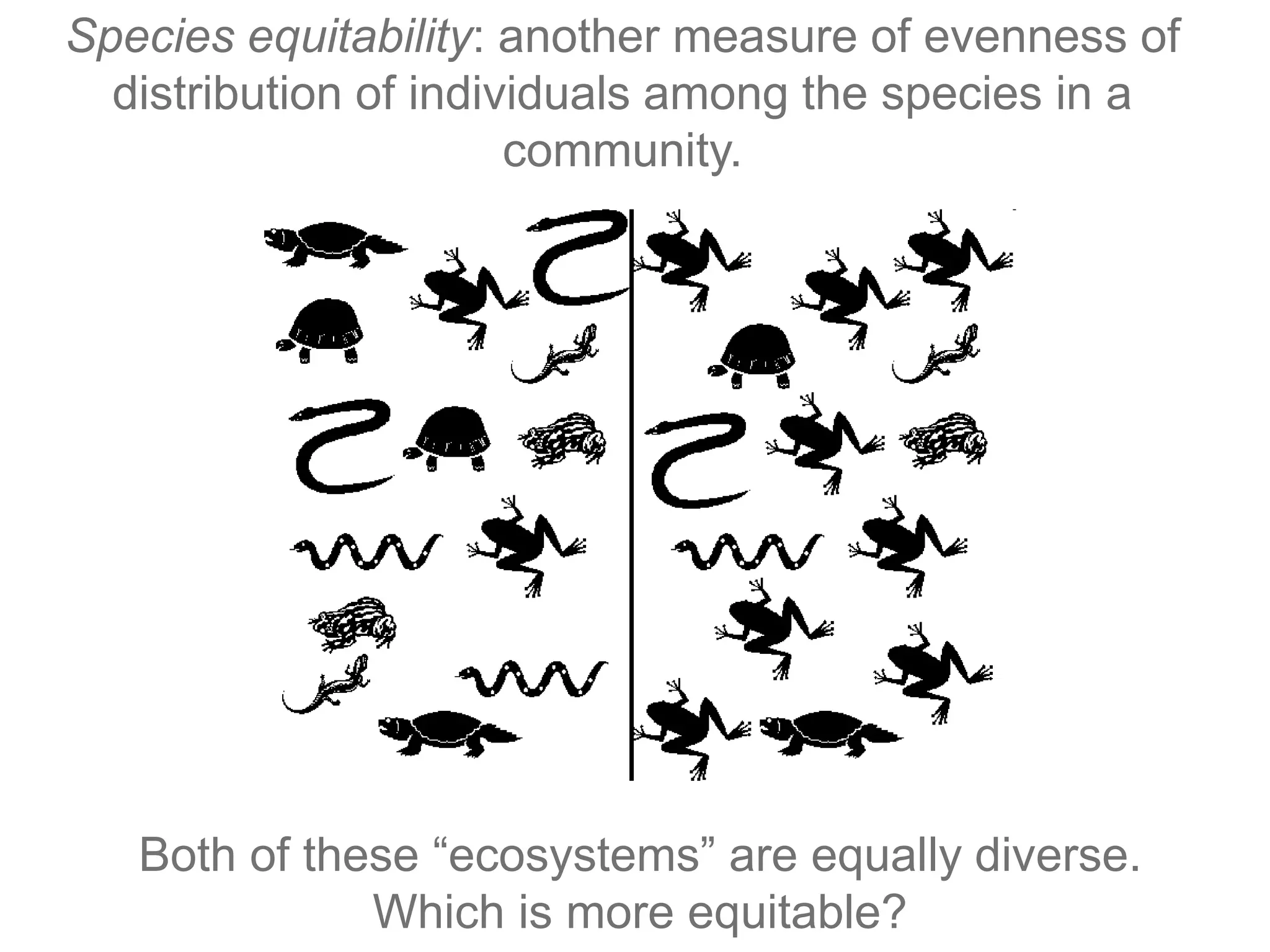
Species equitability: another measure of evenness of
distribution of individuals among the species in a
community.
Both of these “ecosystems” are equally diverse.
Which is more equitable?
High species diversity is found in tropical rainforests
and coral reefs. Why?
Extinction Risks
• Specialization and resource partitioning
increase diversity.
• However, the tradeoff is that organisms
become more vulnerable to extinction if
the environment drastically changes.
Localized Distribution
• By living in a limited
area, a population
avoids competition
with other
populations.
• The risk is that a
natural disaster will
destroy the limited
habitat.
The Devil’s Hole Pupfish lives
in a single waterhole in
Nevada.
Overspecialization
• Organisms that have
specialized feeding
habits reduce
competition with
other species.
• If the limited food
source goes extinct,
so does the species
feeding on it.
Fender’s Blue Butterfly feeds
only on Kinkaid’s Lupine.
Interactions
• Isolation reduces
competition and
predation.
• If a new predator or
competitor is
introduced, a formerly
isolated species may
be hunted or out-
competed to
extinction.
Many Hawai’ian birds were driven
to extinction by introduced
predators.
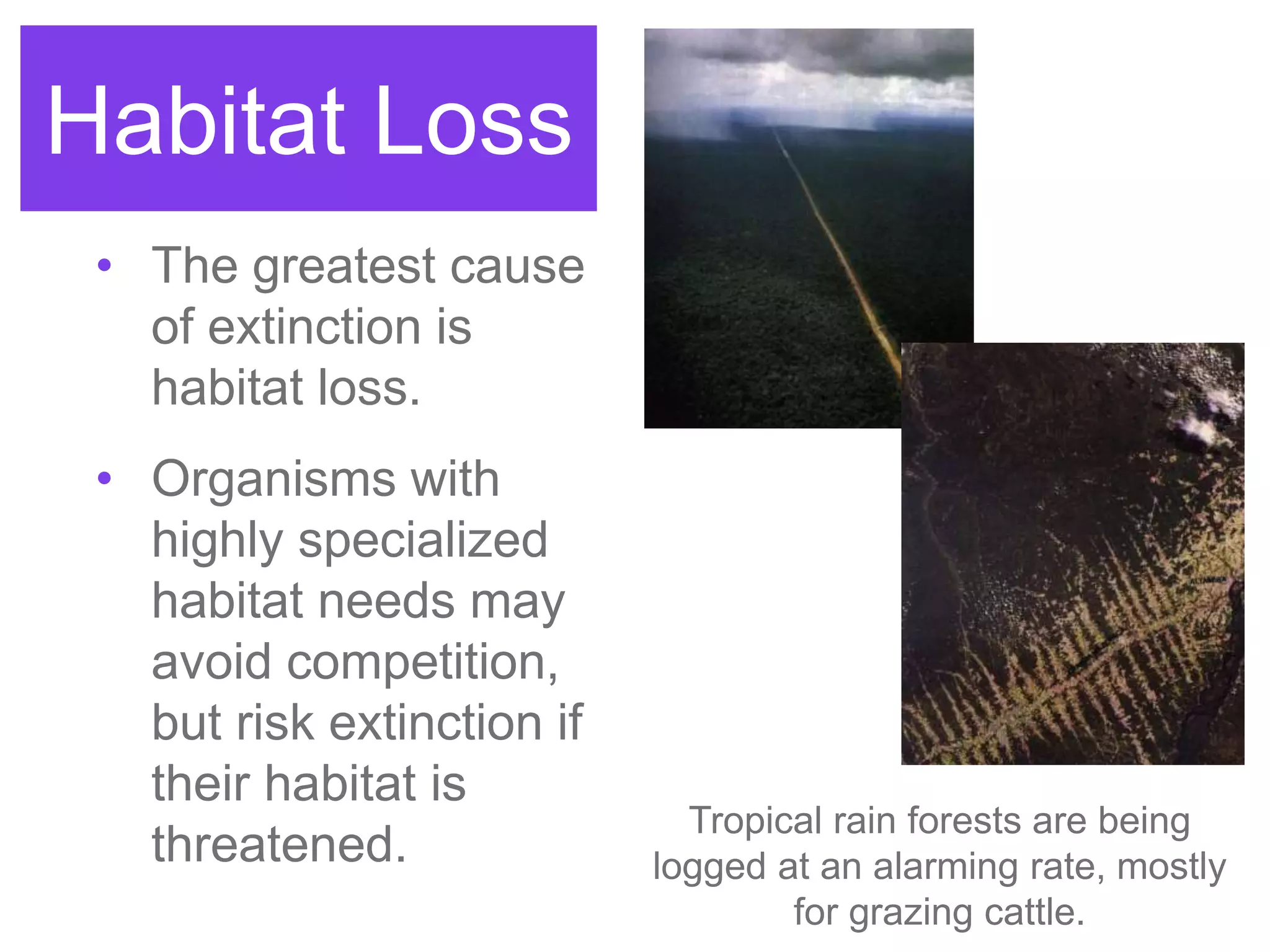
Habitat Loss
• The greatest cause
of extinction is
habitat loss.
• Organisms with
highly specialized
habitat needs may
avoid competition,
but risk extinction if
their habitat is
threatened.
Tropical rain forests are being
logged at an alarming rate, mostly
for grazing cattle.
Species are at LEAST risk for
extinction if they:
1 2 3 4
25% 25%
25%
25%
1. Are highly
specialized for their
niche.
2. Have a widespread
distribution.
3. Are losing their
habitat.
4. Must compete with
invasive species.
Humans and Biodiversity
• Humans change ecosystems:
deforestation, use of land for farming,
pollution, altering rivers, and more.
Habitat destruction reduces biodiversity.
• Ecosystems also impact humans: Loss
of forests, farmland, clean water, flood
protection, and more can directly impact
human life.
• Habitat destruction
worldwide threatens –
or may have
destroyed – many
species that have not
even been named.
• Recent discoveries of
new mammal species
have found the
animals already on
the brink of extinction.
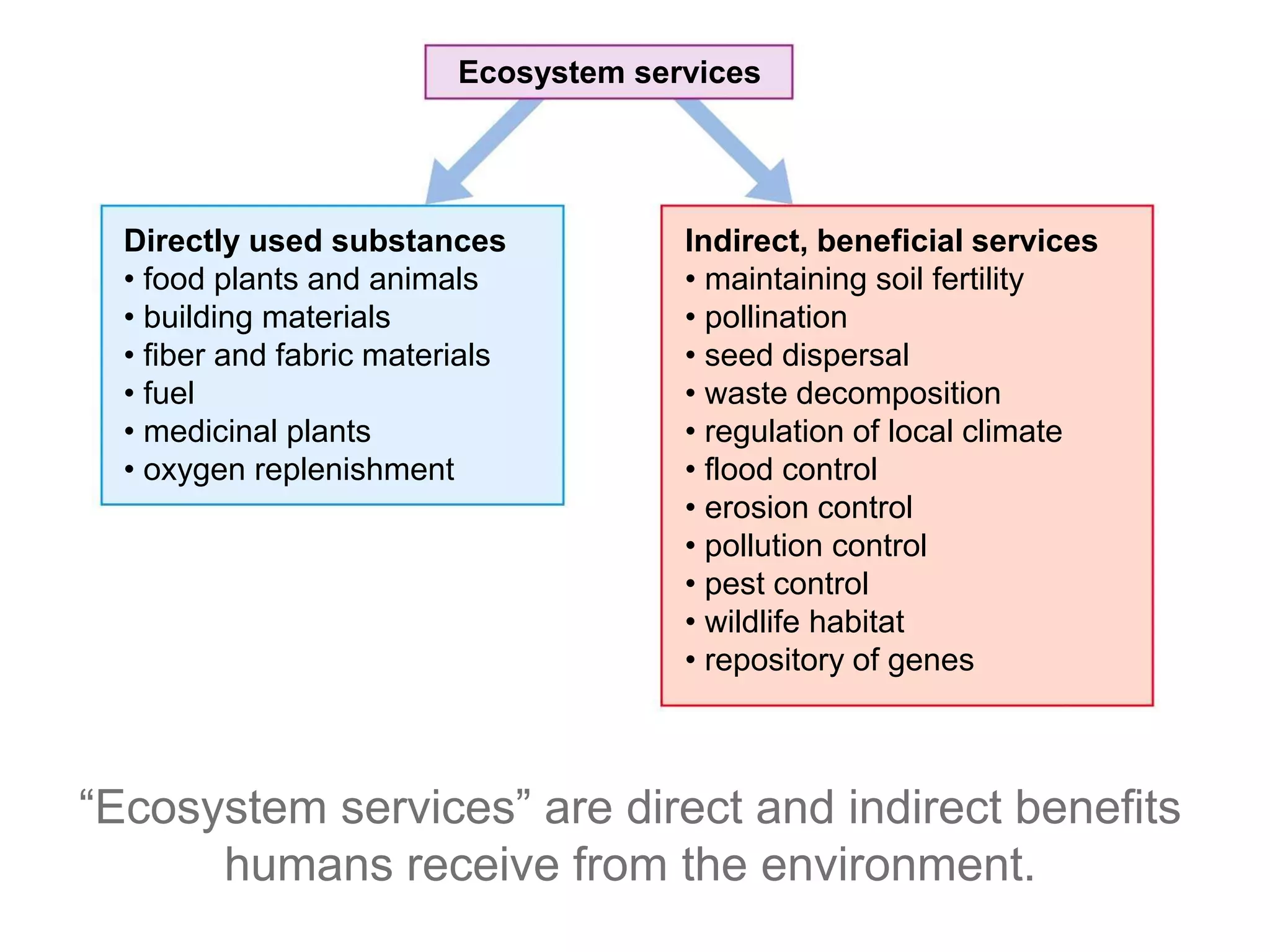
Ecosystem services
Indirect, beneficial services
• maintaining soil fertility
• pollination
• seed dispersal
• waste decomposition
• regulation of local climate
• flood control
• erosion control
• pollution control
• pest control
• wildlife habitat
• repository of genes
Directly used substances
• food plants and animals
• building materials
• fiber and fabric materials
• fuel
• medicinal plants
• oxygen replenishment
“Ecosystem services” are direct and indirect benefits
humans receive from the environment.
Humans have directly benefitted from biodiversity.
Drugs derived from plants and animals.
Andean Potatoes
Forest mushrooms
Tropical fruits
A diverse ecosystem yields a diversity of foods.
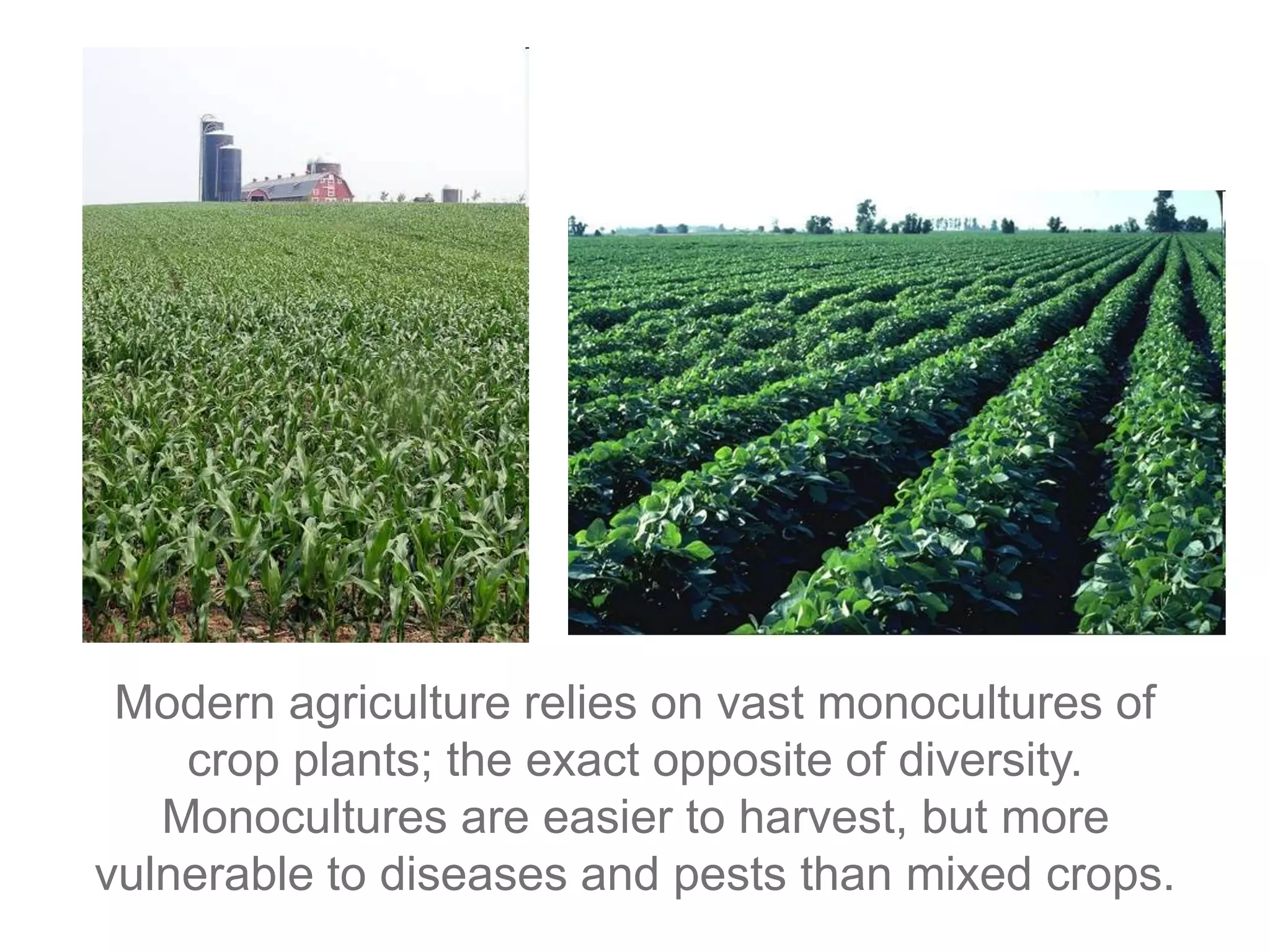
Modern agriculture relies on vast monocultures of
crop plants; the exact opposite of diversity.
Monocultures are easier to harvest, but more
vulnerable to diseases and pests than mixed crops.
Permaculture and
mixed-crop agriculture
supports a diverse soil
food web, which
supports the crops.
These methods tend to
be more labor-intensive.
• It is estimated that the Native Americans on
the east coast used over 200 different
plants and several dozen different animals
for food. By comparison, how diverse is our
food supply?
• What grains do you eat regularly? List as
many as you can think of.
• What other plants have you eaten in the
past week? List as many as you can think
of.
• What animals and animal products (milk,
eggs) have you eaten in the pats week ,if
any? List as many as you can think of.
W
O
R
K
T
O
G
E
T
H
E
R
Natural rivers meander, creating a richly diverse
wetland ecosystem.
Humans also benefit indirectly from intact, diverse
ecosystems.
Channelizing rivers, reducing
wetlands, and cutting down
trees along rivers changes
the ecosystem.
Loss of wetland diversity
means loss of species.
Sediments that would be
deposited along the river
system and in islands
around the mouth of the
river flows straight out to
sea.
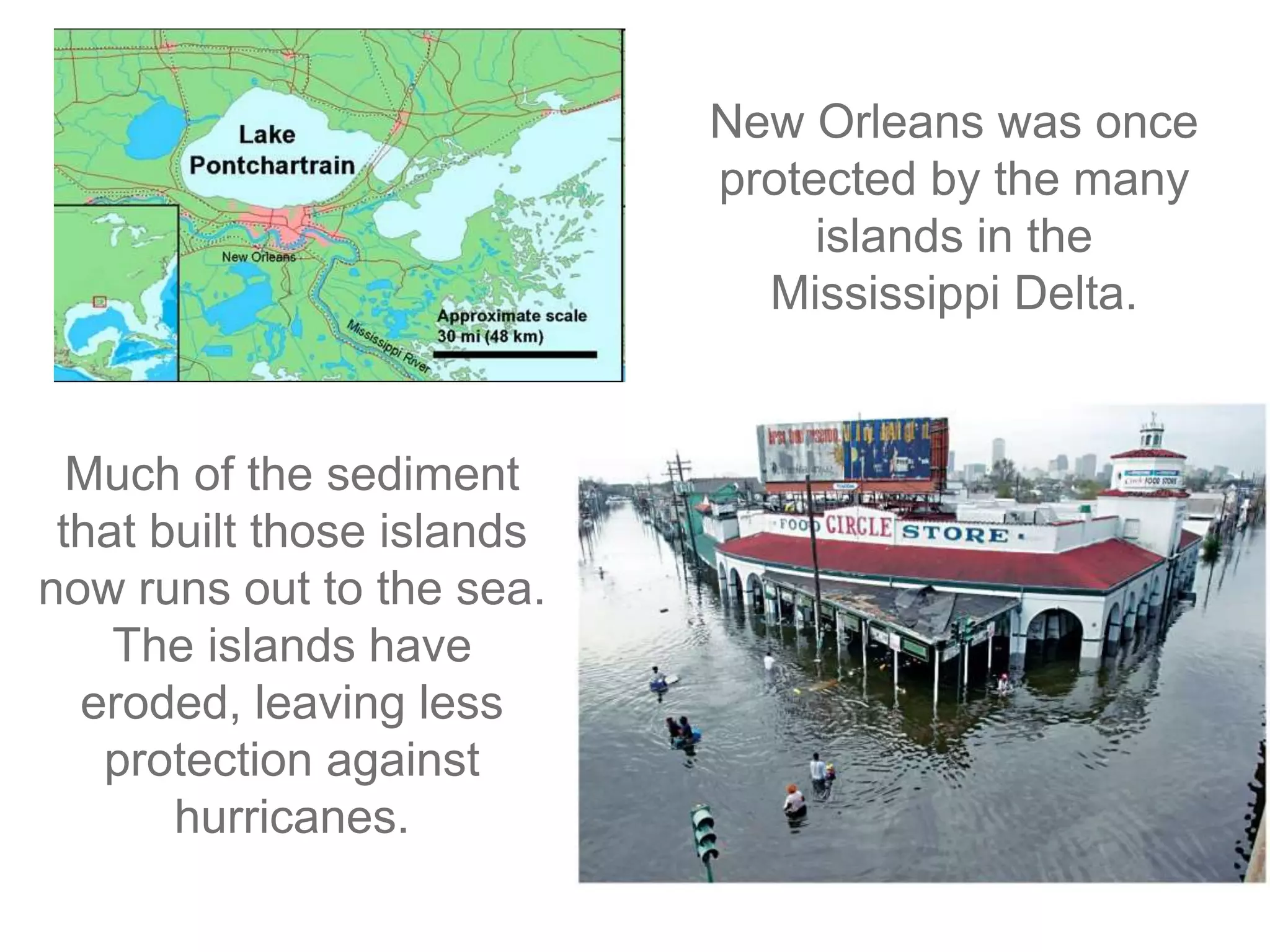
New Orleans was once
protected by the many
islands in the
Mississippi Delta.
Much of the sediment
that built those islands
now runs out to the sea.
The islands have
eroded, leaving less
protection against
hurricanes.
The term “ecosystem services”
refers to:
1 2 3
33% 33%
33%
1. Direct and indirect
benefits humans
receive from the
ecosystem.
2. How the ecosystem
supplies our needs
even when we extract
resources at a high
rate.
3. When humans do
service projects to help
restore ecosystems.
E.O. Wilson on Biodiversity
TED Presentation
• According to E.O. Wilson, what is the
importance of discovering and naming all
the species on Earth?
• Have we named all or nearly all of the
species on our planet?
W
O
R
K
T
O
G
E
T
H
E
R
Recap
• Biodiversity refers to the number of
different species in an ecosystem.
• Measures of biodiversity also take into
account the relative population sizes of
different species.
• Humans have a powerful effect on the
biodiversity of many ecosystems. Loss of
biodiversity can affect humans in turn.

Ch18.4&16.4&30-Biodiversity.ppt

  • 1.
  • 2.
    • The word“diversity” is used in many contexts. • What is “genetic diversity” within a species? • What is meant by “species diversity” within an ecosystem? • Can there be genetic diversity within an ecosystem? W O R K T O G E T H E R
  • 3.
    Biodiversity is: 1 23 4 25% 25% 25% 25% 1. The number of species in a region. 2. The types of alleles found in the gene pool. 3. The number of individuals found in an ecosystem. 4. The number of individuals in a population.
  • 4.
    Biodiversity • The totalnumber of species in a region is known as biodiversity. • Besides the number of species, the numbers within each species is important. If one population grows in size and dominates an ecosystem, that ecosystem can lose biodiversity.
  • 5.
    Different areas ofthe world differ in their relative amounts of biodiversity. Why?
  • 6.
    Studying Biodiversity • Thenumber of named species falls far behind the estimated number of actual species. • Some groups, such as insects are studied far more than others. Why? Notice this is just Eukaryotes!
  • 7.
    Estimates vary aboutthe number of species yet to be discovered and named, but it’s clear that we have a long way to go!
  • 8.
    How do scientistsestimate how many species have not been discovered yet? 1 2 3 33% 33% 33% 1. They count known species, then multiply by 10 as a guess. 2. They base the number on sampling methods that determine species richness. 3. They don’t. It’s just too hard.
  • 9.
    • Species richness: thenumber of species in a given area. • A species area curve plots the number of species encountered as a function of sampling area size.
  • 10.
    • Species richness: Oftenused to describe species within the same trophic level. • In many ecosystems, most species are present in small numbers of individuals. Only a few species are present in high numbers of individuals.
  • 11.
    Species equitability: anothermeasure of evenness of distribution of individuals among the species in a community. Both of these “ecosystems” are equally diverse. Which is more equitable?
  • 12.
    High species diversityis found in tropical rainforests and coral reefs. Why?
  • 13.
    Extinction Risks • Specializationand resource partitioning increase diversity. • However, the tradeoff is that organisms become more vulnerable to extinction if the environment drastically changes.
  • 14.
    Localized Distribution • Byliving in a limited area, a population avoids competition with other populations. • The risk is that a natural disaster will destroy the limited habitat. The Devil’s Hole Pupfish lives in a single waterhole in Nevada.
  • 15.
    Overspecialization • Organisms thathave specialized feeding habits reduce competition with other species. • If the limited food source goes extinct, so does the species feeding on it. Fender’s Blue Butterfly feeds only on Kinkaid’s Lupine.
  • 16.
    Interactions • Isolation reduces competitionand predation. • If a new predator or competitor is introduced, a formerly isolated species may be hunted or out- competed to extinction. Many Hawai’ian birds were driven to extinction by introduced predators.
  • 17.
    Habitat Loss • Thegreatest cause of extinction is habitat loss. • Organisms with highly specialized habitat needs may avoid competition, but risk extinction if their habitat is threatened. Tropical rain forests are being logged at an alarming rate, mostly for grazing cattle.
  • 18.
    Species are atLEAST risk for extinction if they: 1 2 3 4 25% 25% 25% 25% 1. Are highly specialized for their niche. 2. Have a widespread distribution. 3. Are losing their habitat. 4. Must compete with invasive species.
  • 19.
    Humans and Biodiversity •Humans change ecosystems: deforestation, use of land for farming, pollution, altering rivers, and more. Habitat destruction reduces biodiversity. • Ecosystems also impact humans: Loss of forests, farmland, clean water, flood protection, and more can directly impact human life.
  • 20.
    • Habitat destruction worldwidethreatens – or may have destroyed – many species that have not even been named. • Recent discoveries of new mammal species have found the animals already on the brink of extinction.
  • 21.
    Ecosystem services Indirect, beneficialservices • maintaining soil fertility • pollination • seed dispersal • waste decomposition • regulation of local climate • flood control • erosion control • pollution control • pest control • wildlife habitat • repository of genes Directly used substances • food plants and animals • building materials • fiber and fabric materials • fuel • medicinal plants • oxygen replenishment “Ecosystem services” are direct and indirect benefits humans receive from the environment.
  • 22.
    Humans have directlybenefitted from biodiversity. Drugs derived from plants and animals.
  • 23.
    Andean Potatoes Forest mushrooms Tropicalfruits A diverse ecosystem yields a diversity of foods.
  • 24.
    Modern agriculture relieson vast monocultures of crop plants; the exact opposite of diversity. Monocultures are easier to harvest, but more vulnerable to diseases and pests than mixed crops.
  • 25.
    Permaculture and mixed-crop agriculture supportsa diverse soil food web, which supports the crops. These methods tend to be more labor-intensive.
  • 26.
    • It isestimated that the Native Americans on the east coast used over 200 different plants and several dozen different animals for food. By comparison, how diverse is our food supply? • What grains do you eat regularly? List as many as you can think of. • What other plants have you eaten in the past week? List as many as you can think of. • What animals and animal products (milk, eggs) have you eaten in the pats week ,if any? List as many as you can think of. W O R K T O G E T H E R
  • 27.
    Natural rivers meander,creating a richly diverse wetland ecosystem. Humans also benefit indirectly from intact, diverse ecosystems.
  • 28.
    Channelizing rivers, reducing wetlands,and cutting down trees along rivers changes the ecosystem. Loss of wetland diversity means loss of species. Sediments that would be deposited along the river system and in islands around the mouth of the river flows straight out to sea.
  • 29.
    New Orleans wasonce protected by the many islands in the Mississippi Delta. Much of the sediment that built those islands now runs out to the sea. The islands have eroded, leaving less protection against hurricanes.
  • 30.
    The term “ecosystemservices” refers to: 1 2 3 33% 33% 33% 1. Direct and indirect benefits humans receive from the ecosystem. 2. How the ecosystem supplies our needs even when we extract resources at a high rate. 3. When humans do service projects to help restore ecosystems.
  • 31.
    E.O. Wilson onBiodiversity TED Presentation
  • 32.
    • According toE.O. Wilson, what is the importance of discovering and naming all the species on Earth? • Have we named all or nearly all of the species on our planet? W O R K T O G E T H E R
  • 33.
    Recap • Biodiversity refersto the number of different species in an ecosystem. • Measures of biodiversity also take into account the relative population sizes of different species. • Humans have a powerful effect on the biodiversity of many ecosystems. Loss of biodiversity can affect humans in turn.