Word

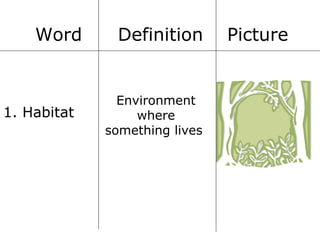
1. Habitat

Definition

Environment
where
something lives

Picture
Word

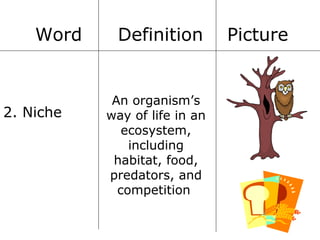
2. Niche

Definition

An organism’s
way of life in an
ecosystem,
including
habitat, food,
predators, and
competition

Picture
What is the niche of a gray wolf?
• Is it a consumer or producer?
– Consumer/carnivore – eats deer, moose,
sheep, birds, snakes, fish

• How do they interact with others?
– They live and hunt in packs

• Do they take care of their young?
– Yes – for 2 years

• Are they needed in the food web?
– Yes, they keep other populations in check.
Most living things produce more
offspring than will survive. A female
frog, for example, might lay
hundreds of eggs in a small pond.
In a few months, the population of
frogs in that pond will be about the
same as the year before. Why
won’t the pond become overrun
with frogs?
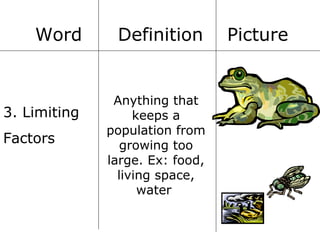
Word

3. Limiting
Factors

Definition

Anything that
keeps a
population from
growing too
large. Ex: food,
living space,
water

Picture
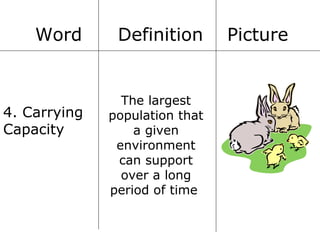
Word

4. Carrying
Capacity

Definition

The largest
population that
a given
environment
can support
over a long
period of time

Picture
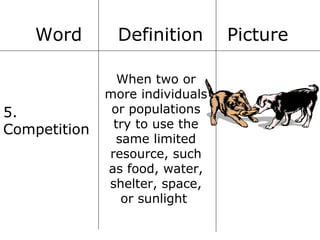
Word

5.
Competition

Definition
When two or
more individuals
or populations
try to use the
same limited
resource, such
as food, water,
shelter, space,
or sunlight

Picture
Questions
1. Which of these could cause a
decrease in the number of squirrels in
a population?
A An increase in cooperation with birds in
the area
B An increase in the squirrels’ territory
C An increase in competition with other nuteating animals
D An increase in the squirrels’ food supply
2. There are many factors that influence
the population changes of an
ecosystem. Which of these does not
influence population size in an
ecosystem?
A Birthrates of animals
B Number of animals in habitats
C An animal’s weight
D The size of a habitat
3. Which term refers to an environmental
factor that prevents a population from
increasing?
A. biotic factor
B.abiotic factor
C.immigration
D.limiting factor
4. The largest population that an
environment can support is called its
A. carrying capacity.
B. limiting factor.
C. birth rate.
D. death rate.
5. All of the following are examples of
limiting factors EXCEPT
A. food.
B. soil.
C. space.
D. weather conditions.

Habitat, niche, limiting factors

  • 1.
  • 2.
    Word 2. Niche Definition An organism’s wayof life in an ecosystem, including habitat, food, predators, and competition Picture
  • 3.
    What is theniche of a gray wolf? • Is it a consumer or producer? – Consumer/carnivore – eats deer, moose, sheep, birds, snakes, fish • How do they interact with others? – They live and hunt in packs • Do they take care of their young? – Yes – for 2 years • Are they needed in the food web? – Yes, they keep other populations in check.
  • 4.
    Most living thingsproduce more offspring than will survive. A female frog, for example, might lay hundreds of eggs in a small pond. In a few months, the population of frogs in that pond will be about the same as the year before. Why won’t the pond become overrun with frogs?
  • 5.
    Word 3. Limiting Factors Definition Anything that keepsa population from growing too large. Ex: food, living space, water Picture
  • 6.
    Word 4. Carrying Capacity Definition The largest populationthat a given environment can support over a long period of time Picture
  • 7.
    Word 5. Competition Definition When two or moreindividuals or populations try to use the same limited resource, such as food, water, shelter, space, or sunlight Picture
  • 8.
    Questions 1. Which ofthese could cause a decrease in the number of squirrels in a population? A An increase in cooperation with birds in the area B An increase in the squirrels’ territory C An increase in competition with other nuteating animals D An increase in the squirrels’ food supply
  • 9.
    2. There aremany factors that influence the population changes of an ecosystem. Which of these does not influence population size in an ecosystem? A Birthrates of animals B Number of animals in habitats C An animal’s weight D The size of a habitat
  • 10.
    3. Which termrefers to an environmental factor that prevents a population from increasing? A. biotic factor B.abiotic factor C.immigration D.limiting factor
  • 11.
    4. The largestpopulation that an environment can support is called its A. carrying capacity. B. limiting factor. C. birth rate. D. death rate.
  • 12.
    5. All ofthe following are examples of limiting factors EXCEPT A. food. B. soil. C. space. D. weather conditions.