FACTORs AFFECTINGInterspecific
competition ininsects
ajaySharma{dept.of entomology}
Competition
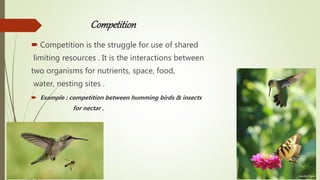
 Competition is the struggle for use of shared
limiting resources . It is the interactions between
two organisms for nutrients, space, food,
water, nesting sites .
 Example : competition between humming birds & insects
for nectar .
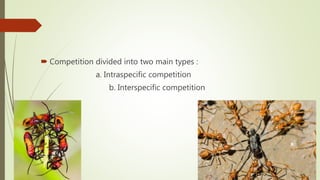
 Competition divided into two main types :
a. Intraspecific competition
b. Interspecific competition
Intraspecificcompetition
 It occurs within the species
 Individuals of the same species compete for the exact same thing in the
environment
 Therefore this is the strongest type of competition.
 Example : Bracon hebetor (minute wasp)- internal parasitoid to larval stage of Indian
mealmoth.
Interspecificcompetition
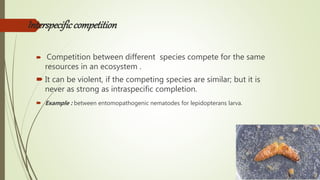
 Competition between different species compete for the same
resources in an ecosystem .
 It can be violent, if the competing species are similar; but it is
never as strong as intraspecific completion.
 Example : between entomopathogenic nematodes for lepidopterans larva.
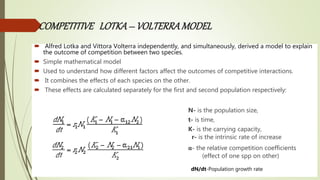
COMPETITIVE LOTKA– VOLTERRAMODEL
 Alfred Lotka and Vittora Volterra independently, and simultaneously, derived a model to explain
the outcome of competition between two species.
 Simple mathematical model
 Used to understand how different factors affect the outcomes of competitive interactions.
 It combines the effects of each species on the other.
 These effects are calculated separately for the first and second population respectively:
N- is the population size,
t- is time,
K- is the carrying capacity,
r- is the intrinsic rate of increase
α- the relative competition coefficients
(effect of one spp on other)
dN/dt-Population growth rate
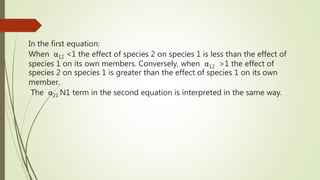
In the first equation:
When α12 <1 the effect of species 2 on species 1 is less than the effect of
species 1 on its own members. Conversely, when α12 >1 the effect of
species 2 on species 1 is greater than the effect of species 1 on its own
member.
The α21 N1 term in the second equation is interpreted in the same way.
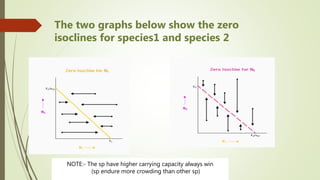
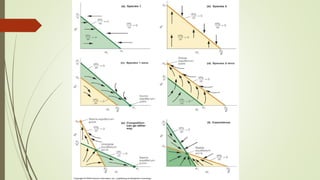
The two graphs below show the zero
isoclines for species1 and species 2
NOTE:- The sp have higher carrying capacity always win
(sp endure more crowding than other sp)
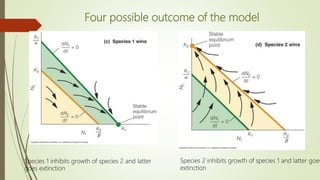
Four possible outcome of the model
Species 1 inhibits growth of species 2 and latter
goes extinction
Species 2 inhibits growth of species 1 and latter goes
extinction
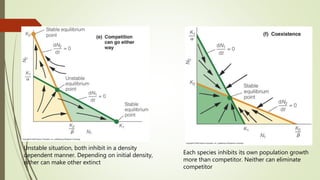
Unstable situation, both inhibit in a density
dependent manner. Depending on initial density,
either can make other extinct
Each species inhibits its own population growth
more than competitor. Neither can eliminate
competitor
Assumptions COMPETITIVE LOTKA– VOLTERRAMODEL
 Environment is homogenous & stable .
 Migration is not important .
 Co-existance requires a stable equilibrium point.
 Carrying capacities and competition coefficients for both sp is
constants
FACTORSAFFECTING
INTERSPECIFICCOMPETITION
 Factors affect interspecific competition are as :
 Abiotic factors
• Temperature
• Moisture
• Light
TEMPERATURE
 The range of temperature within which animal thrive .
 According to Chapman : it is the condition of body which determine transfer o
heat to or from the other bodies .
 Temperature affects
 Speed of development
 Rate of dispersal
 Fecundity
TEMPERATURE continue…
 PREFERRED TEMPERATURE :When animals allowed to move
along temp gradient they usually congregate between quite
narrow limits of temperature .
 Also known as temperature preferendum.
 Example : Schistocerca gregaria : 29.4⁰C
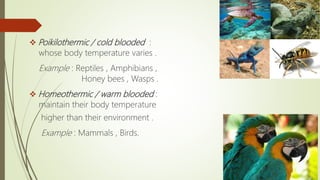
 Poikilothermic / cold blooded :
whose body temperature varies .
Example : Reptiles , Amphibians ,
Honey bees , Wasps .
 Homeothermic / warm blooded :
maintain their body temperature
higher than their environment .
Example : Mammals , Birds.
 Eurythermic insects : which can tolerate and thrives well in
wide range of temperature
Example :Dipteran larvae (upto55⁰C)
 Stenothermic insects :Which are restrict to narrow range of
temperature.
Example : Astagobius angustatus (-1.7-1⁰C)
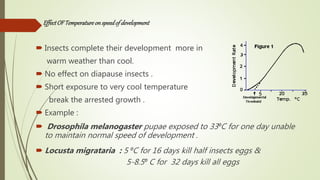
EffectOF Temperatureonspeedof development
 Insects complete their development more in
warm weather than cool.
 No effect on diapause insects .
 Short exposure to very cool temperature
break the arrested growth .
 Example :
 Drosophila melanogaster pupae exposed to 33⁰C for one day unable
to maintain normal speed of development .
 Locusta migrataria : 5 ⁰C for 16 days kill half insects eggs &
5-8.5⁰ C for 32 days kill all eggs
Effectof temponrateof dispaersal
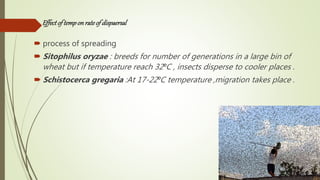
 process of spreading
 Sitophilus oryzae : breeds for number of generations in a large bin of
wheat but if temperature reach 32⁰C , insects disperse to cooler places .
 Schistocerca gregaria :At 17-22⁰C temperature ,migration takes place .
Effectof tempon fecundity
 the ability to produce an abundance of offspring
 Plutella xylostella : lay less eggs at 22⁰ C &
more eggs at 16⁰ C
 Sitophilus oryzae : lay few eggs at 14 ⁰C &
more eggs at 32 ⁰C
MOISTURE
 Aquatic insects live in high moisture conditions while terrestrial
insects live in dry places . Desert insects survive in air containing
less than 10% moisture .
 Food is the source of moisture for all insects .
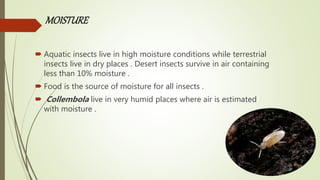
 Collembola live in very humid places where air is estimated
with moisture .
MOISTURE cont….
 Moisture measured in terms of : Humidity - is the amount of water
vapor present in the air
Effectofdryair
 Insects in some stages can’t survive in loss of even small %age of
water .
 Diapause insects loose high proportion of water .
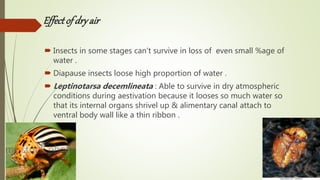
 Leptinotarsa decemlineata : Able to survive in dry atmospheric
conditions during aestivation because it looses so much water so
that its internal organs shrivel up & alimentary canal attach to
ventral body wall like a thin ribbon .
Effect of excessivemoisture
• High mortality in insects.
• Affect breeding & development.
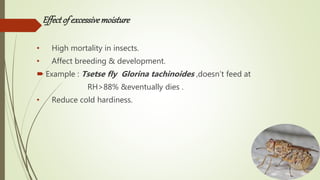
 Example : Tsetse fly Glorina tachinoides ,doesn’t feed at
RH>88% &eventually dies .
• Reduce cold hardiness.
Effectofmoistureondevelopment
 At high humidity :
• speed of development retarded . (Nymph of locust)
• Speed of development accelerated (Eggs of locust & Musca )
• Speed of development independent (Tineola , Thermobia )
Effectof moistureon reproduction
• Tribolium molitor : reared at 20% RH laid 4eggs/female/day &
at65% RH laid 102.4eggs/female/day .
• Dermestes spp when kept at 73%RH without drinking water laid
304eggs/female/day & with drinking water lay
567eggs/female/day.
LIGHT
 Light plays an important role in the growth development &survival in
insects .
 Oviposition stimulated by exposure to light & darkness .
 Codling moth & cotton bollworm lay eggs in darkness while fruit flies
lay eggs in light .
 Drosphila melanogaster caterpillar when exposed to light period of
12hours ,flies coming out are coloured but when exposed to 16hours
light period dark coloured butterflies emerge .
 Reproduction is parthenogenetic & viviparous under long day light &
sexual during short day length .
EFFECTOF LIGHTONDIAPAUSE
 In bivoltine races of silkworm Bombyx mori all females of first gen which
arise from eggs that are developing during short days of spring produce
only non diapause eggs but 2nd gen females which arise from eggs that
were developed during long days of mid summer laid diapause eggs .
 He reared at different photoperiods ranging from 0-24hours of light
each day ranging from 15-28⁰C . Eggs which are exposed to <14hours of
light at 15 ⁰C give rise to moths which laid pale non diapause eggs
while which are exposed to >16hours at 20⁰C give rise to moths which
lay dark diapause eggs .
 BIOTICfactors
 Exploitative competition:- also referred to as resource competition.
is a form of competition in which one species consumes and
either reduces or more efficiently uses a shared limiting
resource and therefore depletes the availability of the
resource for the other species.
Thus, it is an indirect interaction because the competing
species interact via a shared resource.
Example- aphid species competing over the sap in plant phloem.
Each aphid species that feeds on host plant sap uses some of
the resource, leaving less for competing species
 Interference competition :-is a form of competition in which individuals
of one species interacts directly with
individuals of other species via antagonistic displays or more
aggressive behavior.
Thus, it is an direct interaction because the competing
species interact directly to each others.
Example- different sp of Burying Beetles compete to other sp of
same genera for reproductive success.
 Consumptive:-when food is a limited resource and individuals
reduce one another's intake. of food via
exploitation
 Preemptive:- occurs when individuals occupy space and prevent
access to resources by other individuals.
.
 Overgrowth competition :- occurs when an organism grows over
another, blocking access to resources.
Example- mainly in sessile organisms.(liverwort)
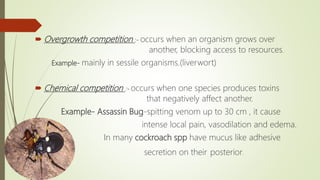
 Chemical competition :- occurs when one species produces toxins
that negatively affect another.
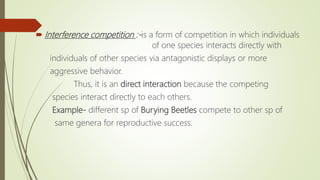
Example- Assassin Bug-spitting venom up to 30 cm , it cause
intense local pain, vasodilation and edema.
In many cockroach spp have mucus like adhesive
secretion on their posterior.
 Territorial competition :- occurs when mobile organisms protect a feeding
or breeding territory.
Example- in Bot Fly, an extreme capital breeding species that depends
on energy acquired during its immature stages
 Encounter competition :- occurs when organisms interfere directly with
each other’s access to specific resources.
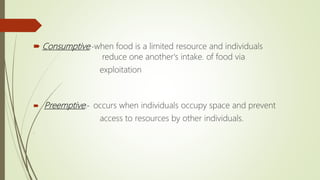
Example- Female crickets choose among males based on
characteristics of the courtship song. Female mated only with
males that produced courtship sound
femalemale
References:-
 INSECT ECOLOGY: An Ecosystem Approach by TIMOTHY D. SCHOWALTER
 ECOLOGICAL METHODES : Richard Southwood
 Andrewartha HG, Brich Lc. The study of distribution and abundance of insects
 Crombie AC. Experiments on insect competition
 Hardin Garrett. The competitive exclusion principle
 Park T. Experimental studies on interspecies competition
Factors affecting interspecific competition in insects

Factors affecting interspecific competition in insects

  • 1.
  • 2.
    Competition  Competition isthe struggle for use of shared limiting resources . It is the interactions between two organisms for nutrients, space, food, water, nesting sites .  Example : competition between humming birds & insects for nectar .
  • 3.
     Competition dividedinto two main types : a. Intraspecific competition b. Interspecific competition
  • 4.
    Intraspecificcompetition  It occurswithin the species  Individuals of the same species compete for the exact same thing in the environment  Therefore this is the strongest type of competition.  Example : Bracon hebetor (minute wasp)- internal parasitoid to larval stage of Indian mealmoth.
  • 5.
    Interspecificcompetition  Competition betweendifferent species compete for the same resources in an ecosystem .  It can be violent, if the competing species are similar; but it is never as strong as intraspecific completion.  Example : between entomopathogenic nematodes for lepidopterans larva.
  • 6.
    COMPETITIVE LOTKA– VOLTERRAMODEL Alfred Lotka and Vittora Volterra independently, and simultaneously, derived a model to explain the outcome of competition between two species.  Simple mathematical model  Used to understand how different factors affect the outcomes of competitive interactions.  It combines the effects of each species on the other.  These effects are calculated separately for the first and second population respectively: N- is the population size, t- is time, K- is the carrying capacity, r- is the intrinsic rate of increase α- the relative competition coefficients (effect of one spp on other) dN/dt-Population growth rate
  • 7.
    In the firstequation: When α12 <1 the effect of species 2 on species 1 is less than the effect of species 1 on its own members. Conversely, when α12 >1 the effect of species 2 on species 1 is greater than the effect of species 1 on its own member. The α21 N1 term in the second equation is interpreted in the same way.
  • 8.
    The two graphsbelow show the zero isoclines for species1 and species 2 NOTE:- The sp have higher carrying capacity always win (sp endure more crowding than other sp)
  • 9.
    Four possible outcomeof the model Species 1 inhibits growth of species 2 and latter goes extinction Species 2 inhibits growth of species 1 and latter goes extinction
  • 10.
    Unstable situation, bothinhibit in a density dependent manner. Depending on initial density, either can make other extinct Each species inhibits its own population growth more than competitor. Neither can eliminate competitor
  • 12.
    Assumptions COMPETITIVE LOTKA–VOLTERRAMODEL  Environment is homogenous & stable .  Migration is not important .  Co-existance requires a stable equilibrium point.  Carrying capacities and competition coefficients for both sp is constants
  • 13.
    FACTORSAFFECTING INTERSPECIFICCOMPETITION  Factors affectinterspecific competition are as :  Abiotic factors • Temperature • Moisture • Light
  • 14.
    TEMPERATURE  The rangeof temperature within which animal thrive .  According to Chapman : it is the condition of body which determine transfer o heat to or from the other bodies .  Temperature affects  Speed of development  Rate of dispersal  Fecundity
  • 15.
    TEMPERATURE continue…  PREFERREDTEMPERATURE :When animals allowed to move along temp gradient they usually congregate between quite narrow limits of temperature .  Also known as temperature preferendum.  Example : Schistocerca gregaria : 29.4⁰C
  • 16.
     Poikilothermic /cold blooded : whose body temperature varies . Example : Reptiles , Amphibians , Honey bees , Wasps .  Homeothermic / warm blooded : maintain their body temperature higher than their environment . Example : Mammals , Birds.
  • 17.
     Eurythermic insects: which can tolerate and thrives well in wide range of temperature Example :Dipteran larvae (upto55⁰C)  Stenothermic insects :Which are restrict to narrow range of temperature. Example : Astagobius angustatus (-1.7-1⁰C)
  • 18.
    EffectOF Temperatureonspeedof development Insects complete their development more in warm weather than cool.  No effect on diapause insects .  Short exposure to very cool temperature break the arrested growth .  Example :  Drosophila melanogaster pupae exposed to 33⁰C for one day unable to maintain normal speed of development .  Locusta migrataria : 5 ⁰C for 16 days kill half insects eggs & 5-8.5⁰ C for 32 days kill all eggs
  • 19.
    Effectof temponrateof dispaersal process of spreading  Sitophilus oryzae : breeds for number of generations in a large bin of wheat but if temperature reach 32⁰C , insects disperse to cooler places .  Schistocerca gregaria :At 17-22⁰C temperature ,migration takes place .
  • 20.
    Effectof tempon fecundity the ability to produce an abundance of offspring  Plutella xylostella : lay less eggs at 22⁰ C & more eggs at 16⁰ C  Sitophilus oryzae : lay few eggs at 14 ⁰C & more eggs at 32 ⁰C
  • 21.
    MOISTURE  Aquatic insectslive in high moisture conditions while terrestrial insects live in dry places . Desert insects survive in air containing less than 10% moisture .  Food is the source of moisture for all insects .  Collembola live in very humid places where air is estimated with moisture .
  • 22.
    MOISTURE cont….  Moisturemeasured in terms of : Humidity - is the amount of water vapor present in the air
  • 23.
    Effectofdryair  Insects insome stages can’t survive in loss of even small %age of water .  Diapause insects loose high proportion of water .  Leptinotarsa decemlineata : Able to survive in dry atmospheric conditions during aestivation because it looses so much water so that its internal organs shrivel up & alimentary canal attach to ventral body wall like a thin ribbon .
  • 24.
    Effect of excessivemoisture •High mortality in insects. • Affect breeding & development.  Example : Tsetse fly Glorina tachinoides ,doesn’t feed at RH>88% &eventually dies . • Reduce cold hardiness.
  • 25.
    Effectofmoistureondevelopment  At highhumidity : • speed of development retarded . (Nymph of locust) • Speed of development accelerated (Eggs of locust & Musca ) • Speed of development independent (Tineola , Thermobia )
  • 26.
    Effectof moistureon reproduction •Tribolium molitor : reared at 20% RH laid 4eggs/female/day & at65% RH laid 102.4eggs/female/day . • Dermestes spp when kept at 73%RH without drinking water laid 304eggs/female/day & with drinking water lay 567eggs/female/day.
  • 27.
    LIGHT  Light playsan important role in the growth development &survival in insects .  Oviposition stimulated by exposure to light & darkness .  Codling moth & cotton bollworm lay eggs in darkness while fruit flies lay eggs in light .  Drosphila melanogaster caterpillar when exposed to light period of 12hours ,flies coming out are coloured but when exposed to 16hours light period dark coloured butterflies emerge .  Reproduction is parthenogenetic & viviparous under long day light & sexual during short day length .
  • 28.
    EFFECTOF LIGHTONDIAPAUSE  Inbivoltine races of silkworm Bombyx mori all females of first gen which arise from eggs that are developing during short days of spring produce only non diapause eggs but 2nd gen females which arise from eggs that were developed during long days of mid summer laid diapause eggs .  He reared at different photoperiods ranging from 0-24hours of light each day ranging from 15-28⁰C . Eggs which are exposed to <14hours of light at 15 ⁰C give rise to moths which laid pale non diapause eggs while which are exposed to >16hours at 20⁰C give rise to moths which lay dark diapause eggs .
  • 29.
     BIOTICfactors  Exploitativecompetition:- also referred to as resource competition. is a form of competition in which one species consumes and either reduces or more efficiently uses a shared limiting resource and therefore depletes the availability of the resource for the other species. Thus, it is an indirect interaction because the competing species interact via a shared resource. Example- aphid species competing over the sap in plant phloem. Each aphid species that feeds on host plant sap uses some of the resource, leaving less for competing species
  • 30.
     Interference competition:-is a form of competition in which individuals of one species interacts directly with individuals of other species via antagonistic displays or more aggressive behavior. Thus, it is an direct interaction because the competing species interact directly to each others. Example- different sp of Burying Beetles compete to other sp of same genera for reproductive success.
  • 31.
     Consumptive:-when foodis a limited resource and individuals reduce one another's intake. of food via exploitation  Preemptive:- occurs when individuals occupy space and prevent access to resources by other individuals. .
  • 32.
     Overgrowth competition:- occurs when an organism grows over another, blocking access to resources. Example- mainly in sessile organisms.(liverwort)  Chemical competition :- occurs when one species produces toxins that negatively affect another. Example- Assassin Bug-spitting venom up to 30 cm , it cause intense local pain, vasodilation and edema. In many cockroach spp have mucus like adhesive secretion on their posterior.
  • 33.
     Territorial competition:- occurs when mobile organisms protect a feeding or breeding territory. Example- in Bot Fly, an extreme capital breeding species that depends on energy acquired during its immature stages  Encounter competition :- occurs when organisms interfere directly with each other’s access to specific resources. Example- Female crickets choose among males based on characteristics of the courtship song. Female mated only with males that produced courtship sound femalemale
  • 34.
    References:-  INSECT ECOLOGY:An Ecosystem Approach by TIMOTHY D. SCHOWALTER  ECOLOGICAL METHODES : Richard Southwood  Andrewartha HG, Brich Lc. The study of distribution and abundance of insects  Crombie AC. Experiments on insect competition  Hardin Garrett. The competitive exclusion principle  Park T. Experimental studies on interspecies competition