
Biodiversity,
Species Interactions, and
Population Dynamics
P re p a re d b y :
Cyrus Vincent Eludo
M A S E d – P h y s i c s
Integrated Science IV
Objectives
At the end of this module you are expected to:
Explain how species diversity increases the
probability of adaptation and survival of
organisms in changing environments
– Identify the five types of species interactions
Explain the relationship between population
growth and carrying capacity
– Discuss population dynamics
Suggest ways to minimize human impact on
the environment
Pre-test Assessment
Pre-test Assessment
1. What do you call the variety of species
in a population or an ecological
community?
A. Bioaccumulation
B. Bioalteration
C. Biodiversity
D. Biomagnification
Pre-test Assessment
2. Which of these kinds of biodiversity
refers to the variety of kinds of species
living in an ecological community?
A. Ecosystem diversity
B. Functional diversity
C. Genetic diversity
D. Species diversity
Pre-test Assessment
3. What term refers to the relationship
between members of two or more
species interacting to use the same
limited resources such as food, water,
light, and space?
A. Commensalism
B. Interspecific Competition
C. Mutualism
D. Parasitism
Pre-test Assessment
4. What kind of relationship pertains to
one species feeds on another organism,
usually by living on or inside the host?
A. Commensalism
B. Interspecific Competition
C. Mutualism
D. Parasitism
Pre-test Assessment
5. What do you call the interaction
between species when both species
involved gain nothing but benefits?
A. Commensalism
B. Mutualism
C. Parasitism
D. Predation
Pre-test Assessment
6. What is the term used when one species
feeds directly on all or part of a living
organism?
A. Interspecific Competition
B. Mutualism
C. Parasitism
D. Predation
Pre-test Assessment
7. Which of these statements does NOT
contribute to the a population’s
environmental resistance?
A. High reproductive rate
B. Inability to adapt to environmental change
C. Specialized niche
D. Too many competitors
Pre-test Assessment
8. Which of the following refers to a group
of individuals of a single species that
lives in a specific area?
A. Community
B. Ecosystem
C. Population
D. None of the above
Pre-test Assessment
9. What is the maximum population of a
given species that a particular habitat
can sustain indefinitely?
A. Carrying Capacity
B. Ecological Succession
C. Environmental Resistance
D. Population Crash
Pre-test Assessment
10. What model represents a slow growth
in population as it approaches the
habitat’s carrying capacity?
A. Exponential Growth
B. Linear Growth
C. Logistic Growth
D. Population Growth
Biodiversity
Click on the picture!
What is biodiversity?
Video feedback
Why is biodiversity
important?
Video feedback
Will an ecosystem collapse
if one species was removed
from it?
Video feedback
Topic in Focus
What isbiodiversity?
• Biodiversity can be described as the quantity
of species (flora and fauna) present in an
ecosystem
• It can be further classified into four types
namely:
– Species diversity
– Genetic diversity
– Ecosystem diversity
– Functional diversity (nutrient cycling)
SpeciesDiversity
Species Diversity
• One of the components of biodiversity which
pertains to the number and variety of the
species present in any biological community.
• The earth’s variety of species contains even
greater variety of genes, which enable life on
earth to survive and adapt to dramatic
environmental changes.
Species Diversity
• A species’ ecological niche is the role that it
plays in an ecosystem or the total set of biotic
and abiotic resources it uses.
• This include the food it eats, the water it
drinks, the space it occupies and any other
resource the species uses.
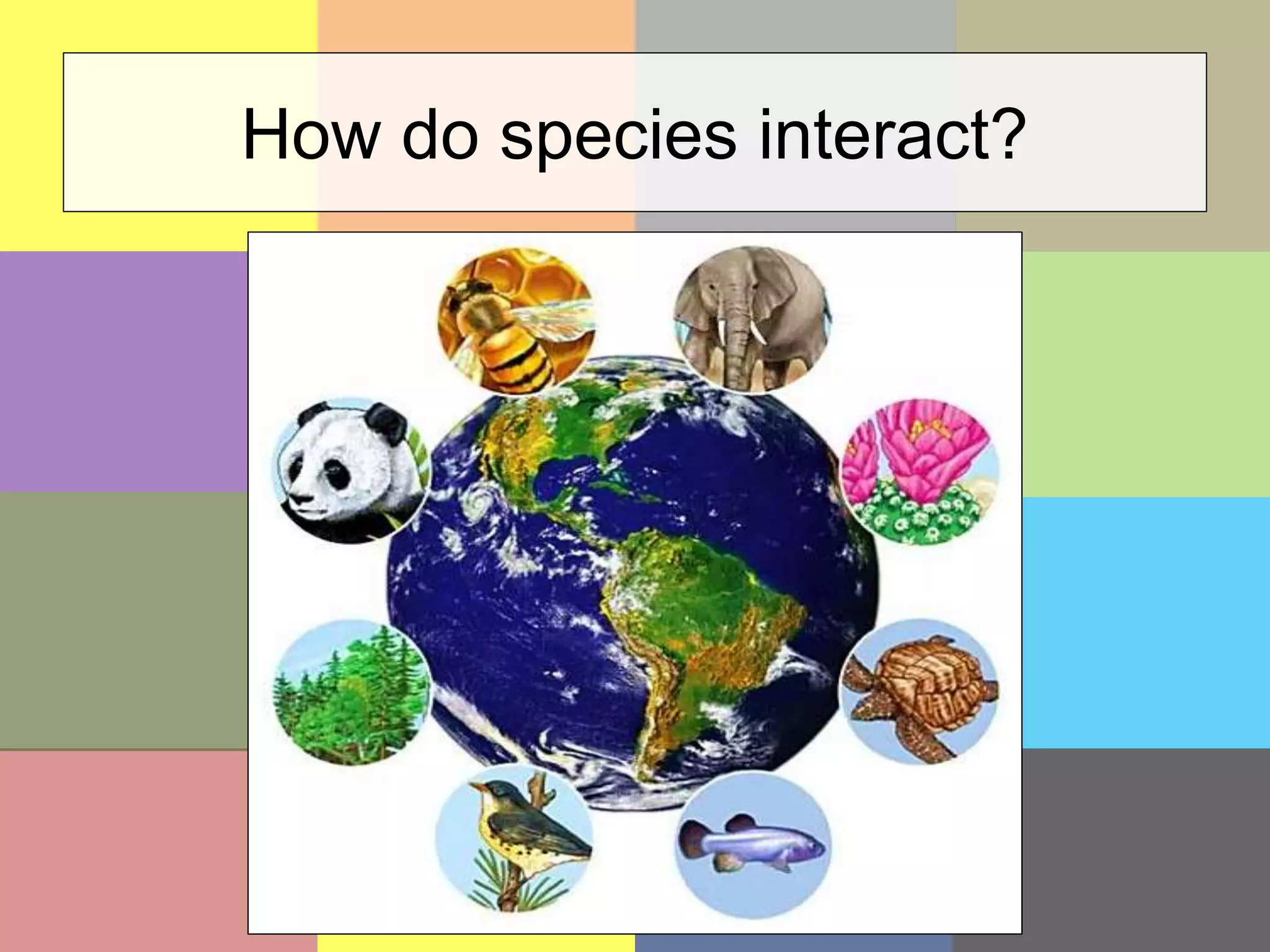
How do species interact?
Kinds of Interaction of Species
• Interspecific
Competition
• Predation
• Symbiosis
– Parasitism
– Mutualism
– Commensalism
Can two species have the
exact same niche in a
habitat? Why or Why not?
Something to Ponder
Interspecific CompetitionIntraspecificCompetition
Interspecific Competition
• Competition between organisms of different
species which, in some cases, are easy to
identify—such as when animals battle over
food.
• Some (organisms) don’t necessarily fight each
other directly as they compete any time they
use the same resource.
• Example: Plants growing near each other
compete for limited sources such as sunlight,
water, and soil nutrients.
Interspecific Competition
• Since NO two species
can share vital limited
resources for long
• Interspecific
competition can be
resolved by:
– Migration
– Shift in feeding habits
or behavior
– Population drop
– Extinction
Interspecific Competition
• (Some) intense competition lead to resource
partitioning
• This partitioning occurs when species
competing for similar scarce resources evolve
specialized traits that allow them to share
resources by
– using parts of them,
– using them at different times, or
– using them in different ways.
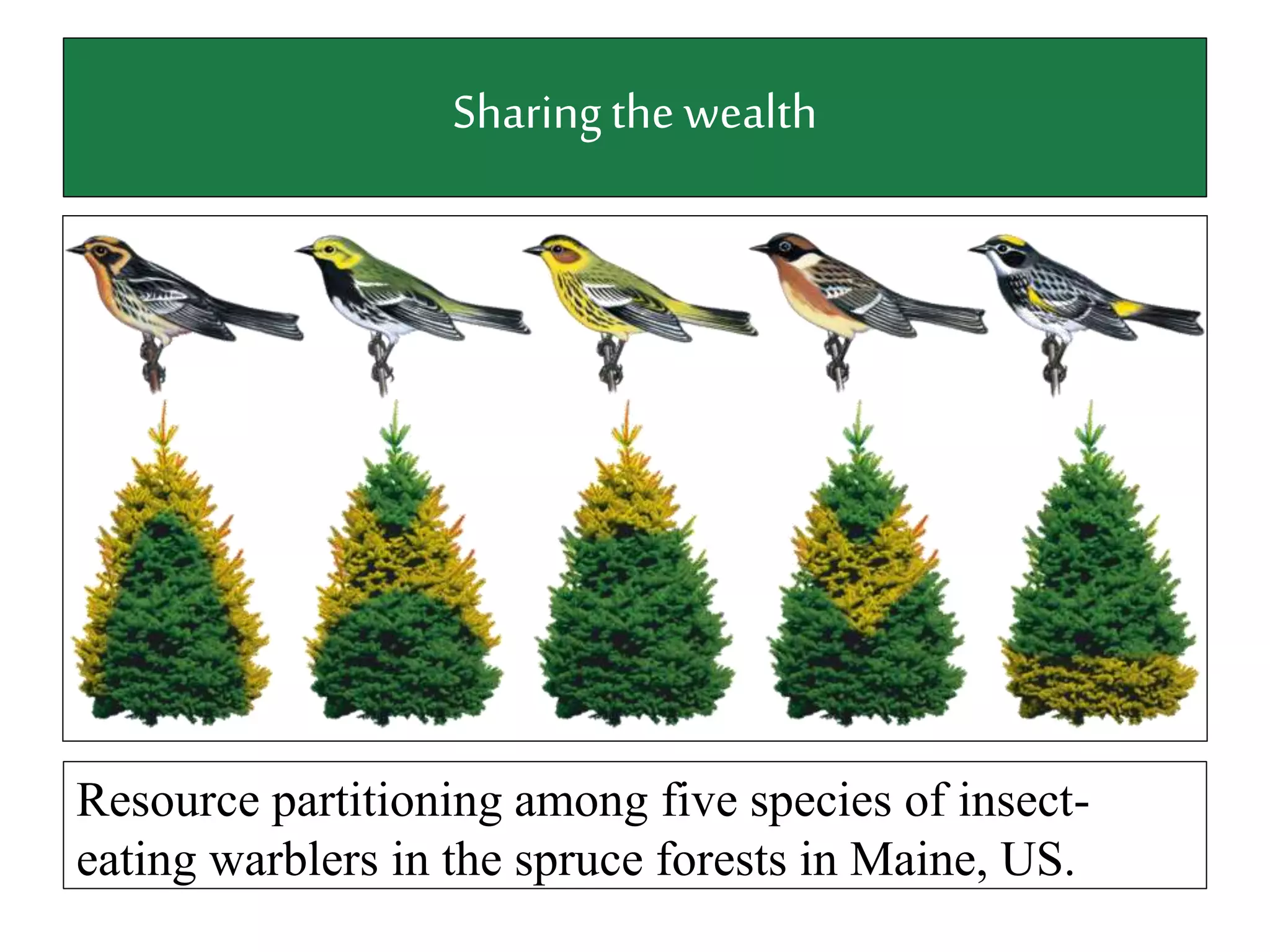
Sharingthe wealth
Resource partitioning among five species of insect-
eating warblers in the spruce forests in Maine, US.
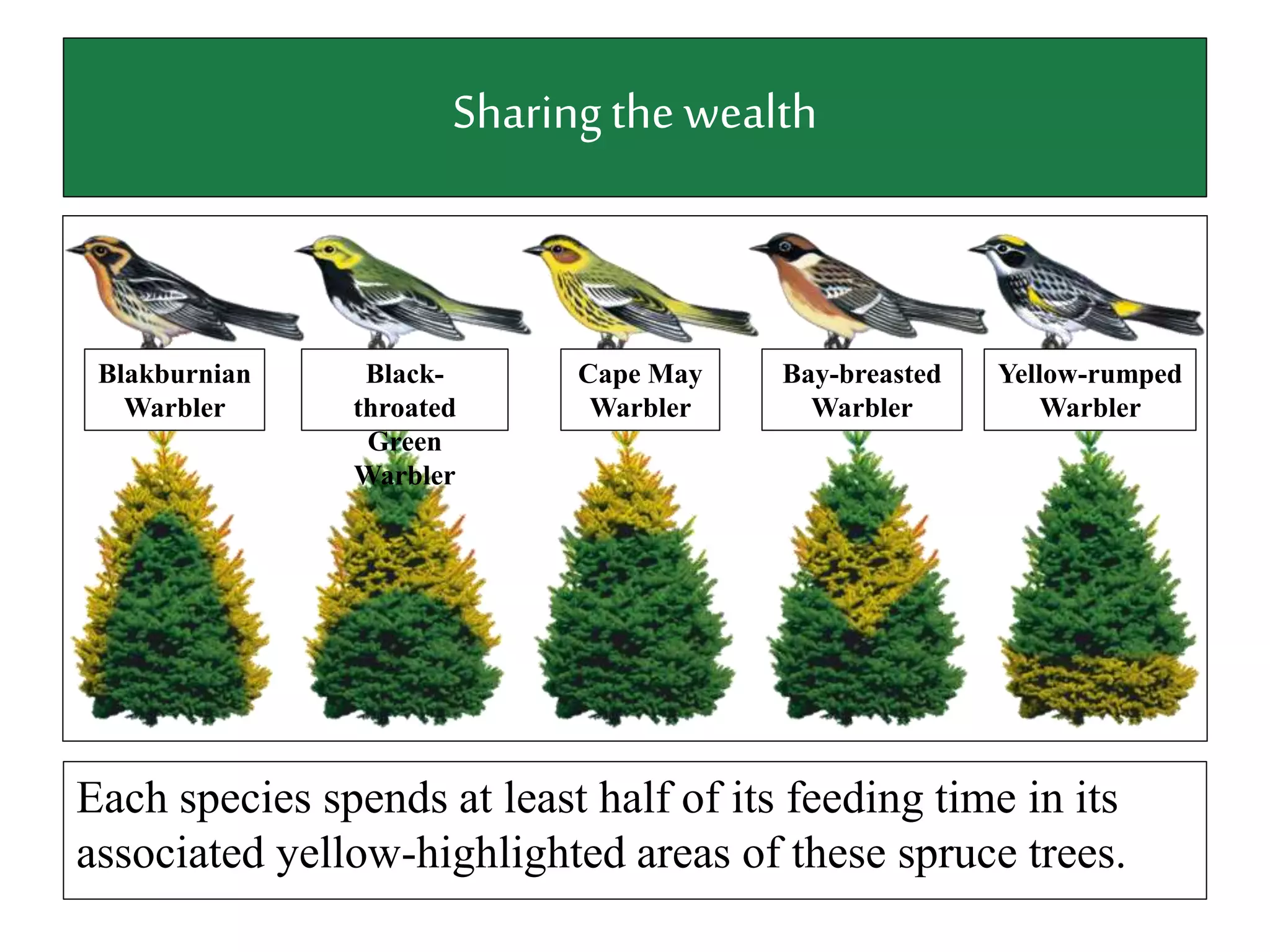
Sharingthe wealth
Each species spends at least half of its feeding time in its
associated yellow-highlighted areas of these spruce trees.
Cape May
Warbler
Blakburnian
Warbler
Black-
throated
Green
Warbler
Yellow-rumped
Warbler
Bay-breasted
Warbler
Why do you think the
warblers have come to such
similar yet non-identical
niches?
Something to Ponder
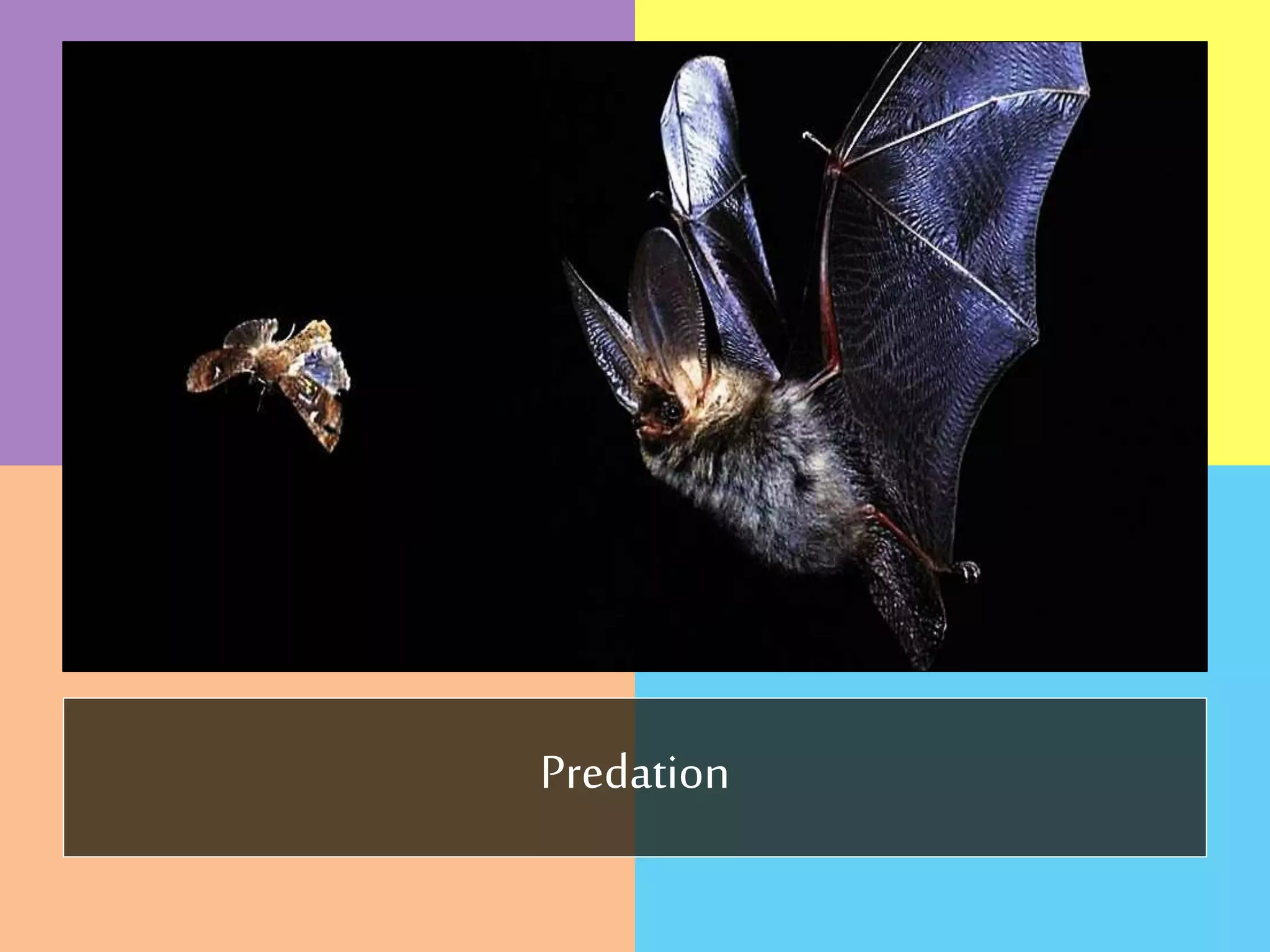
Predation
Predation
• A relationship that is evident in the food chain
(and food web) which shows one organisms
feeding off on another organism
• The predator feeds directly on all or part of the
prey
• Predators are usually carnivores and found on
higher trophic levels.
A Species in Recovery
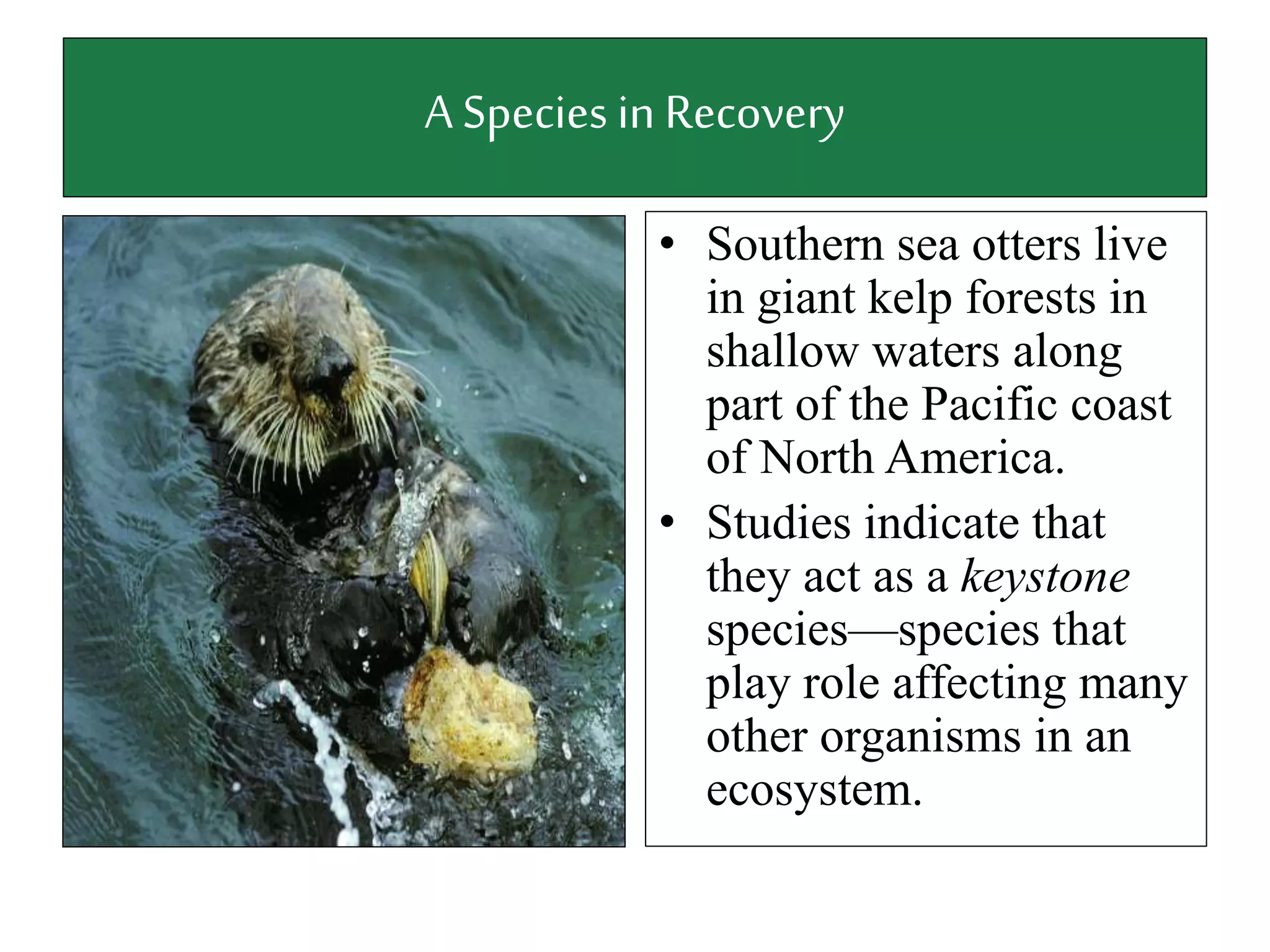
• Southern sea otters live
in giant kelp forests in
shallow waters along
part of the Pacific coast
of North America.
• Studies indicate that
they act as a keystone
species—species that
play role affecting many
other organisms in an
ecosystem.
A Species in Recovery
• Otters use stones to pry shellfish off rocks under
water then resurfaces to the water and as they swim
on their backs, they break open the shells by cracking
them against a stone.
• Each day, an otter consumes ¼ of its weight in clams,
mussels, crabs, abalones, sea urchins, and other
bottom-dwelling organisms.
• An adult southern sea otter can eat up to 50 sea
urchins a day—equivalent to a 68-kilogram person or
160 quarter pounders!
A Species in Recovery
• Without these sea otters,
scientists hypothesize
that sea urchins and
other kelp-eating
species would probably
destroy the kelp forests
and much of the rich
biodiversity of species
they support.
Threat toKelp Forests
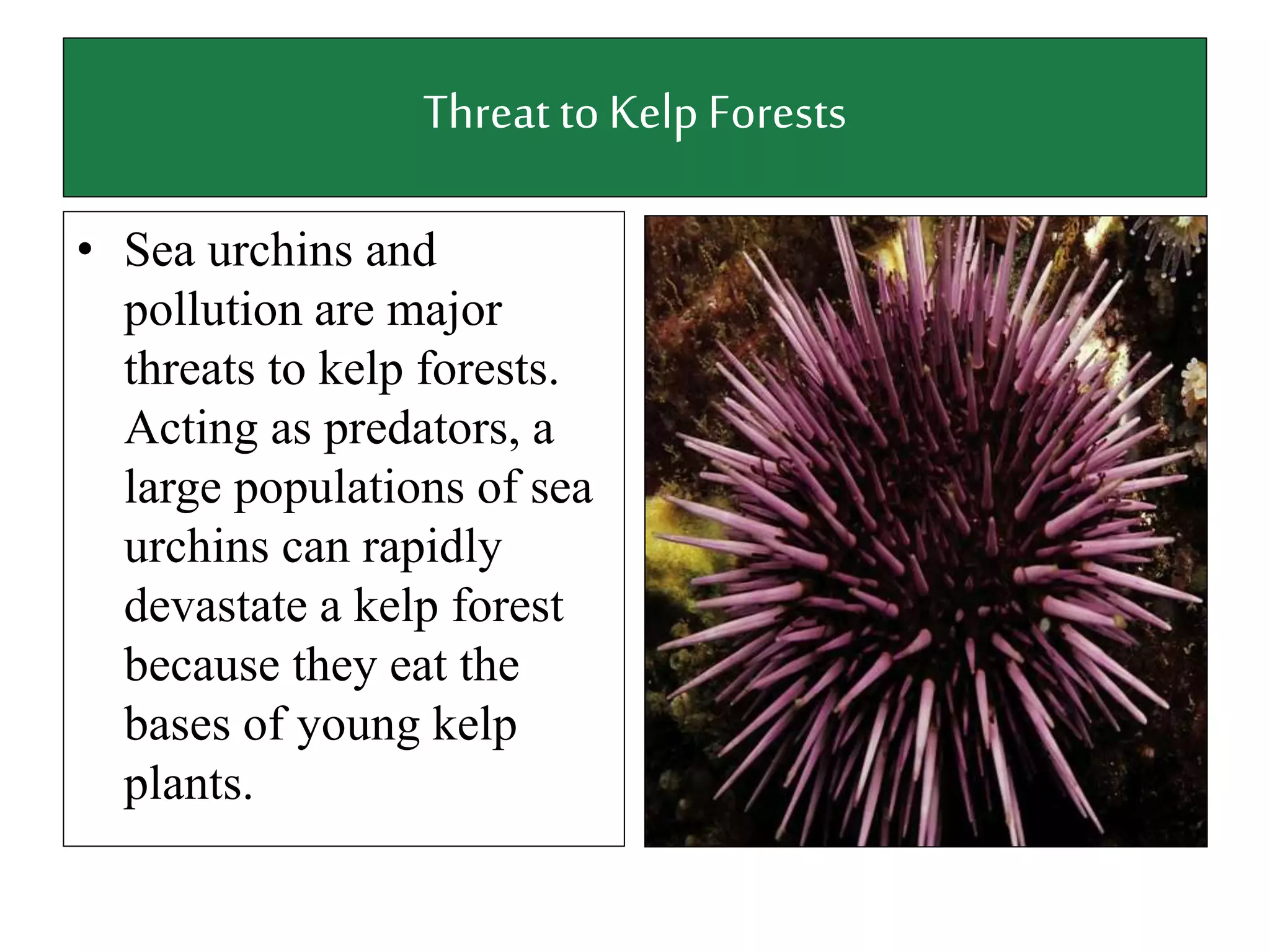
• Sea urchins and
pollution are major
threats to kelp forests.
Acting as predators, a
large populations of sea
urchins can rapidly
devastate a kelp forest
because they eat the
bases of young kelp
plants.
Threat toKelp Forests
• Kelp forests are one of the most biologically diverse
ecosystems found in marine waters, supporting large
numbers of marine plants and animals.
• They* help reduce shore erosion by blunting the force
of incoming waves.
• People harvest kelp as a renewable source, extracting
a substance called algin from its blades.
• This substance is used as a thickening agent in
toothpaste, cosmetics, ice cream and hundreds of
other products.
What simple ways can you do
protect giant kelp forests
and southern sea otters?
Name at least three.
Something to Ponder
Individuals oftwo species live in closeassociationwith
one another.
Symbiosis
Parasitism
Parasitism
• Occurs when the parasite feeds on another
organism, usually by living on or inside the host.
• The parasite benefits and the host is often harmed
but not immediately killed.
• A parasite is also usually is much smaller than its
host and rarely kills it. However most parasites
continue to draw nourishment from then and may
gradually weaken them over time
Parasitism
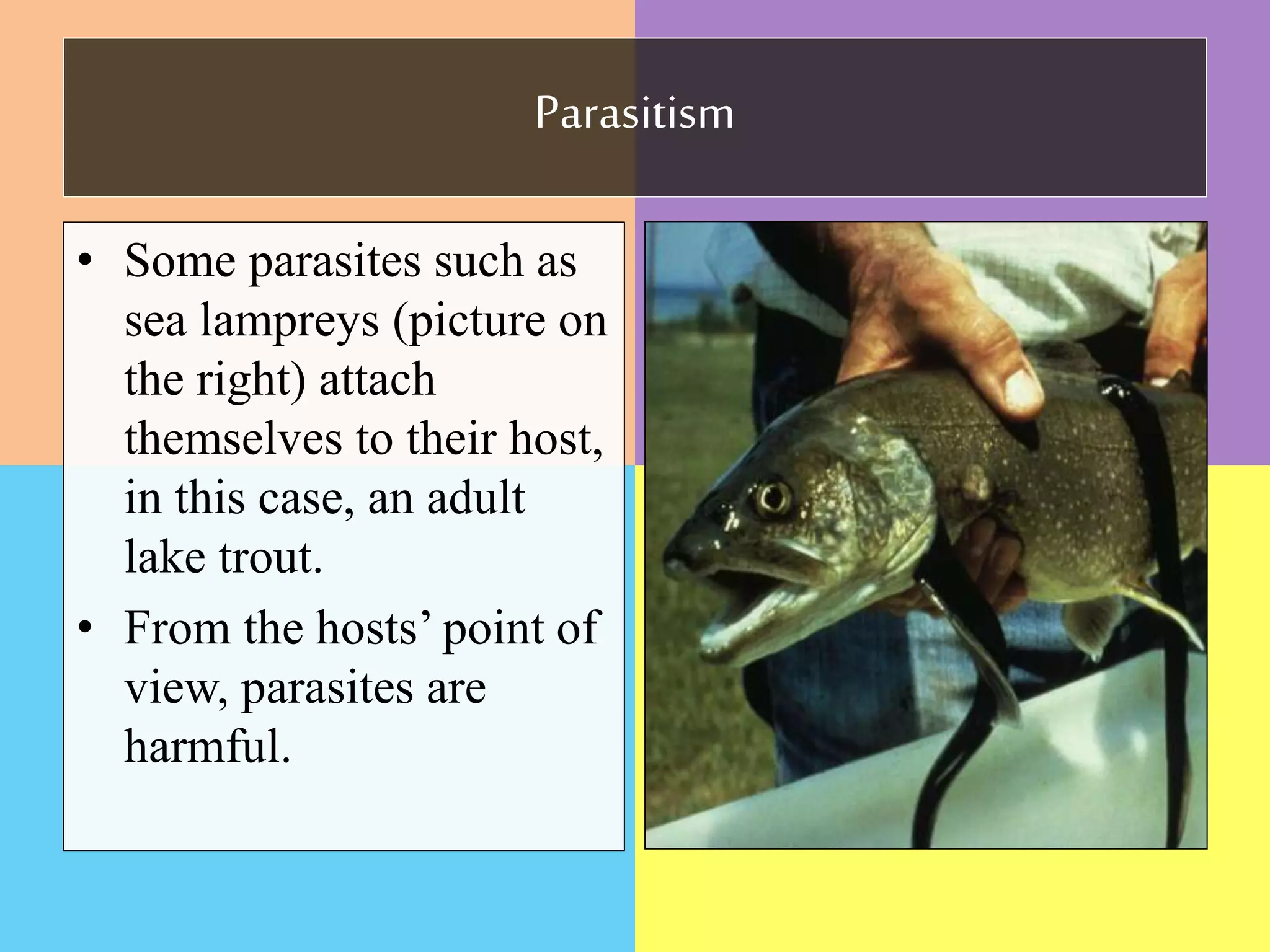
• Some parasites such as
sea lampreys (picture on
the right) attach
themselves to their host,
in this case, an adult
lake trout.
• From the hosts’ point of
view, parasites are
harmful.
Parasitism
• But from the population
perspective, parasites
can promote
biodiversity by
contributing to species
richness or sometimes
help keep the
populations of their
hosts in check.
What are some examples of
parasites that harm human
beings?
Check Yourself
Mutualism
Mutualism
• Occurs when two species behave in ways that
benefit both by providing each with food,
shelter, or some other resource.
• Examples include pollination of flowering
plants by species such as honeybees and
butterflies that feed on the nectar of flowers.
Mutualism
• Birds that ride on the
backs of large animals
like rhinoceros.
• The birds remove and
eat parasites and pests
from the animals’
bodies (also send out
warning from incoming
predators by making
noises)
Is mutualism an example of
cooperation between the two
species involved? Justify
your answer.
Something to Ponder
Commensalism
Commensalism
• An interaction that benefits one species but has
little, if any, beneficial or harmful effect on the
other.
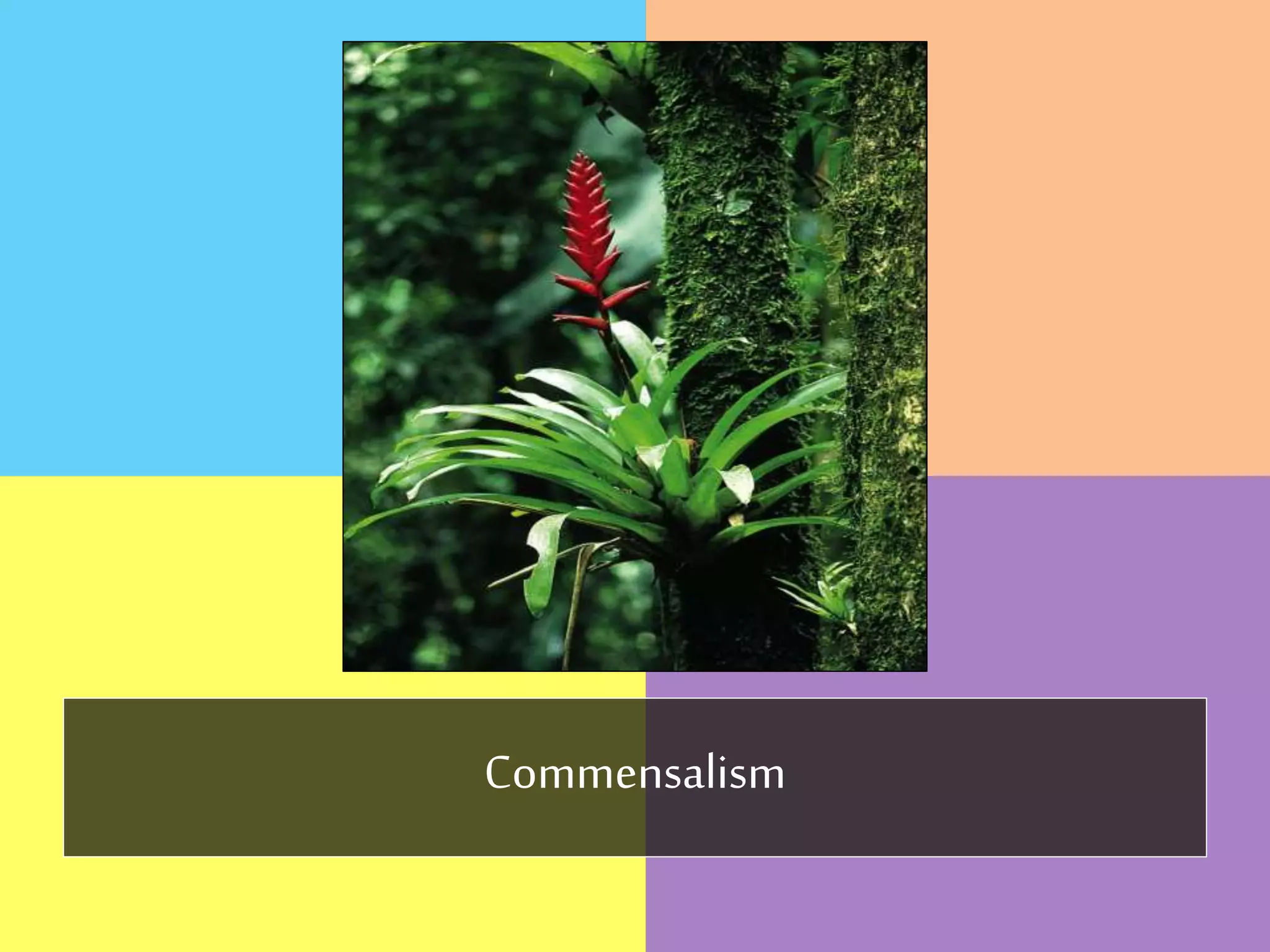
• Example includes epiphytes (air plants) such as
certain types of orchids that attach themselves
to the trunks or branches of large trees
commonly found in tropical forests (see photo
from previous slide)
What other examples of
commensalism can you think
of? Give at least two.
Check Yourself
PopulationDynamics
PopulationDynamics
• A population is a group of individuals of the
same species living in particular place.
• The size of a population is governed by four
variables namely: births, deaths, immigration,
and immigration.
– Immigration – arrival of individuals from outside the
population
– Emigration – departure of individuals from the population
PopulationDynamics
• The equation widely used to determine the size
of a population is presented below:
Population change = (Births + Immigration) – (Deaths + Emigration)
• The presence or absence of certain physical
and chemical factors—limiting factors—can
also help to determine the number of
organisms in a population
PopulationDynamics
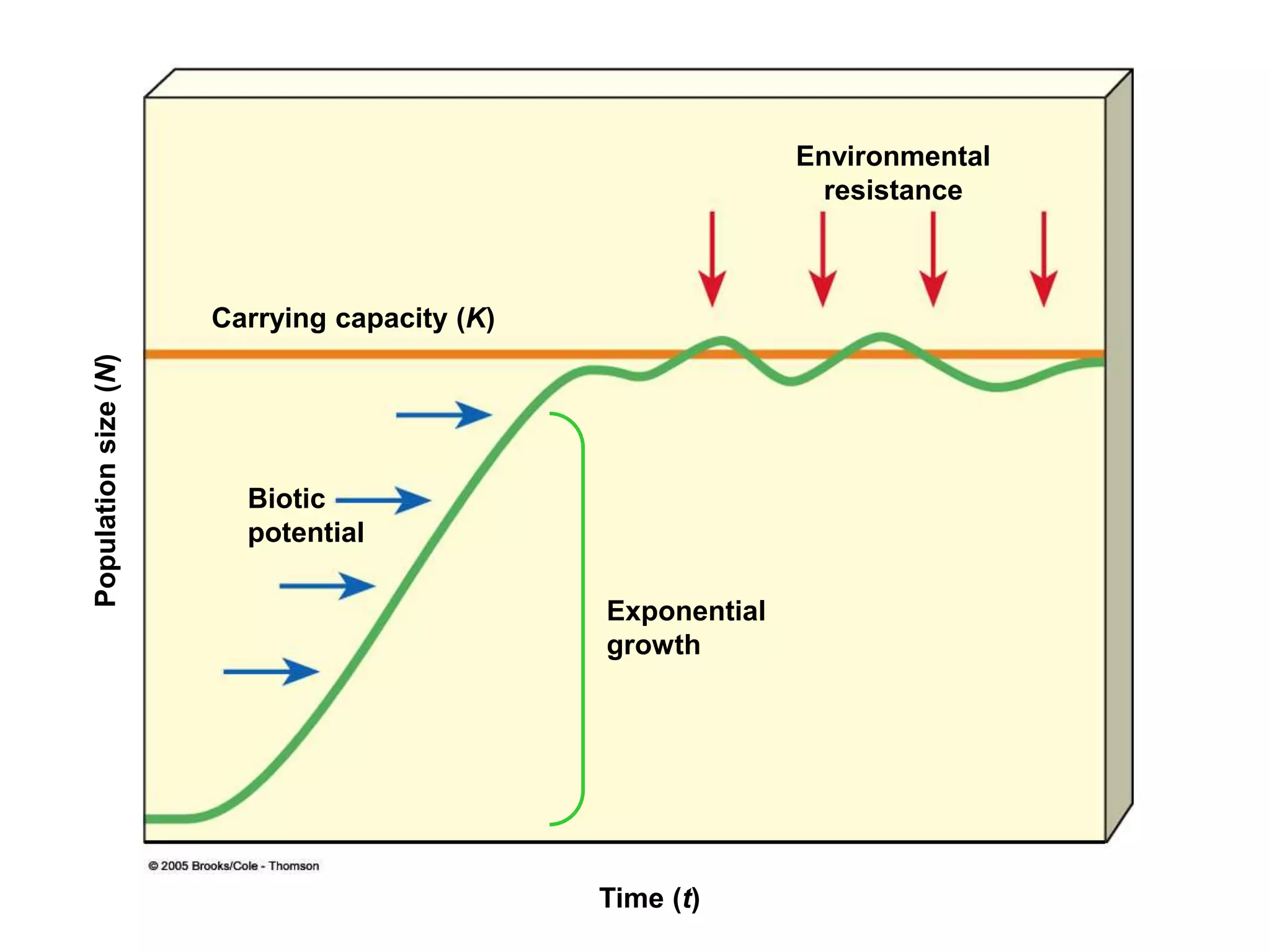
• Populations vary in their capacity for growth,
also known as biotic potential. Intrinsic rate of
growth (r) is the rate at which a population will
grow if it had unlimited resources.
• Carrying capacity (K): The number of
individuals in a population that can be
supported in a given area.
Populationsize(N)
Time (t)
Carrying capacity (K)
Environmental
resistance
Biotic
potential
Exponential
growth
PopulationDynamics
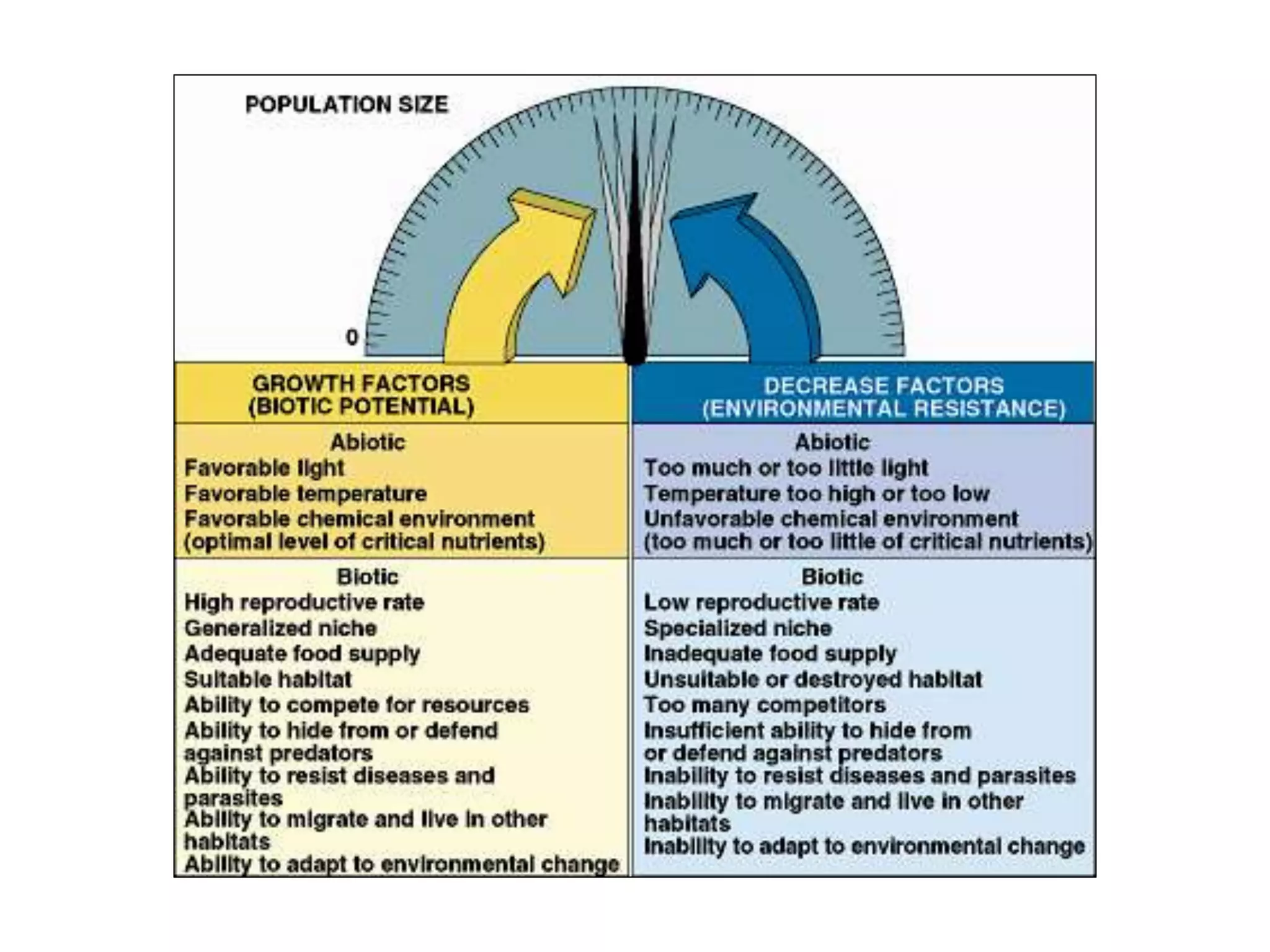
• Factors that tend to increase or decrease
population size:
• Biotic potential and environmental resistance
determines the carrying capacity (see the next
image)
Population Density affects Population Growth
• Density-dependent
population controls
are reliant on a dense
population for effect:
– Pests
– Infectious diseases
– Competition for
resources
– Predation
• Density-independent
population controls
affect population size
regardless of density:
– Weather
– Fire
– Habitat destruction
– Pesticides
– Pollution
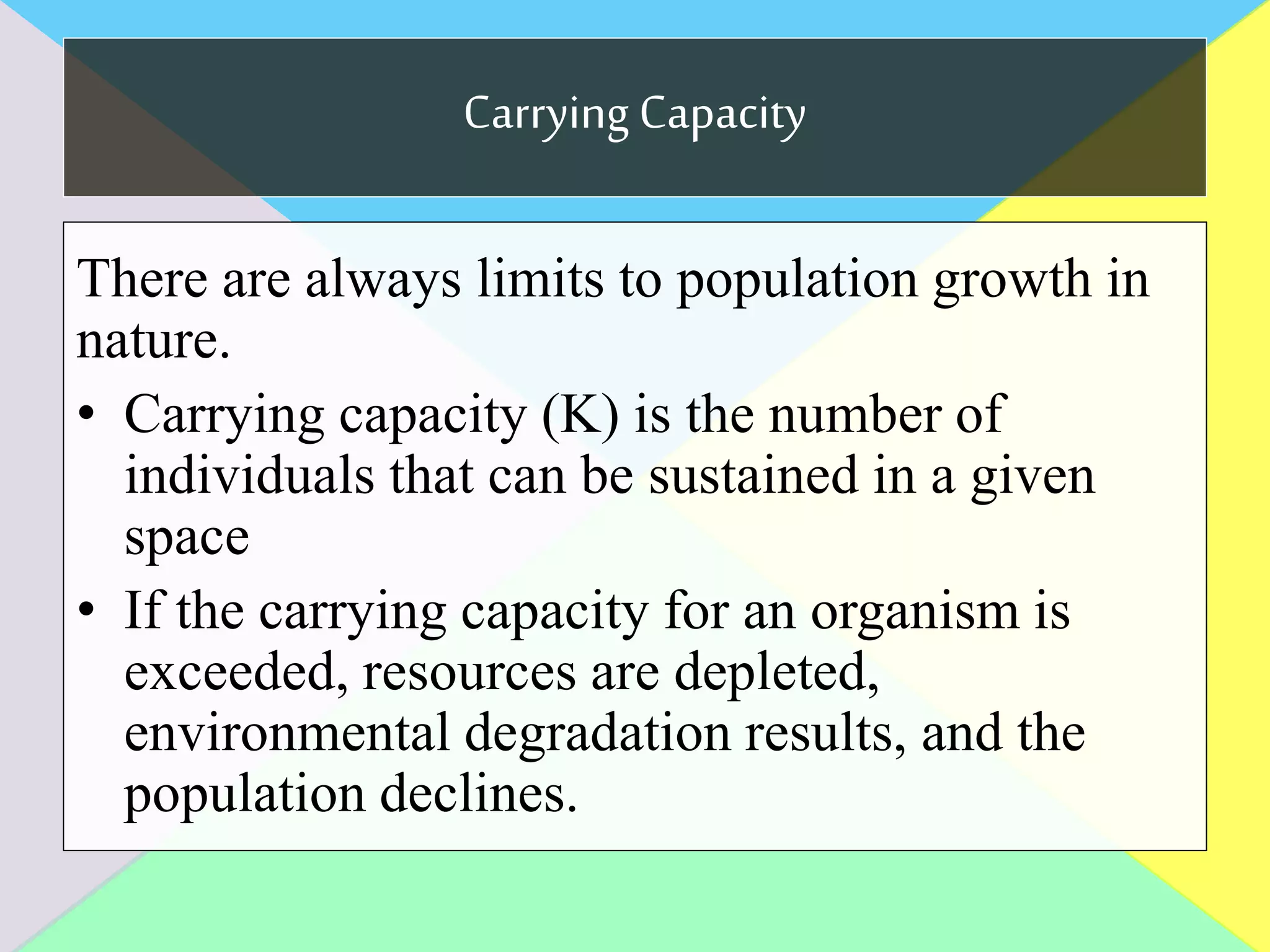
Carrying Capacity
There are always limits to population growth in
nature.
• Carrying capacity (K) is the number of
individuals that can be sustained in a given
space
• If the carrying capacity for an organism is
exceeded, resources are depleted,
environmental degradation results, and the
population declines.
Carrying capacity is determined by
climatic changes, predation, resource
availability and interspecific
competition.
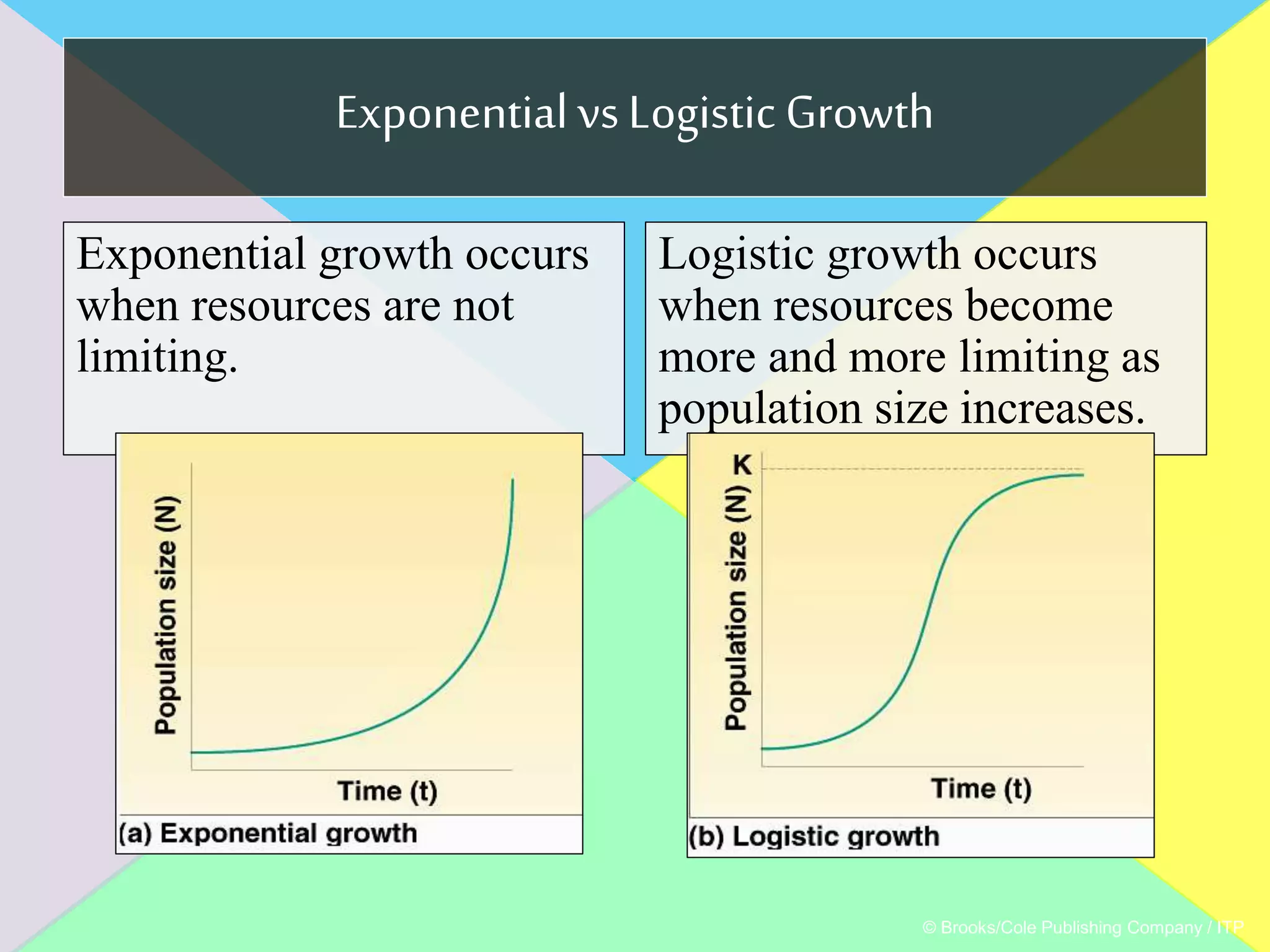
ExponentialvsLogistic Growth
Exponential growth occurs
when resources are not
limiting.
Logistic growth occurs
when resources become
more and more limiting as
population size increases.
© Brooks/Cole Publishing Company / ITP
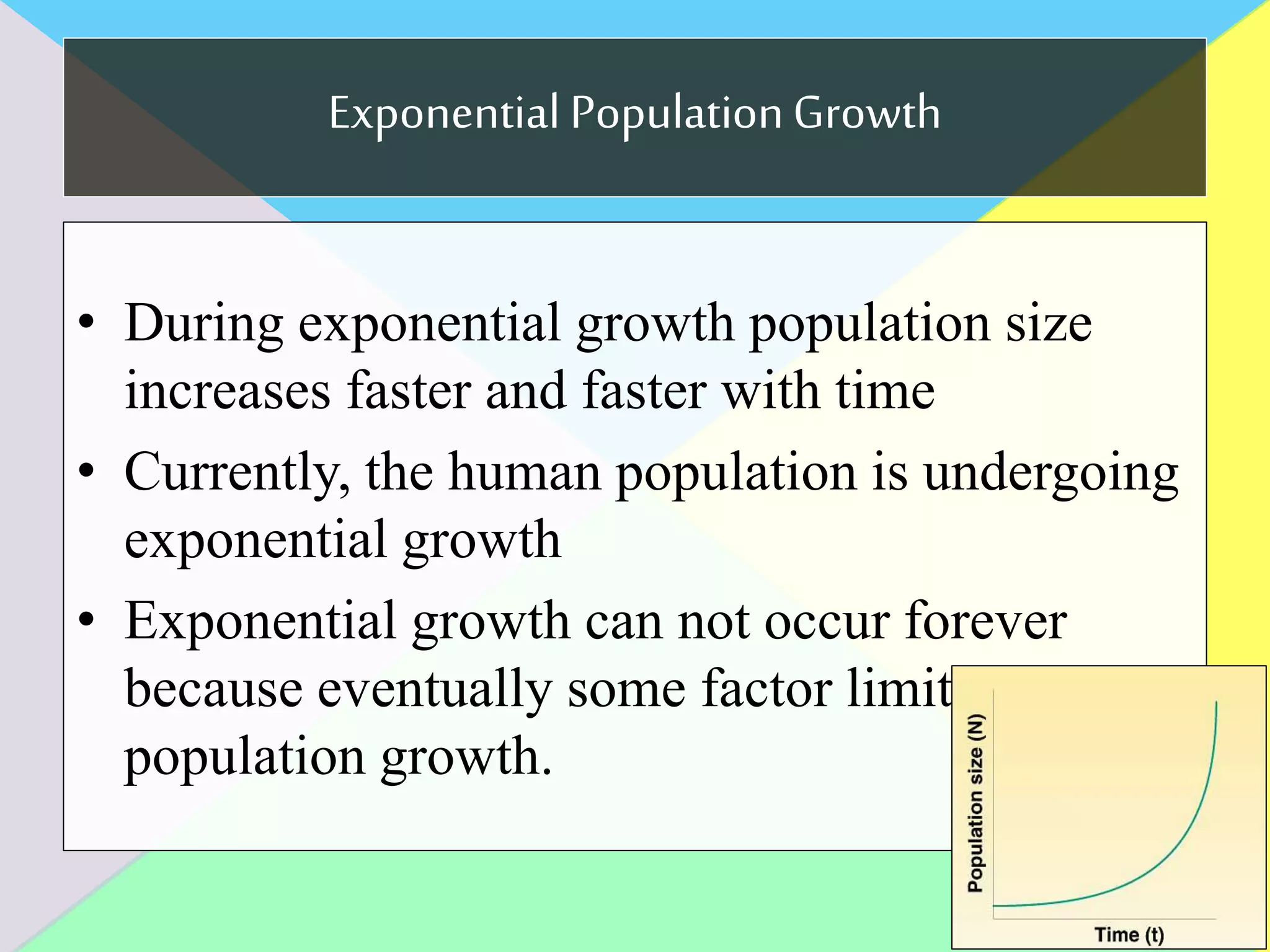
Exponential PopulationGrowth
• During exponential growth population size
increases faster and faster with time
• Currently, the human population is undergoing
exponential growth
• Exponential growth can not occur forever
because eventually some factor limits
population growth.
Logistic PopulationGrowth
• Logistic population growth occurs when the
population growth rate decreases as the
population size increases.
– Note that when the population is small the logistic
population growth curve looks like exponential
growth
– Over time, the population size
approaches a carrying capacity (K).
Exceedingthe Carrying Capacity
• During the mid–1800s
sheep populations
exceeded the carrying
capacity of the island of
Tasmania.
• This "overshoot" was
followed by a "population
crash". Numbers then
stabilized, with
oscillation about the
carrying capacity.
© Brooks/Cole Publishing Company / ITP
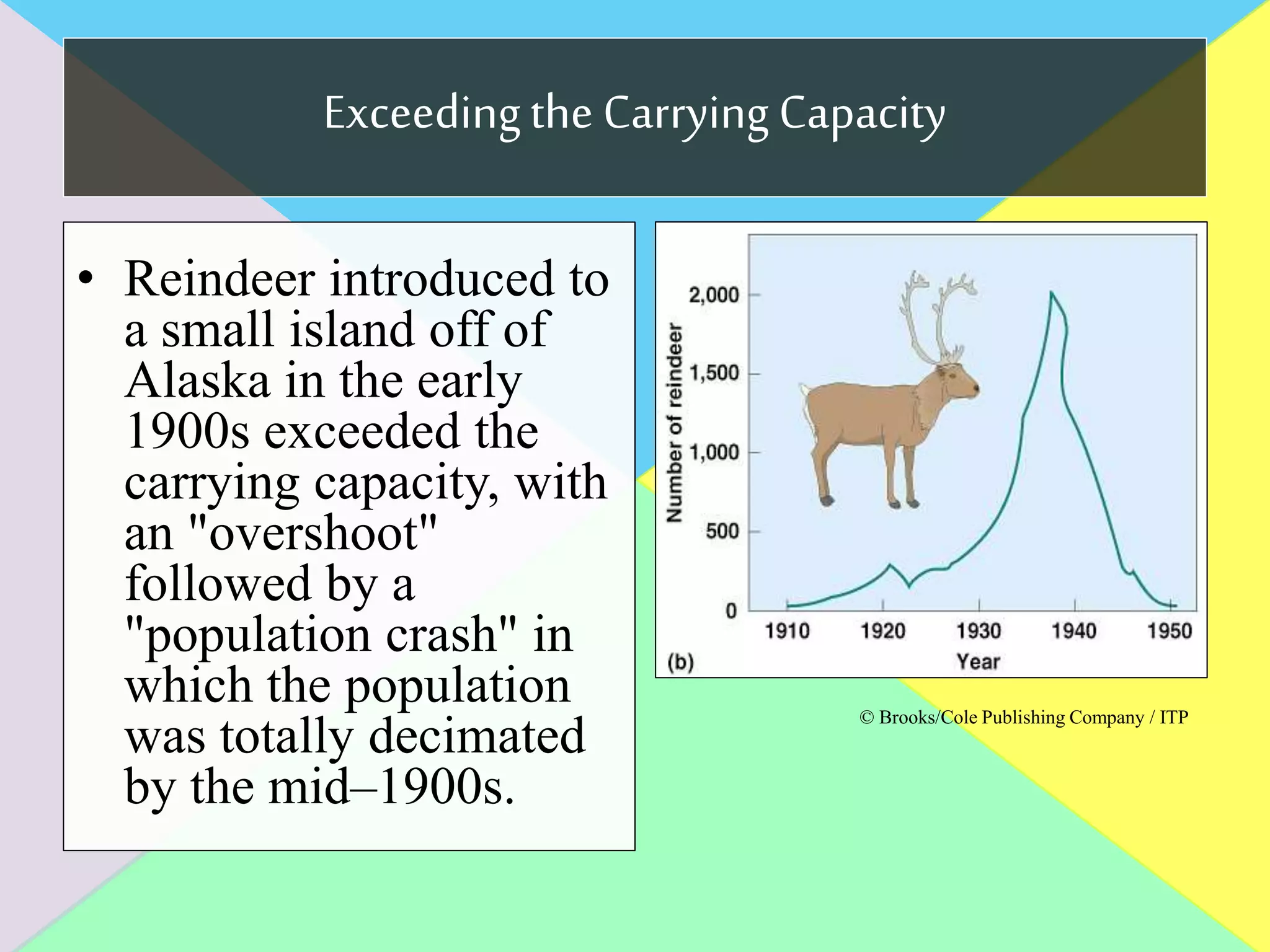
Exceedingthe Carrying Capacity
• Reindeer introduced to
a small island off of
Alaska in the early
1900s exceeded the
carrying capacity, with
an "overshoot"
followed by a
"population crash" in
which the population
was totally decimated
by the mid–1900s.
© Brooks/Cole Publishing Company / ITP
Do humans contribute in
lowering the carrying
capacity of certain animals?
Explain your answer.
Something to Ponder
Case Study
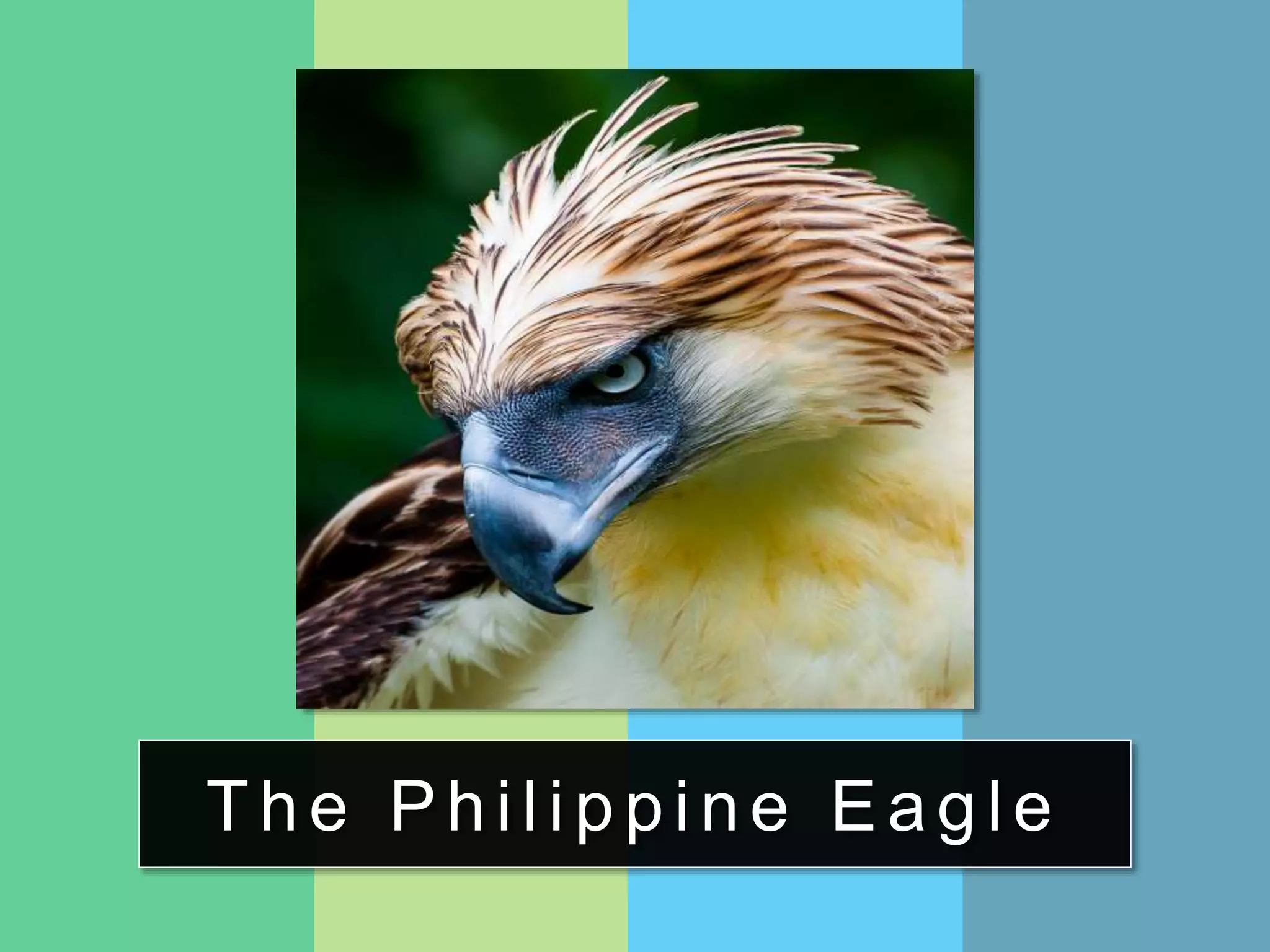
The Philippine Eagle
Getting toknow the PhilippineEagle
The Philippine monkey-eating eagle is
well named for its preference for eating
monkeys, particularly macaques.
They inhabit tropical rain forests and are
well-adapted to life in dense foliage.
They are adept at snatching monkeys or
other mammals or birds from trees.
Like most big predators, they require a
large territory for hunting.
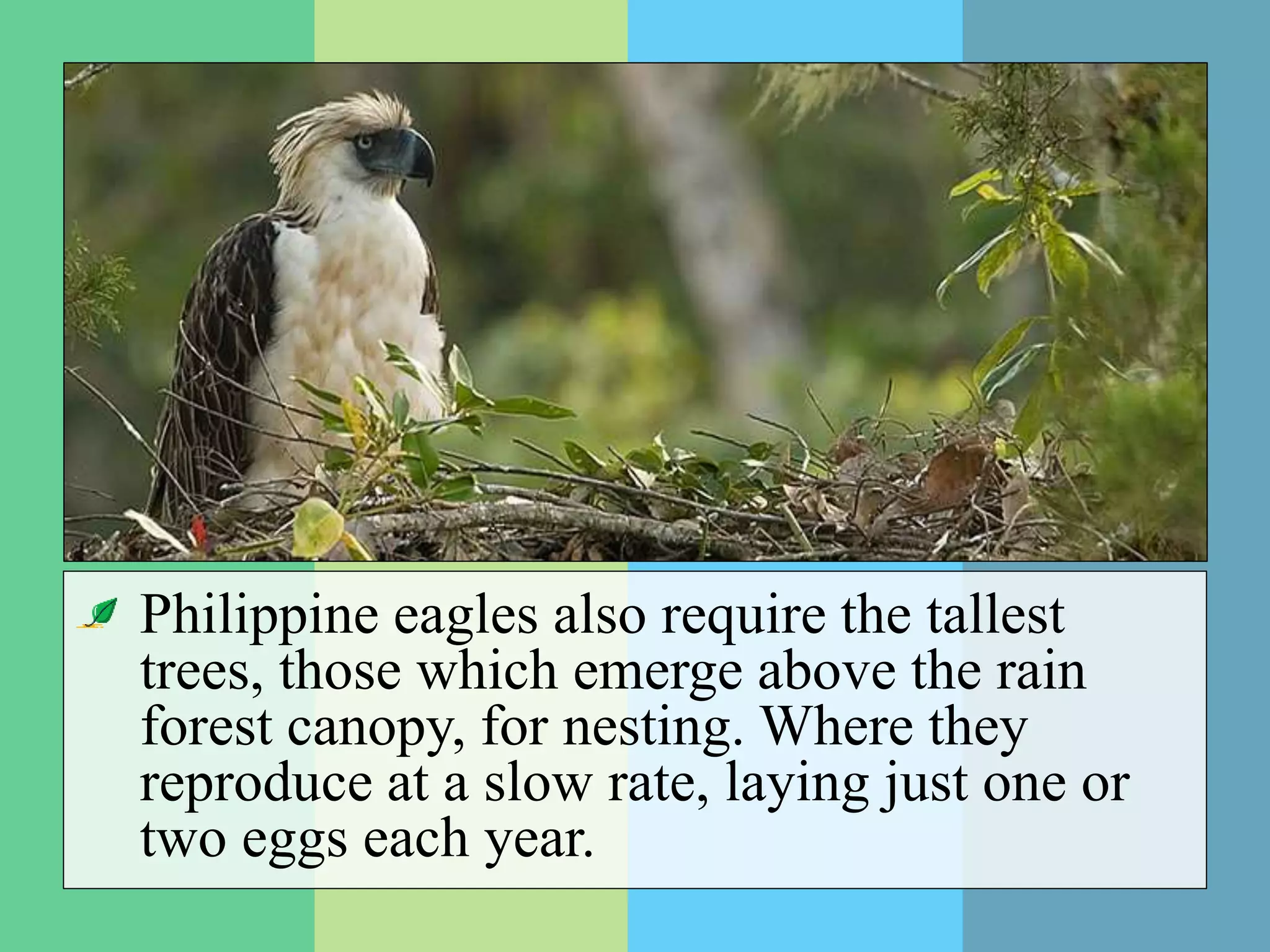
Philippine eagles also require the tallest
trees, those which emerge above the rain
forest canopy, for nesting. Where they
reproduce at a slow rate, laying just one or
two eggs each year.
What are the causes of its endangerment?
• Habitat Loss
• Hunting
• Pollution
• Collectors
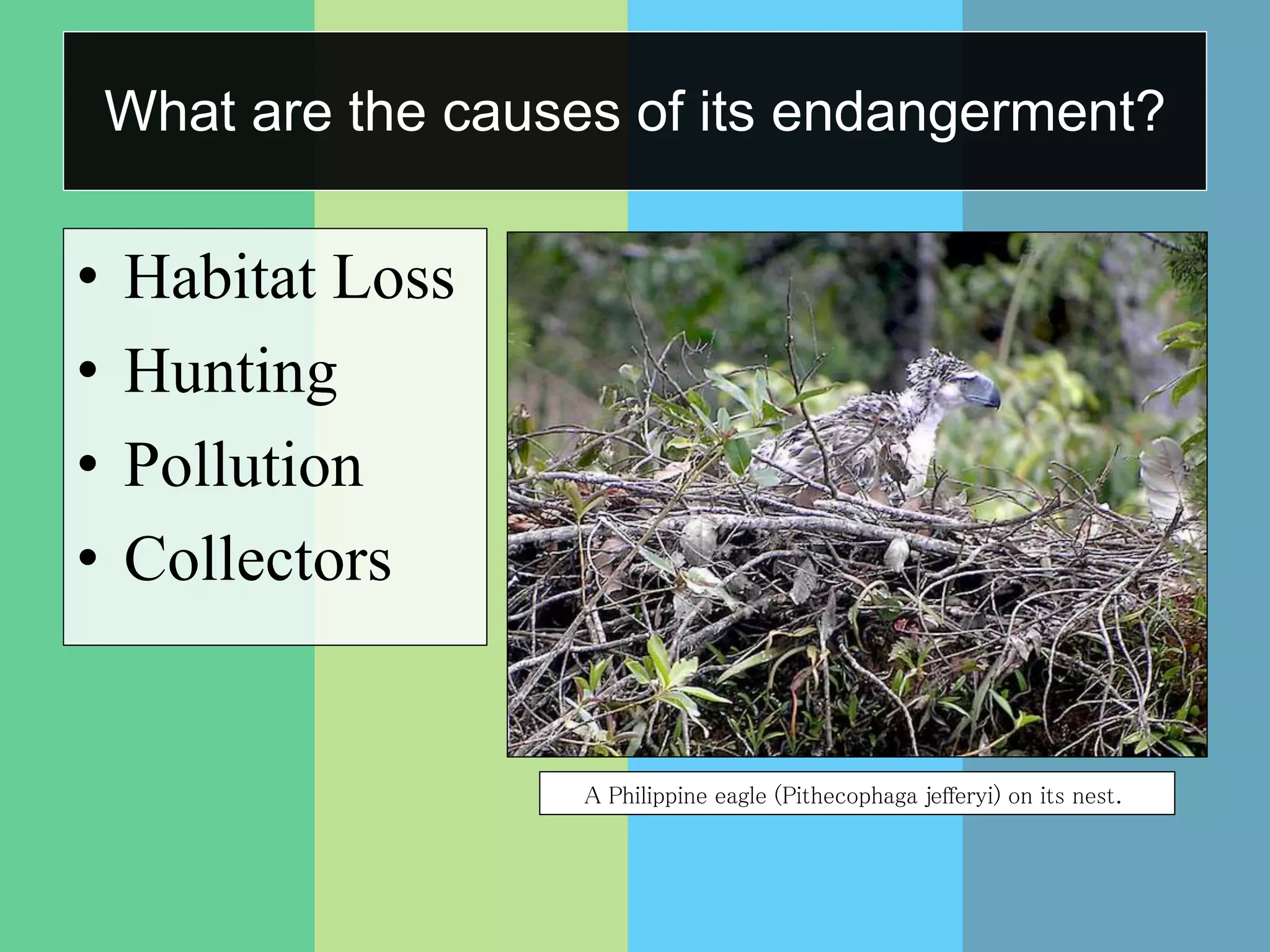
A Philippine eagle (Pithecophaga jefferyi) on its nest.
Which of the factors
mentioned greatly affects
the species’ endangerment?
Explain your answer.
Check Yourself
How can we help protect the
Philippine eagle?
Something to Ponder
Recapitulation
Biodiversity is the variety of life in the world
or in a particular habitat or ecosystem
One of the examples of biodiversity is species
diversity where the presence of many kinds of
organisms make way to species interactions
Interaction of species ensures survival of
many organisms even in changing
environments
Population growth can be determined by the
number of births and deaths
Recapitulation
Exponential growth occurs when there is
unlimited resources so its size increases at
a greater and greater rate.
Logistic population growth occurs when
the growth rate decreases as the
population reaches carrying capacity.
Carrying capacity is determined by
climatic changes, predation, resource
availability and interspecific competition.
Recapitulation
Logistic population growth occurs when
the growth rate decreases as the
population reaches carrying capacity.
Humans activities such as deforestation
pose great risks to wildlife such as the
Philippine eagle
Understanding biodiversity and
population, you may be able to help take
care of it
C h a r l e s D a r w i n
“In looking at nature, never forget that
every single organic being around us
may be said to be striving to increase
its numbers.”

Biodiversity and population

  • 1.
    Biodiversity, Species Interactions, and PopulationDynamics P re p a re d b y : Cyrus Vincent Eludo M A S E d – P h y s i c s Integrated Science IV
  • 2.
    Objectives At the endof this module you are expected to: Explain how species diversity increases the probability of adaptation and survival of organisms in changing environments – Identify the five types of species interactions Explain the relationship between population growth and carrying capacity – Discuss population dynamics Suggest ways to minimize human impact on the environment
  • 3.
  • 4.
    Pre-test Assessment 1. Whatdo you call the variety of species in a population or an ecological community? A. Bioaccumulation B. Bioalteration C. Biodiversity D. Biomagnification
  • 5.
    Pre-test Assessment 2. Whichof these kinds of biodiversity refers to the variety of kinds of species living in an ecological community? A. Ecosystem diversity B. Functional diversity C. Genetic diversity D. Species diversity
  • 6.
    Pre-test Assessment 3. Whatterm refers to the relationship between members of two or more species interacting to use the same limited resources such as food, water, light, and space? A. Commensalism B. Interspecific Competition C. Mutualism D. Parasitism
  • 7.
    Pre-test Assessment 4. Whatkind of relationship pertains to one species feeds on another organism, usually by living on or inside the host? A. Commensalism B. Interspecific Competition C. Mutualism D. Parasitism
  • 8.
    Pre-test Assessment 5. Whatdo you call the interaction between species when both species involved gain nothing but benefits? A. Commensalism B. Mutualism C. Parasitism D. Predation
  • 9.
    Pre-test Assessment 6. Whatis the term used when one species feeds directly on all or part of a living organism? A. Interspecific Competition B. Mutualism C. Parasitism D. Predation
  • 10.
    Pre-test Assessment 7. Whichof these statements does NOT contribute to the a population’s environmental resistance? A. High reproductive rate B. Inability to adapt to environmental change C. Specialized niche D. Too many competitors
  • 11.
    Pre-test Assessment 8. Whichof the following refers to a group of individuals of a single species that lives in a specific area? A. Community B. Ecosystem C. Population D. None of the above
  • 12.
    Pre-test Assessment 9. Whatis the maximum population of a given species that a particular habitat can sustain indefinitely? A. Carrying Capacity B. Ecological Succession C. Environmental Resistance D. Population Crash
  • 13.
    Pre-test Assessment 10. Whatmodel represents a slow growth in population as it approaches the habitat’s carrying capacity? A. Exponential Growth B. Linear Growth C. Logistic Growth D. Population Growth
  • 14.
  • 15.
  • 16.
  • 17.
    Will an ecosystemcollapse if one species was removed from it? Video feedback
  • 18.
  • 19.
    What isbiodiversity? • Biodiversitycan be described as the quantity of species (flora and fauna) present in an ecosystem • It can be further classified into four types namely: – Species diversity – Genetic diversity – Ecosystem diversity – Functional diversity (nutrient cycling)
  • 20.
  • 21.
    Species Diversity • Oneof the components of biodiversity which pertains to the number and variety of the species present in any biological community. • The earth’s variety of species contains even greater variety of genes, which enable life on earth to survive and adapt to dramatic environmental changes.
  • 22.
    Species Diversity • Aspecies’ ecological niche is the role that it plays in an ecosystem or the total set of biotic and abiotic resources it uses. • This include the food it eats, the water it drinks, the space it occupies and any other resource the species uses.
  • 23.
    How do speciesinteract?
  • 24.
    Kinds of Interactionof Species • Interspecific Competition • Predation • Symbiosis – Parasitism – Mutualism – Commensalism
  • 25.
    Can two specieshave the exact same niche in a habitat? Why or Why not? Something to Ponder
  • 26.
  • 27.
    Interspecific Competition • Competitionbetween organisms of different species which, in some cases, are easy to identify—such as when animals battle over food. • Some (organisms) don’t necessarily fight each other directly as they compete any time they use the same resource. • Example: Plants growing near each other compete for limited sources such as sunlight, water, and soil nutrients.
  • 28.
    Interspecific Competition • SinceNO two species can share vital limited resources for long • Interspecific competition can be resolved by: – Migration – Shift in feeding habits or behavior – Population drop – Extinction
  • 29.
    Interspecific Competition • (Some)intense competition lead to resource partitioning • This partitioning occurs when species competing for similar scarce resources evolve specialized traits that allow them to share resources by – using parts of them, – using them at different times, or – using them in different ways.
  • 30.
    Sharingthe wealth Resource partitioningamong five species of insect- eating warblers in the spruce forests in Maine, US.
  • 31.
    Sharingthe wealth Each speciesspends at least half of its feeding time in its associated yellow-highlighted areas of these spruce trees. Cape May Warbler Blakburnian Warbler Black- throated Green Warbler Yellow-rumped Warbler Bay-breasted Warbler
  • 32.
    Why do youthink the warblers have come to such similar yet non-identical niches? Something to Ponder
  • 33.
  • 34.
    Predation • A relationshipthat is evident in the food chain (and food web) which shows one organisms feeding off on another organism • The predator feeds directly on all or part of the prey • Predators are usually carnivores and found on higher trophic levels.
  • 35.
    A Species inRecovery • Southern sea otters live in giant kelp forests in shallow waters along part of the Pacific coast of North America. • Studies indicate that they act as a keystone species—species that play role affecting many other organisms in an ecosystem.
  • 36.
    A Species inRecovery • Otters use stones to pry shellfish off rocks under water then resurfaces to the water and as they swim on their backs, they break open the shells by cracking them against a stone. • Each day, an otter consumes ¼ of its weight in clams, mussels, crabs, abalones, sea urchins, and other bottom-dwelling organisms. • An adult southern sea otter can eat up to 50 sea urchins a day—equivalent to a 68-kilogram person or 160 quarter pounders!
  • 37.
    A Species inRecovery • Without these sea otters, scientists hypothesize that sea urchins and other kelp-eating species would probably destroy the kelp forests and much of the rich biodiversity of species they support.
  • 38.
    Threat toKelp Forests •Sea urchins and pollution are major threats to kelp forests. Acting as predators, a large populations of sea urchins can rapidly devastate a kelp forest because they eat the bases of young kelp plants.
  • 39.
    Threat toKelp Forests •Kelp forests are one of the most biologically diverse ecosystems found in marine waters, supporting large numbers of marine plants and animals. • They* help reduce shore erosion by blunting the force of incoming waves. • People harvest kelp as a renewable source, extracting a substance called algin from its blades. • This substance is used as a thickening agent in toothpaste, cosmetics, ice cream and hundreds of other products.
  • 40.
    What simple wayscan you do protect giant kelp forests and southern sea otters? Name at least three. Something to Ponder
  • 41.
    Individuals oftwo specieslive in closeassociationwith one another. Symbiosis
  • 42.
  • 43.
    Parasitism • Occurs whenthe parasite feeds on another organism, usually by living on or inside the host. • The parasite benefits and the host is often harmed but not immediately killed. • A parasite is also usually is much smaller than its host and rarely kills it. However most parasites continue to draw nourishment from then and may gradually weaken them over time
  • 44.
    Parasitism • Some parasitessuch as sea lampreys (picture on the right) attach themselves to their host, in this case, an adult lake trout. • From the hosts’ point of view, parasites are harmful.
  • 45.
    Parasitism • But fromthe population perspective, parasites can promote biodiversity by contributing to species richness or sometimes help keep the populations of their hosts in check.
  • 46.
    What are someexamples of parasites that harm human beings? Check Yourself
  • 47.
  • 48.
    Mutualism • Occurs whentwo species behave in ways that benefit both by providing each with food, shelter, or some other resource. • Examples include pollination of flowering plants by species such as honeybees and butterflies that feed on the nectar of flowers.
  • 49.
    Mutualism • Birds thatride on the backs of large animals like rhinoceros. • The birds remove and eat parasites and pests from the animals’ bodies (also send out warning from incoming predators by making noises)
  • 50.
    Is mutualism anexample of cooperation between the two species involved? Justify your answer. Something to Ponder
  • 51.
  • 52.
    Commensalism • An interactionthat benefits one species but has little, if any, beneficial or harmful effect on the other. • Example includes epiphytes (air plants) such as certain types of orchids that attach themselves to the trunks or branches of large trees commonly found in tropical forests (see photo from previous slide)
  • 53.
    What other examplesof commensalism can you think of? Give at least two. Check Yourself
  • 54.
  • 55.
    PopulationDynamics • A populationis a group of individuals of the same species living in particular place. • The size of a population is governed by four variables namely: births, deaths, immigration, and immigration. – Immigration – arrival of individuals from outside the population – Emigration – departure of individuals from the population
  • 56.
    PopulationDynamics • The equationwidely used to determine the size of a population is presented below: Population change = (Births + Immigration) – (Deaths + Emigration) • The presence or absence of certain physical and chemical factors—limiting factors—can also help to determine the number of organisms in a population
  • 57.
    PopulationDynamics • Populations varyin their capacity for growth, also known as biotic potential. Intrinsic rate of growth (r) is the rate at which a population will grow if it had unlimited resources. • Carrying capacity (K): The number of individuals in a population that can be supported in a given area.
  • 58.
    Populationsize(N) Time (t) Carrying capacity(K) Environmental resistance Biotic potential Exponential growth
  • 59.
    PopulationDynamics • Factors thattend to increase or decrease population size: • Biotic potential and environmental resistance determines the carrying capacity (see the next image)
  • 61.
    Population Density affectsPopulation Growth • Density-dependent population controls are reliant on a dense population for effect: – Pests – Infectious diseases – Competition for resources – Predation • Density-independent population controls affect population size regardless of density: – Weather – Fire – Habitat destruction – Pesticides – Pollution
  • 62.
    Carrying Capacity There arealways limits to population growth in nature. • Carrying capacity (K) is the number of individuals that can be sustained in a given space • If the carrying capacity for an organism is exceeded, resources are depleted, environmental degradation results, and the population declines.
  • 63.
    Carrying capacity isdetermined by climatic changes, predation, resource availability and interspecific competition.
  • 65.
    ExponentialvsLogistic Growth Exponential growthoccurs when resources are not limiting. Logistic growth occurs when resources become more and more limiting as population size increases. © Brooks/Cole Publishing Company / ITP
  • 66.
    Exponential PopulationGrowth • Duringexponential growth population size increases faster and faster with time • Currently, the human population is undergoing exponential growth • Exponential growth can not occur forever because eventually some factor limits population growth.
  • 67.
    Logistic PopulationGrowth • Logisticpopulation growth occurs when the population growth rate decreases as the population size increases. – Note that when the population is small the logistic population growth curve looks like exponential growth – Over time, the population size approaches a carrying capacity (K).
  • 68.
    Exceedingthe Carrying Capacity •During the mid–1800s sheep populations exceeded the carrying capacity of the island of Tasmania. • This "overshoot" was followed by a "population crash". Numbers then stabilized, with oscillation about the carrying capacity. © Brooks/Cole Publishing Company / ITP
  • 69.
    Exceedingthe Carrying Capacity •Reindeer introduced to a small island off of Alaska in the early 1900s exceeded the carrying capacity, with an "overshoot" followed by a "population crash" in which the population was totally decimated by the mid–1900s. © Brooks/Cole Publishing Company / ITP
  • 70.
    Do humans contributein lowering the carrying capacity of certain animals? Explain your answer. Something to Ponder
  • 71.
  • 72.
  • 73.
    Getting toknow thePhilippineEagle The Philippine monkey-eating eagle is well named for its preference for eating monkeys, particularly macaques. They inhabit tropical rain forests and are well-adapted to life in dense foliage. They are adept at snatching monkeys or other mammals or birds from trees.
  • 74.
    Like most bigpredators, they require a large territory for hunting.
  • 75.
    Philippine eagles alsorequire the tallest trees, those which emerge above the rain forest canopy, for nesting. Where they reproduce at a slow rate, laying just one or two eggs each year.
  • 76.
    What are thecauses of its endangerment? • Habitat Loss • Hunting • Pollution • Collectors A Philippine eagle (Pithecophaga jefferyi) on its nest.
  • 77.
    Which of thefactors mentioned greatly affects the species’ endangerment? Explain your answer. Check Yourself
  • 78.
    How can wehelp protect the Philippine eagle? Something to Ponder
  • 79.
    Recapitulation Biodiversity is thevariety of life in the world or in a particular habitat or ecosystem One of the examples of biodiversity is species diversity where the presence of many kinds of organisms make way to species interactions Interaction of species ensures survival of many organisms even in changing environments Population growth can be determined by the number of births and deaths
  • 80.
    Recapitulation Exponential growth occurswhen there is unlimited resources so its size increases at a greater and greater rate. Logistic population growth occurs when the growth rate decreases as the population reaches carrying capacity. Carrying capacity is determined by climatic changes, predation, resource availability and interspecific competition.
  • 81.
    Recapitulation Logistic population growthoccurs when the growth rate decreases as the population reaches carrying capacity. Humans activities such as deforestation pose great risks to wildlife such as the Philippine eagle Understanding biodiversity and population, you may be able to help take care of it
  • 82.
    C h ar l e s D a r w i n “In looking at nature, never forget that every single organic being around us may be said to be striving to increase its numbers.”

Editor's Notes

  • #2 Image: http://www.pixelstalk.net/wp-content/uploads/2016/06/Jungle-Background-Download-Free.jpg
  • #3 Image: http://7-themes.com/data_images/out/23/6846235-prairie.jpg
  • #4 Image: http://7-themes.com/data_images/out/23/6846235-prairie.jpg
  • #15 Video: https://www.youtube.com/watch?v=GK_vRtHJZu4
  • #19 Image: http://www.pixelstalk.net/wp-content/uploads/2016/06/Jungle-HD-Picture.jpg Content: http://www.bagheera.com/inthewild/van_anim_phleagle.htm
  • #23 Image: https://judebuffum.files.wordpress.com/2011/08/deku.jpg
  • #24 Image: https://judebuffum.files.wordpress.com/2011/08/deku.jpg
  • #25 Image: https://judebuffum.files.wordpress.com/2011/08/deku.jpg
  • #31 Content: MacArthur, R.H., “Population Ecology of Some Warblers in Northeastern Coniferous Forests.” Ecology. 36 (1958): 533-536
  • #32 Content: MacArthur, R.H., “Population Ecology of Some Warblers in Northeastern Coniferous Forests.” Ecology. 36 (1958): 533-536
  • #37 Content: Miller, T.G., “The Southern Sea Otter: A Species in Recovery.” Introduction to Environmental Science. (2014) p. 71
  • #38 Content: Miller, T.G., “The Southern Sea Otter: A Species in Recovery.” Introduction to Environmental Science. (2014) p. 71
  • #39 Content: Miller, T.G., “The Southern Sea Otter: A Species in Recovery.” Introduction to Environmental Science. (2014) p. 71
  • #40 Content: Miller, T.G., “The Southern Sea Otter: A Species in Recovery.” Introduction to Environmental Science. (2014) p. 71
  • #41 Content: Miller, T.G., “The Southern Sea Otter: A Species in Recovery.” Introduction to Environmental Science. (2014) p. 71
  • #73 Image: http://www.pixelstalk.net/wp-content/uploads/2016/06/Jungle-HD-Picture.jpg Content: http://www.bagheera.com/inthewild/van_anim_phleagle.htm
  • #74 Image: http://www.pixelstalk.net/wp-content/uploads/2016/06/Jungle-HD-Picture.jpg Content: http://www.bagheera.com/inthewild/van_anim_phleagle.htm
  • #78 Image: https://mongabay-images.s3.amazonaws.com/14/0731-eagle.jpg Content: http://www.bagheera.com/inthewild/van_anim_phleagle.htm
  • #81 Image: http://7-themes.com/data_images/out/23/6846235-prairie.jpg
  • #82 Image: http://7-themes.com/data_images/out/23/6846235-prairie.jpg
  • #83 Image: http://7-themes.com/data_images/out/23/6846235-prairie.jpg
  • #84 Image: https://mongabay-images.s3.amazonaws.com/14/0731-eagle.jpg Content: http://www.bagheera.com/inthewild/van_anim_phleagle.htm
  • #85 Image: http://cdn.wallpapersafari.com/64/28/oG7Ocw.jpg