LESSON # 8 
If my father is blond, why am I not?
MENDELIAN GENETICS 
Inheritance
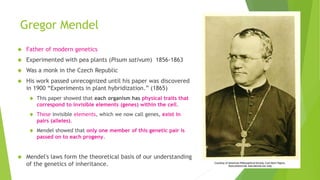
Gregor Mendel 
 Father of modern genetics 
 Experimented with pea plants (Pisum sativum) 1856-1863 
 Was a monk in the Czech Republic 
 His work passed unrecognized until his paper was discovered 
in 1900 “Experiments in plant hybridization.” (1865) 
 This paper showed that each organism has physical traits that 
correspond to invisible elements (genes) within the cell. 
 These invisible elements, which we now call genes, exist in 
pairs (alleles). 
 Mendel showed that only one member of this genetic pair is 
passed on to each progeny. 
 Mendel's laws form the theoretical basis of our understanding 
of the genetics of inheritance.
What he did right 
 Picked the pea plant which is easy self or cross pollinate and grows fast. 
 Chose to study traits with only two possible phenotypes : 
 Pea texture: round or wrinkled seed phenotype 
 Pea color: yellow or green seed phenotype 
 Flower color: red or white flower phenotype 
 Pea plant size: tall or dwarf plant phenotype 
 Pea pod color: green or yellow
Genetic studies innovations 
 Mendel made two innovations to the science of genetics: 
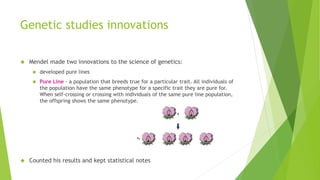
 developed pure lines 
 Pure Line - a population that breeds true for a particular trait. All individuals of 
the population have the same phenotype for a specific trait they are pure for. 
When self-crossing or crossing with individuals of the same pure line population, 
the offspring shows the same phenotype. 
 Counted his results and kept statistical notes
Law of Dominance or Uniformity of 
Hybrids. 
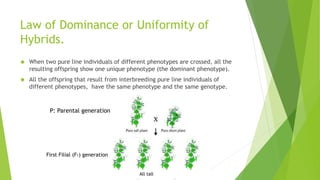
 When two pure line individuals of different phenotypes are crossed, all the 
resulting offspring show one unique phenotype (the dominant phenotype). 
 All the offspring that result from interbreeding pure line individuals of 
different phenotypes, have the same phenotype and the same genotype. 
All tall 
P: Parental generation 
First Filial (F1) generation
Representing the cross 
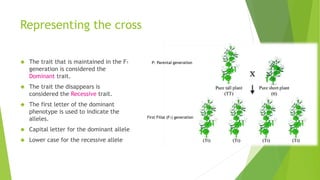
 The trait that is maintained in the F1 
generation is considered the 
Dominant trait. 
 The trait the disappears is 
considered the Recessive trait. 
 The first letter of the dominant 
phenotype is used to indicate the 
alleles. 
 Capital letter for the dominant allele 
 Lower case for the recessive allele 
P: Parental generation 
First Filial (F1) generation
How to begin 
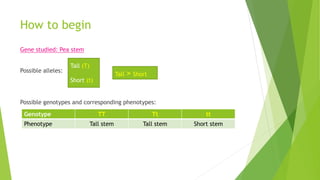
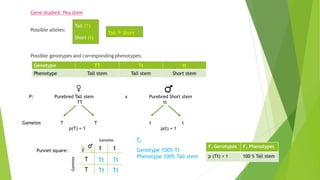
Gene studied: Pea stem 
Possible alleles: 
Tall (T) 
Short (t) 
Tall > Short 
Possible genotypes and corresponding phenotypes: 
Genotype TT Tt tt 
Phenotype Tall stem Tall stem Short stem
P: Purebred Tall stem x Purebred Short stem 
TT tt 
Gametes T T t t 
p(T) = 1 p(t) = 1 
Punnet square: 
Gametes 
T 
T 
t t 
Tt Tt 
Tt Tt 
Gametes 
F1 
Genotype 100% Tt 
Phenotype 100% Tall stem 
F1 Genotypes F1 Phenotypes 
p (Tt) = 1 100 % Tall stem
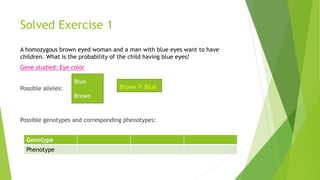
Solved Exercise 1 
A homozygous brown eyed woman and a man with blue eyes want to have 
children. What is the probability of the child having blue eyes? 
Gene studied: Eye color 
Possible alleles: 
Blue 
Brown 
Brown > Blue 
Possible genotypes and corresponding phenotypes: 
Genotype 
Phenotype
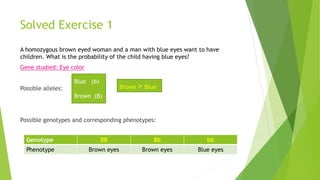
Solved Exercise 1 
A homozygous brown eyed woman and a man with blue eyes want to have 
children. What is the probability of the child having blue eyes? 
Gene studied: Eye color 
Possible alleles: 
Blue (b) 
Brown (B) 
Brown > Blue 
Possible genotypes and corresponding phenotypes: 
Genotype BB Bb bb 
Phenotype Brown eyes Brown eyes Blue eyes
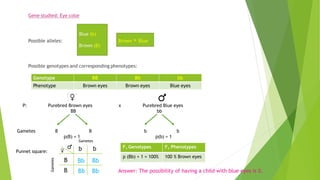
P: Purebred Brown eyes x Purebred Blue eyes 
BB bb 
Gametes B B b b 
Punnet square: 
p(B) = 1 p(b) = 1 
Gametes 
B 
B 
b b 
Bb Bb 
Bb Bb 
Gametes 
F1 Genotypes F1 Phenotypes 
p (Bb) = 1 = 100% 100 % Brown eyes 
Answer: The possibility of having a child with blue eyes is 0.
Exercise 2 
What is the probability of getting a pea plant with wrinkled peas if we cross two 
hybrids? 
Gene studied: Pea texture 
Possible alleles: 
Smooth ___ 
Wrinkled ___ 
Smooth > Wrinkled 
Possible genotypes and corresponding phenotypes: 
Genotype 
Phenotype
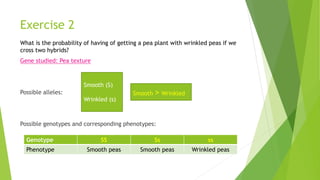
Exercise 2 
What is the probability of having of getting a pea plant with wrinkled peas if we 
cross two hybrids? 
Gene studied: Pea texture 
Possible alleles: 
Smooth (S) 
Wrinkled (s) 
Smooth > Wrinkled 
Possible genotypes and corresponding phenotypes: 
Genotype SS Ss ss 
Phenotype Smooth peas Smooth peas Wrinkled peas
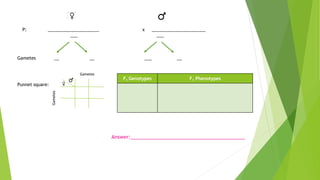
P: _____________________ x ______________________ 
___ ___ 
Gametes __ __ ___ __ 
Punnet square: 
Gametes 
Gametes 
F1 Genotypes F1 Phenotypes 
Answer:_________________________________________
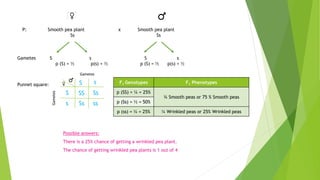
P: Smooth pea plant x Smooth pea plant 
Ss Ss 
Gametes S s S s 
p (S) = ½ p(s) = ½ p (S) = ½ p(s) = ½ 
Punnet square: 
Gametes 
Gametes 
S 
SS Ss 
Ss ss 
S 
s 
s F1 Genotypes F1 Phenotypes 
p (SS) = ¼ = 25% 
¾ Smooth peas or 75 % Smooth peas 
p (Ss) = ½ = 50% 
p (ss) = ¼ = 25% ¼ Wrinkled peas or 25% Wrinkled peas 
Possible answers: 
There is a 25% chance of getting a wrinkled pea plant. 
The chance of getting wrinkled pea plants is 1 out of 4
Developing the 
Law of Segregation 
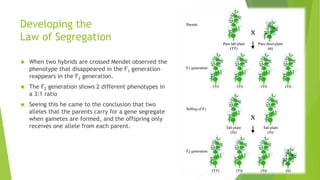
 When two hybrids are crossed Mendel observed the 
phenotype that disappeared in the F1 generation 
reappears in the F2 generation. 
 The F2 generation shows 2 different phenotypes in 
a 3:1 ratio 
 Seeing this he came to the conclusion that two 
alleles that the parents carry for a gene segregate 
when gametes are formed, and the offspring only 
receives one allele from each parent.
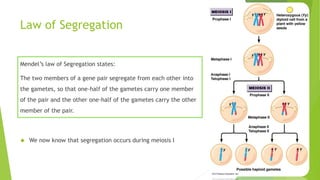
Law of Segregation 
Mendel’s law of Segregation states: 
The two members of a gene pair segregate from each other into 
the gametes, so that one-half of the gametes carry one member 
of the pair and the other one-half of the gametes carry the other 
member of the pair. 
 We now know that segregation occurs during meiosis I
Exercise 3 
How can I find out if a black hen is purebred or heterozygous? 
Gene studied: Color feathers in hens 
Possible alleles: 
Black ___ 
White ___ 
Black > White 
Possible genotypes and corresponding phenotypes: 
Genotype 
Phenotype
P: Black feathered hen x White feathered rooster 
(homozygous recessive) 
BB or Bb bb 
Gametes ___ ___ or ___ ___ ___ ___ 
Punnet square: 
Gametes 
Gametes 
F1 Genotypes F1 Phenotypes 
Answer: If the black feathered hen is purebred (BB) ________________________________________ 
Test cross 
Gametes 
Gametes 
or 
F1 Genotypes F1 Phenotypes 
Answer: If the black feathered hen is hybrid (Bb) _______________________ 
Therefore, if when we cross a black feathered hen with a white feathered hen, we get a white 
feathered hen we know that ___________________ 
1st Possibility 
2nd Possibility 
1st Possibility 2nd Possibility 
1st Possibility 
2nd Possibility

Lesson 8 mendelian inheritance

  • 1.
    LESSON # 8 If my father is blond, why am I not?
  • 2.
  • 3.
    Gregor Mendel Father of modern genetics  Experimented with pea plants (Pisum sativum) 1856-1863  Was a monk in the Czech Republic  His work passed unrecognized until his paper was discovered in 1900 “Experiments in plant hybridization.” (1865)  This paper showed that each organism has physical traits that correspond to invisible elements (genes) within the cell.  These invisible elements, which we now call genes, exist in pairs (alleles).  Mendel showed that only one member of this genetic pair is passed on to each progeny.  Mendel's laws form the theoretical basis of our understanding of the genetics of inheritance.
  • 4.
    What he didright  Picked the pea plant which is easy self or cross pollinate and grows fast.  Chose to study traits with only two possible phenotypes :  Pea texture: round or wrinkled seed phenotype  Pea color: yellow or green seed phenotype  Flower color: red or white flower phenotype  Pea plant size: tall or dwarf plant phenotype  Pea pod color: green or yellow
  • 5.
    Genetic studies innovations  Mendel made two innovations to the science of genetics:  developed pure lines  Pure Line - a population that breeds true for a particular trait. All individuals of the population have the same phenotype for a specific trait they are pure for. When self-crossing or crossing with individuals of the same pure line population, the offspring shows the same phenotype.  Counted his results and kept statistical notes
  • 6.
    Law of Dominanceor Uniformity of Hybrids.  When two pure line individuals of different phenotypes are crossed, all the resulting offspring show one unique phenotype (the dominant phenotype).  All the offspring that result from interbreeding pure line individuals of different phenotypes, have the same phenotype and the same genotype. All tall P: Parental generation First Filial (F1) generation
  • 7.
    Representing the cross  The trait that is maintained in the F1 generation is considered the Dominant trait.  The trait the disappears is considered the Recessive trait.  The first letter of the dominant phenotype is used to indicate the alleles.  Capital letter for the dominant allele  Lower case for the recessive allele P: Parental generation First Filial (F1) generation
  • 8.
    How to begin Gene studied: Pea stem Possible alleles: Tall (T) Short (t) Tall > Short Possible genotypes and corresponding phenotypes: Genotype TT Tt tt Phenotype Tall stem Tall stem Short stem
  • 9.
    P: Purebred Tallstem x Purebred Short stem TT tt Gametes T T t t p(T) = 1 p(t) = 1 Punnet square: Gametes T T t t Tt Tt Tt Tt Gametes F1 Genotype 100% Tt Phenotype 100% Tall stem F1 Genotypes F1 Phenotypes p (Tt) = 1 100 % Tall stem
  • 10.
    Solved Exercise 1 A homozygous brown eyed woman and a man with blue eyes want to have children. What is the probability of the child having blue eyes? Gene studied: Eye color Possible alleles: Blue Brown Brown > Blue Possible genotypes and corresponding phenotypes: Genotype Phenotype
  • 11.
    Solved Exercise 1 A homozygous brown eyed woman and a man with blue eyes want to have children. What is the probability of the child having blue eyes? Gene studied: Eye color Possible alleles: Blue (b) Brown (B) Brown > Blue Possible genotypes and corresponding phenotypes: Genotype BB Bb bb Phenotype Brown eyes Brown eyes Blue eyes
  • 12.
    P: Purebred Browneyes x Purebred Blue eyes BB bb Gametes B B b b Punnet square: p(B) = 1 p(b) = 1 Gametes B B b b Bb Bb Bb Bb Gametes F1 Genotypes F1 Phenotypes p (Bb) = 1 = 100% 100 % Brown eyes Answer: The possibility of having a child with blue eyes is 0.
  • 13.
    Exercise 2 Whatis the probability of getting a pea plant with wrinkled peas if we cross two hybrids? Gene studied: Pea texture Possible alleles: Smooth ___ Wrinkled ___ Smooth > Wrinkled Possible genotypes and corresponding phenotypes: Genotype Phenotype
  • 14.
    Exercise 2 Whatis the probability of having of getting a pea plant with wrinkled peas if we cross two hybrids? Gene studied: Pea texture Possible alleles: Smooth (S) Wrinkled (s) Smooth > Wrinkled Possible genotypes and corresponding phenotypes: Genotype SS Ss ss Phenotype Smooth peas Smooth peas Wrinkled peas
  • 15.
    P: _____________________ x______________________ ___ ___ Gametes __ __ ___ __ Punnet square: Gametes Gametes F1 Genotypes F1 Phenotypes Answer:_________________________________________
  • 16.
    P: Smooth peaplant x Smooth pea plant Ss Ss Gametes S s S s p (S) = ½ p(s) = ½ p (S) = ½ p(s) = ½ Punnet square: Gametes Gametes S SS Ss Ss ss S s s F1 Genotypes F1 Phenotypes p (SS) = ¼ = 25% ¾ Smooth peas or 75 % Smooth peas p (Ss) = ½ = 50% p (ss) = ¼ = 25% ¼ Wrinkled peas or 25% Wrinkled peas Possible answers: There is a 25% chance of getting a wrinkled pea plant. The chance of getting wrinkled pea plants is 1 out of 4
  • 17.
    Developing the Lawof Segregation  When two hybrids are crossed Mendel observed the phenotype that disappeared in the F1 generation reappears in the F2 generation.  The F2 generation shows 2 different phenotypes in a 3:1 ratio  Seeing this he came to the conclusion that two alleles that the parents carry for a gene segregate when gametes are formed, and the offspring only receives one allele from each parent.
  • 18.
    Law of Segregation Mendel’s law of Segregation states: The two members of a gene pair segregate from each other into the gametes, so that one-half of the gametes carry one member of the pair and the other one-half of the gametes carry the other member of the pair.  We now know that segregation occurs during meiosis I
  • 19.
    Exercise 3 Howcan I find out if a black hen is purebred or heterozygous? Gene studied: Color feathers in hens Possible alleles: Black ___ White ___ Black > White Possible genotypes and corresponding phenotypes: Genotype Phenotype
  • 20.
    P: Black featheredhen x White feathered rooster (homozygous recessive) BB or Bb bb Gametes ___ ___ or ___ ___ ___ ___ Punnet square: Gametes Gametes F1 Genotypes F1 Phenotypes Answer: If the black feathered hen is purebred (BB) ________________________________________ Test cross Gametes Gametes or F1 Genotypes F1 Phenotypes Answer: If the black feathered hen is hybrid (Bb) _______________________ Therefore, if when we cross a black feathered hen with a white feathered hen, we get a white feathered hen we know that ___________________ 1st Possibility 2nd Possibility 1st Possibility 2nd Possibility 1st Possibility 2nd Possibility