PRESSURE TRACING OF
LEFT VENTRICLE
By
Gopal C Ghosh
History of cardiac catheterisation
“The cardiac catheter was......the key in the
lock”-Andre Cournand (1956)
Cardiac catheterization was first performed by
Claude Bernard in 1844(horse)
Stephen Hales – as first to do cardiac
catheterisation in animals(1711 on horse)
Mueller RL et al. Am Heart J 1995;129:146.
Cardiac catheterisation in human
• Werner Theodor Otto Forssmann( August
1904 – June 1979)
• First to do cardiac catheterisation in human
heart
• Retrograde left heart catheterization was
first reported by Zimmerman, Scott &
Becker and Limon-Lason and Bouchard in
1950.
Zimmerman HA, Scott RW, Becker ND. Catheterization of the left side of the
heart in man. Circulation 1950;1:357.
Dynamic pressure monitoring
• Dynamic blood pressure has been of interest to
physiologists and physicians
• 1732- Stephen Hales measured the blood
pressure of a horse by using a vertical glass
tube
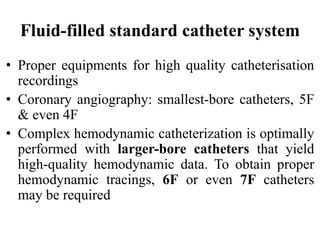
Fluid-filled standard catheter system
• Proper equipments for high quality catheterisation
recordings
• Coronary angiography: smallest-bore catheters, 5F
& even 4F
• Complex hemodynamic catheterization is optimally
performed with larger-bore catheters that yield
high-quality hemodynamic data. To obtain proper
hemodynamic tracings, 6F or even 7F catheters
may be required
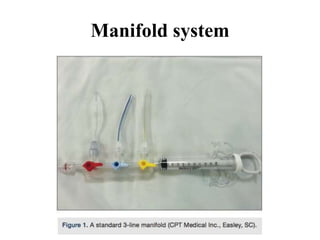
Manifold system
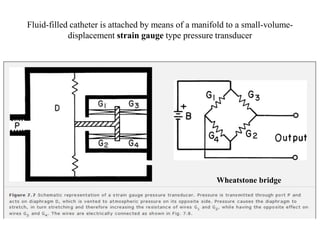
Fluid-filled catheter is attached by means of a manifold to a small-volume-
displacement strain gauge type pressure transducer
Wheatstone bridge
Pressure Measurement
Terminology
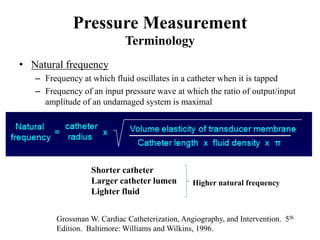
• Natural frequency
– Frequency at which fluid oscillates in a catheter when it is tapped
– Frequency of an input pressure wave at which the ratio of output/input
amplitude of an undamaged system is maximal
Grossman W. Cardiac Catheterization, Angiography, and Intervention. 5th
Edition. Baltimore: Williams and Wilkins, 1996.
Shorter catheter
Larger catheter lumen
Lighter fluid
Higher natural frequency
Damping
• Dissipation of the energy of oscillation of a
pressure management system, due to friction
Greater fluid viscosity
Smaller catheter radius
Less dense fluid
Greater damping
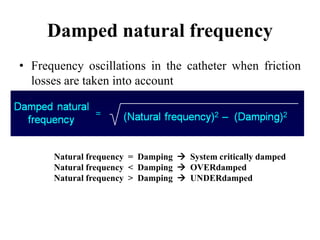
Damped natural frequency
• Frequency oscillations in the catheter when friction
losses are taken into account
Natural frequency = Damping  System critically damped
Natural frequency < Damping  OVERdamped
Natural frequency > Damping  UNDERdamped
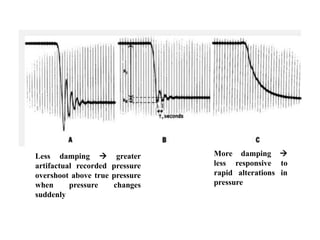
Less damping  greater
artifactual recorded pressure
overshoot above true pressure
when pressure changes
suddenly
More damping 
less responsive to
rapid alterations in
pressure
Sensitivity
• Ratio of amplitude of the recorded
signal to the amplitude of the input
signal
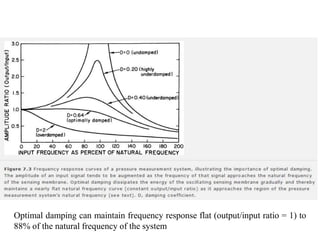
Optimal damping can maintain frequency response flat (output/input ratio = 1) to
88% of the natural frequency of the system
Frequency response
• Ratio of output amplitude to input
amplitude over a range of frequencies of the
input pressure wave
• Frequency response of a catheter system is
dependent on catheter’s natural frequency
and amount of damping
• The higher the natural frequency of the system,
the more accurate the pressure measurement
at lower physiologic frequencies
Grossman W. Cardiac Catheterization, Angiography, and Intervention.
7th Edition.
What is the optimal frequency
response?
• The essential physiologic information is
contained within the first 10 harmonics of the
pressure wave's Fourier series
• The useful frequency response range of
commonly used pressure measurement
systems is usually <20 Hz
• Frequency response was flat to <10 Hz with
small-bore (6F) catheters
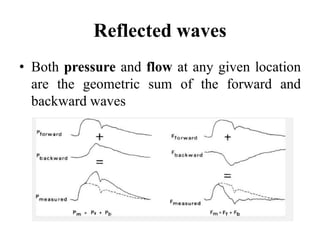
Reflected waves
• Both pressure and flow at any given location
are the geometric sum of the forward and
backward waves
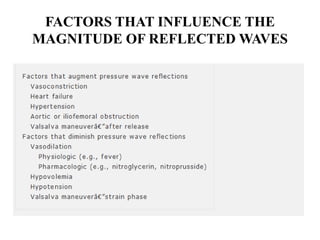
FACTORS THAT INFLUENCE THE
MAGNITUDE OF REFLECTED WAVES
Sources of Error
• Tachycardia
 If pulse is too fast for natural frequency of system, the fidelity of
the recording will drop.
 Pulse = 120  10th harmonic = 20 Hz  Damped natural
frequency should be at least 60 Hz
• Sudden changes in pressure
• Deterioration in frequency response
• Catheter whip artifact
• End-pressure artifact
• Catheter impact artifact
• Systolic pressure amplification in the periphery
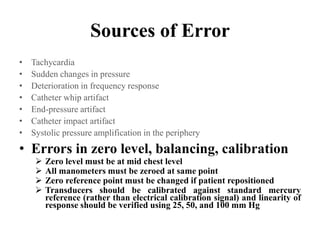
• Errors in zero level, balancing, calibration
Sources of Error
• Tachycardia
• Sudden changes in pressure
 Peak LV systole, trough early diastole, catheter bumping against
wall of valve
 Artifact seen due to under damping
• Deterioration in frequency response
• Catheter whip artifact
• End-pressure artifact
• Catheter impact artifact
• Systolic pressure amplification in the periphery
• Errors in zero level, balancing, calibration
Sources of Error
• Tachycardia
• Sudden changes in pressure
• Deterioration in frequency response
 Introduction of air or stopcocks permits damping and reduces
natural frequency by serving as added compliance
 When natural frequency of pressure system and low frequency
components falls, high frequency components of the pressure
waveform (intraventricular pressure rise and fall) may set the
system into oscillation, producing “pressure overshoots” in early
systole & diastole
• Catheter whip artifact
• End-pressure artifact
• Catheter impact artifact
• Systolic pressure amplification in the periphery
• Errors in zero level, balancing, calibration
Sources of Error
• Tachycardia
• Sudden changes in pressure
• Deterioration in frequency response
• Catheter whip artifact
 Motion of the catheter within heart or large vessels accelerates fluid in
catheter and produces superimposed waves of  10 mm Hg
 Common in pulmonary arteries & unavoidable
• End-pressure artifact
• Catheter impact artifact
• Systolic pressure amplification in the periphery
• Errors in zero level, balancing, calibration
Sources of Error
• Tachycardia
• Sudden changes in pressure
• Deterioration in frequency response
• Catheter whip artifact
• End-pressure artifact
 Pressure from endhole catheter pointing upstream is artifactually
elevated. When blood flow is halted at tip of catheter, kinetic
energy is converted in part to pressure. Added pressure may range
2-10 mm Hg.
 When endhole catheter is oriented into the stream of flow, the
“suction” can lower pressure by up to 5%
• Catheter impact artifact
• Systolic pressure amplification in the periphery
• Errors in zero level, balancing, calibration
Sources of Error
• Tachycardia
• Sudden changes in pressure
• Deterioration in frequency response
• Catheter whip artifact
• End-pressure artifact
• Catheter impact artifact
 Pressure transient produced by impact on the fluid-filled catheter
by an adjacent structure (i.e. heart valve)
 Any frequency component of this transient that coincides with the
natural frequency of the catheter manometer system will cause a
superimposed oscillation on the recorded pressure wave
 Common with pigtail catheters in the left ventricular chamber,
where the terminal pigtail may be hit by the mitral valve leaflets as
they open
• Systolic pressure amplification in the periphery
• Errors in zero level, balancing, calibration
Sources of Error
• Tachycardia
• Sudden changes in pressure
• Deterioration in frequency response
• Catheter whip artifact
• End-pressure artifact
• Catheter impact artifact
• Systolic pressure amplification in the
periphery
 Consequence of reflected wave
 Peripheral arterial systolic pressure commonly 20 mm Hg higher than
central aortic pressure (mean pressure same or slightly lower)
 Masks pressure gradients in LV or across aortic valve
 Use of a double-lumen catheter (e.g., double-lumen pigtail) or
trans-septal technique with a second catheter in the central aorta
can be helpful
• Errors in zero level, balancing, calibration
Sources of Error
• Tachycardia
• Sudden changes in pressure
• Deterioration in frequency response
• Catheter whip artifact
• End-pressure artifact
• Catheter impact artifact
• Systolic pressure amplification in the periphery
• Errors in zero level, balancing, calibration
 Zero level must be at mid chest level
 All manometers must be zeroed at same point
 Zero reference point must be changed if patient repositioned
 Transducers should be calibrated against standard mercury
reference (rather than electrical calibration signal) and linearity of
response should be verified using 25, 50, and 100 mm Hg
Intracardiac micromanometers
(Catheter-tip pressure manometer)
• High fidelity transducer catheter with
miniaturized transducer placed at tip (Millar
Instruments)
• Improved frequency response characteristics
and reduced artifact
• Measurement of myocardial mechanics
(dP/dt of LV)
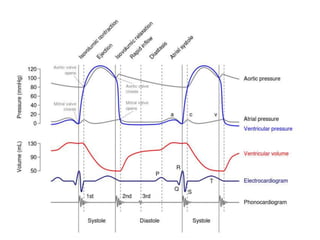
Cardiac cycle
Wiggers Diagram
• Systolic ejection phase - QT interval on the
ECG
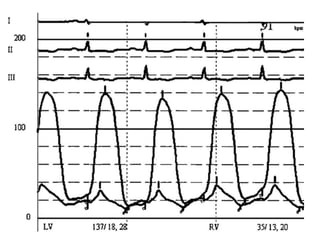
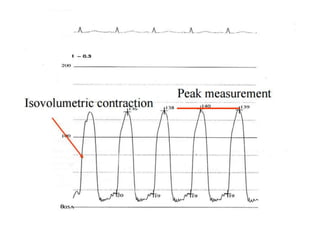
• LV systolic pressure is measured at the peak
pressure of the ejection phase
Left ventricular end diastolic pressure
• End Diastolic pressure can be measured on the
R wave of the ECG, which will coincide just
after the ‘a’ wave on the LV trace. This is
called the post ‘a’ wave measurement of EDP
• To be measured at end expiration
Aortic Pressure
Anachrotic Notch
• During the first phase of ventricular systole
(isovolumetric contraction), a presystolic rise
may be seen
• Occurs before the opening of the aortic valve
Dichrotic notch
• Blood flow attempts to equalize by flowing
backwards - results in closure of the aortic
valve
• This event marks the end of systole and the
start of diastole
Pulse Pressure
• The difference between the systolic and
diastolic pressure
• Factors Factors that affect pulse pressure
pressure
– changes in stroke volume
– aortic regurgitation
– changes in vascular compliance
Common cardiological conditions
Needs invasive monitoring
Aortic Stenosis(severity)
• Discrepancy between the physical examination
and the elements of the Doppler echocardiogram
• Optimal technique: record simultaneously
obtained left ventricular and ascending aortic
pressures
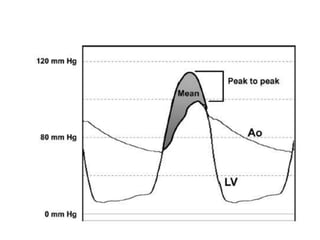
• Mean gradient differences not the peak to
peak gradient (peak left ventricular pressure
does not occur simultaneously with the peak
aortic pressure)
• Pullback traces with a single catheter from the
left ventricle to the aorta can be helpful, but
only if the patient is in normal sinus rhythm
with a regular rate
• Carabello sign:
Critical aortic stenosis
Catheter across the valve itself will cause
further obstruction to outflow
This sign occurs in valve areas 0.6 cm2 or less
& when 7F or 8F catheters are used to cross
the valve
Carabello sign
Use side hole catheters. Aortic pressure damping
can occure with end hole catheters
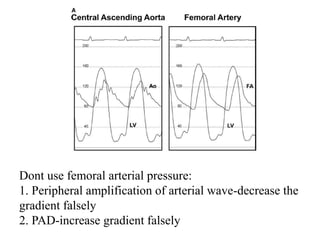
Dont use femoral arterial pressure:
1. Peripheral amplification of arterial wave-decrease the
gradient falsely
2. PAD-increase gradient falsely
Evaluation of low flow low gradient
aortic stenosis(LVEF<40%)
• Gradient (<30 mm Hg) and a low output,
resulting in a small calculated valve
area(<1cm2)
• These patients with low-flow/low-gradient AS
(LF/LGAS) may truly have severe AS with
resultant myocardial failure (true AS) or may
have more moderate degrees of AS and
unrelated myocardial dysfunction (pseudo-
AS)
• True AS: increased flow across a fixed valve
orifice results in increased transvalvular flow
velocity and gradients, without a change in
calculated valve area.
• Pseudo-AS: augmented flow results in only a
mild increase in transvalvular gradient and
an increase in valve area by ≥0.2 cm2
Dynamic LVOT obstruction
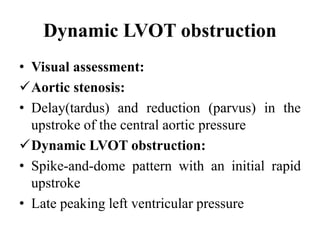
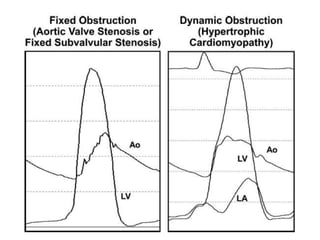
• Visual assessment:
Aortic stenosis:
• Delay(tardus) and reduction (parvus) in the
upstroke of the central aortic pressure
Dynamic LVOT obstruction:
• Spike-and-dome pattern with an initial rapid
upstroke
• Late peaking left ventricular pressure
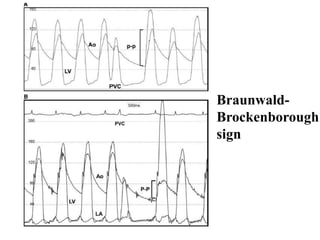
Braunwald-
Brockenborough
sign
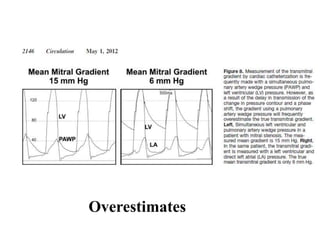
Mitral Stenosis
• Continuous-wave Doppler echocardiography is
highly accurate
• Noninvasive estimations are inconsistent &
pulmonary hypertension out of proportion to
the apparent severity of the mitral valve
disease
• Simultaneous pulmonary artery wedge
pressure and left ventricular pressure
Overestimates
Evaluation of valvular regurgitation
• left ventriculography and aortic
angiography are the modalities most often
used to assess the severity of valve
regurgitation
• When there is a discrepency between clinical
assessment and dopplar echocardiographic
measurement
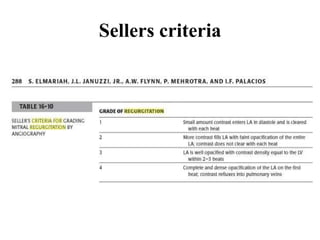
• Sellar criteria used
Sellers criteria
Precautions
• Large-bore catheters and a large amount of
contrast to completely opacify the cardiac
chambers(small amount underestimate)
• Avoidance of ventricular ectopy and entrapment
of the mitral valve apparatus by the catheter
• High right anterior oblique views for left
ventriculograms may be necessary to avoid the
retrograde contrast from being superimposed on
the spine or descending aorta
Evaluation of aortic regurgitation
• Grade 1: a small amount of contrast material enters the
left ventricle in diastole; it is essentially cleared with
each beat and never fills the ventricular chamber
• Grade 2: More contrast material enters with each
diastole and faint opacification of the entire chamber
occurs
• Grade 3: the LV chamber is well opacified and equal in
density with the ascending aorta
• Grade 4: complete, dense opacification of the LV
chamber in one beat, and the left ventricle appears more
densely opacified than the ascending aorta
Part of the angiographic assessment of aortic
regurgitation involves assessment of (LAO
view):
1. Aortic valve leaflets (mobility, calcification,
number of leaflets)
2. Ascending aorta (extent and type of
dilatation)
3. Possible associated abnormalities (e.g.,
coronary lesions, sinus of Valsalva aneurysm,
dissecting aneurysm of the aorta, and
ventricular septal defect)
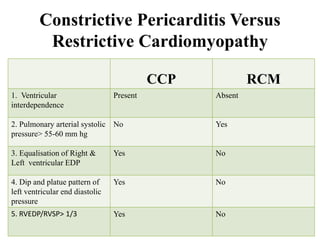
Constrictive Pericarditis Versus
Restrictive Cardiomyopathy
CCP RCM
1. Ventricular
interdependence
Present Absent
2. Pulmonary arterial systolic
pressure> 55-60 mm hg
No Yes
3. Equalisation of Right &
Left ventricular EDP
Yes No
4. Dip and platue pattern of
left ventricular end diastolic
pressure
Yes No
5. RVEDP/RVSP> 1/3 Yes No
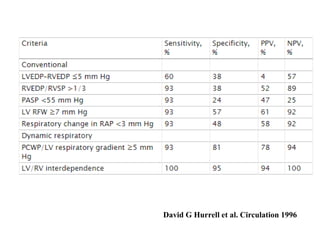
David G Hurrell et al. Circulation 1996
Ventricular interdependence
• Highly sensitive & specific
• Also seen in cardiac tamponade, acute right
ventricular infarction, subacute tricuspid
regurgitation
• Inspiratory decrease in pulmonary venous and
intrathoracic pressure is not transmitted into
the cardiac chambers
Hatle et al. Circulation.1989;79:357-370.
Irina Kozarez et al.
Grand Rounds Vol
11 pages 111–114
Hypertrophic Cardiomyopathy
• There is frequently a dynamic left ventricular
outflow tract obstruction that is highly
dependent on loading conditions and the
contractile state of the ventricle
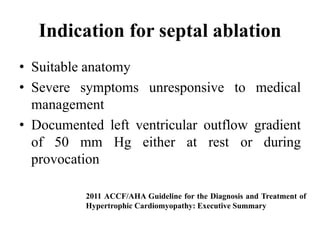
Indication for septal ablation
• Suitable anatomy
• Severe symptoms unresponsive to medical
management
• Documented left ventricular outflow gradient
of 50 mm Hg either at rest or during
provocation
2011 ACCF/AHA Guideline for the Diagnosis and Treatment of
Hypertrophic Cardiomyopathy: Executive Summary
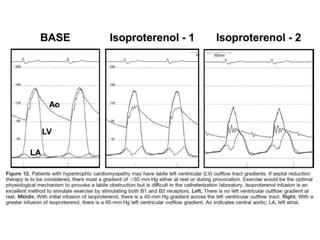
• If there is a gradient 50 mm Hg at rest,
provocative maneuvers such as the Valsalva
maneuver or induction of a premature
ventricular contraction should be performed
• However, if a gradient is not provoked with
these maneuvers, infusion of isoproterenol is
helpful because direct stimulation of the beta 1
and beta 2 receptors simulates exercise and
may uncover a labile outflow tract gradient
Hemodynamics
• The left ventricular outflow tract gradient is
dynamic and can change significantly during a
single diagnostic catheterization
• It is recommended that catheters such as a
multipurpose or Rodriquez catheter with side
holes at the distal portion of the catheter
should be used to determine the exact location
of obstruction (pigtail with multiple side holes
to be avoided & single end hole catheters to be
avoided)
Nishimura et al. Circulation 2012
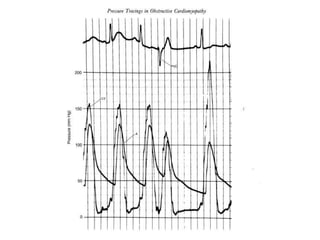
Brockenbrough-Braunwald sign
• The decrease in pulse pressure after a
premature ventricular contraction is due to
reduced stroke volume caused by increased
dynamic obstruction
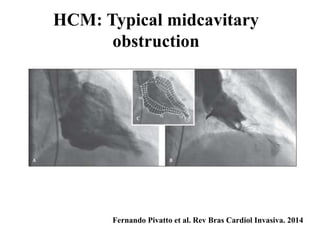
HCM: Typical midcavitary
obstruction
Fernando Pivatto et al. Rev Bras Cardiol Invasiva. 2014
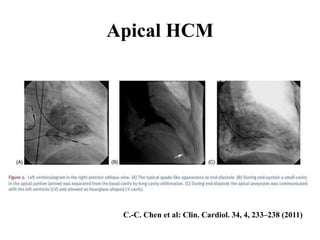
Apical HCM
C.-C. Chen et al: Clin. Cardiol. 34, 4, 233–238 (2011)
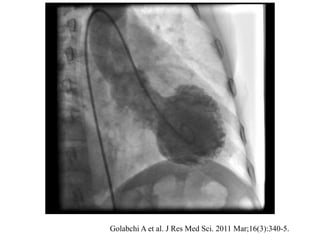
Takotsubo cardiomyopathy
• Apical ballooning with basal hyperkinesis on
the left ventriculogram.
Golabchi A et al. J Res Med Sci. 2011 Mar;16(3):340-5.
Left ventricular pressure tracings

Left ventricular pressure tracings

  • 1.
    PRESSURE TRACING OF LEFTVENTRICLE By Gopal C Ghosh
  • 2.
    History of cardiaccatheterisation “The cardiac catheter was......the key in the lock”-Andre Cournand (1956) Cardiac catheterization was first performed by Claude Bernard in 1844(horse) Stephen Hales – as first to do cardiac catheterisation in animals(1711 on horse) Mueller RL et al. Am Heart J 1995;129:146.
  • 3.
    Cardiac catheterisation inhuman • Werner Theodor Otto Forssmann( August 1904 – June 1979) • First to do cardiac catheterisation in human heart • Retrograde left heart catheterization was first reported by Zimmerman, Scott & Becker and Limon-Lason and Bouchard in 1950. Zimmerman HA, Scott RW, Becker ND. Catheterization of the left side of the heart in man. Circulation 1950;1:357.
  • 4.
    Dynamic pressure monitoring •Dynamic blood pressure has been of interest to physiologists and physicians • 1732- Stephen Hales measured the blood pressure of a horse by using a vertical glass tube
  • 5.
    Fluid-filled standard cathetersystem • Proper equipments for high quality catheterisation recordings • Coronary angiography: smallest-bore catheters, 5F & even 4F • Complex hemodynamic catheterization is optimally performed with larger-bore catheters that yield high-quality hemodynamic data. To obtain proper hemodynamic tracings, 6F or even 7F catheters may be required
  • 7.
  • 8.
    Fluid-filled catheter isattached by means of a manifold to a small-volume- displacement strain gauge type pressure transducer Wheatstone bridge
  • 9.
    Pressure Measurement Terminology • Naturalfrequency – Frequency at which fluid oscillates in a catheter when it is tapped – Frequency of an input pressure wave at which the ratio of output/input amplitude of an undamaged system is maximal Grossman W. Cardiac Catheterization, Angiography, and Intervention. 5th Edition. Baltimore: Williams and Wilkins, 1996. Shorter catheter Larger catheter lumen Lighter fluid Higher natural frequency
  • 10.
    Damping • Dissipation ofthe energy of oscillation of a pressure management system, due to friction Greater fluid viscosity Smaller catheter radius Less dense fluid Greater damping
  • 11.
    Damped natural frequency •Frequency oscillations in the catheter when friction losses are taken into account Natural frequency = Damping  System critically damped Natural frequency < Damping  OVERdamped Natural frequency > Damping  UNDERdamped
  • 12.
    Less damping greater artifactual recorded pressure overshoot above true pressure when pressure changes suddenly More damping  less responsive to rapid alterations in pressure
  • 13.
    Sensitivity • Ratio ofamplitude of the recorded signal to the amplitude of the input signal
  • 14.
    Optimal damping canmaintain frequency response flat (output/input ratio = 1) to 88% of the natural frequency of the system
  • 15.
    Frequency response • Ratioof output amplitude to input amplitude over a range of frequencies of the input pressure wave • Frequency response of a catheter system is dependent on catheter’s natural frequency and amount of damping • The higher the natural frequency of the system, the more accurate the pressure measurement at lower physiologic frequencies Grossman W. Cardiac Catheterization, Angiography, and Intervention. 7th Edition.
  • 16.
    What is theoptimal frequency response? • The essential physiologic information is contained within the first 10 harmonics of the pressure wave's Fourier series • The useful frequency response range of commonly used pressure measurement systems is usually <20 Hz • Frequency response was flat to <10 Hz with small-bore (6F) catheters
  • 17.
    Reflected waves • Bothpressure and flow at any given location are the geometric sum of the forward and backward waves
  • 18.
    FACTORS THAT INFLUENCETHE MAGNITUDE OF REFLECTED WAVES
  • 20.
    Sources of Error •Tachycardia  If pulse is too fast for natural frequency of system, the fidelity of the recording will drop.  Pulse = 120  10th harmonic = 20 Hz  Damped natural frequency should be at least 60 Hz • Sudden changes in pressure • Deterioration in frequency response • Catheter whip artifact • End-pressure artifact • Catheter impact artifact • Systolic pressure amplification in the periphery • Errors in zero level, balancing, calibration
  • 21.
    Sources of Error •Tachycardia • Sudden changes in pressure  Peak LV systole, trough early diastole, catheter bumping against wall of valve  Artifact seen due to under damping • Deterioration in frequency response • Catheter whip artifact • End-pressure artifact • Catheter impact artifact • Systolic pressure amplification in the periphery • Errors in zero level, balancing, calibration
  • 22.
    Sources of Error •Tachycardia • Sudden changes in pressure • Deterioration in frequency response  Introduction of air or stopcocks permits damping and reduces natural frequency by serving as added compliance  When natural frequency of pressure system and low frequency components falls, high frequency components of the pressure waveform (intraventricular pressure rise and fall) may set the system into oscillation, producing “pressure overshoots” in early systole & diastole • Catheter whip artifact • End-pressure artifact • Catheter impact artifact • Systolic pressure amplification in the periphery • Errors in zero level, balancing, calibration
  • 23.
    Sources of Error •Tachycardia • Sudden changes in pressure • Deterioration in frequency response • Catheter whip artifact  Motion of the catheter within heart or large vessels accelerates fluid in catheter and produces superimposed waves of  10 mm Hg  Common in pulmonary arteries & unavoidable • End-pressure artifact • Catheter impact artifact • Systolic pressure amplification in the periphery • Errors in zero level, balancing, calibration
  • 24.
    Sources of Error •Tachycardia • Sudden changes in pressure • Deterioration in frequency response • Catheter whip artifact • End-pressure artifact  Pressure from endhole catheter pointing upstream is artifactually elevated. When blood flow is halted at tip of catheter, kinetic energy is converted in part to pressure. Added pressure may range 2-10 mm Hg.  When endhole catheter is oriented into the stream of flow, the “suction” can lower pressure by up to 5% • Catheter impact artifact • Systolic pressure amplification in the periphery • Errors in zero level, balancing, calibration
  • 25.
    Sources of Error •Tachycardia • Sudden changes in pressure • Deterioration in frequency response • Catheter whip artifact • End-pressure artifact • Catheter impact artifact  Pressure transient produced by impact on the fluid-filled catheter by an adjacent structure (i.e. heart valve)  Any frequency component of this transient that coincides with the natural frequency of the catheter manometer system will cause a superimposed oscillation on the recorded pressure wave  Common with pigtail catheters in the left ventricular chamber, where the terminal pigtail may be hit by the mitral valve leaflets as they open • Systolic pressure amplification in the periphery • Errors in zero level, balancing, calibration
  • 26.
    Sources of Error •Tachycardia • Sudden changes in pressure • Deterioration in frequency response • Catheter whip artifact • End-pressure artifact • Catheter impact artifact • Systolic pressure amplification in the periphery  Consequence of reflected wave  Peripheral arterial systolic pressure commonly 20 mm Hg higher than central aortic pressure (mean pressure same or slightly lower)  Masks pressure gradients in LV or across aortic valve  Use of a double-lumen catheter (e.g., double-lumen pigtail) or trans-septal technique with a second catheter in the central aorta can be helpful • Errors in zero level, balancing, calibration
  • 27.
    Sources of Error •Tachycardia • Sudden changes in pressure • Deterioration in frequency response • Catheter whip artifact • End-pressure artifact • Catheter impact artifact • Systolic pressure amplification in the periphery • Errors in zero level, balancing, calibration  Zero level must be at mid chest level  All manometers must be zeroed at same point  Zero reference point must be changed if patient repositioned  Transducers should be calibrated against standard mercury reference (rather than electrical calibration signal) and linearity of response should be verified using 25, 50, and 100 mm Hg
  • 28.
    Intracardiac micromanometers (Catheter-tip pressuremanometer) • High fidelity transducer catheter with miniaturized transducer placed at tip (Millar Instruments) • Improved frequency response characteristics and reduced artifact • Measurement of myocardial mechanics (dP/dt of LV)
  • 30.
  • 32.
    • Systolic ejectionphase - QT interval on the ECG • LV systolic pressure is measured at the peak pressure of the ejection phase
  • 33.
    Left ventricular enddiastolic pressure • End Diastolic pressure can be measured on the R wave of the ECG, which will coincide just after the ‘a’ wave on the LV trace. This is called the post ‘a’ wave measurement of EDP • To be measured at end expiration
  • 36.
  • 38.
    Anachrotic Notch • Duringthe first phase of ventricular systole (isovolumetric contraction), a presystolic rise may be seen • Occurs before the opening of the aortic valve
  • 39.
    Dichrotic notch • Bloodflow attempts to equalize by flowing backwards - results in closure of the aortic valve • This event marks the end of systole and the start of diastole
  • 40.
    Pulse Pressure • Thedifference between the systolic and diastolic pressure • Factors Factors that affect pulse pressure pressure – changes in stroke volume – aortic regurgitation – changes in vascular compliance
  • 41.
  • 42.
    Aortic Stenosis(severity) • Discrepancybetween the physical examination and the elements of the Doppler echocardiogram • Optimal technique: record simultaneously obtained left ventricular and ascending aortic pressures • Mean gradient differences not the peak to peak gradient (peak left ventricular pressure does not occur simultaneously with the peak aortic pressure)
  • 44.
    • Pullback traceswith a single catheter from the left ventricle to the aorta can be helpful, but only if the patient is in normal sinus rhythm with a regular rate • Carabello sign: Critical aortic stenosis Catheter across the valve itself will cause further obstruction to outflow This sign occurs in valve areas 0.6 cm2 or less & when 7F or 8F catheters are used to cross the valve
  • 45.
  • 46.
    Use side holecatheters. Aortic pressure damping can occure with end hole catheters
  • 47.
    Dont use femoralarterial pressure: 1. Peripheral amplification of arterial wave-decrease the gradient falsely 2. PAD-increase gradient falsely
  • 48.
    Evaluation of lowflow low gradient aortic stenosis(LVEF<40%) • Gradient (<30 mm Hg) and a low output, resulting in a small calculated valve area(<1cm2) • These patients with low-flow/low-gradient AS (LF/LGAS) may truly have severe AS with resultant myocardial failure (true AS) or may have more moderate degrees of AS and unrelated myocardial dysfunction (pseudo- AS)
  • 49.
    • True AS:increased flow across a fixed valve orifice results in increased transvalvular flow velocity and gradients, without a change in calculated valve area. • Pseudo-AS: augmented flow results in only a mild increase in transvalvular gradient and an increase in valve area by ≥0.2 cm2
  • 50.
    Dynamic LVOT obstruction •Visual assessment: Aortic stenosis: • Delay(tardus) and reduction (parvus) in the upstroke of the central aortic pressure Dynamic LVOT obstruction: • Spike-and-dome pattern with an initial rapid upstroke • Late peaking left ventricular pressure
  • 52.
  • 53.
    Mitral Stenosis • Continuous-waveDoppler echocardiography is highly accurate • Noninvasive estimations are inconsistent & pulmonary hypertension out of proportion to the apparent severity of the mitral valve disease • Simultaneous pulmonary artery wedge pressure and left ventricular pressure
  • 54.
  • 55.
    Evaluation of valvularregurgitation • left ventriculography and aortic angiography are the modalities most often used to assess the severity of valve regurgitation • When there is a discrepency between clinical assessment and dopplar echocardiographic measurement • Sellar criteria used
  • 56.
  • 57.
    Precautions • Large-bore cathetersand a large amount of contrast to completely opacify the cardiac chambers(small amount underestimate) • Avoidance of ventricular ectopy and entrapment of the mitral valve apparatus by the catheter • High right anterior oblique views for left ventriculograms may be necessary to avoid the retrograde contrast from being superimposed on the spine or descending aorta
  • 58.
    Evaluation of aorticregurgitation • Grade 1: a small amount of contrast material enters the left ventricle in diastole; it is essentially cleared with each beat and never fills the ventricular chamber • Grade 2: More contrast material enters with each diastole and faint opacification of the entire chamber occurs • Grade 3: the LV chamber is well opacified and equal in density with the ascending aorta • Grade 4: complete, dense opacification of the LV chamber in one beat, and the left ventricle appears more densely opacified than the ascending aorta
  • 59.
    Part of theangiographic assessment of aortic regurgitation involves assessment of (LAO view): 1. Aortic valve leaflets (mobility, calcification, number of leaflets) 2. Ascending aorta (extent and type of dilatation) 3. Possible associated abnormalities (e.g., coronary lesions, sinus of Valsalva aneurysm, dissecting aneurysm of the aorta, and ventricular septal defect)
  • 60.
    Constrictive Pericarditis Versus RestrictiveCardiomyopathy CCP RCM 1. Ventricular interdependence Present Absent 2. Pulmonary arterial systolic pressure> 55-60 mm hg No Yes 3. Equalisation of Right & Left ventricular EDP Yes No 4. Dip and platue pattern of left ventricular end diastolic pressure Yes No 5. RVEDP/RVSP> 1/3 Yes No
  • 61.
    David G Hurrellet al. Circulation 1996
  • 62.
    Ventricular interdependence • Highlysensitive & specific • Also seen in cardiac tamponade, acute right ventricular infarction, subacute tricuspid regurgitation • Inspiratory decrease in pulmonary venous and intrathoracic pressure is not transmitted into the cardiac chambers Hatle et al. Circulation.1989;79:357-370.
  • 64.
    Irina Kozarez etal. Grand Rounds Vol 11 pages 111–114
  • 65.
    Hypertrophic Cardiomyopathy • Thereis frequently a dynamic left ventricular outflow tract obstruction that is highly dependent on loading conditions and the contractile state of the ventricle
  • 66.
    Indication for septalablation • Suitable anatomy • Severe symptoms unresponsive to medical management • Documented left ventricular outflow gradient of 50 mm Hg either at rest or during provocation 2011 ACCF/AHA Guideline for the Diagnosis and Treatment of Hypertrophic Cardiomyopathy: Executive Summary
  • 67.
    • If thereis a gradient 50 mm Hg at rest, provocative maneuvers such as the Valsalva maneuver or induction of a premature ventricular contraction should be performed • However, if a gradient is not provoked with these maneuvers, infusion of isoproterenol is helpful because direct stimulation of the beta 1 and beta 2 receptors simulates exercise and may uncover a labile outflow tract gradient
  • 68.
  • 69.
    • The leftventricular outflow tract gradient is dynamic and can change significantly during a single diagnostic catheterization • It is recommended that catheters such as a multipurpose or Rodriquez catheter with side holes at the distal portion of the catheter should be used to determine the exact location of obstruction (pigtail with multiple side holes to be avoided & single end hole catheters to be avoided) Nishimura et al. Circulation 2012
  • 70.
    Brockenbrough-Braunwald sign • Thedecrease in pulse pressure after a premature ventricular contraction is due to reduced stroke volume caused by increased dynamic obstruction
  • 73.
    HCM: Typical midcavitary obstruction FernandoPivatto et al. Rev Bras Cardiol Invasiva. 2014
  • 74.
    Apical HCM C.-C. Chenet al: Clin. Cardiol. 34, 4, 233–238 (2011)
  • 75.
    Takotsubo cardiomyopathy • Apicalballooning with basal hyperkinesis on the left ventriculogram.
  • 76.
    Golabchi A etal. J Res Med Sci. 2011 Mar;16(3):340-5.