DR. ROHIT WALSE
FELLOW
INTERVENTION CARDIOLOGY
SCTIMST KERALA
Right Heart Catheters
SCOPE
• HISTORY
• INDICATIONS OF RHC
• GENERAL PURPOSE CATHETERS
• ANGIOGRAPHIC CATHETERS
HISTORY
• 1929- Werner Forssmann
• 1964- Ronald Bradley
• First person to describe the use of a
pulmonary-artery catheter in man
• Miniature catheter [extremely narrow portex
catheter (0·63 mm diam)] having no balloon
• 1970- Jeremy Swan &
William Ganz
• Balloon floatation catheter
• Balloon tip was a
modification of the simple
portex tubing method
developed by Bradley
INDICATIONS OF RHC
• Diagnostic indications
• Therapeutic indications
Diagnostic Indications
• Routine preop evaluation of VSD, ASD, TOF, CoA,
other complex CHD
• High flow or low flow physiology associated with
semilunar valves- Combined AS/AR, combined
PS/PR
• To measure transvalvular pressure difference in
PS, MS, AS
• BDG Cath prior to Fontan
• EP study
• Angiography
Diagnostic Indications
• Oxymetry-
• Shunt Quantification
• Calculate CO, CI
• Calculate PVR, SVR
Therapeutic Indication
• Closure of- ASD, VSD, PDA, MAPCA
• PTMC
• IVC filter
• BAS
• BPV
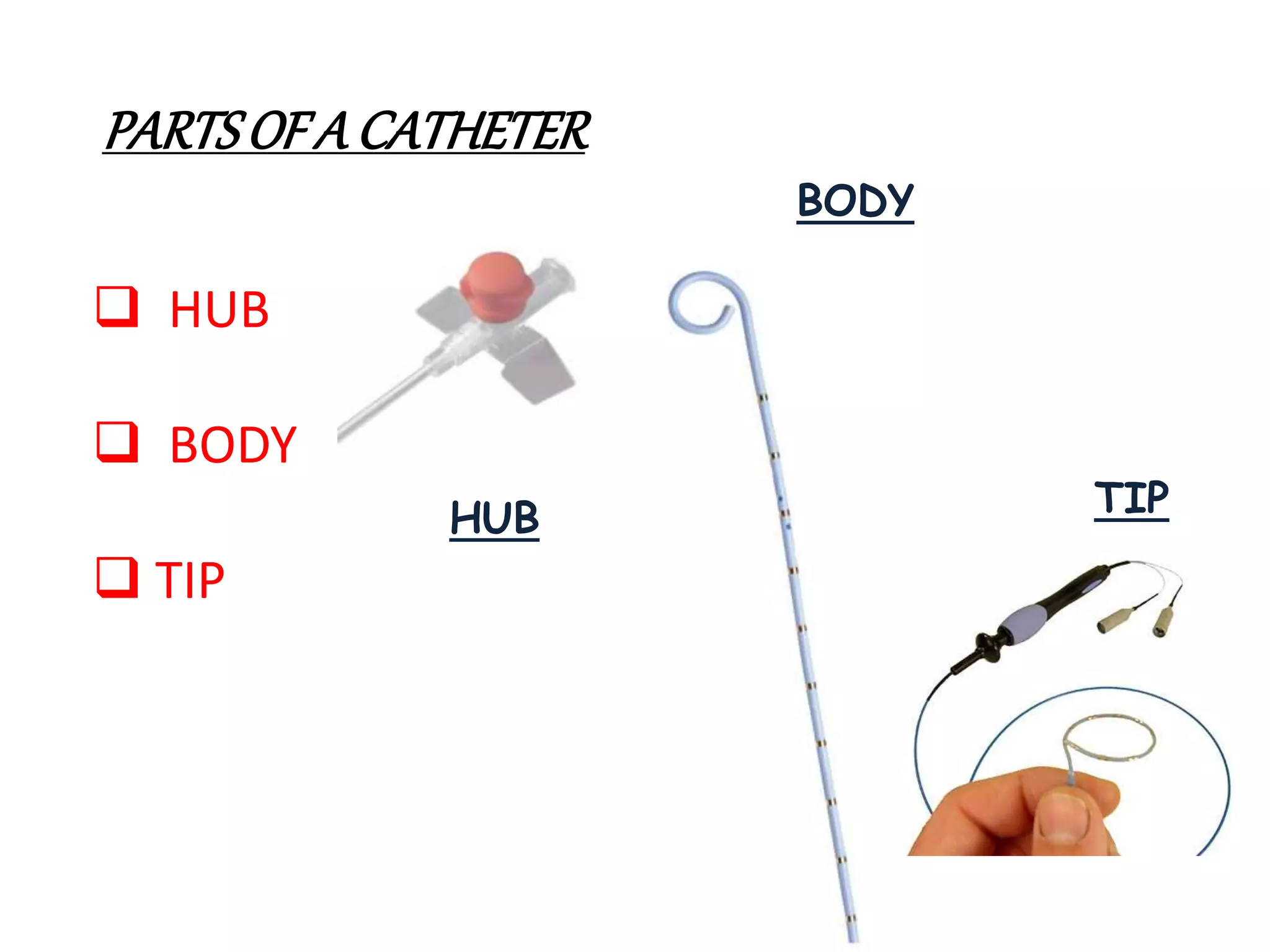
PARTSOF A CATHETER
 HUB
 BODY
 TIP
HUB
BODY
TIP
• TIP: Neither blunt nor too sharp, soft &
flexible.
• Bullet nose tip- least trauma, Though too
taper increased tip penetration.
• HUB: Metal or plastic, larger than catheter,
tapered hubs – easier insertion of guidewire.
TIP & HUB
• Rt heart catheters- 100 to 125 cm.
• Lt heart catheters- 100 to 110 cm.
• 125 cm for very tall person.
LENGTH
General purpose catheters
• Cournand
• Lehman
• Goodale-Lubin
• Multipurpose Catheter
• Balloon flotation catheters- Swan Ganz
Angiographic Catheters
• Pigtail angiographic catheter
• NIH
• Flow directed angiographic catheter(balloon
flotation catheter)
• Gensini
• Lehman Ventriculography
• Eppendorf
Cournand Catheter
• Designed by- Andre Cournand
• End hole radiopaque woven dacron catheter
with outer coating of polyurethrane & nylon
braiding
• Construction- Very gradual distal curve tapered
tip
• Use- All purpose right heart catheter & wedge
pressure recording
• Size- 5 to 8 F, Length- 100 & 125cm
• Disadv- needs frequent flushing, especially in
those with thrombotic tendency like cyanotic
CHD
Side Holes
ADVANTAGES
• Prevent catheter damping
[occlusion of coronary
ostium]
• Allow additional blood flow
out of tip, to perfuse artery
• Avoid catastrophic
dissections in the ostium of
artery
• Avoid disengagement
during injections
DISADVANTAGES
• False sense of security
becoz now aortic pressures
& not the coronary pressure
is being monitored
• Suboptimal opacification
• Makes catheter weak-
kinking at side holes
Goodale-Lubin Catheter
• Birdseye catheter
• Construction- Woven dacron coated with
polyurethane with nylon braiding
• Hole- Two laterally opposed oval shaped
sidehole near the endhole
• Use- Right heart pressure measurements,
Oxymetry Sampling
• Size- 4 to 8 F; length-80, 100 & 125 cm
GL Catheter
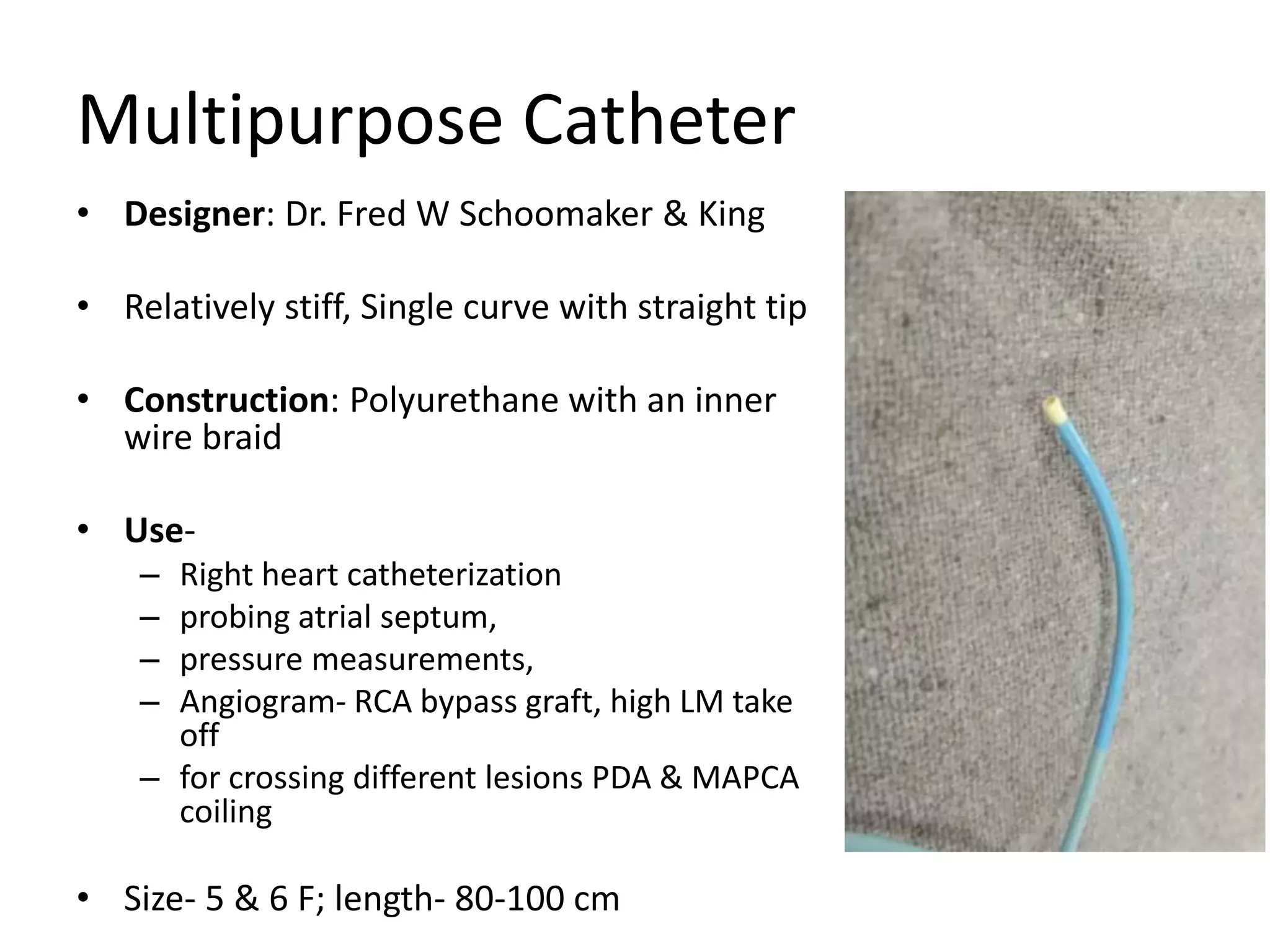
Multipurpose Catheter
• Designer: Dr. Fred W Schoomaker & King
• Relatively stiff, Single curve with straight tip
• Construction: Polyurethane with an inner
wire braid
• Use-
– Right heart catheterization
– probing atrial septum,
– pressure measurements,
– Angiogram- RCA bypass graft, high LM take
off
– for crossing different lesions PDA & MAPCA
coiling
• Size- 5 & 6 F; length- 80-100 cm
Balloon Floatation Catheter- Swan Ganz
• Available with 2-3 lumens
• Balloon tipped-floats through the right side of the
heart safely & easily
• Construction- Balloon- Latex; Shaft-PVC
– (a) Two lumen- Distal port for pressure monitoring &
one lumen for balloon
– (b) Three lumen- additional proximal port for RAP
monitoring
• Size- 5 to 7 F, Catheter length markings at every
10 cm, length-50-110 cm
Approx Balloon inflation
• 5 F  0.75 ml
• 6 F  1 ml
• 7 F  1.5 ml
Uses
• Wedge pressure measurement
• Occlusion Angiogram in CS prior to CRT
• To cross mitral valve in BMV
• To cross RSOV
• To cross PA in case of PS
ANGIOGRAPHIC CATHETERS
Pigtail Catheter
• Designer: Judkins
• Construction: Polyurethane or polyethylene with a
tapered tip, terminal 5 cm of which is coiled back on
itself in a tight loop with 3-6 pairs of side holes on shaft
• Use- LV, RV angiography, aortography & pulmonary
angiography
• Size- 4 to 7 F; Length-65, 80, 100 & 110cm, side holes-
6, 8 or 12
Pig tail Catheter
• The end hole permits insertion of a guide wire and hence
can negotiate through tortious vessels and stenotic valves.
• The loop shape keeps the end hole away from the
myocardium.
• Multiple side holes over several centimeters on the shaft
provides stability to the catheter preventing recoil.
• Advantages : excellent contrast delivery , Atraumatic
design, No endocardial staining, Less chance of VPCs , An
end-hole catheter may be used for pressure monitoring
TYPES OF PIG TAIL CATHETER
 Quanticor (Cardiomarker pigtail )
 Pigtail Angiographic
 Van Tassel angled pigtail
 Grollman PA
 Elliptical or Oval
 Tennis Racquet
CARDIOMARKER PIG TAIL
 This is a standard pigtail with radiopaque markers set
2 cm apart.
 These act to calibrate distance for quantitative
angiography.
 Exact LV distances, volumes and stroke volume can
then be calculated using these markers as a “ruler.”
VAN TASSEL ANGLED PIGTAIL
• 8 Non-laterally opposed side hole near the end hole.
• Has a 145˚or 155˚angle that lifts the catheter off the
inferior LV wall for a more centrally located LV gram
• Used for LV gram and aortography.
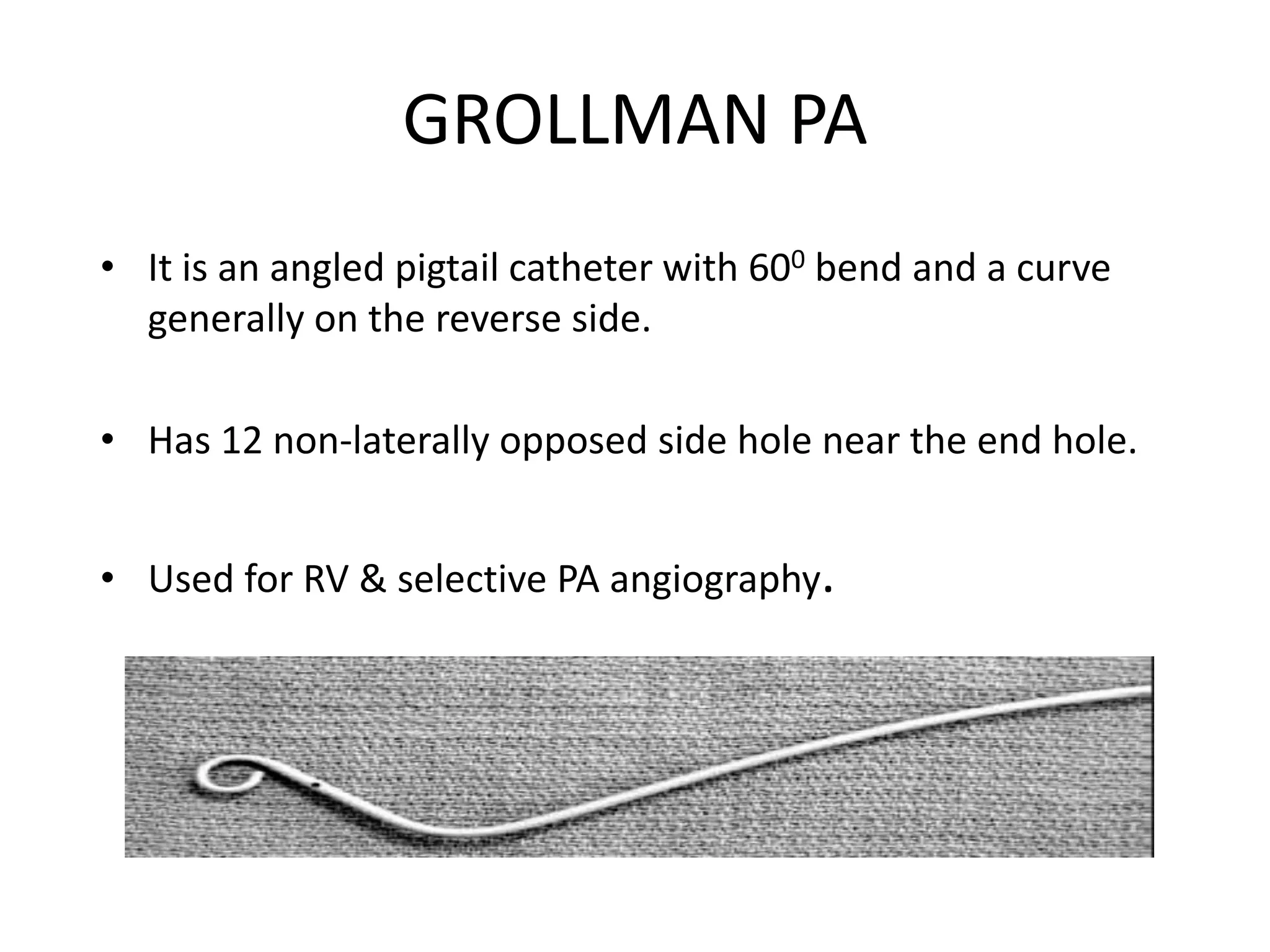
GROLLMAN PA
• It is an angled pigtail catheter with 600 bend and a curve
generally on the reverse side.
• Has 12 non-laterally opposed side hole near the end hole.
• Used for RV & selective PA angiography.
• PIGTAIL ANGIOGRAPHIC
The pigtail catheter is the most commonly used LV gram
catheter. With up to 12 side holes it evenly disperses the
contrast within the LV.
• ELLIPTICAL OR OVAL
Designed to pass small aortic valves or vessels with the
curve intact.
• TENNIS RACQUET
The central shaft was designed to reduce the risk of vessel
wall extravasation.
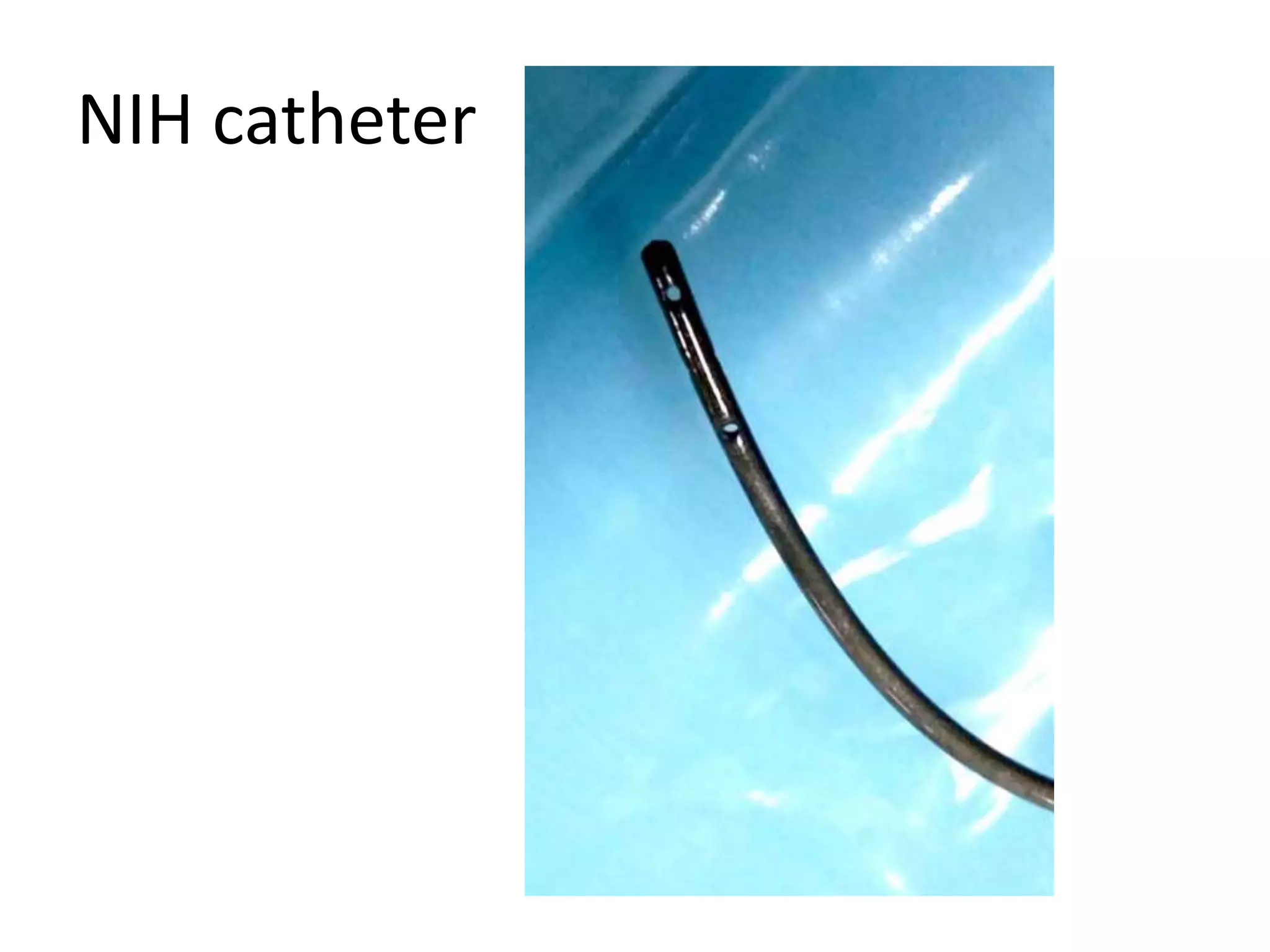
NIH Catheter
• It is a side hole catheter without any endhole
• Construction: Made up of woven dacron with nylon reinforcement
& especially stiff. Has 6 round side holes(3 pairs)
• COOK- polyethylene with stainless steel braid, 4 to 6 sideholes
• Polyurethane Cordis NIH cathter & Polyethylene Cook NIH Torcon
blue catheter are much softer & less likely to cause dissection or
perforation
• Use- Visualising RV, LV, arterial, pulmonary vasculature
• Size: 4 to 8 F, Length- 50 to 125 cm
NIH catheter
BALLOON FLOTATION ANGIOGRAPHIC CATHETER-
Berman
• Standard Berman
• Reverse Berman
• Size- 4 to 8F
• Selected French sizes –lengths-50-110cm
• Identification- (Colour coded Injection port)
• Standard Berman-Pink
• Reverse Berman- Blue
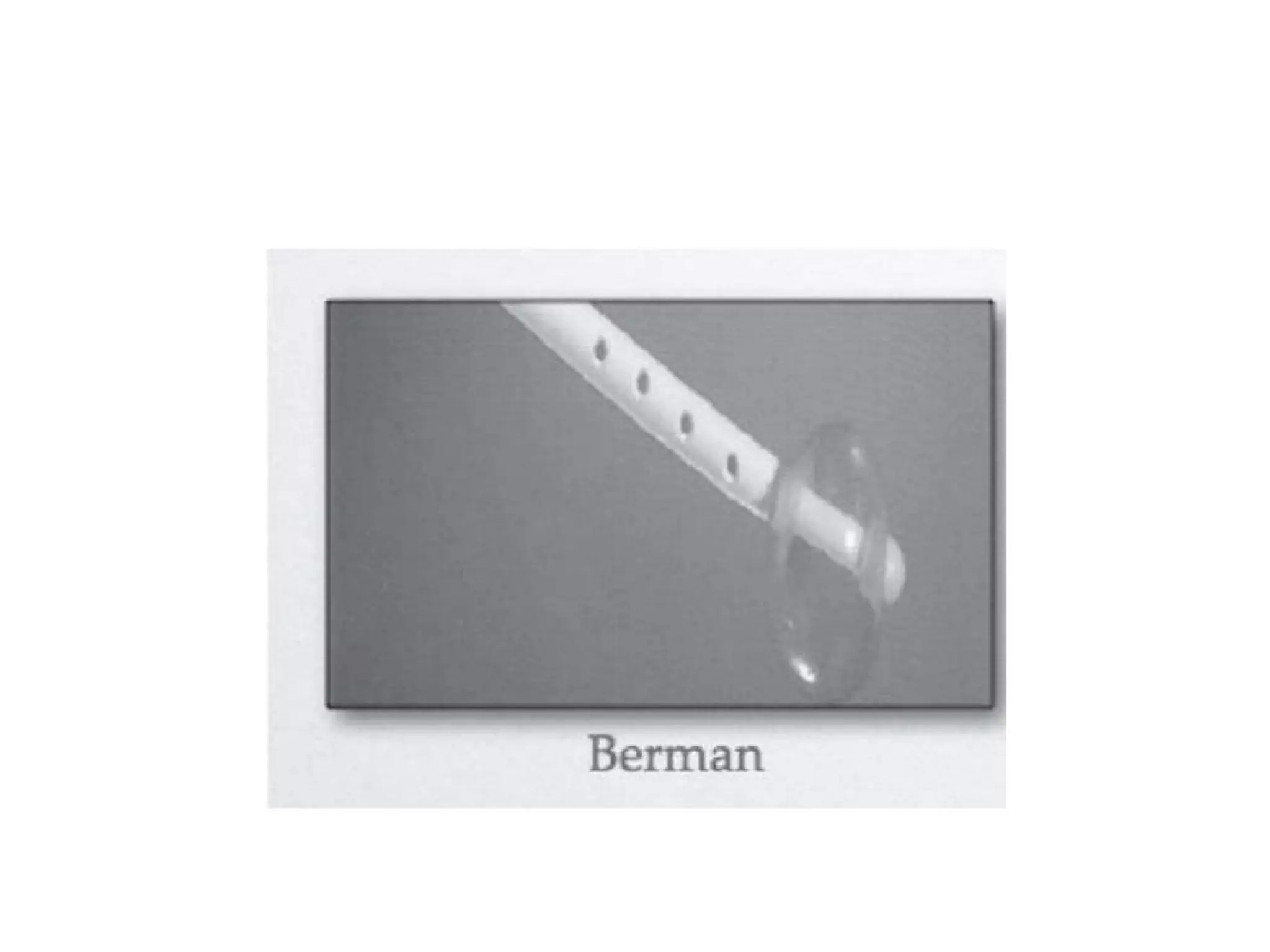
Berman Angiography Catheter
• Large Lumen- flow rates similar to pigtail catheter
• Balloon tipped-increases the catheter stability
during angiography
• No end hole-can’t measure wedge
• Multiple side holes-holes proximal to balloon
• Uses-
• Measurement of PA pressure
• Right Ventriculography
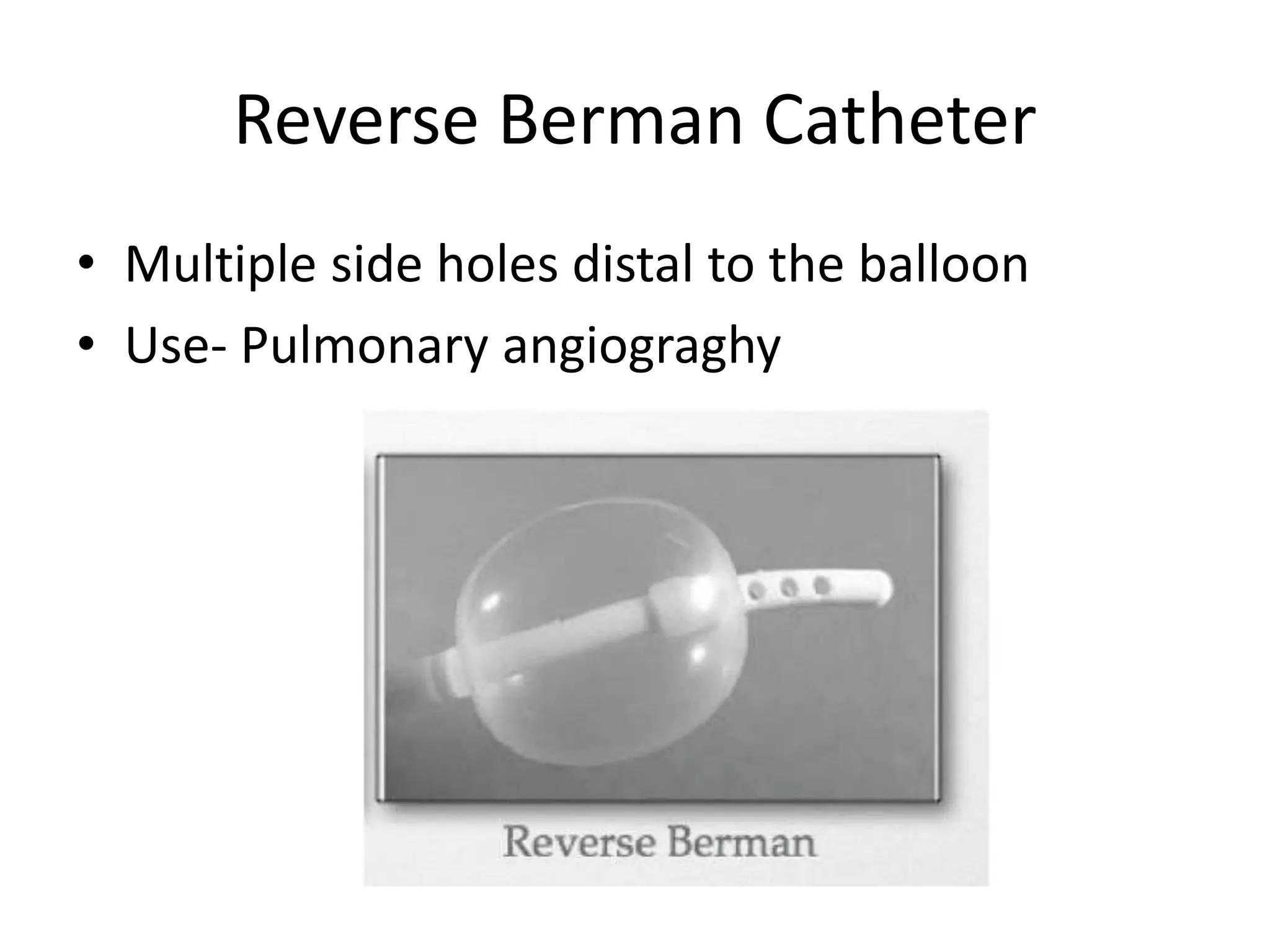
Reverse Berman Catheter
• Multiple side holes distal to the balloon
• Use- Pulmonary angiograghy
GENSINI CATHETER
• A type of straight tip catheter.
• Has 3 pairs of side holes and an end
hole.
• Used for left and right angiographic
studies.
• Recoils at high pressure rates and is
more arrhythmogenic and causes
more staining.
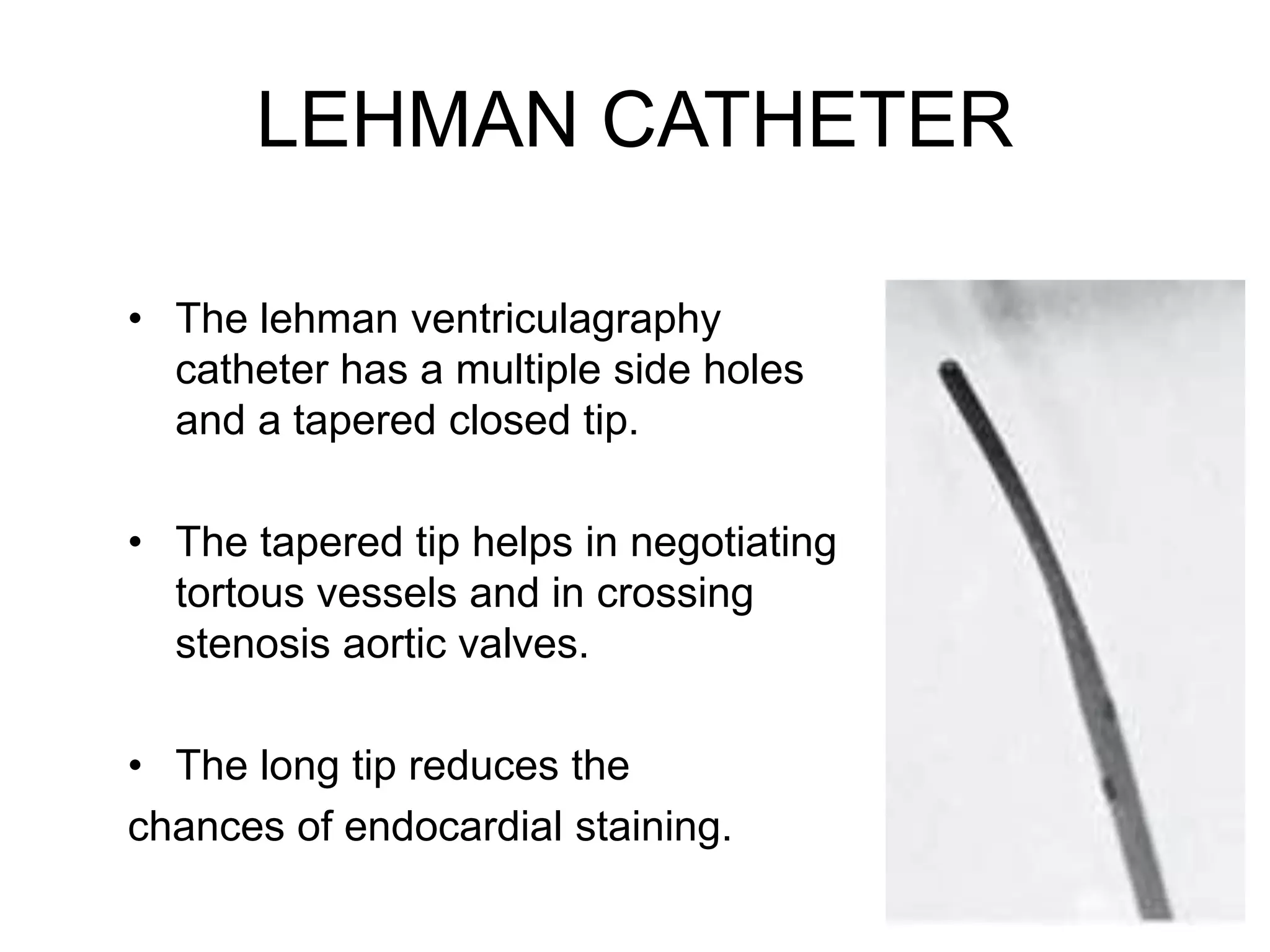
LEHMAN CATHETER
• The lehman ventriculagraphy
catheter has a multiple side holes
and a tapered closed tip.
• The tapered tip helps in negotiating
tortous vessels and in crossing
stenosis aortic valves.
• The long tip reduces the
chances of endocardial staining.
Right heart catheters

Right heart catheters

  • 1.
    DR. ROHIT WALSE FELLOW INTERVENTIONCARDIOLOGY SCTIMST KERALA Right Heart Catheters
  • 2.
    SCOPE • HISTORY • INDICATIONSOF RHC • GENERAL PURPOSE CATHETERS • ANGIOGRAPHIC CATHETERS
  • 3.
  • 4.
    • 1964- RonaldBradley • First person to describe the use of a pulmonary-artery catheter in man • Miniature catheter [extremely narrow portex catheter (0·63 mm diam)] having no balloon
  • 5.
    • 1970- JeremySwan & William Ganz • Balloon floatation catheter • Balloon tip was a modification of the simple portex tubing method developed by Bradley
  • 6.
    INDICATIONS OF RHC •Diagnostic indications • Therapeutic indications
  • 7.
    Diagnostic Indications • Routinepreop evaluation of VSD, ASD, TOF, CoA, other complex CHD • High flow or low flow physiology associated with semilunar valves- Combined AS/AR, combined PS/PR • To measure transvalvular pressure difference in PS, MS, AS • BDG Cath prior to Fontan • EP study • Angiography
  • 8.
    Diagnostic Indications • Oxymetry- •Shunt Quantification • Calculate CO, CI • Calculate PVR, SVR
  • 9.
    Therapeutic Indication • Closureof- ASD, VSD, PDA, MAPCA • PTMC • IVC filter • BAS • BPV
  • 10.
    PARTSOF A CATHETER HUB  BODY  TIP HUB BODY TIP
  • 11.
    • TIP: Neitherblunt nor too sharp, soft & flexible. • Bullet nose tip- least trauma, Though too taper increased tip penetration. • HUB: Metal or plastic, larger than catheter, tapered hubs – easier insertion of guidewire. TIP & HUB
  • 12.
    • Rt heartcatheters- 100 to 125 cm. • Lt heart catheters- 100 to 110 cm. • 125 cm for very tall person. LENGTH
  • 13.
    General purpose catheters •Cournand • Lehman • Goodale-Lubin • Multipurpose Catheter • Balloon flotation catheters- Swan Ganz
  • 14.
    Angiographic Catheters • Pigtailangiographic catheter • NIH • Flow directed angiographic catheter(balloon flotation catheter) • Gensini • Lehman Ventriculography • Eppendorf
  • 15.
    Cournand Catheter • Designedby- Andre Cournand • End hole radiopaque woven dacron catheter with outer coating of polyurethrane & nylon braiding • Construction- Very gradual distal curve tapered tip • Use- All purpose right heart catheter & wedge pressure recording • Size- 5 to 8 F, Length- 100 & 125cm • Disadv- needs frequent flushing, especially in those with thrombotic tendency like cyanotic CHD
  • 16.
    Side Holes ADVANTAGES • Preventcatheter damping [occlusion of coronary ostium] • Allow additional blood flow out of tip, to perfuse artery • Avoid catastrophic dissections in the ostium of artery • Avoid disengagement during injections DISADVANTAGES • False sense of security becoz now aortic pressures & not the coronary pressure is being monitored • Suboptimal opacification • Makes catheter weak- kinking at side holes
  • 17.
    Goodale-Lubin Catheter • Birdseyecatheter • Construction- Woven dacron coated with polyurethane with nylon braiding • Hole- Two laterally opposed oval shaped sidehole near the endhole • Use- Right heart pressure measurements, Oxymetry Sampling • Size- 4 to 8 F; length-80, 100 & 125 cm
  • 18.
  • 19.
    Multipurpose Catheter • Designer:Dr. Fred W Schoomaker & King • Relatively stiff, Single curve with straight tip • Construction: Polyurethane with an inner wire braid • Use- – Right heart catheterization – probing atrial septum, – pressure measurements, – Angiogram- RCA bypass graft, high LM take off – for crossing different lesions PDA & MAPCA coiling • Size- 5 & 6 F; length- 80-100 cm
  • 21.
    Balloon Floatation Catheter-Swan Ganz • Available with 2-3 lumens • Balloon tipped-floats through the right side of the heart safely & easily • Construction- Balloon- Latex; Shaft-PVC – (a) Two lumen- Distal port for pressure monitoring & one lumen for balloon – (b) Three lumen- additional proximal port for RAP monitoring • Size- 5 to 7 F, Catheter length markings at every 10 cm, length-50-110 cm
  • 23.
    Approx Balloon inflation •5 F  0.75 ml • 6 F  1 ml • 7 F  1.5 ml
  • 24.
    Uses • Wedge pressuremeasurement • Occlusion Angiogram in CS prior to CRT • To cross mitral valve in BMV • To cross RSOV • To cross PA in case of PS
  • 25.
  • 26.
    Pigtail Catheter • Designer:Judkins • Construction: Polyurethane or polyethylene with a tapered tip, terminal 5 cm of which is coiled back on itself in a tight loop with 3-6 pairs of side holes on shaft • Use- LV, RV angiography, aortography & pulmonary angiography • Size- 4 to 7 F; Length-65, 80, 100 & 110cm, side holes- 6, 8 or 12
  • 27.
    Pig tail Catheter •The end hole permits insertion of a guide wire and hence can negotiate through tortious vessels and stenotic valves. • The loop shape keeps the end hole away from the myocardium. • Multiple side holes over several centimeters on the shaft provides stability to the catheter preventing recoil. • Advantages : excellent contrast delivery , Atraumatic design, No endocardial staining, Less chance of VPCs , An end-hole catheter may be used for pressure monitoring
  • 28.
    TYPES OF PIGTAIL CATHETER  Quanticor (Cardiomarker pigtail )  Pigtail Angiographic  Van Tassel angled pigtail  Grollman PA  Elliptical or Oval  Tennis Racquet
  • 30.
    CARDIOMARKER PIG TAIL This is a standard pigtail with radiopaque markers set 2 cm apart.  These act to calibrate distance for quantitative angiography.  Exact LV distances, volumes and stroke volume can then be calculated using these markers as a “ruler.”
  • 31.
    VAN TASSEL ANGLEDPIGTAIL • 8 Non-laterally opposed side hole near the end hole. • Has a 145˚or 155˚angle that lifts the catheter off the inferior LV wall for a more centrally located LV gram • Used for LV gram and aortography.
  • 32.
    GROLLMAN PA • Itis an angled pigtail catheter with 600 bend and a curve generally on the reverse side. • Has 12 non-laterally opposed side hole near the end hole. • Used for RV & selective PA angiography.
  • 33.
    • PIGTAIL ANGIOGRAPHIC Thepigtail catheter is the most commonly used LV gram catheter. With up to 12 side holes it evenly disperses the contrast within the LV. • ELLIPTICAL OR OVAL Designed to pass small aortic valves or vessels with the curve intact. • TENNIS RACQUET The central shaft was designed to reduce the risk of vessel wall extravasation.
  • 35.
    NIH Catheter • Itis a side hole catheter without any endhole • Construction: Made up of woven dacron with nylon reinforcement & especially stiff. Has 6 round side holes(3 pairs) • COOK- polyethylene with stainless steel braid, 4 to 6 sideholes • Polyurethane Cordis NIH cathter & Polyethylene Cook NIH Torcon blue catheter are much softer & less likely to cause dissection or perforation • Use- Visualising RV, LV, arterial, pulmonary vasculature • Size: 4 to 8 F, Length- 50 to 125 cm
  • 36.
  • 37.
    BALLOON FLOTATION ANGIOGRAPHICCATHETER- Berman • Standard Berman • Reverse Berman • Size- 4 to 8F • Selected French sizes –lengths-50-110cm • Identification- (Colour coded Injection port) • Standard Berman-Pink • Reverse Berman- Blue
  • 38.
    Berman Angiography Catheter •Large Lumen- flow rates similar to pigtail catheter • Balloon tipped-increases the catheter stability during angiography • No end hole-can’t measure wedge • Multiple side holes-holes proximal to balloon • Uses- • Measurement of PA pressure • Right Ventriculography
  • 40.
    Reverse Berman Catheter •Multiple side holes distal to the balloon • Use- Pulmonary angiograghy
  • 42.
    GENSINI CATHETER • Atype of straight tip catheter. • Has 3 pairs of side holes and an end hole. • Used for left and right angiographic studies. • Recoils at high pressure rates and is more arrhythmogenic and causes more staining.
  • 43.
    LEHMAN CATHETER • Thelehman ventriculagraphy catheter has a multiple side holes and a tapered closed tip. • The tapered tip helps in negotiating tortous vessels and in crossing stenosis aortic valves. • The long tip reduces the chances of endocardial staining.

Editor's Notes

  • #4 proved that right heart catheterisation is possible in humans
  • #16 It has an end hole & no side holes- hence suitable for wedge pressure measurements