LOW FLOW AS
DR. DEEP CHANDH RAJA S
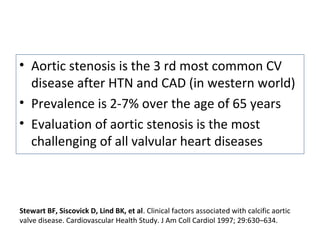
• Aortic stenosis is the 3 rd most common CV
disease after HTN and CAD (in western world)
• Prevalence is 2-7% over the age of 65 years
• Evaluation of aortic stenosis is the most
challenging of all valvular heart diseases
Stewart BF, Siscovick D, Lind BK, et al. Clinical factors associated with calcific aortic
valve disease. Cardiovascular Health Study. J Am Coll Cardiol 1997; 29:630–634.
2 MAJOR GUIDELINES
• ACC 2006
• ESC 2012
A FEW IMPORTANT NEW CONCLUSIONS IN ESC
2012 BASED ON EVOLVING NEW CONCEPTS
AFTER 2007 (MISSING IN ACC 2006)
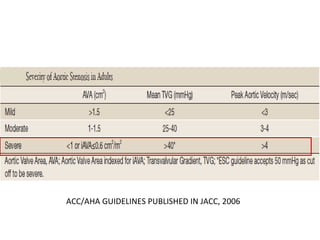
ACC/AHA GUIDELINES PUBLISHED IN JACC, 2006
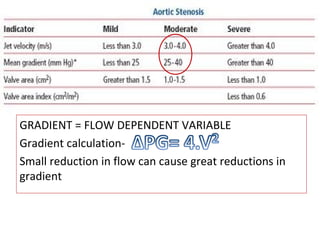
GRADIENT = FLOW DEPENDENT VARIABLE
Gradient calculation-
Small reduction in flow can cause great reductions in
gradient
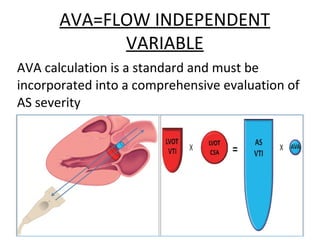
AVA calculation is a standard and must be
incorporated into a comprehensive evaluation of
AS severity
AVA=FLOW INDEPENDENT
VARIABLE
MISMATCH BETWEEN GRADIENTS
AND VALVE AREA
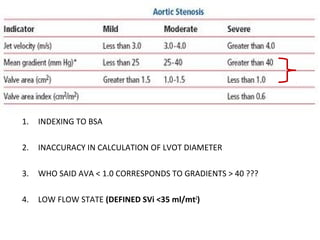
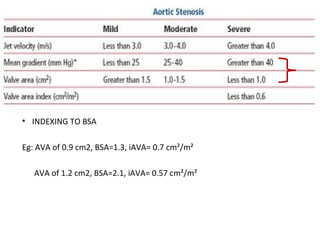
1. INDEXING TO BSA
2. INACCURACY IN CALCULATION OF LVOT DIAMETER
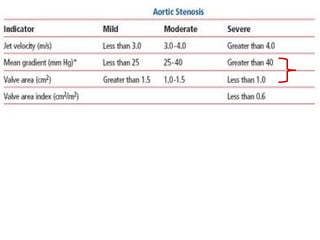
3. WHO SAID AVA < 1.0 CORRESPONDS TO GRADIENTS > 40 ???
4. LOW FLOW STATE (DEFINED SVi <35 ml/mt2
)
• INDEXING TO BSA
Eg: AVA of 0.9 cm2, BSA=1.3, iAVA= 0.7 cm²/m²
AVA of 1.2 cm2, BSA=2.1, iAVA= 0.57 cm²/m²
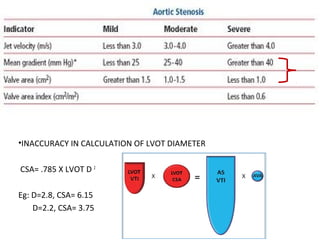
•INACCURACY IN CALCULATION OF LVOT DIAMETER
CSA= .785 X LVOT D 2
Eg: D=2.8, CSA= 6.15
D=2.2, CSA= 3.75
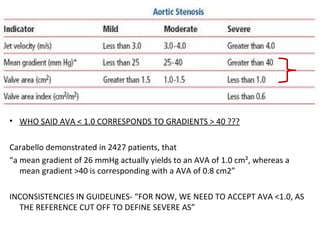
• WHO SAID AVA < 1.0 CORRESPONDS TO GRADIENTS > 40 ???
Carabello demonstrated in 2427 patients, that
“a mean gradient of 26 mmHg actually yields to an AVA of 1.0 cm², whereas a
mean gradient >40 is corresponding with a AVA of 0.8 cm2”
INCONSISTENCIES IN GUIDELINES- “FOR NOW, WE NEED TO ACCEPT AVA <1.0, AS
THE REFERENCE CUT OFF TO DEFINE SEVERE AS”
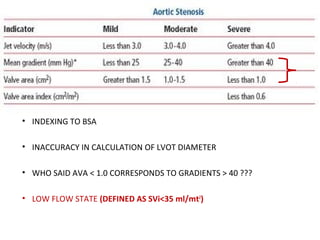
• INDEXING TO BSA
• INACCURACY IN CALCULATION OF LVOT DIAMETER
• WHO SAID AVA < 1.0 CORRESPONDS TO GRADIENTS > 40 ???
• LOW FLOW STATE (DEFINED AS SVi<35 ml/mt2
)
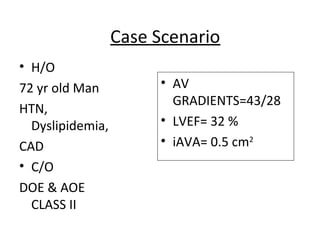
• H/O
72 yr old Man
HTN,
Dyslipidemia,
CAD
• C/O
DOE & AOE
CLASS II
• AV
GRADIENTS=43/28
• LVEF= 32 %
• iAVA= 0.5 cm2
Case Scenario
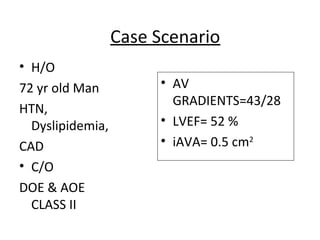
• H/O
72 yr old Man
HTN,
Dyslipidemia,
CAD
• C/O
DOE & AOE
CLASS II
• AV
GRADIENTS=43/28
• LVEF= 52 %
• iAVA= 0.5 cm2
Case Scenario
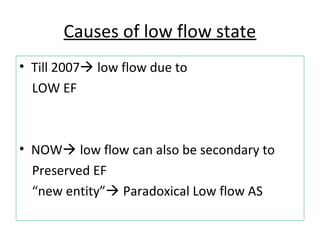
Causes of low flow state
• Till 2007 low flow due to
LOW EF
• NOW low flow can also be secondary to
Preserved EF
“new entity” Paradoxical Low flow AS
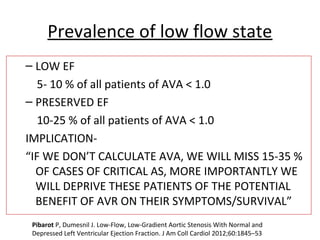
Prevalence of low flow state
– LOW EF
5- 10 % of all patients of AVA < 1.0
– PRESERVED EF
10-25 % of all patients of AVA < 1.0
IMPLICATION-
“IF WE DON’T CALCULATE AVA, WE WILL MISS 15-35 %
OF CASES OF CRITICAL AS, MORE IMPORTANTLY WE
WILL DEPRIVE THESE PATIENTS OF THE POTENTIAL
BENEFIT OF AVR ON THEIR SYMPTOMS/SURVIVAL”
Pibarot P, Dumesnil J. Low-Flow, Low-Gradient Aortic Stenosis With Normal and
Depressed Left Ventricular Ejection Fraction. J Am Coll Cardiol 2012;60:1845–53
LOW FLOW STATE
• LOW EF
• PRESERVED EF
• PATHOPHYSIOLOGY
• DIAGNOSIS
• TREATMENT OPTIONS
• PROGNOSIS
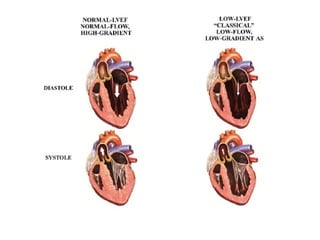
LOW FLOW, LOW EF, SEVERE AS
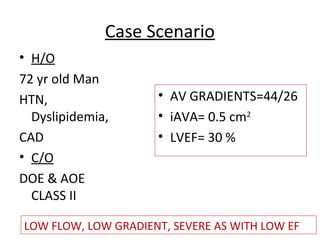
Case Scenario
• H/O
72 yr old Man
HTN,
Dyslipidemia,
CAD
• C/O
DOE & AOE
CLASS II
• AV GRADIENTS=44/26
• iAVA= 0.5 cm2
• LVEF= 30 %
LOW FLOW, LOW GRADIENT, SEVERE AS WITH LOW EF
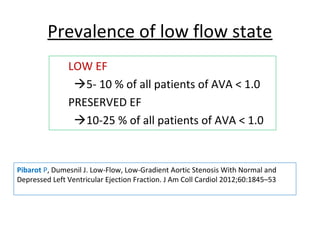
Prevalence of low flow state
LOW EF
5- 10 % of all patients of AVA < 1.0
PRESERVED EF
10-25 % of all patients of AVA < 1.0
Pibarot P, Dumesnil J. Low-Flow, Low-Gradient Aortic Stenosis With Normal and
Depressed Left Ventricular Ejection Fraction. J Am Coll Cardiol 2012;60:1845–53
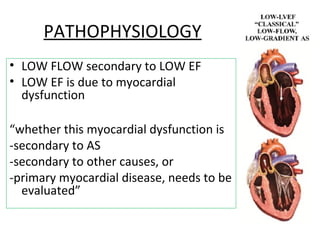
PATHOPHYSIOLOGY
• LOW FLOW secondary to LOW EF
• LOW EF is due to myocardial
dysfunction
“whether this myocardial dysfunction is
-secondary to AS
-secondary to other causes, or
-primary myocardial disease, needs to be
evaluated”
MYOCARDIAL DYSFUNCTION SECONDARY
TO CAUSES OTHER THAN AS
-DILATED CARDIOMYOPATHIES (1O
MYOCARDIAL
DYFUNCTION)
-ISCHEMIC HEART DISEASE
-HTN HEART DISEASE (AFTER LOAD MISMATCH)
In all these patients, AVA was misjudged as <1.0
due to incomplete opening of AV due to low EF and
 labelled as “PSEUDO SEVERE AS”
MYOCARDIAL DYSFUNCTION
SECONDARY TO AS
• “ True severe AS”
• Removal of the only afterload-AS can lead to
dramatic improvements in patients’
symtoms/survival compared to medical
therapy alone
DIAGNOSIS
DIAGNOSIS
• FIRST SUSPICION GRADIENT-AVA MISMATCH
during routine echo
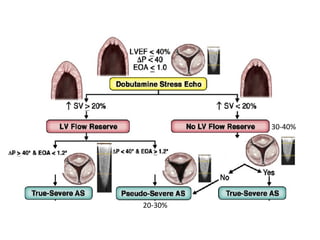
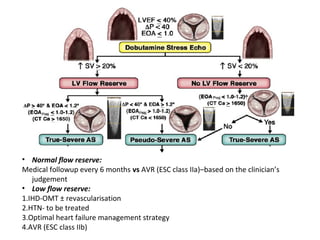
• GRADIENT < 40 mmhg, AVA <1.0, EF <40 %
• Dobutamine stress echo (exercise stress echo)
Class IIA recommendation
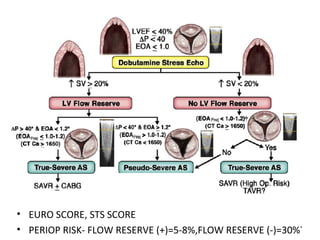
Dobutamine stress echo
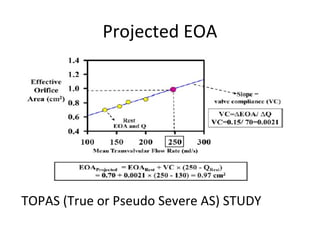
• Low dose protocol upto 20 µg/kg/mt
• We look for three things:
-Flow reserve
-Change in EOA
-Change in Gradient
30-40%
20-30%
Projected EOA
TOPAS (True or Pseudo Severe AS) STUDY
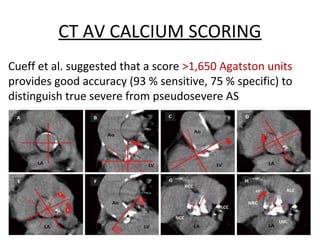
CT AV CALCIUM SCORING
Cueff et al. suggested that a score >1,650 Agatston units
provides good accuracy (93 % sensitive, 75 % specific) to
distinguish true severe from pseudosevere AS
Treatment Decisions
• SYMPTOM STATUS
• VALVULAR SEVERITY
“ANY SYMPTOMATIC SEVERE AS, IRRESPECTIVE
OF EF AND FLOW RESERVE, HAS TO BE
INTERVENED (class I)”
WITHOUT AVR, 1 YR. MORTALITY IS 30-50% (Turina et al EhJ 1987)
Severe ‘Asymptomatic’ AS WITH LOW EF
• WITH NORMAL EF-management is challenging, an abnormal response to
exercise stress testing and elevated BNP may identify a higher-risk group
that might benefit from closer followup and earlier surgery
Recommendation:
AVR for patients who have no symptoms and
whose left ventricular ejection fraction is less
than 50% (class I indication, level of evidence C)
• EURO SCORE, STS SCORE
• PERIOP RISK- FLOW RESERVE (+)=5-8%,FLOW RESERVE (-)=30%*
Role of TAVI
• Operative risk for open heart surgery is generally very
high in absence of flow reserve
• TAVI - valuable alternative in these patients
• Recent studies reported a greater and more rapid
improvement of LVEF in patients treated by TAVR than
those treated by surgical AVR *
• RATIONALE related to a lesser incidence of patient–
prosthesis mismatch.
• In contrast, TAVR associated with a higher incidence of
paravalvular regurgitation, stroke, vascular
complications which may eventually have a negative
impact on outcomes
• PARTNER A & B and STACCATO TRIALS
*
Clavel et al. Circulation 2010;122:1928 –36
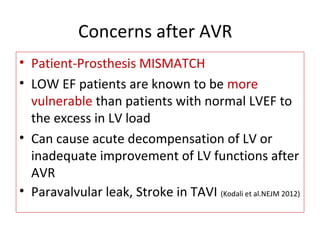
• Normal flow reserve:
Medical followup every 6 months vs AVR (ESC class IIa)–based on the clinician’s
judgement
• Low flow reserve:
1.IHD-OMT ± revascularisation
2.HTN- to be treated
3.Optimal heart failure management strategy
4.AVR (ESC class IIb)
Concerns after AVR
• Patient-Prosthesis MISMATCH
• LOW EF patients are known to be more
vulnerable than patients with normal LVEF to
the excess in LV load
• Can cause acute decompensation of LV or
inadequate improvement of LV functions after
AVR
• Paravalvular leak, Stroke in TAVI (Kodali et al.NEJM 2012)
PROGNOSIS
Prognosis
• Concomitant CAD (46-79 %)
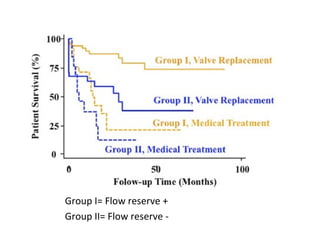
• LOW EF SEVERE AS compared to Normal EF severe AS
have higher periop mortality rates (6-33%), depending
on presence of myocardial contractile reserve (5-8%)
or not (22-33%)
• BUT, irrespective of degree of myocardial dysfunction
or contractile reserve, the patients benefit more from
AVR than medical treatment only
“Severe LV dysfunction IS NOT A CI FOR AVR, albeit the
high risk of surgery in these patients”
Group I= Flow reserve +
Group II= Flow reserve -
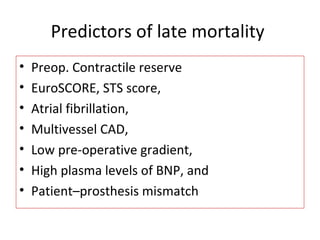
Predictors of late mortality
• Preop. Contractile reserve
• EuroSCORE, STS score,
• Atrial fibrillation,
• Multivessel CAD,
• Low pre-operative gradient,
• High plasma levels of BNP, and
• Patient–prosthesis mismatch
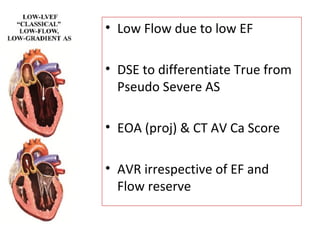
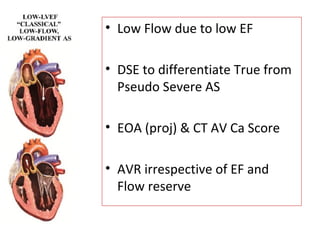
• Low Flow due to low EF
• DSE to differentiate True from
Pseudo Severe AS
• EOA (proj) & CT AV Ca Score
• AVR irrespective of EF and
Flow reserve
LOW FLOW NORMAL EF SEVERE AS
“PARADOXICAL”
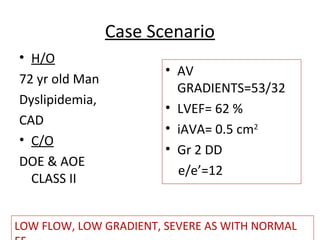
Case Scenario
• H/O
72 yr old Man
Dyslipidemia,
CAD
• C/O
DOE & AOE
CLASS II
• AV
GRADIENTS=53/32
• LVEF= 62 %
• iAVA= 0.5 cm2
• Gr 2 DD
e/e’=12
LOW FLOW, LOW GRADIENT, SEVERE AS WITH NORMAL
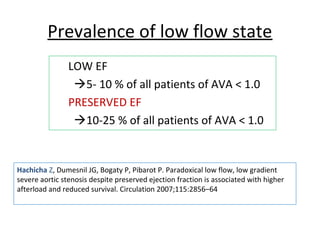
Prevalence of low flow state
LOW EF
5- 10 % of all patients of AVA < 1.0
PRESERVED EF
10-25 % of all patients of AVA < 1.0
Hachicha Z, Dumesnil JG, Bogaty P, Pibarot P. Paradoxical low flow, low gradient
severe aortic stenosis despite preserved ejection fraction is associated with higher
afterload and reduced survival. Circulation 2007;115:2856–64
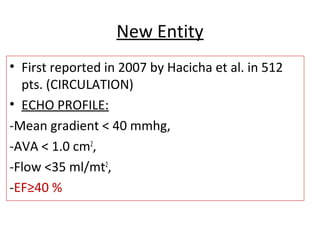
New Entity
• First reported in 2007 by Hacicha et al. in 512
pts. (CIRCULATION)
• ECHO PROFILE:
-Mean gradient < 40 mmhg,
-AVA < 1.0 cm2
,
-Flow <35 ml/mt2
,
-EF≥40 %
PATHOPHYSIOLOGY AND
CHARACTERISTICS OF LOW FLOW
NORMAL EF SEVERE AS
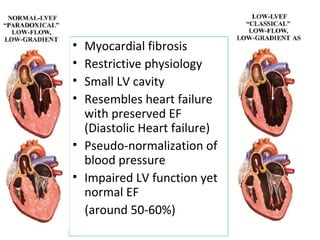
• Myocardial fibrosis
• Restrictive physiology
• Small LV cavity
• Resembles heart failure
with preserved EF
(Diastolic Heart failure)
• Pseudo-normalization of
blood pressure
• Impaired LV function yet
normal EF
(around 50-60%)
DIAGNOSIS
“Normal LVEF Does Not Mean
Normal Myocardial Function”
• LVEF is a late and insensitive marker for study of
LV functions
• Not too far that LVEF will be replaced by other
better markers of LV function
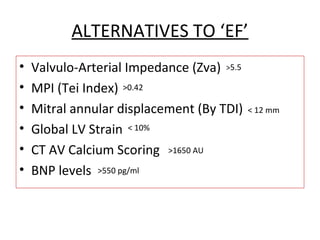
ALTERNATIVES TO ‘EF’
• Valvulo-Arterial Impedance (Zva)
• MPI (Tei Index)
• Mitral annular displacement (By TDI)
• Global LV Strain
• CT AV Calcium Scoring
• BNP levels
>5.5
>0.42
< 12 mm
< 10%
>1650 AU
>550 pg/ml
Valvulo-Arterial impedance (Zva)
• A measurement of “afterload”
• Just quantifies the total load, that helps in
prognostication
• Values > 3.5 Zva(mmHg·mL-1
·m2
) call for
reduction in load- (both valvular and vascular)
• Does not differentiate between the type of
load –valvular vs vascular
• Does not differentiate moderate vs severe AS
(SBP + Mean AV Gradient) / i SV
TREATMENT DECISIONS
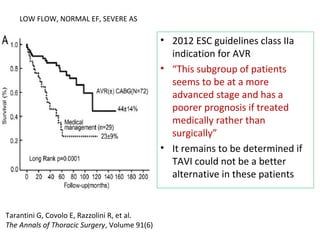
• 2012 ESC guidelines class IIa
indication for AVR
• “This subgroup of patients
seems to be at a more
advanced stage and has a
poorer prognosis if treated
medically rather than
surgically”
• It remains to be determined if
TAVI could not be a better
alternative in these patients
Tarantini G, Covolo E, Razzolini R, et al.
The Annals of Thoracic Surgery, Volume 91(6)
LOW FLOW, NORMAL EF, SEVERE AS
PROGNOSIS
LOW FLOW, N.EF, SEVERE AS
• Worse than moderate AS (albeit contradictory reports)
• Worse than severe AS with high gradient group
lower overall 3-year survival
(76% versus 86%; P<0.006 in 512 patients By Hacicha et al.)
• Two-fold increase in mortality and an almost
50% lower referral rate for AVR in the low-
gradient AS compared to the high gradient
group (Barasch et al)
FUTURE TERMINOLOGY
• SEVERE AS WITHOUT MYOCARDIAL DYSFUNCTION
• SEVERE AS WITH MYOCARDIAL DYSFUNCTION
-SEVERE AV STENOSIS BASED ON AVA
-IRRESPECTIVE OF FLOW, GRADIENTS, EF
SUMMARY
• ACCURATE AVA CALCULATION BY CONTINUITY
EQUATION MUST BE A STANDARD IN
EVALUATION OF A.S BY ECHO
• ELSE WE ARE GOING TO MISS 30 % CASES OF
SEVERE AS
• LOW FLOW AS COULD BE DUE TO BOTH NORMAL
AND REDUCED EF
• INSTITUTION PROTOCOLS TO BE DESIGNED FOR
EVALUATION AND TREATMENT OF LOW FLOW
STATES
• Low Flow due to low EF
• DSE to differentiate True from
Pseudo Severe AS
• EOA (proj) & CT AV Ca Score
• AVR irrespective of EF and
Flow reserve
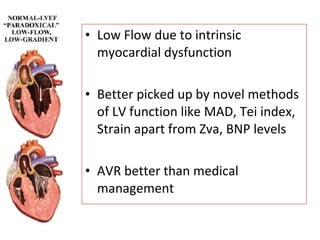
• Low Flow due to intrinsic
myocardial dysfunction
• Better picked up by novel methods
of LV function like MAD, Tei index,
Strain apart from Zva, BNP levels
• AVR better than medical
management
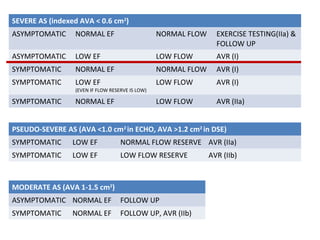
SEVERE AS (indexed AVA < 0.6 cm2
)
ASYMPTOMATIC NORMAL EF NORMAL FLOW EXERCISE TESTING(IIa) &
FOLLOW UP
ASYMPTOMATIC LOW EF LOW FLOW AVR (I)
SYMPTOMATIC NORMAL EF NORMAL FLOW AVR (I)
SYMPTOMATIC LOW EF
(EVEN IF FLOW RESERVE IS LOW)
LOW FLOW AVR (I)
SYMPTOMATIC NORMAL EF LOW FLOW AVR (IIa)
PSEUDO-SEVERE AS (AVA <1.0 cm2
in ECHO, AVA >1.2 cm2
in DSE)
SYMPTOMATIC LOW EF NORMAL FLOW RESERVE AVR (IIa)
SYMPTOMATIC LOW EF LOW FLOW RESERVE AVR (IIb)
MODERATE AS (AVA 1-1.5 cm2
)
ASYMPTOMATIC NORMAL EF FOLLOW UP
SYMPTOMATIC NORMAL EF FOLLOW UP, AVR (IIb)
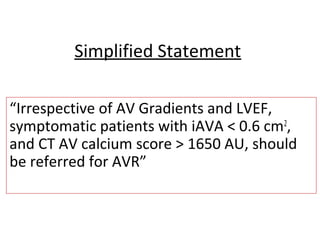
Simplified Statement
“Irrespective of AV Gradients and LVEF,
symptomatic patients with iAVA < 0.6 cm2
,
and CT AV calcium score > 1650 AU, should
be referred for AVR”
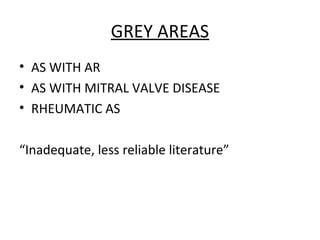
GREY AREAS
• AS WITH AR
• AS WITH MITRAL VALVE DISEASE
• RHEUMATIC AS
“Inadequate, less reliable literature”
“TAVI may eventually prove to be an attractive
alternative to surgical AVR in both types of LF-LG
severe AS, but this remains to be confirmed by
future randomized studies”
Low flow Aortic Stenosis-latest explanations

Low flow Aortic Stenosis-latest explanations

  • 2.
    LOW FLOW AS DR.DEEP CHANDH RAJA S
  • 3.
    • Aortic stenosisis the 3 rd most common CV disease after HTN and CAD (in western world) • Prevalence is 2-7% over the age of 65 years • Evaluation of aortic stenosis is the most challenging of all valvular heart diseases Stewart BF, Siscovick D, Lind BK, et al. Clinical factors associated with calcific aortic valve disease. Cardiovascular Health Study. J Am Coll Cardiol 1997; 29:630–634.
  • 4.
    2 MAJOR GUIDELINES •ACC 2006 • ESC 2012 A FEW IMPORTANT NEW CONCLUSIONS IN ESC 2012 BASED ON EVOLVING NEW CONCEPTS AFTER 2007 (MISSING IN ACC 2006)
  • 5.
  • 6.
    GRADIENT = FLOWDEPENDENT VARIABLE Gradient calculation- Small reduction in flow can cause great reductions in gradient
  • 7.
    AVA calculation isa standard and must be incorporated into a comprehensive evaluation of AS severity AVA=FLOW INDEPENDENT VARIABLE
  • 9.
  • 10.
    1. INDEXING TOBSA 2. INACCURACY IN CALCULATION OF LVOT DIAMETER 3. WHO SAID AVA < 1.0 CORRESPONDS TO GRADIENTS > 40 ??? 4. LOW FLOW STATE (DEFINED SVi <35 ml/mt2 )
  • 11.
    • INDEXING TOBSA Eg: AVA of 0.9 cm2, BSA=1.3, iAVA= 0.7 cm²/m² AVA of 1.2 cm2, BSA=2.1, iAVA= 0.57 cm²/m²
  • 12.
    •INACCURACY IN CALCULATIONOF LVOT DIAMETER CSA= .785 X LVOT D 2 Eg: D=2.8, CSA= 6.15 D=2.2, CSA= 3.75
  • 13.
    • WHO SAIDAVA < 1.0 CORRESPONDS TO GRADIENTS > 40 ??? Carabello demonstrated in 2427 patients, that “a mean gradient of 26 mmHg actually yields to an AVA of 1.0 cm², whereas a mean gradient >40 is corresponding with a AVA of 0.8 cm2” INCONSISTENCIES IN GUIDELINES- “FOR NOW, WE NEED TO ACCEPT AVA <1.0, AS THE REFERENCE CUT OFF TO DEFINE SEVERE AS”
  • 14.
    • INDEXING TOBSA • INACCURACY IN CALCULATION OF LVOT DIAMETER • WHO SAID AVA < 1.0 CORRESPONDS TO GRADIENTS > 40 ??? • LOW FLOW STATE (DEFINED AS SVi<35 ml/mt2 )
  • 15.
    • H/O 72 yrold Man HTN, Dyslipidemia, CAD • C/O DOE & AOE CLASS II • AV GRADIENTS=43/28 • LVEF= 32 % • iAVA= 0.5 cm2 Case Scenario
  • 16.
    • H/O 72 yrold Man HTN, Dyslipidemia, CAD • C/O DOE & AOE CLASS II • AV GRADIENTS=43/28 • LVEF= 52 % • iAVA= 0.5 cm2 Case Scenario
  • 17.
    Causes of lowflow state • Till 2007 low flow due to LOW EF • NOW low flow can also be secondary to Preserved EF “new entity” Paradoxical Low flow AS
  • 19.
    Prevalence of lowflow state – LOW EF 5- 10 % of all patients of AVA < 1.0 – PRESERVED EF 10-25 % of all patients of AVA < 1.0 IMPLICATION- “IF WE DON’T CALCULATE AVA, WE WILL MISS 15-35 % OF CASES OF CRITICAL AS, MORE IMPORTANTLY WE WILL DEPRIVE THESE PATIENTS OF THE POTENTIAL BENEFIT OF AVR ON THEIR SYMPTOMS/SURVIVAL” Pibarot P, Dumesnil J. Low-Flow, Low-Gradient Aortic Stenosis With Normal and Depressed Left Ventricular Ejection Fraction. J Am Coll Cardiol 2012;60:1845–53
  • 20.
    LOW FLOW STATE •LOW EF • PRESERVED EF
  • 21.
    • PATHOPHYSIOLOGY • DIAGNOSIS •TREATMENT OPTIONS • PROGNOSIS
  • 22.
    LOW FLOW, LOWEF, SEVERE AS
  • 23.
    Case Scenario • H/O 72yr old Man HTN, Dyslipidemia, CAD • C/O DOE & AOE CLASS II • AV GRADIENTS=44/26 • iAVA= 0.5 cm2 • LVEF= 30 % LOW FLOW, LOW GRADIENT, SEVERE AS WITH LOW EF
  • 24.
    Prevalence of lowflow state LOW EF 5- 10 % of all patients of AVA < 1.0 PRESERVED EF 10-25 % of all patients of AVA < 1.0 Pibarot P, Dumesnil J. Low-Flow, Low-Gradient Aortic Stenosis With Normal and Depressed Left Ventricular Ejection Fraction. J Am Coll Cardiol 2012;60:1845–53
  • 25.
    PATHOPHYSIOLOGY • LOW FLOWsecondary to LOW EF • LOW EF is due to myocardial dysfunction “whether this myocardial dysfunction is -secondary to AS -secondary to other causes, or -primary myocardial disease, needs to be evaluated”
  • 26.
    MYOCARDIAL DYSFUNCTION SECONDARY TOCAUSES OTHER THAN AS -DILATED CARDIOMYOPATHIES (1O MYOCARDIAL DYFUNCTION) -ISCHEMIC HEART DISEASE -HTN HEART DISEASE (AFTER LOAD MISMATCH) In all these patients, AVA was misjudged as <1.0 due to incomplete opening of AV due to low EF and  labelled as “PSEUDO SEVERE AS”
  • 27.
    MYOCARDIAL DYSFUNCTION SECONDARY TOAS • “ True severe AS” • Removal of the only afterload-AS can lead to dramatic improvements in patients’ symtoms/survival compared to medical therapy alone
  • 28.
  • 29.
    DIAGNOSIS • FIRST SUSPICIONGRADIENT-AVA MISMATCH during routine echo • GRADIENT < 40 mmhg, AVA <1.0, EF <40 % • Dobutamine stress echo (exercise stress echo) Class IIA recommendation
  • 30.
    Dobutamine stress echo •Low dose protocol upto 20 µg/kg/mt • We look for three things: -Flow reserve -Change in EOA -Change in Gradient
  • 31.
  • 32.
    Projected EOA TOPAS (Trueor Pseudo Severe AS) STUDY
  • 33.
    CT AV CALCIUMSCORING Cueff et al. suggested that a score >1,650 Agatston units provides good accuracy (93 % sensitive, 75 % specific) to distinguish true severe from pseudosevere AS
  • 34.
  • 35.
    • SYMPTOM STATUS •VALVULAR SEVERITY “ANY SYMPTOMATIC SEVERE AS, IRRESPECTIVE OF EF AND FLOW RESERVE, HAS TO BE INTERVENED (class I)” WITHOUT AVR, 1 YR. MORTALITY IS 30-50% (Turina et al EhJ 1987)
  • 36.
    Severe ‘Asymptomatic’ ASWITH LOW EF • WITH NORMAL EF-management is challenging, an abnormal response to exercise stress testing and elevated BNP may identify a higher-risk group that might benefit from closer followup and earlier surgery Recommendation: AVR for patients who have no symptoms and whose left ventricular ejection fraction is less than 50% (class I indication, level of evidence C)
  • 37.
    • EURO SCORE,STS SCORE • PERIOP RISK- FLOW RESERVE (+)=5-8%,FLOW RESERVE (-)=30%*
  • 38.
    Role of TAVI •Operative risk for open heart surgery is generally very high in absence of flow reserve • TAVI - valuable alternative in these patients • Recent studies reported a greater and more rapid improvement of LVEF in patients treated by TAVR than those treated by surgical AVR * • RATIONALE related to a lesser incidence of patient– prosthesis mismatch. • In contrast, TAVR associated with a higher incidence of paravalvular regurgitation, stroke, vascular complications which may eventually have a negative impact on outcomes • PARTNER A & B and STACCATO TRIALS * Clavel et al. Circulation 2010;122:1928 –36
  • 39.
    • Normal flowreserve: Medical followup every 6 months vs AVR (ESC class IIa)–based on the clinician’s judgement • Low flow reserve: 1.IHD-OMT ± revascularisation 2.HTN- to be treated 3.Optimal heart failure management strategy 4.AVR (ESC class IIb)
  • 40.
    Concerns after AVR •Patient-Prosthesis MISMATCH • LOW EF patients are known to be more vulnerable than patients with normal LVEF to the excess in LV load • Can cause acute decompensation of LV or inadequate improvement of LV functions after AVR • Paravalvular leak, Stroke in TAVI (Kodali et al.NEJM 2012)
  • 41.
  • 42.
    Prognosis • Concomitant CAD(46-79 %) • LOW EF SEVERE AS compared to Normal EF severe AS have higher periop mortality rates (6-33%), depending on presence of myocardial contractile reserve (5-8%) or not (22-33%) • BUT, irrespective of degree of myocardial dysfunction or contractile reserve, the patients benefit more from AVR than medical treatment only “Severe LV dysfunction IS NOT A CI FOR AVR, albeit the high risk of surgery in these patients”
  • 43.
    Group I= Flowreserve + Group II= Flow reserve -
  • 44.
    Predictors of latemortality • Preop. Contractile reserve • EuroSCORE, STS score, • Atrial fibrillation, • Multivessel CAD, • Low pre-operative gradient, • High plasma levels of BNP, and • Patient–prosthesis mismatch
  • 45.
    • Low Flowdue to low EF • DSE to differentiate True from Pseudo Severe AS • EOA (proj) & CT AV Ca Score • AVR irrespective of EF and Flow reserve
  • 47.
    LOW FLOW NORMALEF SEVERE AS “PARADOXICAL”
  • 48.
    Case Scenario • H/O 72yr old Man Dyslipidemia, CAD • C/O DOE & AOE CLASS II • AV GRADIENTS=53/32 • LVEF= 62 % • iAVA= 0.5 cm2 • Gr 2 DD e/e’=12 LOW FLOW, LOW GRADIENT, SEVERE AS WITH NORMAL
  • 49.
    Prevalence of lowflow state LOW EF 5- 10 % of all patients of AVA < 1.0 PRESERVED EF 10-25 % of all patients of AVA < 1.0 Hachicha Z, Dumesnil JG, Bogaty P, Pibarot P. Paradoxical low flow, low gradient severe aortic stenosis despite preserved ejection fraction is associated with higher afterload and reduced survival. Circulation 2007;115:2856–64
  • 50.
    New Entity • Firstreported in 2007 by Hacicha et al. in 512 pts. (CIRCULATION) • ECHO PROFILE: -Mean gradient < 40 mmhg, -AVA < 1.0 cm2 , -Flow <35 ml/mt2 , -EF≥40 %
  • 51.
    PATHOPHYSIOLOGY AND CHARACTERISTICS OFLOW FLOW NORMAL EF SEVERE AS
  • 52.
    • Myocardial fibrosis •Restrictive physiology • Small LV cavity • Resembles heart failure with preserved EF (Diastolic Heart failure) • Pseudo-normalization of blood pressure • Impaired LV function yet normal EF (around 50-60%)
  • 53.
  • 54.
    “Normal LVEF DoesNot Mean Normal Myocardial Function” • LVEF is a late and insensitive marker for study of LV functions • Not too far that LVEF will be replaced by other better markers of LV function
  • 55.
    ALTERNATIVES TO ‘EF’ •Valvulo-Arterial Impedance (Zva) • MPI (Tei Index) • Mitral annular displacement (By TDI) • Global LV Strain • CT AV Calcium Scoring • BNP levels >5.5 >0.42 < 12 mm < 10% >1650 AU >550 pg/ml
  • 56.
    Valvulo-Arterial impedance (Zva) •A measurement of “afterload” • Just quantifies the total load, that helps in prognostication • Values > 3.5 Zva(mmHg·mL-1 ·m2 ) call for reduction in load- (both valvular and vascular) • Does not differentiate between the type of load –valvular vs vascular • Does not differentiate moderate vs severe AS (SBP + Mean AV Gradient) / i SV
  • 57.
  • 58.
    • 2012 ESCguidelines class IIa indication for AVR • “This subgroup of patients seems to be at a more advanced stage and has a poorer prognosis if treated medically rather than surgically” • It remains to be determined if TAVI could not be a better alternative in these patients Tarantini G, Covolo E, Razzolini R, et al. The Annals of Thoracic Surgery, Volume 91(6) LOW FLOW, NORMAL EF, SEVERE AS
  • 59.
  • 60.
    LOW FLOW, N.EF,SEVERE AS • Worse than moderate AS (albeit contradictory reports) • Worse than severe AS with high gradient group lower overall 3-year survival (76% versus 86%; P<0.006 in 512 patients By Hacicha et al.) • Two-fold increase in mortality and an almost 50% lower referral rate for AVR in the low- gradient AS compared to the high gradient group (Barasch et al)
  • 61.
    FUTURE TERMINOLOGY • SEVEREAS WITHOUT MYOCARDIAL DYSFUNCTION • SEVERE AS WITH MYOCARDIAL DYSFUNCTION -SEVERE AV STENOSIS BASED ON AVA -IRRESPECTIVE OF FLOW, GRADIENTS, EF
  • 62.
  • 63.
    • ACCURATE AVACALCULATION BY CONTINUITY EQUATION MUST BE A STANDARD IN EVALUATION OF A.S BY ECHO • ELSE WE ARE GOING TO MISS 30 % CASES OF SEVERE AS • LOW FLOW AS COULD BE DUE TO BOTH NORMAL AND REDUCED EF • INSTITUTION PROTOCOLS TO BE DESIGNED FOR EVALUATION AND TREATMENT OF LOW FLOW STATES
  • 64.
    • Low Flowdue to low EF • DSE to differentiate True from Pseudo Severe AS • EOA (proj) & CT AV Ca Score • AVR irrespective of EF and Flow reserve
  • 65.
    • Low Flowdue to intrinsic myocardial dysfunction • Better picked up by novel methods of LV function like MAD, Tei index, Strain apart from Zva, BNP levels • AVR better than medical management
  • 66.
    SEVERE AS (indexedAVA < 0.6 cm2 ) ASYMPTOMATIC NORMAL EF NORMAL FLOW EXERCISE TESTING(IIa) & FOLLOW UP ASYMPTOMATIC LOW EF LOW FLOW AVR (I) SYMPTOMATIC NORMAL EF NORMAL FLOW AVR (I) SYMPTOMATIC LOW EF (EVEN IF FLOW RESERVE IS LOW) LOW FLOW AVR (I) SYMPTOMATIC NORMAL EF LOW FLOW AVR (IIa) PSEUDO-SEVERE AS (AVA <1.0 cm2 in ECHO, AVA >1.2 cm2 in DSE) SYMPTOMATIC LOW EF NORMAL FLOW RESERVE AVR (IIa) SYMPTOMATIC LOW EF LOW FLOW RESERVE AVR (IIb) MODERATE AS (AVA 1-1.5 cm2 ) ASYMPTOMATIC NORMAL EF FOLLOW UP SYMPTOMATIC NORMAL EF FOLLOW UP, AVR (IIb)
  • 67.
    Simplified Statement “Irrespective ofAV Gradients and LVEF, symptomatic patients with iAVA < 0.6 cm2 , and CT AV calcium score > 1650 AU, should be referred for AVR”
  • 68.
    GREY AREAS • ASWITH AR • AS WITH MITRAL VALVE DISEASE • RHEUMATIC AS “Inadequate, less reliable literature”
  • 69.
    “TAVI may eventuallyprove to be an attractive alternative to surgical AVR in both types of LF-LG severe AS, but this remains to be confirmed by future randomized studies”

Editor's Notes

  • #4 Stewart BF, Siscovick D, Lind BK, et al. Clinical factors associated with calcific aortic valve disease. Cardiovascular Health Study. J Am Coll Cardiol 1997; 29:630–634. Iung B, Baron G, Butchart EG, et al. A prospective survey of patients with valvular heart disease in Europe: The Euro Heart Survey on Valvular Heart Disease. Eur Heart J 2003; 24:1231–1243. One of the main reasons being the title of this topic per se..ie…”…”
  • #7 IF WE CLASSIFY PATIENTS ONLY BASED ON THE GRADIENTS, THEN THERE ARE HIGH CHANCES THAT WE WILL MISS PATIENTS OF SEVERE AS CO…..
  • #8 But even after ava calculation, we will find a lot of discrepancies between…..
  • #9 But even after ava calculation, we will find a lot of discrepancies between…..
  • #11 There r many reasons for mismatches, one of them is low flow state…others being….
  • #12 I WE HAVE TO AVOID SUCH A MISMATCH…
  • #13 Measurement of the LVOT diameter, representing the Achilles’ heel of the calculation of aortic valve area by the continuity equation
  • #14 Carabello BA. Clinical practice. Aortic stenosis. N Engl J Med 2002;346:677-82. IN VARIOUS STUDIES THEY FOUND THAT NOT ALL PATIENTS WITH SEVERE AS AVA &amp;lt;1.0 HAVE MEAN GRADIENTS &amp;gt;40
  • #15 BEST UNDERSTOOD WITH THESE CASE SCENARIOS…
  • #17 A FORM OF LOW FLOW STATE
  • #18 AN OTHER FORM OF LOW FLOW STATE
  • #21 UNDERSTANDING THESE PREVALENCE RATES HAS A VERY STRONG IMPLICATION COS…IF WE CLASSIFY PATIENTS BASED ON ONLY GRADIENTS THEN WE ARE GOING TO MISS ALL THESE PATIENTS OF SEVERE AS…..TRUE THAT THOSE WITH LOW EF MAY HAVE PSEUDO SEVERE AS Hachicha Z, Dumesnil JG, Bogaty P, Pibarot P. Paradoxical low flow, low gradient severe aortic stenosis despite preserved ejection fraction is associated with higher afterload and reduced survival. Circulation 2007;115:2856–64 Pibarot P, Dumesnil J. Low-Flow, Low-Gradient Aortic Stenosis With Normal and Depressed Left Ventricular Ejection Fraction. J Am Coll Cardiol 2012;60:1845–53
  • #22 EACH WILL BE DEALT IN DETAIL UNDER THE FOLLOWING HEADINGS…
  • #26 Hachicha Z, Dumesnil JG, Bogaty P, Pibarot P. Paradoxical low flow, low gradient severe aortic stenosis despite preserved ejection fraction is associated with higher afterload and reduced survival. Circulation 2007;115:2856–64 Pibarot P, Dumesnil J. Low-Flow, Low-Gradient Aortic Stenosis With Normal and Depressed Left Ventricular Ejection Fraction. J Am Coll Cardiol 2012;60:1845–53
  • #29 Lond standing ASmyo dysfunctionlow eflow flow
  • #31 Suspect a low flow state…
  • #33 Monin JL, Monchi M, Gest V, Duval-Moulin AM, Dubois-Rande JL, Gueret P. Aortic stenosis with severe left ventricular dysfunction and low transvalvular pressure gradients: risk stratification by low-dose dobutamine echocardiography. J Am Coll Cardiol. 2001;37:2101–2107
  • #34 Flow= CSA X VTI
  • #35 Cueff C, Serfaty JM, Cimadevilla C, et al. Measurement of aortic valve calcification using multislice computed tomography: correlation with haemodynamic severity of aortic stenosis and clinical implication for patients with low ejection fraction. Heart 2011;97:721– 6.
  • #38 UNIKE ASYMTOMATIC AS, severe as WITH NORMAL EF, WHERE MANAGEMENT IS CHALLENGING WITH NEED FOR ADDITIONAL EXERCISE , BNP TESTING, THOSE WITH LOW EF HAVE A CLASS 1 REC FOR AVR…. abnormal blood pressure response, ST segment changes, symptoms such as limiting dyspnea, chest discomfort, or dizziness on a modified Bruce protocol, or complex ventricular arrhythmias
  • #39 PERI OP RISK FOR N EF= 1.3% Brown et al J Thorac Cardiovasc Surg 2009; 137:82–90. 5-year survival rate in patients with no contractile reserve who underwent aortic valve replacement than in similar patients who received medical management (65% ± 11% vs 11 ± 7%, P = .019) * Burwash IG. Low-flow, low-gradient aortic stenosis: from evaluation to treatment. Curr Opin Cardiol 2007; 22:84–91
  • #40 *Clavel MA, Webb JG, Rodés-Cabau J, et al. Comparison between transcatheter and surgical prosthetic valve implantation in patients with severe aortic stenosis and reduced left ventricular ejection fraction. Circulation 2010;122:1928 –36 *Gotzmann M, Lindstaedt M, Bojara W, Ewers A, Mugge A. Clinical outcome of transcatheter aortic valve implantation in patients with low-flow, low gradient aortic stenosis. Catheter Cardiovasc Interv 2012;79:693–701 Procedural success rates 95%.. PARTNER A AND B---TAVI VS MEDICAL MANAGEMENT VS BALLOON ANGIOPLASTY VS SURGICAL AVR
  • #41 These pts of PseuSevere AS have an underlying myocardial dysfunction…. Balance between the myocardial disease and AS severity.. …but, periop mortality rates appraoch 50 % in these patients cos of underlying heart dysfunction and hence benefit more from medical management….but it also true that what is moderate stenosis for a normal ventricle may correspond to a severe stenosis for a diseased ventricle…NO SPECIFIC ACC GUIDELINES…ESC 2012 GUIDELINES… Connolly HM, Oh JK, Schaff HV, et al. Severe aortic stenosis with low transvalvular gradient and severe left ventricular dysfunction: result of aortic valve replacement in 52 patients. Circulation 2000; 101:1940–1946
  • #42 PPM= EOA &amp;lt;0.85 /mt2
  • #44 Connolly HM, Oh JK, Schaff HV, et al. Severe aortic stenosis with low transvalvular gradient and severe left ventricular dysfunction. Result of aortic valve replacement. Circulation 2000; 101:1940–6 PERI OP RISK FOR N EF= 1.3% Brown et al J Thorac Cardiovasc Surg 2009; 137:82–90. 5-year survival rate in patients with no contractile reserve who underwent aortic valve replacement than in similar patients who received medical management (65% ± 11% vs 11 ± 7%, P = .019) * Burwash IG. Low-flow, low-gradient aortic stenosis: from evaluation to treatment. Curr Opin Cardiol 2007; 22:84–91
  • #46 APART FROM CONTRACTILE RESERVE…. BNP level 550 pg/mL predicts both overall 1-year survival (47% if BNP 550 versus 97% if BNP 550) and 1-year survival after AVR (53% if BNP 550 versus 92% if BNP 500)* TOPAS Study. Circulation. 2007;115:2848 –2855.
  • #48 ANIMATION……………
  • #50 Just when u think the pat. Has probably moderate AS… Not uncommon…..
  • #51 Hachicha Z, Dumesnil JG, Bogaty P, Pibarot P. Paradoxical low flow, low gradient severe aortic stenosis despite preserved ejection fraction is associated with higher afterload and reduced survival. Circulation 2007;115:2856–64 Pibarot P, Dumesnil J. Low-Flow, Low-Gradient Aortic Stenosis With Normal and Depressed Left Ventricular Ejection Fraction. J Am Coll Cardiol 2012;60:1845–53
  • #52 Hachicha Z, Dumesnil JG, Bogaty P, Pibarot P. Paradoxical low flow, low gradient severe aortic stenosis despite preserved ejection fraction is associated with higher afterload and reduced survival. Circulation 2007;115:2856–64 It is generally assumed that patients with severe AS and preserved LVEF should necessarily have a high transvalvular gradient. However, recent studies revealed that this perception is erroneous and that a substantial proportion of patients with severe AS may indeed have a low transvalvular flow and thus a low gradient despite a preserved LVEF
  • #54 -Higher prevalence of women, older age, smaller LV end-diastolic volume, -Signs of AS severity can be masked by the presence of concomitant hypertension, blood pressure should routinely be measured at the time of the echocardiogram in every patient with AS -Patients with severe AS and LV concentric remodelling often tend to have relatively higher EF’s than normal (e.g. .70%)…and that is why in these patients we go other better markers of lv function…..
  • #56 Specially affected by comorbidities like htn, ihd
  • #57 Tei index .0.42 has been reported to differentiate almost all patients with severe aortic stenosis and left ventricular dysfunction from control subjects or patients with aortic stenosis and preserved left ventricles
  • #58 Hachicha et al
  • #60 The Annals of Thoracic Surgery, Volume 91(6), Tarantini G, Covolo E, Razzolini R, et al. No ACC guidleines as it was formulated in 2006, the time when this new entity was not even introduced….
  • #62 Barasch E, Fan D, Chukwu EO, et al. Severe isolated aortic stenosis with normal left ventricular systolic function and low transvalvular gradients: pathophysiologic and prognostic insights. J Heart Valve Dis 2008;17:81-8. Hachicha Z, Dumesnil JG, Bogaty P, et al. Paradoxical low-flow, low-gradient severe aortic stenosis despite preserved ejection fraction is associated with higher afterload and reduced survival. Circulation 2007;115:2856-64. Jander N, Minners J, Holme I, et al. Outcome of patients with low-gradient &amp;quot;severe&amp;quot; aortic stenosis and preserved ejection fraction. Circulation 2011;123:887-95.
  • #63 MYOCAR. DYSFUNCTION CAN BE SEVERE OR SUBTLE…..IS SEVERE RULE OUT PSEUDO.SEVERE AS…..
  • #68 In pseudo severe AS, peri AVR mortality rates approach 50 % due to underlying myoc. Dysfunction unrelated to AS…and hence benefit better from HF management…. If the clinician needs better markers for LV function than EF, he can always go for other params like Mitral annular displacement, Tei index, global strain measurements…..
  • #69 This ct av calcium score is to diff. from pseudo severe as when we have a pt of low ef…we can also do DSE….
  • #70 INADE