Supervised Exercise, Stent Revascularization,
or Medical Therapy for Claudication
Due to Aortoiliac Peripheral Artery Disease
The CLEVER Study
[Claudication: Exercise Versus Endoluminal
Revascularization ]
JOURNAL OF THE AMERICAN COLLEGE OF
CARD IOLOGY
VOL. 65, NO. 10, 2015
BACKGROUND
โ€ข Treatment for claudication that is due to
aortoiliac peripheral artery disease (PAD) often
relies on stent revascularization (ST).
โ€ข However, supervised exercise (SE) is known to
provide comparable short-term (6-month)
improvements in functional status and quality
of life. [Circulation. 2012 January 3]
โ€ข Longer-term outcomes are not known.
โ€ข PAD is one of the most prevalent
cardiovascular diseases, affecting up to 5% of
individuals over 55 years of age.[Circulation
2004;110:738โ€“43]
โ€ข Clinical trials have demonstrated that
supervised exercise (SE) is an effective
treatment because it significantly improves
walking performance.[JAMA 1995;274:975โ€“
80], and quality of life. [J Vasc Surg 1996;
23:104โ€“15]
โ€ข Despite this, access to SE is limited, because
clinicians do not actively prescribe this
claudication treatment.
OBJECTIVES
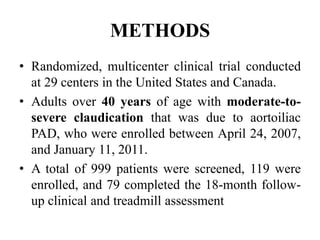
โ€ข To report the longer-term (18-month) efficacy
of SE compared with ST and optimal medical
care (OMC)
โ€ข Comparative effectiveness study that
compared outcomes for aortoiliac stenting
(ST) or SE with optimal medical therapy
(OMT) at 6 and 18 months
METHODS
โ€ข Randomized, multicenter clinical trial conducted
at 29 centers in the United States and Canada.
โ€ข Adults over 40 years of age with moderate-to-
severe claudication that was due to aortoiliac
PAD, who were enrolled between April 24, 2007,
and January 11, 2011.
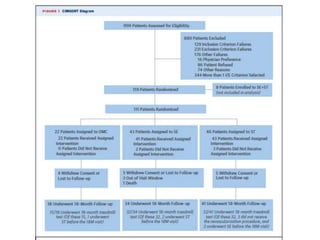
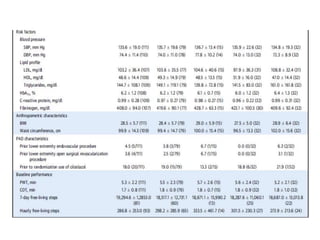
โ€ข A total of 999 patients were screened, 119 were
enrolled, and 79 completed the 18-month follow-
up clinical and treadmill assessment
EXCLUSION CRITERIA
โ€ข Individuals with critical limb ischemia or who
had comorbid conditions that limited their
walking ability were excluded
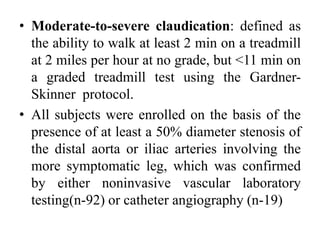
โ€ข Moderate-to-severe claudication: defined as
the ability to walk at least 2 min on a treadmill
at 2 miles per hour at no grade, but <11 min on
a graded treadmill test using the Gardner-
Skinner protocol.
โ€ข All subjects were enrolled on the basis of the
presence of at least a 50% diameter stenosis of
the distal aorta or iliac arteries involving the
more symptomatic leg, which was confirmed
by either noninvasive vascular laboratory
testing(n-92) or catheter angiography (n-19)
SUPERVISED EXERCISSE
โ€ข SE: It consisted of treadmill walking for up to
78 scheduled exercise sessions that were 1 h
long, 3 days a week, for 6 months.
โ€ข Patients in the SE group received quarterly
contact by research coordinators during the
supervised phase, and then participated in a
telephone-based maintenance program
designed to promote exercise adherence during
the unsupervised phase of the study.
โ€ข This telephone support system was provided to
SE patients from the beginning of month 7 to
the end of month 18.
โ€ข OMC: atherosclerosis risk factor management;
the claudication medication, cilostazol; and
home exercise counseling
ENDPOINTS
โ€ข All endpoints were assessed at 6 months and at 18
months.
โ€ข Functional status was measured by treadmill
performance measurements that included the
PWT(Peak walking time), and claudication onset
time (COT).
โ€ข Three quality-of-life health status measures were
used: the Medical Outcomes Study Short Form-
12, the Walking Impairment Questionnaire
(WIQ), and the Peripheral Artery Questionnaire
(PAQ).
STATISTICALANALYSIS
โ€ข All endpoints were analyzed according to the
intention-to-treat principle
โ€ข Secondary analyses were performed on a per-
protocol population
RESULTS
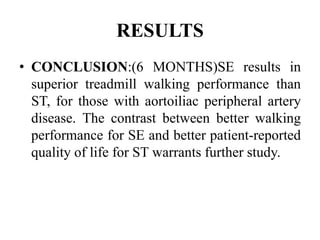
โ€ข CONCLUSION:(6 MONTHS)SE results in
superior treadmill walking performance than
ST, for those with aortoiliac peripheral artery
disease. The contrast between better walking
performance for SE and better patient-reported
quality of life for ST warrants further study.
TREADMILL WALKING AND
HEMODYNAMIC ENDPOINTS
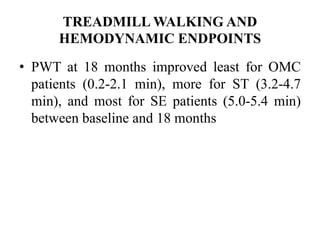
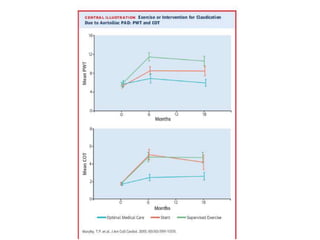
โ€ข PWT at 18 months improved least for OMC
patients (0.2-2.1 min), more for ST (3.2-4.7
min), and most for SE patients (5.0-5.4 min)
between baseline and 18 months
QUALITY OF LIFE
โ€ข There were no baseline differences in quality
of life among the treatment groups.
โ€ข At 18 months, improvement in disease-specific
scales (WIQ, PAQ) was statistically superior
for ST and SE compared with OMC
DISCUSSION
โ€ข The 18-month follow-up results of the
CLEVER study demonstrate a comparable,
clinically important, and durable benefit in
functional status, as measured by the PWT, for
both ST and SE compared with OMC
CONCLUSIONS
โ€ข The benefit of SE, a strategy of care that
provides several proven biological benefits
that improve limb muscle strength, efficiency,
and performance, was equal to the invasive
stent strategy and was maintained for a full
year after completion of the supervised
training phase with use of a telephone-based
counseling program.
DIAGNOSIS OF PAD
โ€ข Evidence of aortoiliac stenosis involving the most
symptomatic limb was established by either noninvasive
vascular testing (ABI <0.9, thigh-brachial index <1.1,
common femoral artery systolic acceleration time >140
msec) (N=41); duplex ultrasound (doubling of peak systolic
velocity in the aortoiliac segment, combined with an ABI
<0.9) (N=26); or computed tomographic angiography
(N=28) or magnetic resonance angiography (N=5)
confirming at least a 60% stenosis by cross-sectional
imaging test, combined with Doppler ultrasound waveform
analysis (showing biphasic common femoral artery
waveform; or catheter angiography (โ‰ฅ50% stenosis in the
aorta or iliac arteries) (N=19).

Supervised Exercise, Stent Revascularization, or Medical Therapy for Claudication Due to Aortoiliac Peripheral Artery Disease

  • 1.
    Supervised Exercise, StentRevascularization, or Medical Therapy for Claudication Due to Aortoiliac Peripheral Artery Disease The CLEVER Study [Claudication: Exercise Versus Endoluminal Revascularization ] JOURNAL OF THE AMERICAN COLLEGE OF CARD IOLOGY VOL. 65, NO. 10, 2015
  • 2.
    BACKGROUND โ€ข Treatment forclaudication that is due to aortoiliac peripheral artery disease (PAD) often relies on stent revascularization (ST). โ€ข However, supervised exercise (SE) is known to provide comparable short-term (6-month) improvements in functional status and quality of life. [Circulation. 2012 January 3] โ€ข Longer-term outcomes are not known.
  • 3.
    โ€ข PAD isone of the most prevalent cardiovascular diseases, affecting up to 5% of individuals over 55 years of age.[Circulation 2004;110:738โ€“43] โ€ข Clinical trials have demonstrated that supervised exercise (SE) is an effective treatment because it significantly improves walking performance.[JAMA 1995;274:975โ€“ 80], and quality of life. [J Vasc Surg 1996; 23:104โ€“15] โ€ข Despite this, access to SE is limited, because clinicians do not actively prescribe this claudication treatment.
  • 4.
    OBJECTIVES โ€ข To reportthe longer-term (18-month) efficacy of SE compared with ST and optimal medical care (OMC) โ€ข Comparative effectiveness study that compared outcomes for aortoiliac stenting (ST) or SE with optimal medical therapy (OMT) at 6 and 18 months
  • 5.
    METHODS โ€ข Randomized, multicenterclinical trial conducted at 29 centers in the United States and Canada. โ€ข Adults over 40 years of age with moderate-to- severe claudication that was due to aortoiliac PAD, who were enrolled between April 24, 2007, and January 11, 2011. โ€ข A total of 999 patients were screened, 119 were enrolled, and 79 completed the 18-month follow- up clinical and treadmill assessment
  • 6.
    EXCLUSION CRITERIA โ€ข Individualswith critical limb ischemia or who had comorbid conditions that limited their walking ability were excluded
  • 8.
    โ€ข Moderate-to-severe claudication:defined as the ability to walk at least 2 min on a treadmill at 2 miles per hour at no grade, but <11 min on a graded treadmill test using the Gardner- Skinner protocol. โ€ข All subjects were enrolled on the basis of the presence of at least a 50% diameter stenosis of the distal aorta or iliac arteries involving the more symptomatic leg, which was confirmed by either noninvasive vascular laboratory testing(n-92) or catheter angiography (n-19)
  • 9.
    SUPERVISED EXERCISSE โ€ข SE:It consisted of treadmill walking for up to 78 scheduled exercise sessions that were 1 h long, 3 days a week, for 6 months. โ€ข Patients in the SE group received quarterly contact by research coordinators during the supervised phase, and then participated in a telephone-based maintenance program designed to promote exercise adherence during the unsupervised phase of the study.
  • 10.
    โ€ข This telephonesupport system was provided to SE patients from the beginning of month 7 to the end of month 18. โ€ข OMC: atherosclerosis risk factor management; the claudication medication, cilostazol; and home exercise counseling
  • 11.
    ENDPOINTS โ€ข All endpointswere assessed at 6 months and at 18 months. โ€ข Functional status was measured by treadmill performance measurements that included the PWT(Peak walking time), and claudication onset time (COT). โ€ข Three quality-of-life health status measures were used: the Medical Outcomes Study Short Form- 12, the Walking Impairment Questionnaire (WIQ), and the Peripheral Artery Questionnaire (PAQ).
  • 12.
    STATISTICALANALYSIS โ€ข All endpointswere analyzed according to the intention-to-treat principle โ€ข Secondary analyses were performed on a per- protocol population
  • 15.
    RESULTS โ€ข CONCLUSION:(6 MONTHS)SEresults in superior treadmill walking performance than ST, for those with aortoiliac peripheral artery disease. The contrast between better walking performance for SE and better patient-reported quality of life for ST warrants further study.
  • 17.
    TREADMILL WALKING AND HEMODYNAMICENDPOINTS โ€ข PWT at 18 months improved least for OMC patients (0.2-2.1 min), more for ST (3.2-4.7 min), and most for SE patients (5.0-5.4 min) between baseline and 18 months
  • 19.
    QUALITY OF LIFE โ€ขThere were no baseline differences in quality of life among the treatment groups. โ€ข At 18 months, improvement in disease-specific scales (WIQ, PAQ) was statistically superior for ST and SE compared with OMC
  • 20.
    DISCUSSION โ€ข The 18-monthfollow-up results of the CLEVER study demonstrate a comparable, clinically important, and durable benefit in functional status, as measured by the PWT, for both ST and SE compared with OMC
  • 21.
    CONCLUSIONS โ€ข The benefitof SE, a strategy of care that provides several proven biological benefits that improve limb muscle strength, efficiency, and performance, was equal to the invasive stent strategy and was maintained for a full year after completion of the supervised training phase with use of a telephone-based counseling program.
  • 22.
    DIAGNOSIS OF PAD โ€ขEvidence of aortoiliac stenosis involving the most symptomatic limb was established by either noninvasive vascular testing (ABI <0.9, thigh-brachial index <1.1, common femoral artery systolic acceleration time >140 msec) (N=41); duplex ultrasound (doubling of peak systolic velocity in the aortoiliac segment, combined with an ABI <0.9) (N=26); or computed tomographic angiography (N=28) or magnetic resonance angiography (N=5) confirming at least a 60% stenosis by cross-sectional imaging test, combined with Doppler ultrasound waveform analysis (showing biphasic common femoral artery waveform; or catheter angiography (โ‰ฅ50% stenosis in the aorta or iliac arteries) (N=19).

Editor's Notes

  • #4ย Lancet 2013;382:1329โ€“40.
  • #6ย HYPOTHESIS: The study was designed to test the hypothesis that ST plus optimal medical care (OMC) and SE plus OMT would be associated with a greater improvement in peak walking time (PWT) on a graded treadmill. test than with OMT alone
  • #8ย OMC:atherosclerosis risk factor management; the claudication medication, cilostazol; and home exercise counseling
  • #9ย Walking 11 min on the Gardner-Skinner protocol is consistent with an approximately 5.5-MET workload, which is considered moderate-intensity physical activity
  • #12ย PWT: defined as the maximal time a participant could walk during the graded treadmill test. COT: defined as the time when claudication was first noticed by a participant