Presenter Dr Praveen Gupta
Moderator Dr Raja Selvaraj
MD(Ped) DNB(Card) Fellowship in Cardiac EP(Toronto)
Cardiac Electrophysiologist
Associate Professor of Cardiology
Jawaharlal Institute of Postgraduate Medical Education and Research
Pondicherry | India 605006
Date 19/12/2016
1
2
3
• The trial was supported by unrestricted grants from Medtronic, St. Jude
Medical, TrygFonden, and the Danish Heart Foundation
• Kober disclosed relevant relationships with Sanofi and Novartis.
• McMurray disclosed relevant relationships with Cardiorentis, Amgen,
Novartis, Oxford University/Bayer, GlaxoSmithKline, Theracos, AbbVie,
AstraZeneca, Vifor-Fresnius Pharma, DalCor, Pfizer, Merck, and Bristol-
Myers Squibb.
4
Introduction
Background
 ICD benefit well documented in ischemic heart diseases
 No trial showed a significant effect of ICD with non-ischemic HF
 Positive effect of ICD confined to New York Heart Association (NYHA) class II,
and no patients received concomitant CRT
 Large proportion of these patients now receive CRT, and the impact of ICD
implantation in this setting is not well known
 ICD implantation confers a risk of device-related complications
5
Introduction
Objective
 DANISH study to investigate the effect of ICD implantation in patients with HF
and reduced ejection fraction not caused by coronary artery disease who receive
contemporary HF therapy including CRT
 DANISH study will add insight into the rate of complications in a cohort where a
large proportion of patients will require implantation of multiple leads
6
Methods
Trial design
 Multicenter
 Randomized
 Unblinded
 Controlled
 Parallel
 2-group trial
7
Inclusion criteria
 Clinical HF
 Non-ischemic etiology
 Optimal medical treatment
 NYHA functional class II or III (patients in NYHA class IV could be
included if planned for CRT)
 LVEF ≤35%
 NT-proBNP N200 pg/mL (23.6 pmol/L)
8
Exclusion criteria
 Dysregulated permanent atrial fibrillation (resting heart rate N100
beats/min)
 Uncorrected congenital heart disease or valve obstruction
 Obstructive cardiomyopathy, active myocarditis, constrictive pericarditis,
untreated hypothyroidism or hyperthyroidism, adrenal insufficiency, and
active vasculitis due to collagen vascular disease
 On the urgent waiting list for a heart transplant (UNOS category 1A or 1B,
or equivalent)
9
Exclusion criteria (Contd)
 Recipient of
 Major organ transplant
 Receiving or received cytotoxic or cytostatic chemotherapy and/or
radiation therapy for malignancy within 6 m before randomization or
clinical evidence of current malignancy, with the following exceptions:
basal or squamous cell carcinoma of the skin, cervical intraepithelial
neoplasia, prostate cancer (if stable localized disease, with a life
expectancy of N2.5 y in the opinion of the investigator)
 Known to be HIV positive, with an expected survival of b5 y due to HIV
 Renal failure treated with dialysis
10
Exclusion criteria (Contd)
 Recent (within 3 m) history of alcohol or illicit drug abuse disorder, based
on self-report
 Any condition (eg, psychiatric illness) or situation that, in the investigator's
opinion, could put the participant at significant risk, confound the study
results, or interfere significantly with the participant's participation in the
study
 Lack of informed consent
11
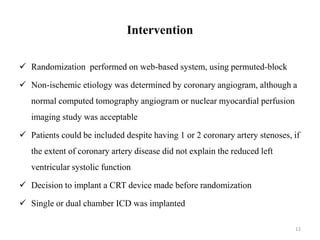
Intervention
 Randomization performed on web-based system, using permuted-block
 Non-ischemic etiology was determined by coronary angiogram, although a
normal computed tomography angiogram or nuclear myocardial perfusion
imaging study was acceptable
 Patients could be included despite having 1 or 2 coronary artery stenoses, if
the extent of coronary artery disease did not explain the reduced left
ventricular systolic function
 Decision to implant a CRT device made before randomization
 Single or dual chamber ICD was implanted
12
Methods (Contd.)
 Follow-up –
 2 months
 Every 6 months
 Patients who receive ICD undergo regular follow-up by implantation center
13
Primary analysis
 Time to death from any cause
14
Secondary outcomes
 Time to sudden cardiac death
 Time to cardiovascular death
 Time to resuscitated cardiac arrest or sustained ventricular tachycardia
 Change in quality of life from baseline (Quality of life is assessed by the
Minnesota Living with Heart Failure Questionnaire)
15
Statistical Analysis
 Study designed to have 80% power to detect a 25% difference in total mortality between the
treatment groups.
 At least 246 primary outcome events were required for the study to be conclusive, and we planned
to include 1000 patients.
 Because the event rate and enrollment rate were lower than expected, the steering committee decided
to prolong enrollment until June 30, 2014, or until 1200 patients were included (whichever came
first) and to follow the last randomly assigned patient for at least 2 years.
 Baseline characteristics compared between the groups with the use of chi-square and Wilcoxon tests
 Outcomes analyzed with the use of time-to-event methods
 Kaplan–Meier plots were calculated for total mortality, and cumulative incidence curves were
calculated for events with competing risk (sudden cardiac death and cardiovascular death)
16
Statistical Analysis
 The analysis of the primary outcome was performed with a log-rank model
 The proportional-hazard assumption was assessed with Schoenfeld residuals
 Post hoc annual event rate ratios were derived from a Poisson regression
 Prespecified subgroup analyses of the primary outcome were performed for the variables
 All analyses were performed in the intention-to-treat population
 Two sided P values of 0.05 or less were considered to indicate statistical significance.
 Analyses were performed with SAS software, version 9.4 (SAS Institute), and R software, version
3.3.1 (R Project for Statistical Computing)
17
18
Result
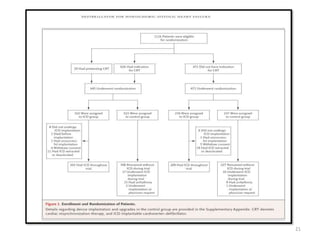
 From February 7, 2008, to June 30, 2014,
 Total of 1116 patients were enrolled at five centers; 556 patients were
randomly assigned to the ICD group, and 560 patients were assigned to the
control group
 Follow-up data for all outcomes were available through June 30, 2016
 The median follow-up period was 67.6 months (interquartile range, 49 to
85), and no patients were lost to follow-up for the primary outcome
19
Cohort and baseline characteristics
20
21
Result
• Primary outcome, death
from any cause, occurred in
120 patients (21.6%) in the
ICD group (4.4 events per
100 person-years) and in
131 patients (23.4%) in the
control group (5.0 events per
100 person-years)
• The hazard ratio for death
from any cause in the ICD
group, as compared with the
control group, was 0.87
(95% confidence interval
[CI] 0.68 to 1.12; P = 0.28)
22
Time-to-Event Curves for Death from Any Cause
Result
• Cardiovascular death
occurred in 77 patients
(13.8%) in the ICD
group and in 95
patients (17.0%) in the
control group (hazard
ratio, 0.77; 95% CI,
0.57 to 1.05; P = 0.10)
23
Time-to-Event Curves for Cardiovascular death
Result
 Sudden cardiac
death occurred in 24
patients (4.3%) in
the ICD group and
in 46 patients
(8.2%) in the control
(hazard ratio, 0.50;
95% CI, 0.31 to
0.82; P = 0.005)
24
Time-to-Event Curves for Sudden Cardiac Death
Result
 The clinical outcome of resuscitated
cardiac arrest or sustained ventricular
tachycardia occurred with similar
frequency in the two groups
 Device infections in 4.9% in the ICD
and in 3.6% in the control (P = 0.29)
 Patients not receiving CRT, the risk of
device infection was higher in the
ICD group than it was in the control
group (5.1% vs 0.8%) ( hazard ratio,
6.35; 95% CI, 1.38 to 58.87; P =
0.006).
 Inappropriate shocks in 5.9% in the
ICD group
25
Result
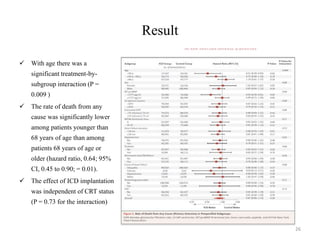
 With age there was a
significant treatment-by-
subgroup interaction (P =
0.009 )
 The rate of death from any
cause was significantly lower
among patients younger than
68 years of age than among
patients 68 years of age or
older (hazard ratio, 0.64; 95%
CI, 0.45 to 0.90; = 0.01).
 The effect of ICD implantation
was independent of CRT status
(P = 0.73 for the interaction)
26
27
Discussion
 Implantation of an ICD in heart failure not caused by ischemic heart
disease did not provide an overall survival benefit, although the risk of
sudden cardiac death was halved with an ICD
 No difference of ICD between patients with CRT and without CRT
 Time-to-event curves diverge during initial 5 years and then converge
 Rationale for long-term studies
28
Discussion
 31% of deaths were due to noncardiovascular causes
 Important interaction with age
 Younger patients have a survival benefit with ICD
 This is not surprising in an elderly population, but it highlights the
importance of selecting patients for ICD implantation carefully
 Patients at higher risk more likely to benefit from ICD
29
Discussion
 Lower likelihood of benefit in older patients might be used as an argument
for not implanting ICDs in frail patients
 Long-term data from the Multicenter Automatic Defibrillator Implantation
Trial (MADIT) II indicate that clinical risk scores may make it possible to
identify the patients with ischemic heart disease who will benefit most from
ICD implantation
 Such a method for identifying patients with nonischemic heart failure who
are at high risk for death from arrhythmia would be very useful
30
Discussion
 The side effects associated with device implantation in our trial not trivial
 Device related infections were not infrequent, but we did have a high
proportion of patients in both groups who were receiving CRT (which
requires implantation of an additional lead in the coronary sinus).
 In addition, 10% of our patients already had a pacemaker and were
randomly assigned either to receive or not to receive an ICD upgrade; this
is a patient group that has not been included in most of the previous trials
31
32
Thank you

DANISH trial (Cardiology)

  • 1.
    Presenter Dr PraveenGupta Moderator Dr Raja Selvaraj MD(Ped) DNB(Card) Fellowship in Cardiac EP(Toronto) Cardiac Electrophysiologist Associate Professor of Cardiology Jawaharlal Institute of Postgraduate Medical Education and Research Pondicherry | India 605006 Date 19/12/2016 1
  • 2.
  • 3.
  • 4.
    • The trialwas supported by unrestricted grants from Medtronic, St. Jude Medical, TrygFonden, and the Danish Heart Foundation • Kober disclosed relevant relationships with Sanofi and Novartis. • McMurray disclosed relevant relationships with Cardiorentis, Amgen, Novartis, Oxford University/Bayer, GlaxoSmithKline, Theracos, AbbVie, AstraZeneca, Vifor-Fresnius Pharma, DalCor, Pfizer, Merck, and Bristol- Myers Squibb. 4
  • 5.
    Introduction Background  ICD benefitwell documented in ischemic heart diseases  No trial showed a significant effect of ICD with non-ischemic HF  Positive effect of ICD confined to New York Heart Association (NYHA) class II, and no patients received concomitant CRT  Large proportion of these patients now receive CRT, and the impact of ICD implantation in this setting is not well known  ICD implantation confers a risk of device-related complications 5
  • 6.
    Introduction Objective  DANISH studyto investigate the effect of ICD implantation in patients with HF and reduced ejection fraction not caused by coronary artery disease who receive contemporary HF therapy including CRT  DANISH study will add insight into the rate of complications in a cohort where a large proportion of patients will require implantation of multiple leads 6
  • 7.
    Methods Trial design  Multicenter Randomized  Unblinded  Controlled  Parallel  2-group trial 7
  • 8.
    Inclusion criteria  ClinicalHF  Non-ischemic etiology  Optimal medical treatment  NYHA functional class II or III (patients in NYHA class IV could be included if planned for CRT)  LVEF ≤35%  NT-proBNP N200 pg/mL (23.6 pmol/L) 8
  • 9.
    Exclusion criteria  Dysregulatedpermanent atrial fibrillation (resting heart rate N100 beats/min)  Uncorrected congenital heart disease or valve obstruction  Obstructive cardiomyopathy, active myocarditis, constrictive pericarditis, untreated hypothyroidism or hyperthyroidism, adrenal insufficiency, and active vasculitis due to collagen vascular disease  On the urgent waiting list for a heart transplant (UNOS category 1A or 1B, or equivalent) 9
  • 10.
    Exclusion criteria (Contd) Recipient of  Major organ transplant  Receiving or received cytotoxic or cytostatic chemotherapy and/or radiation therapy for malignancy within 6 m before randomization or clinical evidence of current malignancy, with the following exceptions: basal or squamous cell carcinoma of the skin, cervical intraepithelial neoplasia, prostate cancer (if stable localized disease, with a life expectancy of N2.5 y in the opinion of the investigator)  Known to be HIV positive, with an expected survival of b5 y due to HIV  Renal failure treated with dialysis 10
  • 11.
    Exclusion criteria (Contd) Recent (within 3 m) history of alcohol or illicit drug abuse disorder, based on self-report  Any condition (eg, psychiatric illness) or situation that, in the investigator's opinion, could put the participant at significant risk, confound the study results, or interfere significantly with the participant's participation in the study  Lack of informed consent 11
  • 12.
    Intervention  Randomization performedon web-based system, using permuted-block  Non-ischemic etiology was determined by coronary angiogram, although a normal computed tomography angiogram or nuclear myocardial perfusion imaging study was acceptable  Patients could be included despite having 1 or 2 coronary artery stenoses, if the extent of coronary artery disease did not explain the reduced left ventricular systolic function  Decision to implant a CRT device made before randomization  Single or dual chamber ICD was implanted 12
  • 13.
    Methods (Contd.)  Follow-up–  2 months  Every 6 months  Patients who receive ICD undergo regular follow-up by implantation center 13
  • 14.
    Primary analysis  Timeto death from any cause 14
  • 15.
    Secondary outcomes  Timeto sudden cardiac death  Time to cardiovascular death  Time to resuscitated cardiac arrest or sustained ventricular tachycardia  Change in quality of life from baseline (Quality of life is assessed by the Minnesota Living with Heart Failure Questionnaire) 15
  • 16.
    Statistical Analysis  Studydesigned to have 80% power to detect a 25% difference in total mortality between the treatment groups.  At least 246 primary outcome events were required for the study to be conclusive, and we planned to include 1000 patients.  Because the event rate and enrollment rate were lower than expected, the steering committee decided to prolong enrollment until June 30, 2014, or until 1200 patients were included (whichever came first) and to follow the last randomly assigned patient for at least 2 years.  Baseline characteristics compared between the groups with the use of chi-square and Wilcoxon tests  Outcomes analyzed with the use of time-to-event methods  Kaplan–Meier plots were calculated for total mortality, and cumulative incidence curves were calculated for events with competing risk (sudden cardiac death and cardiovascular death) 16
  • 17.
    Statistical Analysis  Theanalysis of the primary outcome was performed with a log-rank model  The proportional-hazard assumption was assessed with Schoenfeld residuals  Post hoc annual event rate ratios were derived from a Poisson regression  Prespecified subgroup analyses of the primary outcome were performed for the variables  All analyses were performed in the intention-to-treat population  Two sided P values of 0.05 or less were considered to indicate statistical significance.  Analyses were performed with SAS software, version 9.4 (SAS Institute), and R software, version 3.3.1 (R Project for Statistical Computing) 17
  • 18.
  • 19.
    Result  From February7, 2008, to June 30, 2014,  Total of 1116 patients were enrolled at five centers; 556 patients were randomly assigned to the ICD group, and 560 patients were assigned to the control group  Follow-up data for all outcomes were available through June 30, 2016  The median follow-up period was 67.6 months (interquartile range, 49 to 85), and no patients were lost to follow-up for the primary outcome 19
  • 20.
    Cohort and baselinecharacteristics 20
  • 21.
  • 22.
    Result • Primary outcome,death from any cause, occurred in 120 patients (21.6%) in the ICD group (4.4 events per 100 person-years) and in 131 patients (23.4%) in the control group (5.0 events per 100 person-years) • The hazard ratio for death from any cause in the ICD group, as compared with the control group, was 0.87 (95% confidence interval [CI] 0.68 to 1.12; P = 0.28) 22 Time-to-Event Curves for Death from Any Cause
  • 23.
    Result • Cardiovascular death occurredin 77 patients (13.8%) in the ICD group and in 95 patients (17.0%) in the control group (hazard ratio, 0.77; 95% CI, 0.57 to 1.05; P = 0.10) 23 Time-to-Event Curves for Cardiovascular death
  • 24.
    Result  Sudden cardiac deathoccurred in 24 patients (4.3%) in the ICD group and in 46 patients (8.2%) in the control (hazard ratio, 0.50; 95% CI, 0.31 to 0.82; P = 0.005) 24 Time-to-Event Curves for Sudden Cardiac Death
  • 25.
    Result  The clinicaloutcome of resuscitated cardiac arrest or sustained ventricular tachycardia occurred with similar frequency in the two groups  Device infections in 4.9% in the ICD and in 3.6% in the control (P = 0.29)  Patients not receiving CRT, the risk of device infection was higher in the ICD group than it was in the control group (5.1% vs 0.8%) ( hazard ratio, 6.35; 95% CI, 1.38 to 58.87; P = 0.006).  Inappropriate shocks in 5.9% in the ICD group 25
  • 26.
    Result  With agethere was a significant treatment-by- subgroup interaction (P = 0.009 )  The rate of death from any cause was significantly lower among patients younger than 68 years of age than among patients 68 years of age or older (hazard ratio, 0.64; 95% CI, 0.45 to 0.90; = 0.01).  The effect of ICD implantation was independent of CRT status (P = 0.73 for the interaction) 26
  • 27.
  • 28.
    Discussion  Implantation ofan ICD in heart failure not caused by ischemic heart disease did not provide an overall survival benefit, although the risk of sudden cardiac death was halved with an ICD  No difference of ICD between patients with CRT and without CRT  Time-to-event curves diverge during initial 5 years and then converge  Rationale for long-term studies 28
  • 29.
    Discussion  31% ofdeaths were due to noncardiovascular causes  Important interaction with age  Younger patients have a survival benefit with ICD  This is not surprising in an elderly population, but it highlights the importance of selecting patients for ICD implantation carefully  Patients at higher risk more likely to benefit from ICD 29
  • 30.
    Discussion  Lower likelihoodof benefit in older patients might be used as an argument for not implanting ICDs in frail patients  Long-term data from the Multicenter Automatic Defibrillator Implantation Trial (MADIT) II indicate that clinical risk scores may make it possible to identify the patients with ischemic heart disease who will benefit most from ICD implantation  Such a method for identifying patients with nonischemic heart failure who are at high risk for death from arrhythmia would be very useful 30
  • 31.
    Discussion  The sideeffects associated with device implantation in our trial not trivial  Device related infections were not infrequent, but we did have a high proportion of patients in both groups who were receiving CRT (which requires implantation of an additional lead in the coronary sinus).  In addition, 10% of our patients already had a pacemaker and were randomly assigned either to receive or not to receive an ICD upgrade; this is a patient group that has not been included in most of the previous trials 31
  • 32.

Editor's Notes

  • #4 The CONSORT (CONsolidated Standards of Reporting Trials) 2010 guideline is intended to improve the reporting of parallel-group randomized controlled trial (RCT), enabling readers to understand a trial's design, conduct, analysis and interpretation, and to assess the validity of its results. This can only be achieved through complete adherence and transparency by authors. CONSORT 2010 was developed through collaboration and consensus between clinical trial methodologists, guideline developers, knowledge translation specialists, and journal editors (see CONSORT group ). CONSORT 2010 is the current version of the guideline and supersedes the 2001 and 1996 versions . It contains a 25-item checklist and flow diagram, freely available for viewing  and downloading through this website