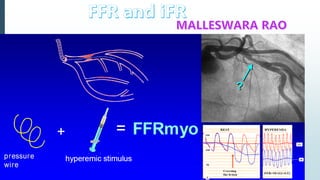
28-06-2017FFR and iFR
 ~5% of the total CO
 increase up to 5 times with exercise, hypoxia, local metabolite release (nitric oxide), and
microcirculatory vasodilators
 microcirculatory resistance is the only resistance to myocardial flow
 epicardial vessels are just conductance vessels that offer no resistance
 systolic compression of the microcirculation- left coronary blood flows mainly during diastole (>80%
occurs in diastole).
 Tachycardia- increasing O2 demands + reduces myocardial O2 supply by reducing diastolic time
28-06-2017FFR and iFR
 tachycardia - increases the relative systolic contribution to coronary flow.
 RV - thin, its microcirculation is not as affected by systole ;~50% of the mid right coronary-to-RV flow
occurs in systole
 autoregulation, that is, microcirculatory vasodilation, maintains coronary perfusion at a constant level
over a wide range of coronary pressure.
 Reduced perfusion pressure distal to a stenosis is compensated by autoregulatory dilation of resistance
vessels.
 Autoregulation allows myocardial flow past the stenosis to remain normal at rest despite a reduction
in pressure; however, flow cannot increase enough with exercise or with maximal vasodilation
28-06-2017FFR and iFR
UNIQUE PHYSIOLOGY
 Determined not only by variations in pressure arising proximally (as in the aorta and other systemic
arteries) but also concurrent variations arising distally in the microcirculation
 inaccurate to assess the severity of a coronary stenosis by measuring the decrease in mean or peak
pressure across a stenosis under basal conditions
 distal coronary pressure is not simply a residuum of the pressure transmitted from the aortic end but
is also due to a pressure component arising from active compression and decompression of the
coronary microcirculation
28-06-2017FFR and iFR
 myocardial flow = microvascular flow = (P1 − P2) / microvascular resistance
 in order to make pressure correlate linearly with flow, maximal microcirculatory vasodilation needs to
be achieved for constant (and minimized) intracoronary resistance
 pressure and flow are directly proportional, and a decrease in pressure across a stenosis reflects a
decrease in blood flow
28-06-2017FFR and iFR
 FFR = 0.6 means: “Due to this particular stenosis, maximum achievable blood flow to the
myocardium supplied by this artery, is only 60 % of what it would be if this coronary artery
completely normal”
28-06-2017FFR and iFR
SIGNAL DRIFT
 blood flow at rest in the left coronary artery occurs predominantly during diastole.
 If a stenosis is present, there will be a diastolic drop in pressure with a smaller systolic drop in pressure
 shape of the pressure curve recorded by the wire is different from the aortic pressure curve, with a flat
or ventricularized diastole.
 During hyperemia, diastolic blood flow increases with a lesser increase in systolic flow, further
accentuating the drop in diastolic pressure and the ventricularized shape of the distal pressure signal.
 FFR<0.80 without distal pressure ventricularization = error in zeroing or equalization of both
transducers at the aortic level.
28-06-2017FFR and iFR
 Beware of advancing the wire sensor in a small branch <1 mm, as the wire itself will be obstructive of
this small vessel and create further pressure drop across the sensor.
28-06-2017FFR and iFR
 heart rate
 blood pressure
 stable microvascular dysfunction
collateral flow
 lesion is more likely to be significant if the artery provides collaterals.
28-06-2017FFR and iFR
 FFR<0.75 - accurately identifies ischemia on noninvasive stress testing with 100% specificity
 FFR >0.80 - sensitivity of >90% for excluding ischemia
 FFR is between 0.75 and 0.80-ischemia is generally present, but clinical variables are necessary to
guide revascularization
28-06-2017FFR and iFR
 calculation of local FFR across each stenosis (Pm/Pa and Pd/ Pm )-- underestimates the true severity of each
lesion
 had there not been another lesion, the local flow across each lesion would be higher and the pressure drop
across one lesion would be higher than estimated by the local FFR
 Pm does not have a linear correlation with the myocardial flow past lesion 1 because the presence of lesion
2 prevents maximal hyperemia past lesion 1
 Pm/Pa and Pd/Pm are not true FFR values
 P2, the summation of pressure drop across both stenoses, linearly correlates with myocardial flow past
lesion 2, and Pd/ Pa is an adequate estimate of myocardial flow drop across all lesions
28-06-2017FFR and iFR
 If one has moderate proximal stenosis (lesion 1) and severe distal stenosis (lesion 2) , placing the wire
in-between lesions to assess the severity of the proximal stenosis will yield an inadequate result
28-06-2017FFR and iFR
 proximal stenosis is more prone to underestimation than the distal stenosis.
 Advancing the wire into a side branch between lesions 1 and 2 does not circumvent
 FFR of the proximal lesion should be assessed after treating the distal lesion.
 If lesion 2 is a very distal lesion with several large branches coming off between lesions 1 and 2, the
territory supplied by the in-between branches is large, and hyperemia of most of the myocardium
supplied by this artery is likely achieved; this allows adequate estimation of the FFR of lesion 1 with
the wire sensor placed between lesions 1 and 2
28-06-2017FFR and iFR
 If FFR < 0.80 but pressure pullback reveals a gradual decline in pressure without focal drop-This may be
seen in patients with mild or moderate diffuse disease and small coronary arteries.
 8% of arteries with mild diffuse coronary atherosclerosis without a focal stenosis have a graded
continuous fall in pressure along the arterial length with FFR <0.75, explaining myocardial ischemia and
angina without angiographically obstructive disease
28-06-2017FFR and iFR
 myocardial territory receiving a bypass graft is supplied by 2
 graft
 native vessel if not totally occluded
 During hyperemia, the drop in pressure distal to a graft stenosis reflects the drop in flow across
the supplied myocardium
 an angiographically severe stenosis across the graft may not lead to a significant flow reduction,
depending on the adequacy of native vessel flow.
 FFR reflects a net FFR from all sources of flow to that region.
28-06-2017FFR and iFR
 too deeply engaged GC-pressure at its tip does not correspond to the aortic pressure but to the pressure distal to the
lesion.
 guiding pressure (false Pa) and the sensor pressure (Pd) correlate closely and the FFR is falsely increased.
 guiding catheter is outside the ostium but the wire is just distal to the ostium-pressure distal to the stenosis is equalized
to the aortic pressure
 FFR may be overestimated and the lesion underestimated
 disengage the guiding catheter and the sensor part of the wire during equalization.
 guide may then be temporarily engaged while wiring the artery but must be disengaged when FFR measurements are
obtained.
catheter with side holes
 pressure of a side-hole guide does not damp upon engagement- may be harder to realize that the catheter is engaged
beyond the ostium
 avoid intracoronary adenosine
28-06-2017FFR and iFR
 Maximal hyperemia is lower
 FFR may be overestimated (lesion underestimated).
 not be used to assess the culprit lesion of MI that occurred within the last 5 days.
28-06-2017FFR and iFR
 question is not whether the lesion is functionally significant but whether the lesion is anatomically
significant and likely to acutely or subacutely progress (eg, plaque rupture, thrombus).
 Beside symptom alleviation, the goal of therapy in ACS is to reduce recurrent infarction
 assessment of anatomy (IVUS) is more valuable
 thrombotic lesion that is not functionally significant at one point in time may still progress within the
next hours or days.
28-06-2017FFR and iFR
 When part of the territory supplied by a coronary artery is infarcted, this territory receives
reduced myocardial flow
 maximal achievable flow across this myocardial territory is reduced.
 FFR dependent - amount of viable myocardium and the severity of microcirculatory impairment.
 FFR <0.75 correlates not only with the size
 large increase in transstenotic pressure gradient or flow with adenosine -sign of the presence of
viable myocardium with healthy microcirculation
 absence of a vasodilatory response -sign of non-viability (ie, "FFR" number remains unchanged
before and after adenosine infusion).
28-06-2017FFR and iFR
FFR vs nuclear perfusion imaging in multivessel disease
 MPI-relative flow reserve (ie, hyperemic flow in a stenotic artery vs hyperemic flow in a nonstenotic
artery) and require the presence of 1 normal vascular bed to demonstrate ischemia.
 Myocardial perfusion underestimates the severity of disease when all territories are underperfused, in
which case only the worst territory looks ischemic, whereas the other territories look relatively
“normal.”
 FFR has a better spatial resolution and allows the independent assessment of individual arteries.
 nuclear substudy of FAME trial - patients with angiographic multivessel disease, ~50% of vessels with
FFR <0.80 were not identified on nuclear imaging, and 34% of patients with ischemia by FFR had a
negative nuclear scan.
28-06-2017FFR and iFR
 incomplete stent expansion
 stent malapposition
 geographical miss
 plaque protrusion
 edge dissection
 plaque shift at the stent edge
step increase of pressure within or close to the stent edges →→ivus
 pullback manoeuvre
continuous gradual reduction in FFR = diffuse CAD.
 diffuse CAD -impaired post-stent FFR, despite an angiographically optimal PCI
28-06-2017FFR and iFR
 No - small peripheral venous access - gets degraded by red blood cells on its way to the heart.
 very short half-life
 Hyperemia is achieved within 1 to 2 minutes of infusion
effects of adenosine
 change in blood pressure
 increase or reduction in heart rate
 change in Pd/Pa
 chest tightness

28-06-2017FFR and iFR
 overestimation of FFR in up to 8%, particularly when doses <30 μg are used
 side effect - transient bradycardia
 no systemic effects
 alternative to intravenous adenosine - asthma
 If IC adenosine is used, ensure reproducibility by repeating the injection and the FFR measurement.
 40 μg - RCA
 60 μg = LCA
 increasing the doses incrementally by 30 μg to a maximum of 150 μg
 some suggest a higher bolus dose (100–150 μg)
 IC papaverine (20 mg) -prolonged hyperemia (30-60 seconds) without a risk of bronchospsm.
 Intra-arterial papaverine - renal arterial FFR, as adenosine may induce renal vasoconstriction.
28-06-2017FFR and iFR
 single bolus injection of 400 μg
 Rapid onset (~ 30 sec)
 steady state long enough ( at least 75 sec) to perform pressure pullback recording,
 No noticeable side effects except the harmless chest discomfort
28-06-2017FFR and iFR
 Assessment of the success of PCI [Class IIa, C]
 •Evaluation of angina in patients without apparent agiographic stenosis [Class IIb, C]
28-06-2017FFR and iFR
 Best Practice for LM PCI Utilizes BOTH IVUS and FFR
28-06-2017FFR and iFR
 even after administration of potent
pharmacologic agents, intracoronary resistance
is not static, but instead fluctuates in a phasic
pattern
 Wave-intensity analysis was used to identify the
backwardtraveling waves
 wave-free period in diastole when resistance is
naturally minimized
 onset of diastole was identified from the
dicrotic notch
 calculated beginning 25% of the way into diastole and ending 5 ms before the end of diastole.
 mean duration 354±78 ms (756% of diastole), starting 112 ± 26 ms after the onset of diastole
 iFR-pressure-derived index without the need for pharmacologic intervention
RESISTANCE( Hg s/m )
NORMAL 613 ± 310 mm
ADENOSINE 302 ± 315 mm
WAVE FREE PERIOD 284 ± 147
28-06-2017FFR and iFR
cFFR
28-06-2017FFR and iFR
what you measure is more reliable than what you see
Measuring FFR of > 0.80 and placing a stent as yet, is NONSENSE
If you are not prepared to believe your measurement, You can better not do it
“FFR never lies”
28-06-2017FFR and iFR

Ffr

  • 1.
  • 2.
     ~5% ofthe total CO  increase up to 5 times with exercise, hypoxia, local metabolite release (nitric oxide), and microcirculatory vasodilators  microcirculatory resistance is the only resistance to myocardial flow  epicardial vessels are just conductance vessels that offer no resistance  systolic compression of the microcirculation- left coronary blood flows mainly during diastole (>80% occurs in diastole).  Tachycardia- increasing O2 demands + reduces myocardial O2 supply by reducing diastolic time 28-06-2017FFR and iFR
  • 3.
     tachycardia -increases the relative systolic contribution to coronary flow.  RV - thin, its microcirculation is not as affected by systole ;~50% of the mid right coronary-to-RV flow occurs in systole  autoregulation, that is, microcirculatory vasodilation, maintains coronary perfusion at a constant level over a wide range of coronary pressure.  Reduced perfusion pressure distal to a stenosis is compensated by autoregulatory dilation of resistance vessels.  Autoregulation allows myocardial flow past the stenosis to remain normal at rest despite a reduction in pressure; however, flow cannot increase enough with exercise or with maximal vasodilation 28-06-2017FFR and iFR
  • 4.
    UNIQUE PHYSIOLOGY  Determinednot only by variations in pressure arising proximally (as in the aorta and other systemic arteries) but also concurrent variations arising distally in the microcirculation  inaccurate to assess the severity of a coronary stenosis by measuring the decrease in mean or peak pressure across a stenosis under basal conditions  distal coronary pressure is not simply a residuum of the pressure transmitted from the aortic end but is also due to a pressure component arising from active compression and decompression of the coronary microcirculation 28-06-2017FFR and iFR
  • 5.
  • 6.
  • 7.
  • 8.
  • 9.
  • 10.
  • 11.
  • 12.
  • 13.
  • 14.
  • 15.
  • 16.
     myocardial flow= microvascular flow = (P1 − P2) / microvascular resistance  in order to make pressure correlate linearly with flow, maximal microcirculatory vasodilation needs to be achieved for constant (and minimized) intracoronary resistance  pressure and flow are directly proportional, and a decrease in pressure across a stenosis reflects a decrease in blood flow 28-06-2017FFR and iFR
  • 17.
  • 18.
     FFR =0.6 means: “Due to this particular stenosis, maximum achievable blood flow to the myocardium supplied by this artery, is only 60 % of what it would be if this coronary artery completely normal” 28-06-2017FFR and iFR
  • 19.
  • 20.
    SIGNAL DRIFT  bloodflow at rest in the left coronary artery occurs predominantly during diastole.  If a stenosis is present, there will be a diastolic drop in pressure with a smaller systolic drop in pressure  shape of the pressure curve recorded by the wire is different from the aortic pressure curve, with a flat or ventricularized diastole.  During hyperemia, diastolic blood flow increases with a lesser increase in systolic flow, further accentuating the drop in diastolic pressure and the ventricularized shape of the distal pressure signal.  FFR<0.80 without distal pressure ventricularization = error in zeroing or equalization of both transducers at the aortic level. 28-06-2017FFR and iFR
  • 21.
  • 22.
     Beware ofadvancing the wire sensor in a small branch <1 mm, as the wire itself will be obstructive of this small vessel and create further pressure drop across the sensor. 28-06-2017FFR and iFR
  • 23.
     heart rate blood pressure  stable microvascular dysfunction collateral flow  lesion is more likely to be significant if the artery provides collaterals. 28-06-2017FFR and iFR
  • 24.
  • 25.
     FFR<0.75 -accurately identifies ischemia on noninvasive stress testing with 100% specificity  FFR >0.80 - sensitivity of >90% for excluding ischemia  FFR is between 0.75 and 0.80-ischemia is generally present, but clinical variables are necessary to guide revascularization 28-06-2017FFR and iFR
  • 26.
  • 27.
  • 28.
     calculation oflocal FFR across each stenosis (Pm/Pa and Pd/ Pm )-- underestimates the true severity of each lesion  had there not been another lesion, the local flow across each lesion would be higher and the pressure drop across one lesion would be higher than estimated by the local FFR  Pm does not have a linear correlation with the myocardial flow past lesion 1 because the presence of lesion 2 prevents maximal hyperemia past lesion 1  Pm/Pa and Pd/Pm are not true FFR values  P2, the summation of pressure drop across both stenoses, linearly correlates with myocardial flow past lesion 2, and Pd/ Pa is an adequate estimate of myocardial flow drop across all lesions 28-06-2017FFR and iFR
  • 29.
  • 30.
     If onehas moderate proximal stenosis (lesion 1) and severe distal stenosis (lesion 2) , placing the wire in-between lesions to assess the severity of the proximal stenosis will yield an inadequate result 28-06-2017FFR and iFR
  • 31.
     proximal stenosisis more prone to underestimation than the distal stenosis.  Advancing the wire into a side branch between lesions 1 and 2 does not circumvent  FFR of the proximal lesion should be assessed after treating the distal lesion.  If lesion 2 is a very distal lesion with several large branches coming off between lesions 1 and 2, the territory supplied by the in-between branches is large, and hyperemia of most of the myocardium supplied by this artery is likely achieved; this allows adequate estimation of the FFR of lesion 1 with the wire sensor placed between lesions 1 and 2 28-06-2017FFR and iFR
  • 32.
  • 33.
     If FFR< 0.80 but pressure pullback reveals a gradual decline in pressure without focal drop-This may be seen in patients with mild or moderate diffuse disease and small coronary arteries.  8% of arteries with mild diffuse coronary atherosclerosis without a focal stenosis have a graded continuous fall in pressure along the arterial length with FFR <0.75, explaining myocardial ischemia and angina without angiographically obstructive disease 28-06-2017FFR and iFR
  • 34.
  • 35.
     myocardial territoryreceiving a bypass graft is supplied by 2  graft  native vessel if not totally occluded  During hyperemia, the drop in pressure distal to a graft stenosis reflects the drop in flow across the supplied myocardium  an angiographically severe stenosis across the graft may not lead to a significant flow reduction, depending on the adequacy of native vessel flow.  FFR reflects a net FFR from all sources of flow to that region. 28-06-2017FFR and iFR
  • 36.
     too deeplyengaged GC-pressure at its tip does not correspond to the aortic pressure but to the pressure distal to the lesion.  guiding pressure (false Pa) and the sensor pressure (Pd) correlate closely and the FFR is falsely increased.  guiding catheter is outside the ostium but the wire is just distal to the ostium-pressure distal to the stenosis is equalized to the aortic pressure  FFR may be overestimated and the lesion underestimated  disengage the guiding catheter and the sensor part of the wire during equalization.  guide may then be temporarily engaged while wiring the artery but must be disengaged when FFR measurements are obtained. catheter with side holes  pressure of a side-hole guide does not damp upon engagement- may be harder to realize that the catheter is engaged beyond the ostium  avoid intracoronary adenosine 28-06-2017FFR and iFR
  • 37.
     Maximal hyperemiais lower  FFR may be overestimated (lesion underestimated).  not be used to assess the culprit lesion of MI that occurred within the last 5 days. 28-06-2017FFR and iFR
  • 38.
     question isnot whether the lesion is functionally significant but whether the lesion is anatomically significant and likely to acutely or subacutely progress (eg, plaque rupture, thrombus).  Beside symptom alleviation, the goal of therapy in ACS is to reduce recurrent infarction  assessment of anatomy (IVUS) is more valuable  thrombotic lesion that is not functionally significant at one point in time may still progress within the next hours or days. 28-06-2017FFR and iFR
  • 39.
     When partof the territory supplied by a coronary artery is infarcted, this territory receives reduced myocardial flow  maximal achievable flow across this myocardial territory is reduced.  FFR dependent - amount of viable myocardium and the severity of microcirculatory impairment.  FFR <0.75 correlates not only with the size  large increase in transstenotic pressure gradient or flow with adenosine -sign of the presence of viable myocardium with healthy microcirculation  absence of a vasodilatory response -sign of non-viability (ie, "FFR" number remains unchanged before and after adenosine infusion). 28-06-2017FFR and iFR
  • 40.
  • 41.
  • 42.
    FFR vs nuclearperfusion imaging in multivessel disease  MPI-relative flow reserve (ie, hyperemic flow in a stenotic artery vs hyperemic flow in a nonstenotic artery) and require the presence of 1 normal vascular bed to demonstrate ischemia.  Myocardial perfusion underestimates the severity of disease when all territories are underperfused, in which case only the worst territory looks ischemic, whereas the other territories look relatively “normal.”  FFR has a better spatial resolution and allows the independent assessment of individual arteries.  nuclear substudy of FAME trial - patients with angiographic multivessel disease, ~50% of vessels with FFR <0.80 were not identified on nuclear imaging, and 34% of patients with ischemia by FFR had a negative nuclear scan. 28-06-2017FFR and iFR
  • 43.
  • 44.
     incomplete stentexpansion  stent malapposition  geographical miss  plaque protrusion  edge dissection  plaque shift at the stent edge step increase of pressure within or close to the stent edges →→ivus  pullback manoeuvre continuous gradual reduction in FFR = diffuse CAD.  diffuse CAD -impaired post-stent FFR, despite an angiographically optimal PCI 28-06-2017FFR and iFR
  • 45.
  • 46.
  • 47.
  • 48.
  • 49.
  • 50.
  • 51.
  • 52.
  • 53.
  • 54.
  • 55.
     No -small peripheral venous access - gets degraded by red blood cells on its way to the heart.  very short half-life  Hyperemia is achieved within 1 to 2 minutes of infusion effects of adenosine  change in blood pressure  increase or reduction in heart rate  change in Pd/Pa  chest tightness  28-06-2017FFR and iFR
  • 56.
     overestimation ofFFR in up to 8%, particularly when doses <30 μg are used  side effect - transient bradycardia  no systemic effects  alternative to intravenous adenosine - asthma  If IC adenosine is used, ensure reproducibility by repeating the injection and the FFR measurement.  40 μg - RCA  60 μg = LCA  increasing the doses incrementally by 30 μg to a maximum of 150 μg  some suggest a higher bolus dose (100–150 μg)  IC papaverine (20 mg) -prolonged hyperemia (30-60 seconds) without a risk of bronchospsm.  Intra-arterial papaverine - renal arterial FFR, as adenosine may induce renal vasoconstriction. 28-06-2017FFR and iFR
  • 57.
     single bolusinjection of 400 μg  Rapid onset (~ 30 sec)  steady state long enough ( at least 75 sec) to perform pressure pullback recording,  No noticeable side effects except the harmless chest discomfort 28-06-2017FFR and iFR
  • 58.
  • 59.
  • 60.
  • 61.
  • 62.
  • 63.
  • 64.
  • 65.
  • 66.
     Assessment ofthe success of PCI [Class IIa, C]  •Evaluation of angina in patients without apparent agiographic stenosis [Class IIb, C] 28-06-2017FFR and iFR
  • 67.
  • 68.
  • 69.
  • 70.
  • 71.
  • 72.
  • 73.
  • 74.
  • 75.
  • 76.
  • 77.
  • 78.
  • 79.
  • 80.
  • 81.
  • 82.
     Best Practicefor LM PCI Utilizes BOTH IVUS and FFR 28-06-2017FFR and iFR
  • 83.
  • 84.
  • 85.
  • 86.
  • 87.
  • 88.
     even afteradministration of potent pharmacologic agents, intracoronary resistance is not static, but instead fluctuates in a phasic pattern  Wave-intensity analysis was used to identify the backwardtraveling waves  wave-free period in diastole when resistance is naturally minimized  onset of diastole was identified from the dicrotic notch
  • 89.
     calculated beginning25% of the way into diastole and ending 5 ms before the end of diastole.  mean duration 354±78 ms (756% of diastole), starting 112 ± 26 ms after the onset of diastole  iFR-pressure-derived index without the need for pharmacologic intervention
  • 90.
    RESISTANCE( Hg s/m) NORMAL 613 ± 310 mm ADENOSINE 302 ± 315 mm WAVE FREE PERIOD 284 ± 147
  • 92.
  • 93.
  • 94.
  • 95.
  • 96.
  • 106.
  • 107.
  • 108.
  • 109.
    what you measureis more reliable than what you see Measuring FFR of > 0.80 and placing a stent as yet, is NONSENSE If you are not prepared to believe your measurement, You can better not do it “FFR never lies” 28-06-2017FFR and iFR