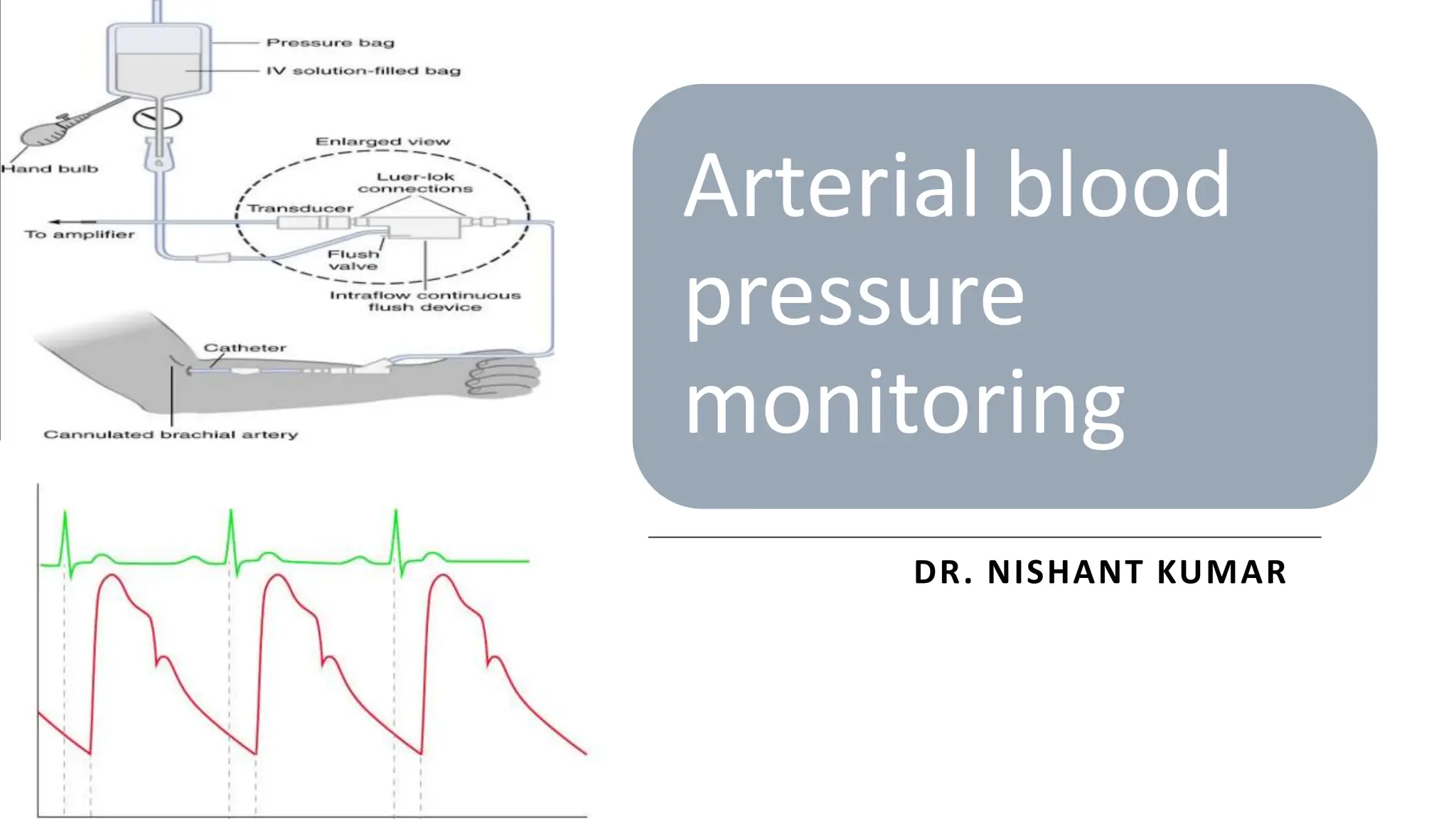
Arterial blood
pressure
monitoring
DR. NISHANT KUMAR
INTRODUCTION
•Invasive blood pressure monitoring is gold standard
in blood pressure monitoring.
•All the invasive pressure are usually expressed as
mm of mercury except CVP which may be expressed
as cm of water [1mm Hg = 1.36 cm of water].
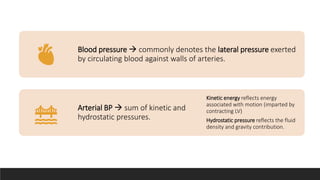
Blood pressure  commonly denotes the lateral pressure exerted
by circulating blood against walls of arteries.
Arterial BP  sum of kinetic and
hydrostatic pressures.
Kinetic energy reflects energy
associated with motion (imparted by
contracting LV)
Hydrostatic pressure reflects the fluid
density and gravity contribution.
Components of IABP monitoring
1. Biological variable
2. Sensor
3. Integrator
4. Output
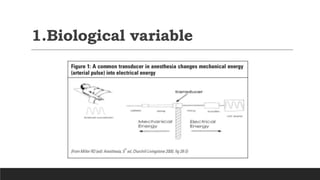
1.Biological variable
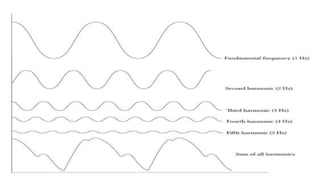
Sinusoid waves
• Decreasing amplitude and having increasing frequency.
• First 6-10 sinusoids contribute maximum to the final waveform.
• First sinusoid —aka fundamental frequency / first harmonic
• Equals to heart rate.
• HR of 60/min  1Hz (fundamental frequency)
• Arterial waveform can have as many as 30 harmonics.
• To accurately produce the original waveform  it will require a
recording system whose frequency response remain undistorted
upto 30 Hz .
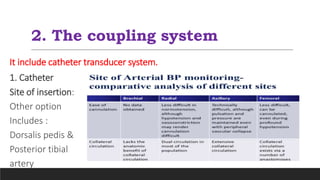
2. The coupling system
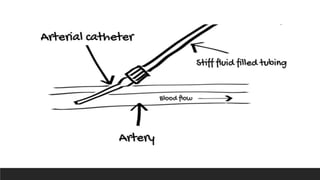
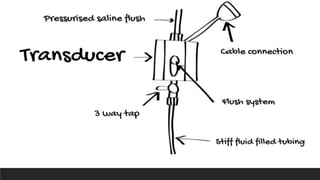
It include catheter transducer system.
1. Catheter
Site of insertion:
Other option
Includes :
Dorsalis pedis &
Posterior tibial
artery
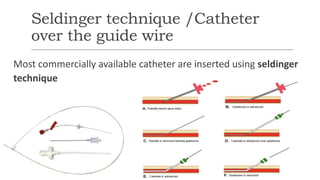
Seldinger technique /Catheter
over the guide wire
Most commercially available catheter are inserted using seldinger
technique
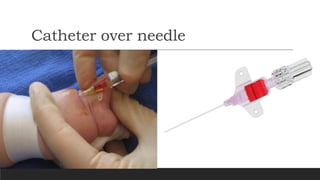
Catheter over needle
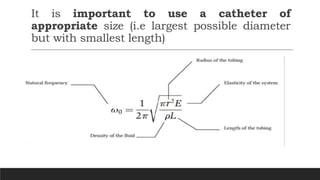
It is important to use a catheter of
appropriate size (i.e largest possible diameter
but with smallest length)
Catheter transducer system
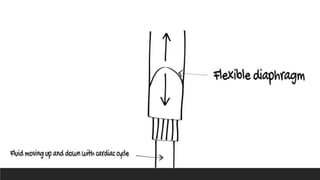
Characterised by three mechanical parameters:
1. Elasticity: stiffness of the system. (Tubing/ pressure transducer
diaphragm)
2. Mass : weight of material moving through the system. (Blood /
fluid)
3. Friction: the resistance encountered as the mass oscillates.
(Resistance to fluid / viscosity)
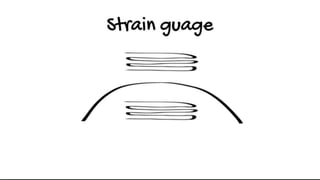
WHEATSTONE BRIDGE
INDICATIONS OF ARTERIAL LINE
•Critically ill patients- BP, Sampling
•Unreliable NIBP
•Post op complex / cardiac surgeries
•Monitoring response to Inotropes
•Predict fluid responsiveness
•Diagnostic procedures
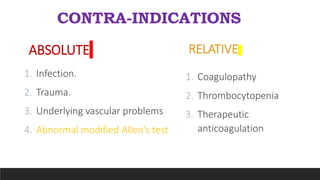
CONTRA-INDICATIONS
RELATIVE
1. Coagulopathy
2. Thrombocytopenia
3. Therapeutic
anticoagulation
ABSOLUTE
1. Infection.
2. Trauma.
3. Underlying vascular problems
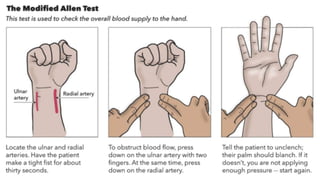
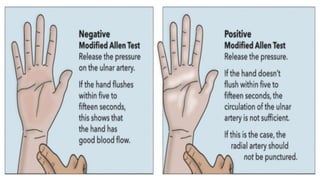
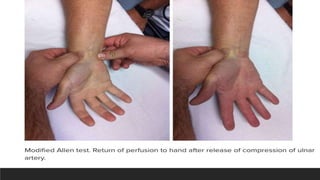
4. Abnormal modified Allen's test
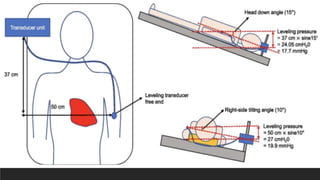
What is levelling?
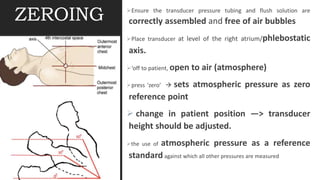
ZEROING Ensure the transducer pressure tubing and flush solution are
correctly assembled and free of air bubbles
Place transducer at level of the right atrium/phlebostatic
axis.
‘off to patient, open to air (atmosphere)
press 'zero’  sets atmospheric pressure as zero
reference point
 change in patient position —> transducer
height should be adjusted.
the use of atmospheric pressure as a reference
standard against which all other pressures are measured
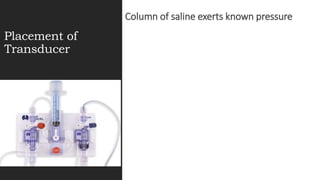
Placement of
Transducer
Column of saline exerts known pressure
Fast flush Test
FAST FLUSH TEST
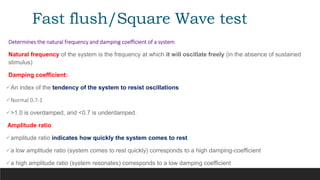
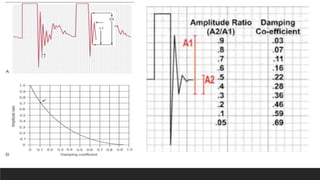
Fast flush/Square Wave test
Determines the natural frequency and damping coefficient of a system
Natural frequency of the system is the frequency at which it will oscillate freely (in the absence of sustained
stimulus)
Damping coefficient:
An index of the tendency of the system to resist oscillations
Normal 0.7-1
>1.0 is overdamped, and <0.7 is underdamped.
Amplitude ratio
amplitude ratio indicates how quickly the system comes to rest
a low amplitude ratio (system comes to rest quickly) corresponds to a high damping-coefficient
a high amplitude ratio (system resonates) corresponds to a low damping coefficient
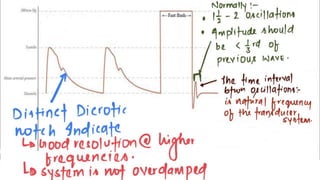
Fast
flush/Square
Wave test
• Rapidly flushing the catheter by
pulling the plunger and
releasing generates a square
wave.
• To check calibration of the
system.
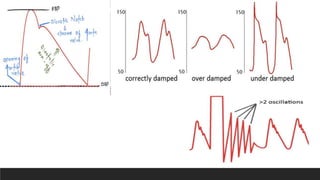
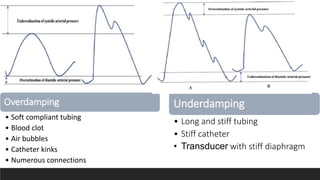
Overdamping
• Soft compliant tubing
• Blood clot
• Air bubbles
• Catheter kinks
• Numerous connections
Underdamping
• Long and stiff tubing
• Stiff catheter
• Transducer with stiff diaphragm
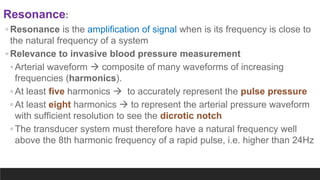
Resonance:
◦ Resonance is the amplification of signal when is its frequency is close to
the natural frequency of a system
◦ Relevance to invasive blood pressure measurement
◦ Arterial waveform  composite of many waveforms of increasing
frequencies (harmonics).
◦ At least five harmonics  to accurately represent the pulse pressure
◦ At least eight harmonics  to represent the arterial pressure waveform
with sufficient resolution to see the dicrotic notch
◦ The transducer system must therefore have a natural frequency well
above the 8th harmonic frequency of a rapid pulse, i.e. higher than 24Hz
Damping:
◦Damping is the process of the system absorbing the
energy (amplitude) of oscillations
The effects of damping:
◦The transducer system must be adequately damped so
that amplitude change due to resonance should not
occur even when it is close to the system's natural
frequency
◦The natural frequency (and thus the frequency response)
of an arterial line transducer can be interrogated using
the fast flush test.
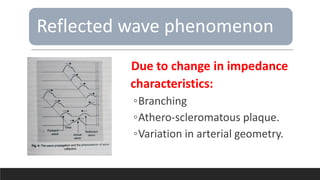
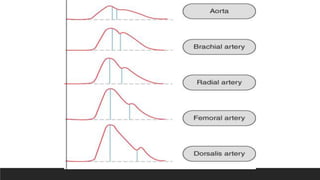
Reflected wave phenomenon
Due to change in impedance
characteristics:
◦Branching
◦Athero-scleromatous plaque.
◦Variation in arterial geometry.
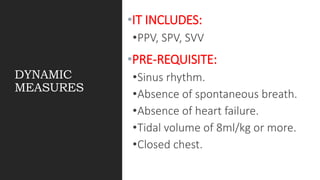
DYNAMIC
MEASURES
•IT INCLUDES:
•PPV, SPV, SVV
•PRE-REQUISITE:
•Sinus rhythm.
•Absence of spontaneous breath.
•Absence of heart failure.
•Tidal volume of 8ml/kg or more.
•Closed chest.
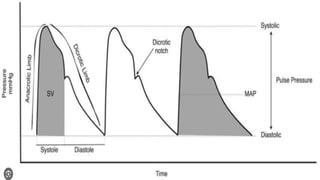
Stroke volume
variance
•Comparable to SPV
•Arterial line swing
• This phenomenon occurs during
respiration
• Variation of >10% is a sensitive
of fluid responsiveness.
•SPV is a direct reflection of the
stroke volume variation
• SPV = [SP max - SP min / SP mean
1x100]
• SPV >10mmHg is fluid responsive
Pulse pressure
variation
•PPV = [Ppmax- Ppmin /
Ppmean ]x 100
•Indicator of the position on
the Frank-Starling curve.
•PPV ≥ 12% is suggestive of
fluid responsiveness.
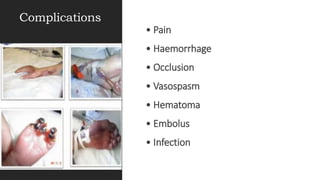
Complications
• Pain
• Haemorrhage
• Occlusion
• Vasospasm
• Hematoma
• Embolus
• Infection
“It’s one small step for man, one
giant leap for mankind.”
- NEIL ARMSTRONG

arterial line insertion in paediatric practice

  • 1.
  • 3.
    INTRODUCTION •Invasive blood pressuremonitoring is gold standard in blood pressure monitoring. •All the invasive pressure are usually expressed as mm of mercury except CVP which may be expressed as cm of water [1mm Hg = 1.36 cm of water].
  • 4.
    Blood pressure commonly denotes the lateral pressure exerted by circulating blood against walls of arteries. Arterial BP  sum of kinetic and hydrostatic pressures. Kinetic energy reflects energy associated with motion (imparted by contracting LV) Hydrostatic pressure reflects the fluid density and gravity contribution.
  • 5.
    Components of IABPmonitoring 1. Biological variable 2. Sensor 3. Integrator 4. Output
  • 6.
  • 8.
    Sinusoid waves • Decreasingamplitude and having increasing frequency. • First 6-10 sinusoids contribute maximum to the final waveform. • First sinusoid —aka fundamental frequency / first harmonic • Equals to heart rate. • HR of 60/min  1Hz (fundamental frequency) • Arterial waveform can have as many as 30 harmonics. • To accurately produce the original waveform  it will require a recording system whose frequency response remain undistorted upto 30 Hz .
  • 9.
    2. The couplingsystem It include catheter transducer system. 1. Catheter Site of insertion: Other option Includes : Dorsalis pedis & Posterior tibial artery
  • 10.
    Seldinger technique /Catheter overthe guide wire Most commercially available catheter are inserted using seldinger technique
  • 11.
  • 12.
    It is importantto use a catheter of appropriate size (i.e largest possible diameter but with smallest length)
  • 13.
    Catheter transducer system Characterisedby three mechanical parameters: 1. Elasticity: stiffness of the system. (Tubing/ pressure transducer diaphragm) 2. Mass : weight of material moving through the system. (Blood / fluid) 3. Friction: the resistance encountered as the mass oscillates. (Resistance to fluid / viscosity)
  • 15.
  • 20.
    INDICATIONS OF ARTERIALLINE •Critically ill patients- BP, Sampling •Unreliable NIBP •Post op complex / cardiac surgeries •Monitoring response to Inotropes •Predict fluid responsiveness •Diagnostic procedures
  • 21.
    CONTRA-INDICATIONS RELATIVE 1. Coagulopathy 2. Thrombocytopenia 3.Therapeutic anticoagulation ABSOLUTE 1. Infection. 2. Trauma. 3. Underlying vascular problems 4. Abnormal modified Allen's test
  • 25.
  • 27.
    ZEROING Ensure thetransducer pressure tubing and flush solution are correctly assembled and free of air bubbles Place transducer at level of the right atrium/phlebostatic axis. ‘off to patient, open to air (atmosphere) press 'zero’  sets atmospheric pressure as zero reference point  change in patient position —> transducer height should be adjusted. the use of atmospheric pressure as a reference standard against which all other pressures are measured
  • 28.
    Placement of Transducer Column ofsaline exerts known pressure
  • 29.
  • 30.
    Fast flush/Square Wavetest Determines the natural frequency and damping coefficient of a system Natural frequency of the system is the frequency at which it will oscillate freely (in the absence of sustained stimulus) Damping coefficient: An index of the tendency of the system to resist oscillations Normal 0.7-1 >1.0 is overdamped, and <0.7 is underdamped. Amplitude ratio amplitude ratio indicates how quickly the system comes to rest a low amplitude ratio (system comes to rest quickly) corresponds to a high damping-coefficient a high amplitude ratio (system resonates) corresponds to a low damping coefficient
  • 31.
    Fast flush/Square Wave test • Rapidlyflushing the catheter by pulling the plunger and releasing generates a square wave. • To check calibration of the system.
  • 33.
    Overdamping • Soft complianttubing • Blood clot • Air bubbles • Catheter kinks • Numerous connections Underdamping • Long and stiff tubing • Stiff catheter • Transducer with stiff diaphragm
  • 34.
    Resonance: ◦ Resonance isthe amplification of signal when is its frequency is close to the natural frequency of a system ◦ Relevance to invasive blood pressure measurement ◦ Arterial waveform  composite of many waveforms of increasing frequencies (harmonics). ◦ At least five harmonics  to accurately represent the pulse pressure ◦ At least eight harmonics  to represent the arterial pressure waveform with sufficient resolution to see the dicrotic notch ◦ The transducer system must therefore have a natural frequency well above the 8th harmonic frequency of a rapid pulse, i.e. higher than 24Hz
  • 35.
    Damping: ◦Damping is theprocess of the system absorbing the energy (amplitude) of oscillations The effects of damping: ◦The transducer system must be adequately damped so that amplitude change due to resonance should not occur even when it is close to the system's natural frequency ◦The natural frequency (and thus the frequency response) of an arterial line transducer can be interrogated using the fast flush test.
  • 37.
    Reflected wave phenomenon Dueto change in impedance characteristics: ◦Branching ◦Athero-scleromatous plaque. ◦Variation in arterial geometry.
  • 40.
    DYNAMIC MEASURES •IT INCLUDES: •PPV, SPV,SVV •PRE-REQUISITE: •Sinus rhythm. •Absence of spontaneous breath. •Absence of heart failure. •Tidal volume of 8ml/kg or more. •Closed chest.
  • 41.
    Stroke volume variance •Comparable toSPV •Arterial line swing • This phenomenon occurs during respiration • Variation of >10% is a sensitive of fluid responsiveness. •SPV is a direct reflection of the stroke volume variation • SPV = [SP max - SP min / SP mean 1x100] • SPV >10mmHg is fluid responsive
  • 43.
    Pulse pressure variation •PPV =[Ppmax- Ppmin / Ppmean ]x 100 •Indicator of the position on the Frank-Starling curve. •PPV ≥ 12% is suggestive of fluid responsiveness.
  • 45.
    Complications • Pain • Haemorrhage •Occlusion • Vasospasm • Hematoma • Embolus • Infection
  • 46.
    “It’s one smallstep for man, one giant leap for mankind.” - NEIL ARMSTRONG

Editor's Notes

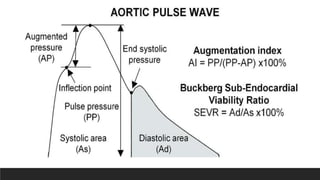
  • #39 Augmentation index reflect systemic arterial stiffness.