CORONARY GUIDEWIRES,CHOICE
AND APPROPRIATE USE IN PCI
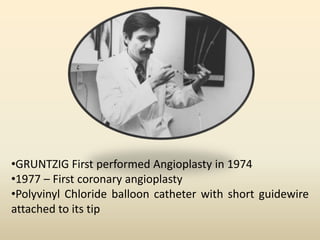
•GRUNTZIG First performed Angioplasty in 1974
•1977 – First coronary angioplasty
•Polyvinyl Chloride balloon catheter with short guidewire
attached to its tip
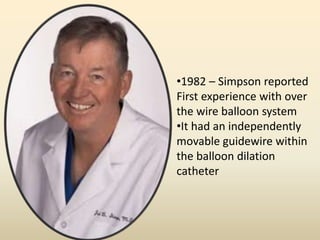
•1982 – Simpson reported
First experience with over
the wire balloon system
•It had an independently
movable guidewire within
the balloon dilation
catheter
CONTENTS
• PURPOSE OF GUIDEWIRE
• COMPONENTS OF A GUIDE WIRE
• CLASSIFICATION
• WIRES FOR DIFFERENT OCCASIONS
• GUIDEWIRE MANIPULATION
• COMPLICATIONS
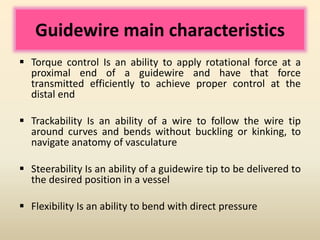
• To track through the vessel
• To access the lesion
• To cross the lesion atraumatically
• To provide support for interventional devices
Guidewire main characteristics
 Torque control Is an ability to apply rotational force at a
proximal end of a guidewire and have that force
transmitted efficiently to achieve proper control at the
distal end
 Trackability Is an ability of a wire to follow the wire tip
around curves and bends without buckling or kinking, to
navigate anatomy of vasculature
 Steerability Is an ability of a guidewire tip to be delivered to
the desired position in a vessel
 Flexibility Is an ability to bend with direct pressure
 Prolapse tendency Tendency of the body of a wire
not to follow the tip around bends
 Radiopacity/visibility Is an ability to visualise a
guidewire or guidewire tip under fluoroscopy.
 Tactile feedback Is tactile sensation on a proximal
end of a guide wire that physician has that tells him
what the distal end of the guidewire is doing
 Crossing Is an ability of a guidewire to cross lesion
with little or no resistance
 Support Is an ability of a guidewire to support a
passage of another device or system over it
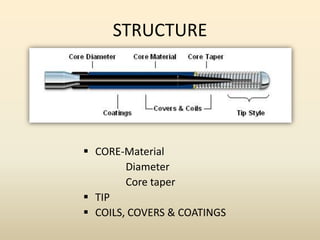
STRUCTURE
 CORE-Material
Diameter
Core taper
 TIP
 COILS, COVERS & COATINGS
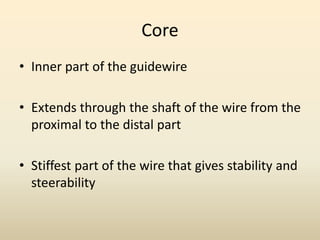
Core
• Inner part of the guidewire
• Extends through the shaft of the wire from the
proximal to the distal part
• Stiffest part of the wire that gives stability and
steerability
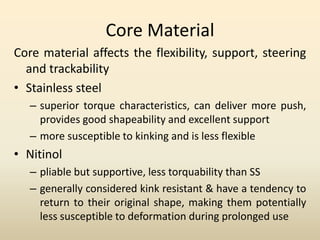
Core Material
Core material affects the flexibility, support, steering
and trackability
• Stainless steel
– superior torque characteristics, can deliver more push,
provides good shapeability and excellent support
– more susceptible to kinking and is less flexible
• Nitinol
– pliable but supportive, less torquability than SS
– generally considered kink resistant & have a tendency to
return to their original shape, making them potentially
less susceptible to deformation during prolonged use
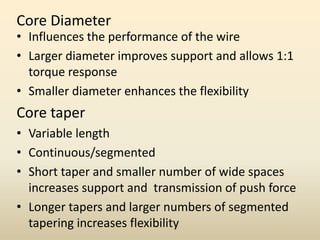
Core Diameter
• Influences the performance of the wire
• Larger diameter improves support and allows 1:1
torque response
• Smaller diameter enhances the flexibility
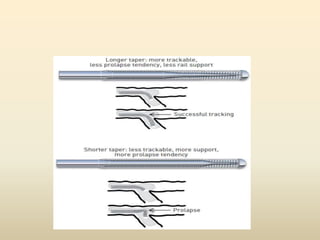
Core taper
• Variable length
• Continuous/segmented
• Short taper and smaller number of wide spaces
increases support and transmission of push force
• Longer tapers and larger numbers of segmented
tapering increases flexibility
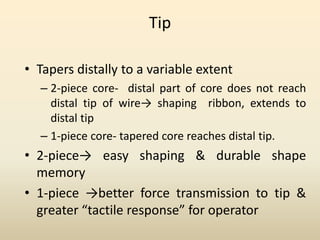
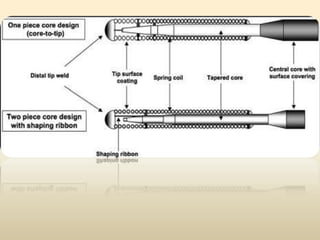
Tip
• Tapers distally to a variable extent
– 2-piece core- distal part of core does not reach
distal tip of wire→ shaping ribbon, extends to
distal tip
– 1-piece core- tapered core reaches distal tip.
• 2-piece→ easy shaping & durable shape
memory
• 1-piece →better force transmission to tip &
greater “tactile response” for operator
Coils, Covers & Coating
Keeps the diameter at .014 inch
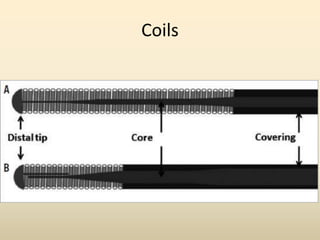
• Coils
– Stainless steel
– Outer coil Design – Coils placed over tapered core
and tip of the wire
– Tip coil Design – Tip alone is covered with coils
– Flexibility, support, steering, tracking, visibility &
tactile feedback
– Radio opaque platinum coils
Coils
Radio-opaque tip
• Visibility of the wire tip is provided by radiopaque
platinum coils that are usually placed at the distal
tip 2 to 3 cm in length, but maybe much longer.
• Many workhorse Wires – 3 cm distal radio-
opaque tip
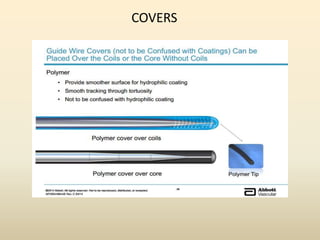
COVERS
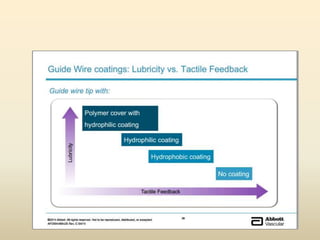
• Coating
– Distal half
– Affects lubricity and tracking
– Creates tactile feel
– Reduces friction
– Facilitates movement of wire within the vessel and
deliverability of intervention equipment
Non-Coated / Hydrophobic wires
Pros
• More controllable (and therefore less likely to dissect)
• Provide better tactile feel
Cons
• Poor trackability
• Wire tip becomes stiffer, torque response increases,
but less tip resistance is transmitted to the operator,
making it easier to enter a false channel.
HYDROPHOBIC
• Hydrophobic coatings are silicone based
coatings which repel water and are applied on
the working length of the wire, with the
exception of the distal tip. They require no
activation by liquids to create a "wax-like"
surface and to achieve the desired effect
— to reduce friction and increase trackability
of the wire. Silicone coating has higher
friction, more stable feel inside the vessel.
Hydrophilic
• Applied over the entire working length of wire
including tip coils
• Attracts water - needs lubrication
• Thin, non slippery, solid when dry→ becomes a gel
when wet
– ↓friction
– ↑trackability
– ↓Thrombogenic
↓tactile feel- ↑risk of perforation
Tendency to stick to angioplasty cath
• Useful in negotiating tortuous lesions and in
“finding microchannels” in total occlusions
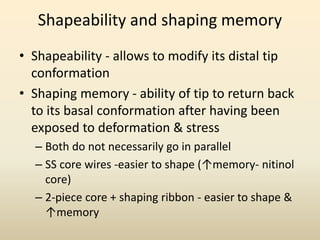
Shapeability and shaping memory
• Shapeability - allows to modify its distal tip
conformation
• Shaping memory - ability of tip to return back
to its basal conformation after having been
exposed to deformation & stress
– Both do not necessarily go in parallel
– SS core wires -easier to shape (↑memory- nitinol
core)
– 2-piece core + shaping ribbon - easier to shape &
↑memory
HOW TO CLASSIFY CORONARY
GUIDE WIRES?
CLASSIFICATION
• NO UNIFORM CLASSIFICATION
• BUT SOME CATEGORISATION
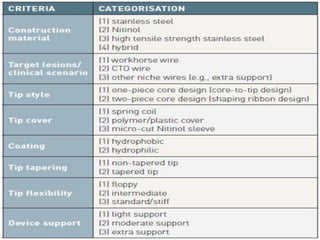
Classification
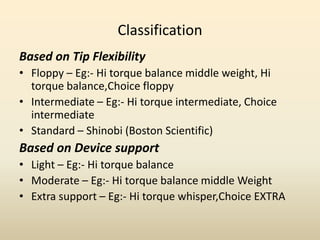
Based on Tip Flexibility
• Floppy – Eg:- Hi torque balance middle weight, Hi
torque balance,Choice floppy
• Intermediate – Eg:- Hi torque intermediate, Choice
intermediate
• Standard – Shinobi (Boston Scientific)
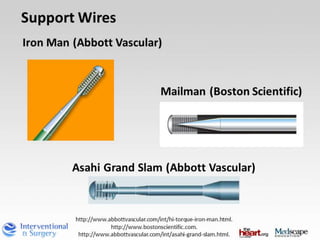
Based on Device support
• Light – Eg:- Hi torque balance
• Moderate – Eg:- Hi torque balance middle Weight
• Extra support – Eg:- Hi torque whisper,Choice EXTRA
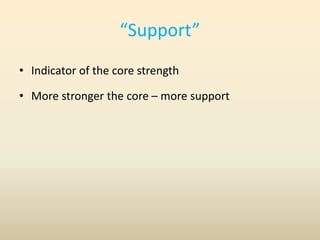
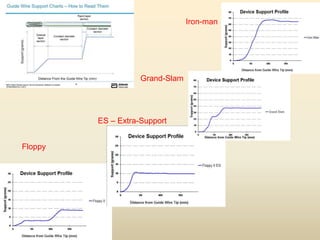
“Support”
• Indicator of the core strength
• More stronger the core – more support
Floppy
ES – Extra-Support
Grand-Slam
Iron-man
Based on coating
• Hydrophilic : Eg:- CholCETM PT Floppy
• Hydrophobic : Eg:- Asahi soft
Depending on tip load
• Floppy, Balanced & Extra support
• Tip load - force needed to bend a wire when
exerted on a straight guide wire tip, at 1 cm
from the tip
– Floppy - <0.5g
– Balanced – 0.5-0.9g
– Extra support - >0.9g
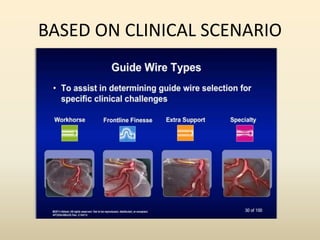
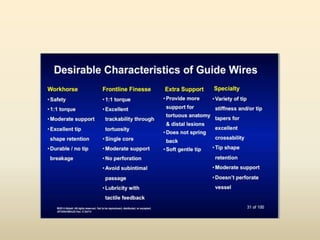
BASED ON CLINICAL SCENARIO
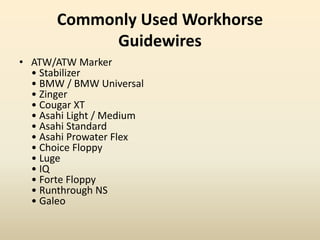
Commonly Used Workhorse
Guidewires
• ATW/ATW Marker
• Stabilizer
• BMW / BMW Universal
• Zinger
• Cougar XT
• Asahi Light / Medium
• Asahi Standard
• Asahi Prowater Flex
• Choice Floppy
• Luge
• IQ
• Forte Floppy
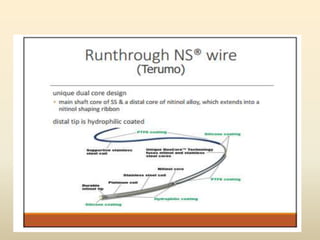
• Runthrough NS
• Galeo
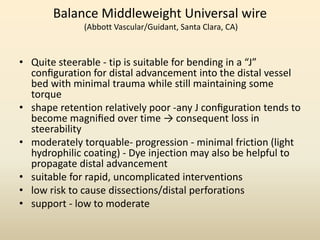
Balance Middleweight Universal wire
(Abbott Vascular/Guidant, Santa Clara, CA)
• Quite steerable - tip is suitable for bending in a “J”
configuration for distal advancement into the distal vessel
bed with minimal trauma while still maintaining some
torque
• shape retention relatively poor -any J configuration tends to
become magnified over time → consequent loss in
steerability
• moderately torquable- progression - minimal friction (light
hydrophilic coating) - Dye injection may also be helpful to
propagate distal advancement
• suitable for rapid, uncomplicated interventions
• low risk to cause dissections/distal perforations
• support - low to moderate
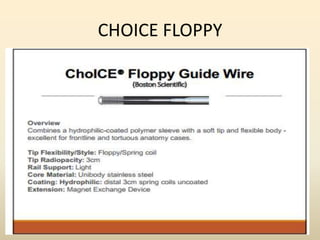
CHOICE FLOPPY
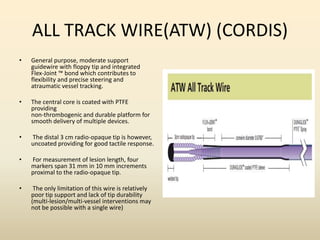
ALL TRACK WIRE(ATW) (CORDIS)
• General purpose, moderate support
guidewire with floppy tip and integrated
Flex-Joint ™ bond which contributes to
flexibility and precise steering and
atraumatic vessel tracking.
• The central core is coated with PTFE
providing
non-thrombogenic and durable platform for
smooth delivery of multiple devices.
• The distal 3 cm radio-opaque tip is however,
uncoated providing for good tactile response.
• For measurement of lesion length, four
markers span 31 mm in 10 mm increments
proximal to the radio-opaque tip.
• The only limitation of this wire is relatively
poor tip support and lack of tip durability
(multi-lesion/multi-vessel interventions may
not be possible with a single wire)
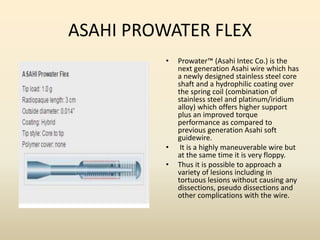
ASAHI PROWATER FLEX
• Prowater™ (Asahi Intec Co.) is the
next generation Asahi wire which has
a newly designed stainless steel core
shaft and a hydrophilic coating over
the spring coil (combination of
stainless steel and platinum/iridium
alloy) which offers higher support
plus an improved torque
performance as compared to
previous generation Asahi soft
guidewire.
• It is a highly maneuverable wire but
at the same time it is very floppy.
• Thus it is possible to approach a
variety of lesions including in
tortuous lesions without causing any
dissections, pseudo dissections and
other complications with the wire.
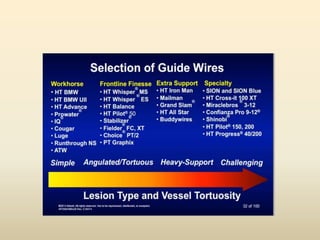
SELECTION OF GUIDEWIRES FOR
SPECIAL LESIONS
The selection of a guidewire
• Essential component
• INFLUENCED BY
• vessel anatomy
• the lesion morphology
• the devices to be used
• operator's experience and preference.
LEFT MAIN PCI
• The choice of a guidewire is not of critical
importance.
• Wire selection usually includes spring tip
guidewire designed for frontline lesions, for
example, ChoICE™ Floppy (Boston Scientific),
Hi-Torque Balance Middleweight (Abbott
Vascular)
• FOR LEFT MAIN OR RCA OSTIAL PCI AN
EXTRASUPPORT WIRE IS PREFERED
BIFURCATION PCI
• In the presence of difficulties accessing the
side branch some hydrophilic wires such as
the ChoICE™ PT Floppy (Boston Scientific), PT
Graphix™ (Boston Scientific) or Asahi Fielder
(Abbott Vascular) may become useful.
• These wires have higher risk to perforate the
distal vessel if allowed to migrate into small
side branches or too distally. Therefore it is
important to monitor the distal position of the
wire tip. These wires also should not to be
jailed because of the risk of wire rupture
during pullback.
DISSECTIONS
• ChOICE Floppy
• Asahi Soft .
• The parallel wire technique can be
recommended if a dissection plane is entered
with the first wire
• Ochiai M, Ashida K, Araki H, Ogata N, Okabayashi
H, Obara C. The latest wire technique for chronic
total occlusion. Ital Heart J 2005;6:489-93..
CALCIFIED LESIONS
• ChoICE Floppy (Boston Scientific).
• If it fails to cross the lesion, the next step is to
choose floppy hydrophilic wire such as the
ChoICE PT Floppy (Boston Scientific) or Asahi
Fielder (Abbott Vascular)
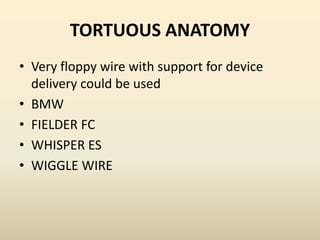
TORTUOUS ANATOMY
• Very floppy wire with support for device
delivery could be used
• BMW
• FIELDER FC
• WHISPER ES
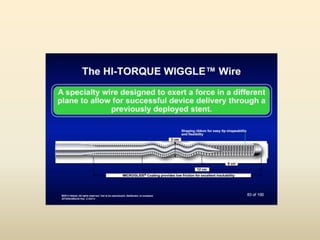
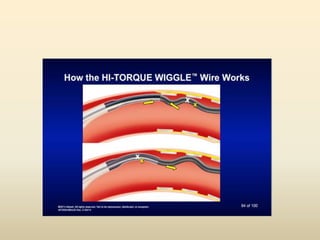
• WIGGLE WIRE
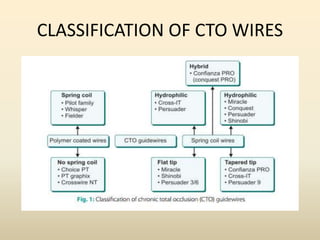
CTO WIRES
CLASSIFICATION OF CTO WIRES
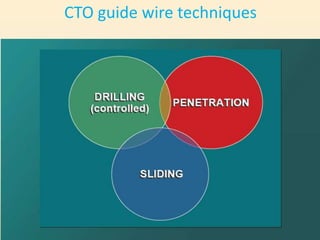
CTO guide wire techniques
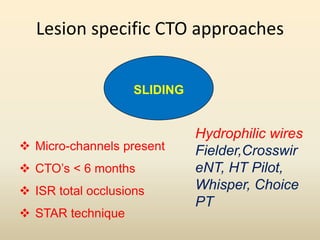
Lesion specific CTO approaches
SLIDING
 Micro-channels present
 CTO’s < 6 months
 ISR total occlusions
 STAR technique
Hydrophilic wires
Fielder,Crosswir
eNT, HT Pilot,
Whisper, Choice
PT
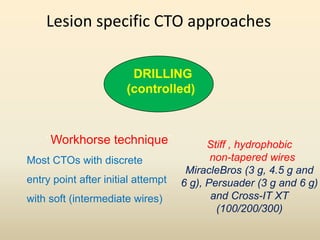
Lesion specific CTO approaches
DRILLING
(controlled)
“Workhorse technique”
Most CTOs with discrete
entry point after initial attempt
with soft (intermediate wires)
Stiff , hydrophobic
non-tapered wires
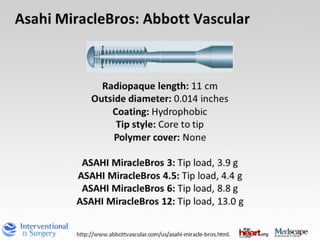
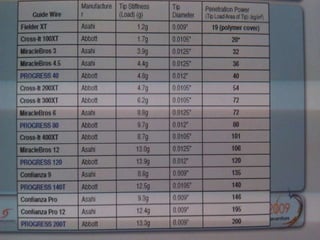
MiracleBros (3 g, 4.5 g and
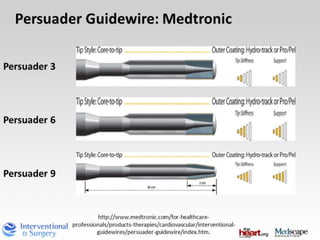
6 g), Persuader (3 g and 6 g)
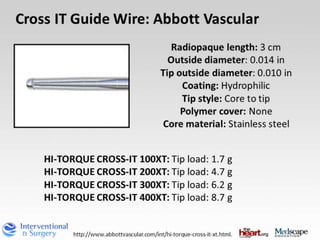
and Cross-IT XT
(100/200/300)
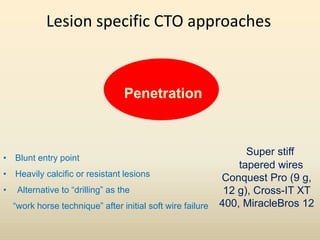
Lesion specific CTO approaches
Penetration
• Blunt entry point
• Heavily calcific or resistant lesions
• Alternative to “drilling” as the
“work horse technique” after initial soft wire failure
Super stiff
tapered wires
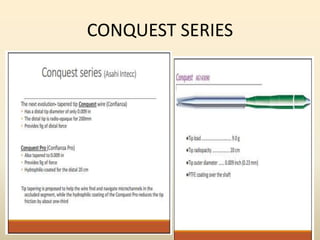
Conquest Pro (9 g,
12 g), Cross-IT XT
400, MiracleBros 12
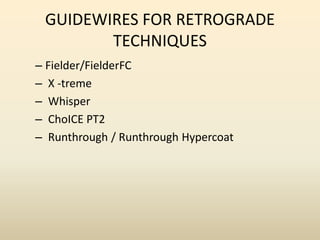
GUIDEWIRES FOR RETROGRADE
TECHNIQUES
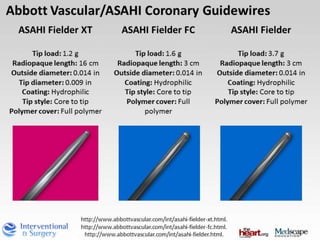
– Fielder/FielderFC
– X -treme
– Whisper
– ChoICE PT2
– Runthrough / Runthrough Hypercoat
COMMONLY USED CTO WIRES
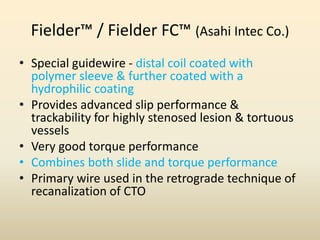
Fielder™ / Fielder FC™ (Asahi Intec Co.)
• Special guidewire - distal coil coated with
polymer sleeve & further coated with a
hydrophilic coating
• Provides advanced slip performance &
trackability for highly stenosed lesion & tortuous
vessels
• Very good torque performance
• Combines both slide and torque performance
• Primary wire used in the retrograde technique of
recanalization of CTO
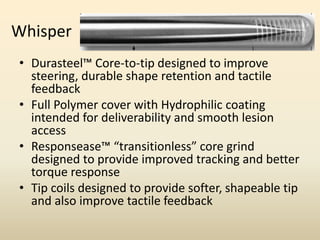
Whisper
• Durasteel™ Core-to-tip designed to improve
steering, durable shape retention and tactile
feedback
• Full Polymer cover with Hydrophilic coating
intended for deliverability and smooth lesion
access
• Responsease™ “transitionless” core grind
designed to provide improved tracking and better
torque response
• Tip coils designed to provide softer, shapeable tip
and also improve tactile feedback
CONQUEST SERIES
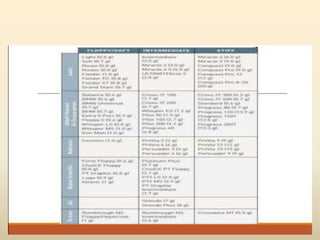
SUMMARY OF WIRES
Guidewire Manipulations
• Two step process
• Shaping the wire tip
– It minimizes the amount of force applied to the
wire
– For steering into the vessel
– For visualization of torquing effort
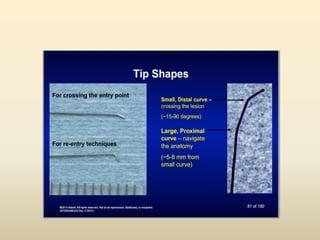
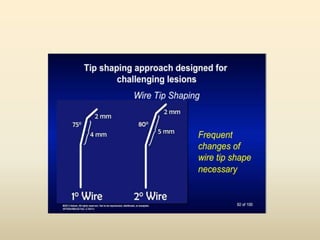
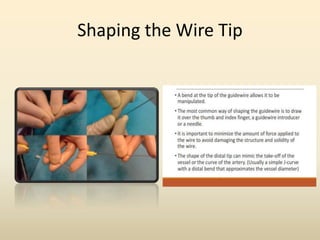
Shaping the Wire Tip
Steering of the wire
• Small alternating rotations to left and right
• Excessive rotations should be avoided to
prevent wire tip fracture
Optimum guide wire positioning
• Should be placed as distally as possible in the
target vessel
• Allows extra support when crossing with
balloon/stent catheters
• ↓ chance of the wire becoming displaced
backwards across the lesion and necessitating
re-crossing
Avoid vessel perforation when positioning
wires with hydrophilic coatings very distally
Strategies if Guidewire fails to cross
• Make the guide more coaxial with the lumen
of the artery
• Use a balloon to direct the wire
• Modify the bend at the tip of the wire
• Change the wire
Complications
• Vessel perforations
– Uncommon <1%
– Risk factors
• Hydrophilic wires, core to tip
• Chronic total occlusions
– Diagnosis
• Angiographic diagnosis
• Small extraluminal extravasation of blush in the distribution
of target vessel
• Emergency echo to r/o pericardial effusion and tamponade
– Prognosis
• Extent of extravasation into pericardium
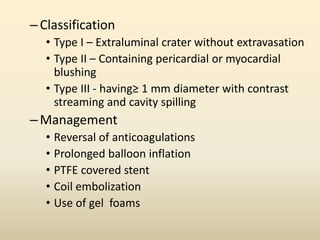
–Classification
• Type I – Extraluminal crater without extravasation
• Type II – Containing pericardial or myocardial
blushing
• Type III - having≥ 1 mm diameter with contrast
streaming and cavity spilling
–Management
• Reversal of anticoagulations
• Prolonged balloon inflation
• PTFE covered stent
• Coil embolization
• Use of gel foams
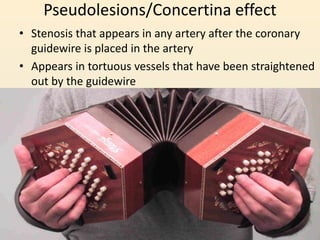
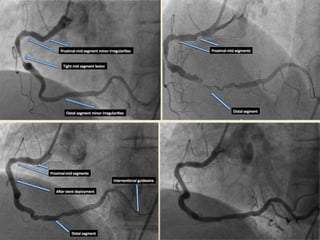
Pseudolesions/Concertina effect
• Stenosis that appears in any artery after the coronary
guidewire is placed in the artery
• Appears in tortuous vessels that have been straightened
out by the guidewire
Diagnosis
• Will disappear if the wire is withdrawn
• Replacement of a stiff wire with a flexible
floppy wire eliminates pseudolesion
Complications
• In some cases cause hemodynamic
compromise and ischemia
Guidewire Entrapment
Factors
• Presence of calcified vessels.
• Repeated use of wire for multiple interventions
• Repeated attempts at crossing the same lesion
multiple times with the same wire
• Two wires may become entrapped when the
“Buddy wire” technique is used
• Crossing stent struts
Management
• Advance a small profile balloon or a small caliber
catheter (transit catheter) to the attachment site
and pull back gently
• When a second or “buddy wire” gets trapped
between a stent and the vessel wall gentle
traction can be used
• Surgery
Guidewire fracture and Embolization
• Risk factors are calcified lesion, bifurcation
stenting and prolonged procedures
• Management
– Surgery
– Snaring the Embolized wire fragment
• The Amplatz Gooseneck Microsnare
• The EnSnare Triple Loop Device
• The X Pro Micro Elite Snare
• The Alligator Retrieval Device
– Push and paste
THANK YOU

Coronary guide wires

  • 1.
  • 3.
    •GRUNTZIG First performedAngioplasty in 1974 •1977 – First coronary angioplasty •Polyvinyl Chloride balloon catheter with short guidewire attached to its tip
  • 4.
    •1982 – Simpsonreported First experience with over the wire balloon system •It had an independently movable guidewire within the balloon dilation catheter
  • 5.
    CONTENTS • PURPOSE OFGUIDEWIRE • COMPONENTS OF A GUIDE WIRE • CLASSIFICATION • WIRES FOR DIFFERENT OCCASIONS • GUIDEWIRE MANIPULATION • COMPLICATIONS
  • 6.
    • To trackthrough the vessel • To access the lesion • To cross the lesion atraumatically • To provide support for interventional devices
  • 7.
    Guidewire main characteristics Torque control Is an ability to apply rotational force at a proximal end of a guidewire and have that force transmitted efficiently to achieve proper control at the distal end  Trackability Is an ability of a wire to follow the wire tip around curves and bends without buckling or kinking, to navigate anatomy of vasculature  Steerability Is an ability of a guidewire tip to be delivered to the desired position in a vessel  Flexibility Is an ability to bend with direct pressure
  • 8.
     Prolapse tendencyTendency of the body of a wire not to follow the tip around bends  Radiopacity/visibility Is an ability to visualise a guidewire or guidewire tip under fluoroscopy.  Tactile feedback Is tactile sensation on a proximal end of a guide wire that physician has that tells him what the distal end of the guidewire is doing  Crossing Is an ability of a guidewire to cross lesion with little or no resistance  Support Is an ability of a guidewire to support a passage of another device or system over it
  • 9.
  • 10.
    Core • Inner partof the guidewire • Extends through the shaft of the wire from the proximal to the distal part • Stiffest part of the wire that gives stability and steerability
  • 11.
    Core Material Core materialaffects the flexibility, support, steering and trackability • Stainless steel – superior torque characteristics, can deliver more push, provides good shapeability and excellent support – more susceptible to kinking and is less flexible • Nitinol – pliable but supportive, less torquability than SS – generally considered kink resistant & have a tendency to return to their original shape, making them potentially less susceptible to deformation during prolonged use
  • 12.
    Core Diameter • Influencesthe performance of the wire • Larger diameter improves support and allows 1:1 torque response • Smaller diameter enhances the flexibility Core taper • Variable length • Continuous/segmented • Short taper and smaller number of wide spaces increases support and transmission of push force • Longer tapers and larger numbers of segmented tapering increases flexibility
  • 14.
    Tip • Tapers distallyto a variable extent – 2-piece core- distal part of core does not reach distal tip of wire→ shaping ribbon, extends to distal tip – 1-piece core- tapered core reaches distal tip. • 2-piece→ easy shaping & durable shape memory • 1-piece →better force transmission to tip & greater “tactile response” for operator
  • 16.
    Coils, Covers &Coating Keeps the diameter at .014 inch • Coils – Stainless steel – Outer coil Design – Coils placed over tapered core and tip of the wire – Tip coil Design – Tip alone is covered with coils – Flexibility, support, steering, tracking, visibility & tactile feedback – Radio opaque platinum coils
  • 17.
  • 18.
    Radio-opaque tip • Visibilityof the wire tip is provided by radiopaque platinum coils that are usually placed at the distal tip 2 to 3 cm in length, but maybe much longer. • Many workhorse Wires – 3 cm distal radio- opaque tip
  • 19.
  • 20.
    • Coating – Distalhalf – Affects lubricity and tracking – Creates tactile feel – Reduces friction – Facilitates movement of wire within the vessel and deliverability of intervention equipment
  • 21.
    Non-Coated / Hydrophobicwires Pros • More controllable (and therefore less likely to dissect) • Provide better tactile feel Cons • Poor trackability • Wire tip becomes stiffer, torque response increases, but less tip resistance is transmitted to the operator, making it easier to enter a false channel.
  • 22.
    HYDROPHOBIC • Hydrophobic coatingsare silicone based coatings which repel water and are applied on the working length of the wire, with the exception of the distal tip. They require no activation by liquids to create a "wax-like" surface and to achieve the desired effect — to reduce friction and increase trackability of the wire. Silicone coating has higher friction, more stable feel inside the vessel.
  • 23.
    Hydrophilic • Applied overthe entire working length of wire including tip coils • Attracts water - needs lubrication • Thin, non slippery, solid when dry→ becomes a gel when wet – ↓friction – ↑trackability – ↓Thrombogenic ↓tactile feel- ↑risk of perforation Tendency to stick to angioplasty cath • Useful in negotiating tortuous lesions and in “finding microchannels” in total occlusions
  • 25.
    Shapeability and shapingmemory • Shapeability - allows to modify its distal tip conformation • Shaping memory - ability of tip to return back to its basal conformation after having been exposed to deformation & stress – Both do not necessarily go in parallel – SS core wires -easier to shape (↑memory- nitinol core) – 2-piece core + shaping ribbon - easier to shape & ↑memory
  • 26.
    HOW TO CLASSIFYCORONARY GUIDE WIRES?
  • 27.
    CLASSIFICATION • NO UNIFORMCLASSIFICATION • BUT SOME CATEGORISATION
  • 29.
    Classification Based on TipFlexibility • Floppy – Eg:- Hi torque balance middle weight, Hi torque balance,Choice floppy • Intermediate – Eg:- Hi torque intermediate, Choice intermediate • Standard – Shinobi (Boston Scientific) Based on Device support • Light – Eg:- Hi torque balance • Moderate – Eg:- Hi torque balance middle Weight • Extra support – Eg:- Hi torque whisper,Choice EXTRA
  • 30.
    “Support” • Indicator ofthe core strength • More stronger the core – more support
  • 31.
  • 33.
    Based on coating •Hydrophilic : Eg:- CholCETM PT Floppy • Hydrophobic : Eg:- Asahi soft Depending on tip load • Floppy, Balanced & Extra support • Tip load - force needed to bend a wire when exerted on a straight guide wire tip, at 1 cm from the tip – Floppy - <0.5g – Balanced – 0.5-0.9g – Extra support - >0.9g
  • 35.
  • 38.
    Commonly Used Workhorse Guidewires •ATW/ATW Marker • Stabilizer • BMW / BMW Universal • Zinger • Cougar XT • Asahi Light / Medium • Asahi Standard • Asahi Prowater Flex • Choice Floppy • Luge • IQ • Forte Floppy • Runthrough NS • Galeo
  • 39.
    Balance Middleweight Universalwire (Abbott Vascular/Guidant, Santa Clara, CA) • Quite steerable - tip is suitable for bending in a “J” configuration for distal advancement into the distal vessel bed with minimal trauma while still maintaining some torque • shape retention relatively poor -any J configuration tends to become magnified over time → consequent loss in steerability • moderately torquable- progression - minimal friction (light hydrophilic coating) - Dye injection may also be helpful to propagate distal advancement • suitable for rapid, uncomplicated interventions • low risk to cause dissections/distal perforations • support - low to moderate
  • 40.
  • 42.
    ALL TRACK WIRE(ATW)(CORDIS) • General purpose, moderate support guidewire with floppy tip and integrated Flex-Joint ™ bond which contributes to flexibility and precise steering and atraumatic vessel tracking. • The central core is coated with PTFE providing non-thrombogenic and durable platform for smooth delivery of multiple devices. • The distal 3 cm radio-opaque tip is however, uncoated providing for good tactile response. • For measurement of lesion length, four markers span 31 mm in 10 mm increments proximal to the radio-opaque tip. • The only limitation of this wire is relatively poor tip support and lack of tip durability (multi-lesion/multi-vessel interventions may not be possible with a single wire)
  • 43.
    ASAHI PROWATER FLEX •Prowater™ (Asahi Intec Co.) is the next generation Asahi wire which has a newly designed stainless steel core shaft and a hydrophilic coating over the spring coil (combination of stainless steel and platinum/iridium alloy) which offers higher support plus an improved torque performance as compared to previous generation Asahi soft guidewire. • It is a highly maneuverable wire but at the same time it is very floppy. • Thus it is possible to approach a variety of lesions including in tortuous lesions without causing any dissections, pseudo dissections and other complications with the wire.
  • 44.
    SELECTION OF GUIDEWIRESFOR SPECIAL LESIONS
  • 45.
    The selection ofa guidewire • Essential component • INFLUENCED BY • vessel anatomy • the lesion morphology • the devices to be used • operator's experience and preference.
  • 46.
    LEFT MAIN PCI •The choice of a guidewire is not of critical importance. • Wire selection usually includes spring tip guidewire designed for frontline lesions, for example, ChoICE™ Floppy (Boston Scientific), Hi-Torque Balance Middleweight (Abbott Vascular) • FOR LEFT MAIN OR RCA OSTIAL PCI AN EXTRASUPPORT WIRE IS PREFERED
  • 47.
    BIFURCATION PCI • Inthe presence of difficulties accessing the side branch some hydrophilic wires such as the ChoICE™ PT Floppy (Boston Scientific), PT Graphix™ (Boston Scientific) or Asahi Fielder (Abbott Vascular) may become useful.
  • 48.
    • These wireshave higher risk to perforate the distal vessel if allowed to migrate into small side branches or too distally. Therefore it is important to monitor the distal position of the wire tip. These wires also should not to be jailed because of the risk of wire rupture during pullback.
  • 49.
    DISSECTIONS • ChOICE Floppy •Asahi Soft . • The parallel wire technique can be recommended if a dissection plane is entered with the first wire • Ochiai M, Ashida K, Araki H, Ogata N, Okabayashi H, Obara C. The latest wire technique for chronic total occlusion. Ital Heart J 2005;6:489-93..
  • 50.
    CALCIFIED LESIONS • ChoICEFloppy (Boston Scientific). • If it fails to cross the lesion, the next step is to choose floppy hydrophilic wire such as the ChoICE PT Floppy (Boston Scientific) or Asahi Fielder (Abbott Vascular)
  • 51.
    TORTUOUS ANATOMY • Veryfloppy wire with support for device delivery could be used • BMW • FIELDER FC • WHISPER ES • WIGGLE WIRE
  • 54.
  • 56.
  • 59.
    CTO guide wiretechniques
  • 60.
    Lesion specific CTOapproaches SLIDING  Micro-channels present  CTO’s < 6 months  ISR total occlusions  STAR technique Hydrophilic wires Fielder,Crosswir eNT, HT Pilot, Whisper, Choice PT
  • 61.
    Lesion specific CTOapproaches DRILLING (controlled) “Workhorse technique” Most CTOs with discrete entry point after initial attempt with soft (intermediate wires) Stiff , hydrophobic non-tapered wires MiracleBros (3 g, 4.5 g and 6 g), Persuader (3 g and 6 g) and Cross-IT XT (100/200/300)
  • 62.
    Lesion specific CTOapproaches Penetration • Blunt entry point • Heavily calcific or resistant lesions • Alternative to “drilling” as the “work horse technique” after initial soft wire failure Super stiff tapered wires Conquest Pro (9 g, 12 g), Cross-IT XT 400, MiracleBros 12
  • 63.
    GUIDEWIRES FOR RETROGRADE TECHNIQUES –Fielder/FielderFC – X -treme – Whisper – ChoICE PT2 – Runthrough / Runthrough Hypercoat
  • 64.
  • 67.
    Fielder™ / FielderFC™ (Asahi Intec Co.) • Special guidewire - distal coil coated with polymer sleeve & further coated with a hydrophilic coating • Provides advanced slip performance & trackability for highly stenosed lesion & tortuous vessels • Very good torque performance • Combines both slide and torque performance • Primary wire used in the retrograde technique of recanalization of CTO
  • 70.
    Whisper • Durasteel™ Core-to-tipdesigned to improve steering, durable shape retention and tactile feedback • Full Polymer cover with Hydrophilic coating intended for deliverability and smooth lesion access • Responsease™ “transitionless” core grind designed to provide improved tracking and better torque response • Tip coils designed to provide softer, shapeable tip and also improve tactile feedback
  • 71.
  • 72.
  • 74.
    Guidewire Manipulations • Twostep process • Shaping the wire tip – It minimizes the amount of force applied to the wire – For steering into the vessel – For visualization of torquing effort
  • 75.
  • 76.
    Steering of thewire • Small alternating rotations to left and right • Excessive rotations should be avoided to prevent wire tip fracture
  • 77.
    Optimum guide wirepositioning • Should be placed as distally as possible in the target vessel • Allows extra support when crossing with balloon/stent catheters • ↓ chance of the wire becoming displaced backwards across the lesion and necessitating re-crossing Avoid vessel perforation when positioning wires with hydrophilic coatings very distally
  • 78.
    Strategies if Guidewirefails to cross • Make the guide more coaxial with the lumen of the artery • Use a balloon to direct the wire • Modify the bend at the tip of the wire • Change the wire
  • 79.
    Complications • Vessel perforations –Uncommon <1% – Risk factors • Hydrophilic wires, core to tip • Chronic total occlusions – Diagnosis • Angiographic diagnosis • Small extraluminal extravasation of blush in the distribution of target vessel • Emergency echo to r/o pericardial effusion and tamponade – Prognosis • Extent of extravasation into pericardium
  • 80.
    –Classification • Type I– Extraluminal crater without extravasation • Type II – Containing pericardial or myocardial blushing • Type III - having≥ 1 mm diameter with contrast streaming and cavity spilling –Management • Reversal of anticoagulations • Prolonged balloon inflation • PTFE covered stent • Coil embolization • Use of gel foams
  • 81.
    Pseudolesions/Concertina effect • Stenosisthat appears in any artery after the coronary guidewire is placed in the artery • Appears in tortuous vessels that have been straightened out by the guidewire
  • 82.
    Diagnosis • Will disappearif the wire is withdrawn • Replacement of a stiff wire with a flexible floppy wire eliminates pseudolesion Complications • In some cases cause hemodynamic compromise and ischemia
  • 84.
    Guidewire Entrapment Factors • Presenceof calcified vessels. • Repeated use of wire for multiple interventions • Repeated attempts at crossing the same lesion multiple times with the same wire • Two wires may become entrapped when the “Buddy wire” technique is used • Crossing stent struts
  • 85.
    Management • Advance asmall profile balloon or a small caliber catheter (transit catheter) to the attachment site and pull back gently • When a second or “buddy wire” gets trapped between a stent and the vessel wall gentle traction can be used • Surgery
  • 86.
    Guidewire fracture andEmbolization • Risk factors are calcified lesion, bifurcation stenting and prolonged procedures • Management – Surgery – Snaring the Embolized wire fragment • The Amplatz Gooseneck Microsnare • The EnSnare Triple Loop Device • The X Pro Micro Elite Snare • The Alligator Retrieval Device – Push and paste
  • 87.