1
1.7
© 2012 Pearson Education, Inc.
Linear Equations
in Linear Algebra
LINEAR INDEPENDENCE
Slide 1.7- 2© 2012 Pearson Education, Inc.
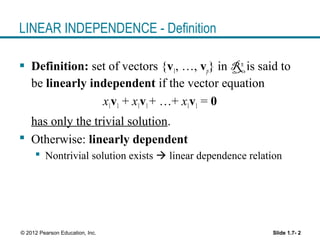
LINEAR INDEPENDENCE - Definition
 Definition: set of vectors {v1, …, vp} in Rn
is said to
be linearly independent if the vector equation
x1v1 + x1v1+ …+ x1v1 = 0
has only the trivial solution.
 Otherwise: linearly dependent
 Nontrivial solution exists  linear dependence relation
Slide 1.7- 3© 2012 Pearson Education, Inc.
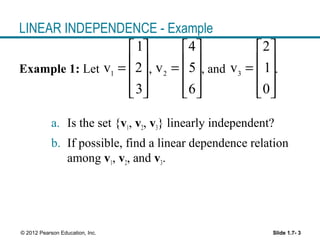
LINEAR INDEPENDENCE - Example
Example 1: Let , , and .
a. Is the set {v1, v2, v3} linearly independent?
b. If possible, find a linear dependence relation
among v1, v2, and v3.
1
1
v 2
3
 
 =
 
  
2
4
v 5
6
 
 =
 
  
3
2
v 1
0
 
 =
 
  
Slide 1.7- 4© 2012 Pearson Education, Inc.
LINEAR INDEPENDENCE OF MATRIX COLUMNS
 matrix A = [a1a2 … a3]
 The matrix equation Ax = 0 can be written as
x1v1 + x1v1+ …+ x1v1 = 0
 Each linear dependence relation among the columns of
A corresponds to a nontrivial solution of Ax = 0.
 Thus, the columns of matrix A are linearly independent
iff the equation Ax = 0 has only the trivial solution.
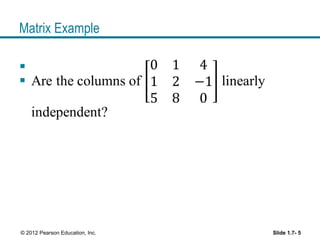
Matrix Example
Slide 1.7- 5© 2012 Pearson Education, Inc.
Slide 1.7- 6© 2012 Pearson Education, Inc.
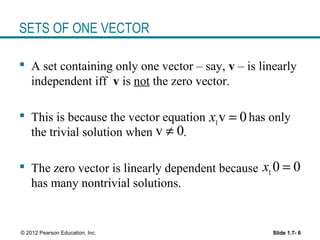
SETS OF ONE VECTOR
 A set containing only one vector – say, v – is linearly
independent iff v is not the zero vector.
 This is because the vector equation has only
the trivial solution when .
 The zero vector is linearly dependent because
has many nontrivial solutions.
1
v 0x =
v 0≠
1
0 0x =
Slide 1.7- 7© 2012 Pearson Education, Inc.
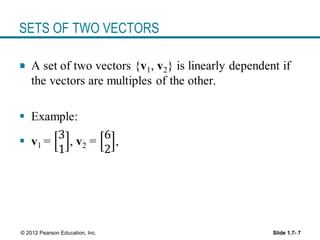
SETS OF TWO VECTORS
Slide 1.7- 8© 2012 Pearson Education, Inc.
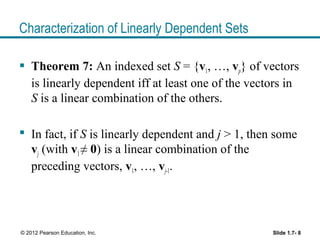
Characterization of Linearly Dependent Sets
 Theorem 7: An indexed set S = {v1, …, vp} of vectors
is linearly dependent iff at least one of the vectors in
S is a linear combination of the others.
 In fact, if S is linearly dependent and j > 1, then some
vj (with v1≠ 0) is a linear combination of the
preceding vectors, v1, …, vj-1.
Slide 1.7- 9© 2012 Pearson Education, Inc.
SETS OF TWO OR MORE VECTORS
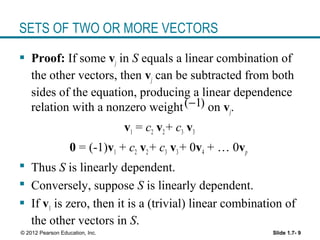
 Proof: If some vj in S equals a linear combination of
the other vectors, then vj can be subtracted from both
sides of the equation, producing a linear dependence
relation with a nonzero weight on vj.
v1 = c2 v2+ c3 v3
0 = (-1)v1 + c2 v2+ c3 v3+ 0v4 + … 0vp
 Thus S is linearly dependent.
 Conversely, suppose S is linearly dependent.
 If v1 is zero, then it is a (trivial) linear combination of
the other vectors in S.
( 1)−
Slide 1.7- 10© 2012 Pearson Education, Inc.
SETS OF TWO OR MORE VECTORS
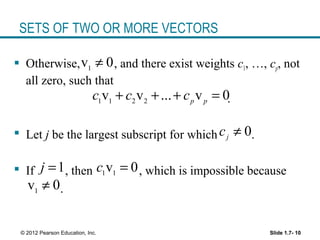
 Otherwise, , and there exist weights c1, …, cp, not
all zero, such that
.
 Let j be the largest subscript for which .
 If , then , which is impossible because
.
1
v 0≠
1 1 2 2
v v ... v 0p p
c c c+ + + =
0j
c ≠
1j = 1 1
v 0c =
1
v 0≠
Slide 1.7- 11© 2012 Pearson Education, Inc.
SETS OF TWO OR MORE VECTORS
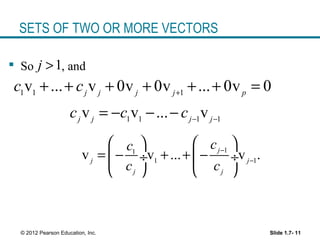
 So , and1j >
1 1 1
v ... v 0v 0v ... 0v 0j j j j p
c c +
+ + + + + + =
1 1 1 1
v v ... vj j j j
c c c − −
= − − −
11
1 1
v v ... v .j
j j
j j
cc
c c
−
−
   
= − + + − ÷  ÷
   
Slide 1.7- 12© 2012 Pearson Education, Inc.
SETS OF TWO OR MORE VECTORS
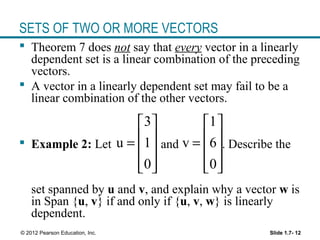
 Theorem 7 does not say that every vector in a linearly
dependent set is a linear combination of the preceding
vectors.
 A vector in a linearly dependent set may fail to be a
linear combination of the other vectors.
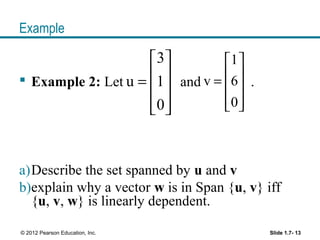
 Example 2: Let and . Describe the
set spanned by u and v, and explain why a vector w is
in Span {u, v} if and only if {u, v, w} is linearly
dependent.
3
u 1
0
 
 =
 
  
1
v 6
0
 
 =
 
  
Example
 Example 2: Let and .
a)Describe the set spanned by u and v
b)explain why a vector w is in Span {u, v} iff
{u, v, w} is linearly dependent.
Slide 1.7- 13© 2012 Pearson Education, Inc.
3
u 1
0
 
 =
 
  
1
v 6
0
 
 =
 
  
Slide 1.7- 14© 2012 Pearson Education, Inc.
SETS OF TWO OR MORE VECTORS
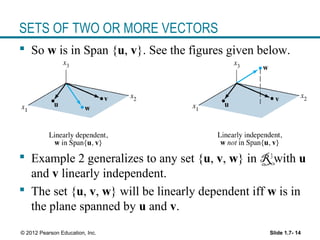
 So w is in Span {u, v}. See the figures given below.
 Example 2 generalizes to any set {u, v, w} in R3
with u
and v linearly independent.
 The set {u, v, w} will be linearly dependent iff w is in
the plane spanned by u and v.
Slide 1.7- 15© 2012 Pearson Education, Inc.
SETS OF TWO OR MORE VECTORS
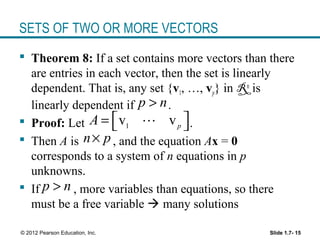
 Theorem 8: If a set contains more vectors than there
are entries in each vector, then the set is linearly
dependent. That is, any set {v1, …, vp} in Rn
is
linearly dependent if .
 Proof: Let .
 Then A is , and the equation Ax = 0
corresponds to a system of n equations in p
unknowns.
 If , more variables than equations, so there
must be a free variable  many solutions
p n>
1
v vp
A  =  L
n p×
p n>
Slide 1.7- 16© 2012 Pearson Education, Inc.
SETS OF TWO OR MORE VECTORS
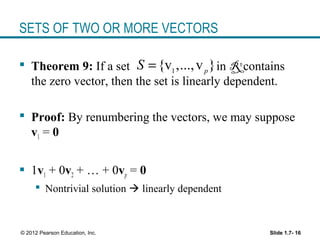
 Theorem 9: If a set in Rn
contains
the zero vector, then the set is linearly dependent.
 Proof: By renumbering the vectors, we may suppose
v1 = 0
 1v1 + 0v2 + … + 0vp = 0
 Nontrivial solution  linearly dependent
1
{v ,...,v }p
S =
Linear Transformations
Slide 1.7- 17© 2012 Pearson Education, Inc.
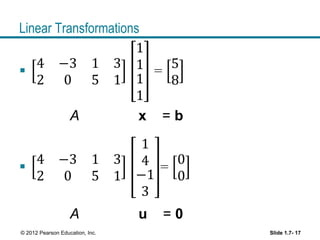
A x = b
A u = 0
Linear Transformations
Slide 1.7- 18© 2012 Pearson Education, Inc.
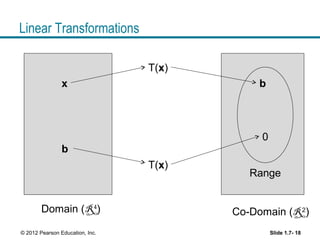
Domain (R4
) Co-Domain (R2
)
x
T(x)
b
b
T(x)
0
Range
Slide 1.8- 19© 2012 Pearson Education, Inc.
LINEAR TRANSFORMATIONS
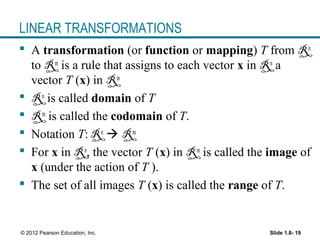
 A transformation (or function or mapping) T from Rn
to Rm
is a rule that assigns to each vector x in Rn
a
vector T (x) in Rm
 Rn
is called domain of T
 Rm
is called the codomain of T.
 Notation T: Rn
 Rm
 For x in Rn
, the vector T (x) in Rm
is called the image of
x (under the action of T ).
 The set of all images T (x) is called the range of T.
Slide 1.8- 20© 2012 Pearson Education, Inc.
MATRIX TRANSFORMATIONS
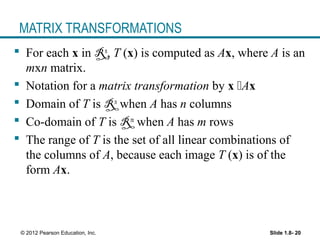
 For each x in Rn
, T (x) is computed as Ax, where A is an
mxn matrix.
 Notation for a matrix transformation by x Ax
 Domain of T is Rn
when A has n columns
 Co-domain of T is Rm
when A has m rows
 The range of T is the set of all linear combinations of
the columns of A, because each image T (x) is of the
form Ax.
Slide 1.8- 21© 2012 Pearson Education, Inc.
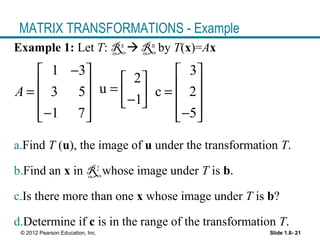
MATRIX TRANSFORMATIONS - Example
Example 1: Let T: Rn
 Rm
by T(x)=Ax
a.Find T (u), the image of u under the transformation T.
b.Find an x in R2
whose image under T is b.
c.Is there more than one x whose image under T is b?
d.Determine if c is in the range of the transformation T.
1 3
3 5
1 7
A
− 
 =
 
−  
2
u
1
 
=  − 
3
c 2
5
 
 =
 
−  
Slide 1.8- 22© 2012 Pearson Education, Inc.
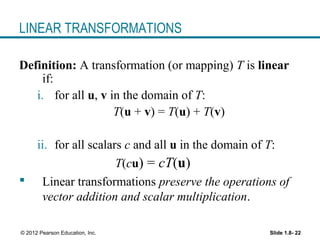
LINEAR TRANSFORMATIONS
Definition: A transformation (or mapping) T is linear
if:
i. for all u, v in the domain of T:
T(u + v) = T(u) + T(v)
ii. for all scalars c and all u in the domain of T:
T(cu) = cT(u)
 Linear transformations preserve the operations of
vector addition and scalar multiplication.
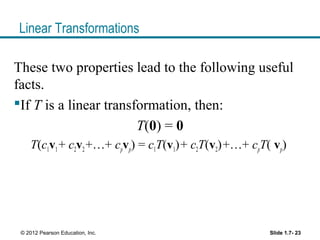
Linear Transformations
These two properties lead to the following useful
facts.
If T is a linear transformation, then:
T(0) = 0
T(c1v1+ c2v2+…+ cpvp) = c1T(v1)+ c2T(v2)+…+ cpT( vp)
Slide 1.7- 23© 2012 Pearson Education, Inc.
Slide 1.8- 24© 2012 Pearson Education, Inc.
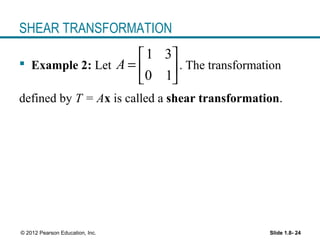
SHEAR TRANSFORMATION
 Example 2: Let . The transformation
defined by T = Ax is called a shear transformation.
1 3
0 1
A
 
=  
 
Slide 1.8- 25© 2012 Pearson Education, Inc.
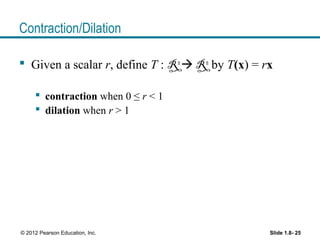
Contraction/Dilation
 Given a scalar r, define T : Rn
 Rn
by T(x) = rx
 contraction when 0 ≤ r < 1
 dilation when r > 1
How to Find Matrix of Transformation
 Theorem 10: T: Rn
 Rm
is linear
transformation, then  a unique matrix A such
that T(x) = Ax for all x in Rn
A is mxn whose jth
column is the vector T(ej) where ej
is the jth
column of In
A = [T(e1) … T(en)]
Examine 1 point in each direction!!
Slide 1.7- 26© 2012 Pearson Education, Inc.
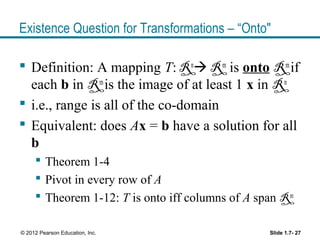
Existence Question for Transformations – “Onto"
 Definition: A mapping T: Rn
 Rm
is onto Rm
if
each b in Rm
is the image of at least 1 x in Rn
 i.e., range is all of the co-domain
 Equivalent: does Ax = b have a solution for all
b
 Theorem 1-4
 Pivot in every row of A
 Theorem 1-12: T is onto iff columns of A span Rm
Slide 1.7- 27© 2012 Pearson Education, Inc.
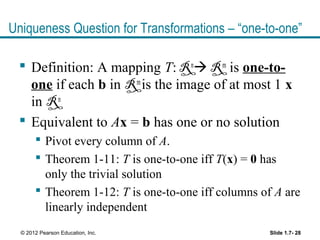
Uniqueness Question for Transformations – “one-to-one”
 Definition: A mapping T: Rn
 Rm
is one-to-
one if each b in Rm
is the image of at most 1 x
in Rn
 Equivalent to Ax = b has one or no solution
 Pivot every column of A.
 Theorem 1-11: T is one-to-one iff T(x) = 0 has
only the trivial solution
 Theorem 1-12: T is one-to-one iff columns of A are
linearly independent
Slide 1.7- 28© 2012 Pearson Education, Inc.
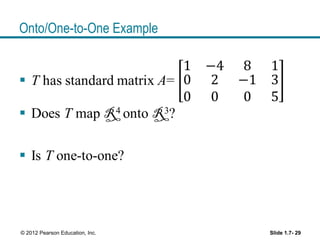
Onto/One-to-One Example
Slide 1.7- 29© 2012 Pearson Education, Inc.
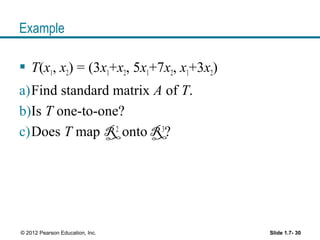
Example
 T(x1, x2) = (3x1+x2, 5x1+7x2, x1+3x2)
a)Find standard matrix A of T.
b)Is T one-to-one?
c)Does T map R2
onto R3
?
Slide 1.7- 30© 2012 Pearson Education, Inc.

Lecture 3 section 1-7, 1-8 and 1-9

  • 1.
    1 1.7 © 2012 PearsonEducation, Inc. Linear Equations in Linear Algebra LINEAR INDEPENDENCE
  • 2.
    Slide 1.7- 2©2012 Pearson Education, Inc. LINEAR INDEPENDENCE - Definition  Definition: set of vectors {v1, …, vp} in Rn is said to be linearly independent if the vector equation x1v1 + x1v1+ …+ x1v1 = 0 has only the trivial solution.  Otherwise: linearly dependent  Nontrivial solution exists  linear dependence relation
  • 3.
    Slide 1.7- 3©2012 Pearson Education, Inc. LINEAR INDEPENDENCE - Example Example 1: Let , , and . a. Is the set {v1, v2, v3} linearly independent? b. If possible, find a linear dependence relation among v1, v2, and v3. 1 1 v 2 3    =      2 4 v 5 6    =      3 2 v 1 0    =     
  • 4.
    Slide 1.7- 4©2012 Pearson Education, Inc. LINEAR INDEPENDENCE OF MATRIX COLUMNS  matrix A = [a1a2 … a3]  The matrix equation Ax = 0 can be written as x1v1 + x1v1+ …+ x1v1 = 0  Each linear dependence relation among the columns of A corresponds to a nontrivial solution of Ax = 0.  Thus, the columns of matrix A are linearly independent iff the equation Ax = 0 has only the trivial solution.
  • 5.
    Matrix Example Slide 1.7-5© 2012 Pearson Education, Inc.
  • 6.
    Slide 1.7- 6©2012 Pearson Education, Inc. SETS OF ONE VECTOR  A set containing only one vector – say, v – is linearly independent iff v is not the zero vector.  This is because the vector equation has only the trivial solution when .  The zero vector is linearly dependent because has many nontrivial solutions. 1 v 0x = v 0≠ 1 0 0x =
  • 7.
    Slide 1.7- 7©2012 Pearson Education, Inc. SETS OF TWO VECTORS
  • 8.
    Slide 1.7- 8©2012 Pearson Education, Inc. Characterization of Linearly Dependent Sets  Theorem 7: An indexed set S = {v1, …, vp} of vectors is linearly dependent iff at least one of the vectors in S is a linear combination of the others.  In fact, if S is linearly dependent and j > 1, then some vj (with v1≠ 0) is a linear combination of the preceding vectors, v1, …, vj-1.
  • 9.
    Slide 1.7- 9©2012 Pearson Education, Inc. SETS OF TWO OR MORE VECTORS  Proof: If some vj in S equals a linear combination of the other vectors, then vj can be subtracted from both sides of the equation, producing a linear dependence relation with a nonzero weight on vj. v1 = c2 v2+ c3 v3 0 = (-1)v1 + c2 v2+ c3 v3+ 0v4 + … 0vp  Thus S is linearly dependent.  Conversely, suppose S is linearly dependent.  If v1 is zero, then it is a (trivial) linear combination of the other vectors in S. ( 1)−
  • 10.
    Slide 1.7- 10©2012 Pearson Education, Inc. SETS OF TWO OR MORE VECTORS  Otherwise, , and there exist weights c1, …, cp, not all zero, such that .  Let j be the largest subscript for which .  If , then , which is impossible because . 1 v 0≠ 1 1 2 2 v v ... v 0p p c c c+ + + = 0j c ≠ 1j = 1 1 v 0c = 1 v 0≠
  • 11.
    Slide 1.7- 11©2012 Pearson Education, Inc. SETS OF TWO OR MORE VECTORS  So , and1j > 1 1 1 v ... v 0v 0v ... 0v 0j j j j p c c + + + + + + + = 1 1 1 1 v v ... vj j j j c c c − − = − − − 11 1 1 v v ... v .j j j j j cc c c − −     = − + + − ÷  ÷    
  • 12.
    Slide 1.7- 12©2012 Pearson Education, Inc. SETS OF TWO OR MORE VECTORS  Theorem 7 does not say that every vector in a linearly dependent set is a linear combination of the preceding vectors.  A vector in a linearly dependent set may fail to be a linear combination of the other vectors.  Example 2: Let and . Describe the set spanned by u and v, and explain why a vector w is in Span {u, v} if and only if {u, v, w} is linearly dependent. 3 u 1 0    =      1 v 6 0    =     
  • 13.
    Example  Example 2:Let and . a)Describe the set spanned by u and v b)explain why a vector w is in Span {u, v} iff {u, v, w} is linearly dependent. Slide 1.7- 13© 2012 Pearson Education, Inc. 3 u 1 0    =      1 v 6 0    =     
  • 14.
    Slide 1.7- 14©2012 Pearson Education, Inc. SETS OF TWO OR MORE VECTORS  So w is in Span {u, v}. See the figures given below.  Example 2 generalizes to any set {u, v, w} in R3 with u and v linearly independent.  The set {u, v, w} will be linearly dependent iff w is in the plane spanned by u and v.
  • 15.
    Slide 1.7- 15©2012 Pearson Education, Inc. SETS OF TWO OR MORE VECTORS  Theorem 8: If a set contains more vectors than there are entries in each vector, then the set is linearly dependent. That is, any set {v1, …, vp} in Rn is linearly dependent if .  Proof: Let .  Then A is , and the equation Ax = 0 corresponds to a system of n equations in p unknowns.  If , more variables than equations, so there must be a free variable  many solutions p n> 1 v vp A  =  L n p× p n>
  • 16.
    Slide 1.7- 16©2012 Pearson Education, Inc. SETS OF TWO OR MORE VECTORS  Theorem 9: If a set in Rn contains the zero vector, then the set is linearly dependent.  Proof: By renumbering the vectors, we may suppose v1 = 0  1v1 + 0v2 + … + 0vp = 0  Nontrivial solution  linearly dependent 1 {v ,...,v }p S =
  • 17.
    Linear Transformations Slide 1.7-17© 2012 Pearson Education, Inc. A x = b A u = 0
  • 18.
    Linear Transformations Slide 1.7-18© 2012 Pearson Education, Inc. Domain (R4 ) Co-Domain (R2 ) x T(x) b b T(x) 0 Range
  • 19.
    Slide 1.8- 19©2012 Pearson Education, Inc. LINEAR TRANSFORMATIONS  A transformation (or function or mapping) T from Rn to Rm is a rule that assigns to each vector x in Rn a vector T (x) in Rm  Rn is called domain of T  Rm is called the codomain of T.  Notation T: Rn  Rm  For x in Rn , the vector T (x) in Rm is called the image of x (under the action of T ).  The set of all images T (x) is called the range of T.
  • 20.
    Slide 1.8- 20©2012 Pearson Education, Inc. MATRIX TRANSFORMATIONS  For each x in Rn , T (x) is computed as Ax, where A is an mxn matrix.  Notation for a matrix transformation by x Ax  Domain of T is Rn when A has n columns  Co-domain of T is Rm when A has m rows  The range of T is the set of all linear combinations of the columns of A, because each image T (x) is of the form Ax.
  • 21.
    Slide 1.8- 21©2012 Pearson Education, Inc. MATRIX TRANSFORMATIONS - Example Example 1: Let T: Rn  Rm by T(x)=Ax a.Find T (u), the image of u under the transformation T. b.Find an x in R2 whose image under T is b. c.Is there more than one x whose image under T is b? d.Determine if c is in the range of the transformation T. 1 3 3 5 1 7 A −   =   −   2 u 1   =  −  3 c 2 5    =   −  
  • 22.
    Slide 1.8- 22©2012 Pearson Education, Inc. LINEAR TRANSFORMATIONS Definition: A transformation (or mapping) T is linear if: i. for all u, v in the domain of T: T(u + v) = T(u) + T(v) ii. for all scalars c and all u in the domain of T: T(cu) = cT(u)  Linear transformations preserve the operations of vector addition and scalar multiplication.
  • 23.
    Linear Transformations These twoproperties lead to the following useful facts. If T is a linear transformation, then: T(0) = 0 T(c1v1+ c2v2+…+ cpvp) = c1T(v1)+ c2T(v2)+…+ cpT( vp) Slide 1.7- 23© 2012 Pearson Education, Inc.
  • 24.
    Slide 1.8- 24©2012 Pearson Education, Inc. SHEAR TRANSFORMATION  Example 2: Let . The transformation defined by T = Ax is called a shear transformation. 1 3 0 1 A   =    
  • 25.
    Slide 1.8- 25©2012 Pearson Education, Inc. Contraction/Dilation  Given a scalar r, define T : Rn  Rn by T(x) = rx  contraction when 0 ≤ r < 1  dilation when r > 1
  • 26.
    How to FindMatrix of Transformation  Theorem 10: T: Rn  Rm is linear transformation, then  a unique matrix A such that T(x) = Ax for all x in Rn A is mxn whose jth column is the vector T(ej) where ej is the jth column of In A = [T(e1) … T(en)] Examine 1 point in each direction!! Slide 1.7- 26© 2012 Pearson Education, Inc.
  • 27.
    Existence Question forTransformations – “Onto"  Definition: A mapping T: Rn  Rm is onto Rm if each b in Rm is the image of at least 1 x in Rn  i.e., range is all of the co-domain  Equivalent: does Ax = b have a solution for all b  Theorem 1-4  Pivot in every row of A  Theorem 1-12: T is onto iff columns of A span Rm Slide 1.7- 27© 2012 Pearson Education, Inc.
  • 28.
    Uniqueness Question forTransformations – “one-to-one”  Definition: A mapping T: Rn  Rm is one-to- one if each b in Rm is the image of at most 1 x in Rn  Equivalent to Ax = b has one or no solution  Pivot every column of A.  Theorem 1-11: T is one-to-one iff T(x) = 0 has only the trivial solution  Theorem 1-12: T is one-to-one iff columns of A are linearly independent Slide 1.7- 28© 2012 Pearson Education, Inc.
  • 29.
    Onto/One-to-One Example Slide 1.7-29© 2012 Pearson Education, Inc.
  • 30.
    Example  T(x1, x2)= (3x1+x2, 5x1+7x2, x1+3x2) a)Find standard matrix A of T. b)Is T one-to-one? c)Does T map R2 onto R3 ? Slide 1.7- 30© 2012 Pearson Education, Inc.