5
5.1
© 2012 Pearson Education, Inc.
Eigenvalues and Eigenvectors
EIGENVECTORS AND
EIGENVALUES
Slide 5.1- 2© 2012 Pearson Education, Inc.
EIGENVECTORS AND EIGENVALUES
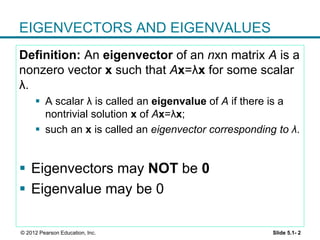
Definition: An eigenvector of an nxn matrix A is a
nonzero vector x such that Ax=λx for some scalar
λ.
 A scalar λ is called an eigenvalue of A if there is a
nontrivial solution x of Ax=λx;
 such an x is called an eigenvector corresponding to λ.
 Eigenvectors may NOT be 0
 Eigenvalue may be 0
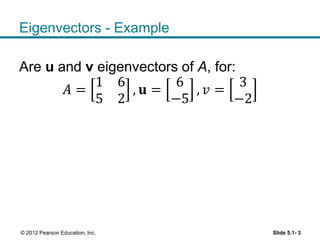
Eigenvectors - Example
Are u and v eigenvectors of A, for:
𝐴 =
1 6
5 2
, 𝐮 =
6
−5
, 𝑣 =
3
−2
Slide 5.1- 3© 2012 Pearson Education, Inc.
Finding Eigenvectors - Example
Show that 7 is an eigenvalue of A from
previous example and find corresponding
eigenvectors.
Slide 5.1- 4© 2012 Pearson Education, Inc.
Eigenspace
 General solution of Ax=λx is same as Nul
space of (A – λI)
 Subspace of Rn
 Called “Eigenspace”
 Contains 0 and all eigenvectors
Slide 5.1- 5© 2012 Pearson Education, Inc.
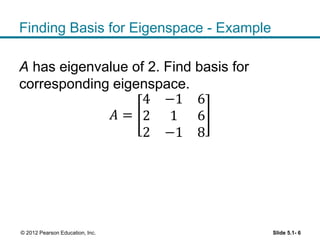
Finding Basis for Eigenspace - Example
A has eigenvalue of 2. Find basis for
corresponding eigenspace.
𝐴 =
4 −1 6
2 1 6
2 −1 8
Slide 5.1- 6© 2012 Pearson Education, Inc.
Slide 5.1- 7© 2012 Pearson Education, Inc.
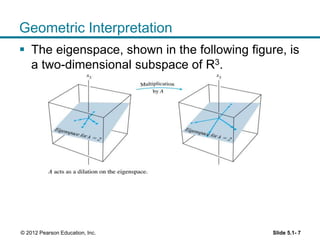
Geometric Interpretation
 The eigenspace, shown in the following figure, is
a two-dimensional subspace of R3.
Slide 5.1- 8© 2012 Pearson Education, Inc.
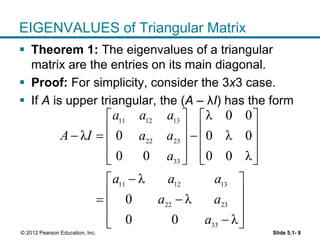
EIGENVALUES of Triangular Matrix
 Theorem 1: The eigenvalues of a triangular
matrix are the entries on its main diagonal.
 Proof: For simplicity, consider the 3x3 case.
 If A is upper triangular, the (A – λI) has the form
11 12 13
22 23
33
11 12 13
22 23
33
λ 0 0
λ 0 0 λ 0
0 0 0 0 λ
λ
0 λ
0 0 λ
a a a
A I a a
a
a a a
a a
a
   
     
   
      
 
  
 
  
Slide 5.1- 9© 2012 Pearson Education, Inc.
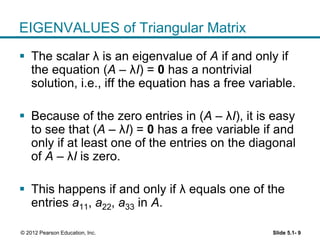
EIGENVALUES of Triangular Matrix
 The scalar λ is an eigenvalue of A if and only if
the equation (A – λI) = 0 has a nontrivial
solution, i.e., iff the equation has a free variable.
 Because of the zero entries in (A – λI), it is easy
to see that (A – λI) = 0 has a free variable if and
only if at least one of the entries on the diagonal
of A – λI is zero.
 This happens if and only if λ equals one of the
entries a11, a22, a33 in A.
Slide 5.1- 10© 2012 Pearson Education, Inc.
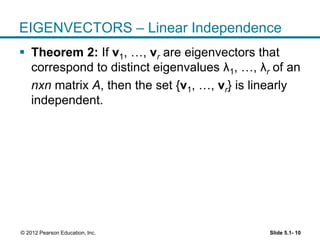
EIGENVECTORS – Linear Independence
 Theorem 2: If v1, …, vr are eigenvectors that
correspond to distinct eigenvalues λ1, …, λr of an
nxn matrix A, then the set {v1, …, vr} is linearly
independent.
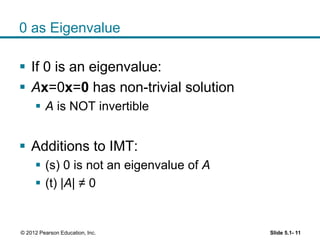
0 as Eigenvalue
 If 0 is an eigenvalue:
 Ax=0x=0 has non-trivial solution
 A is NOT invertible
 Additions to IMT:
 (s) 0 is not an eigenvalue of A
 (t) |A| ≠ 0
Slide 5.1- 11© 2012 Pearson Education, Inc.
5
5.1
© 2012 Pearson Education, Inc.
Eigenvalues and Eigenvectors
THE CHARACTERISTIC
EQUATION
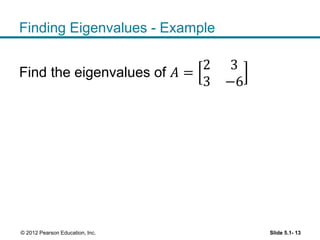
Finding Eigenvalues - Example
Find the eigenvalues of 𝐴 =
2 3
3 −6
Slide 5.1- 13© 2012 Pearson Education, Inc.
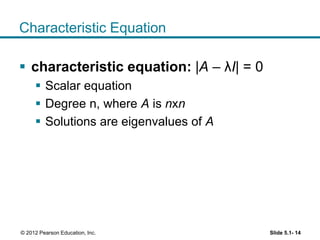
Characteristic Equation
 characteristic equation: |A – λI| = 0
 Scalar equation
 Degree n, where A is nxn
 Solutions are eigenvalues of A
Slide 5.1- 14© 2012 Pearson Education, Inc.
Slide 5.2- 15© 2012 Pearson Education, Inc.
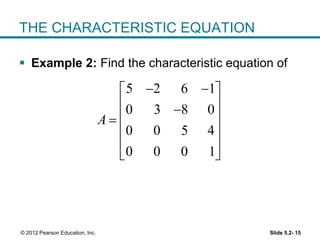
THE CHARACTERISTIC EQUATION
 Example 2: Find the characteristic equation of
5 2 6 1
0 3 8 0
0 0 5 4
0 0 0 1
A
  
 
 
 
 
 
Slide 5.2- 16© 2012 Pearson Education, Inc.
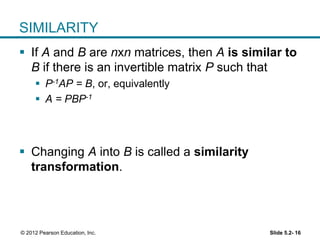
SIMILARITY
 If A and B are nxn matrices, then A is similar to
B if there is an invertible matrix P such that
 P-1AP = B, or, equivalently
 A = PBP-1
 Changing A into B is called a similarity
transformation.
Slide 5.2- 17© 2012 Pearson Education, Inc.
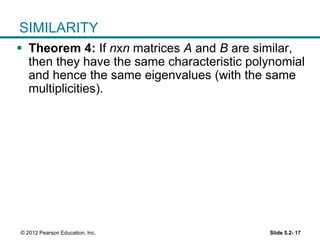
SIMILARITY
 Theorem 4: If nxn matrices A and B are similar,
then they have the same characteristic polynomial
and hence the same eigenvalues (with the same
multiplicities).

Lecture 9 eigenvalues - 5-1 & 5-2

  • 1.
    5 5.1 © 2012 PearsonEducation, Inc. Eigenvalues and Eigenvectors EIGENVECTORS AND EIGENVALUES
  • 2.
    Slide 5.1- 2©2012 Pearson Education, Inc. EIGENVECTORS AND EIGENVALUES Definition: An eigenvector of an nxn matrix A is a nonzero vector x such that Ax=λx for some scalar λ.  A scalar λ is called an eigenvalue of A if there is a nontrivial solution x of Ax=λx;  such an x is called an eigenvector corresponding to λ.  Eigenvectors may NOT be 0  Eigenvalue may be 0
  • 3.
    Eigenvectors - Example Areu and v eigenvectors of A, for: 𝐴 = 1 6 5 2 , 𝐮 = 6 −5 , 𝑣 = 3 −2 Slide 5.1- 3© 2012 Pearson Education, Inc.
  • 4.
    Finding Eigenvectors -Example Show that 7 is an eigenvalue of A from previous example and find corresponding eigenvectors. Slide 5.1- 4© 2012 Pearson Education, Inc.
  • 5.
    Eigenspace  General solutionof Ax=λx is same as Nul space of (A – λI)  Subspace of Rn  Called “Eigenspace”  Contains 0 and all eigenvectors Slide 5.1- 5© 2012 Pearson Education, Inc.
  • 6.
    Finding Basis forEigenspace - Example A has eigenvalue of 2. Find basis for corresponding eigenspace. 𝐴 = 4 −1 6 2 1 6 2 −1 8 Slide 5.1- 6© 2012 Pearson Education, Inc.
  • 7.
    Slide 5.1- 7©2012 Pearson Education, Inc. Geometric Interpretation  The eigenspace, shown in the following figure, is a two-dimensional subspace of R3.
  • 8.
    Slide 5.1- 8©2012 Pearson Education, Inc. EIGENVALUES of Triangular Matrix  Theorem 1: The eigenvalues of a triangular matrix are the entries on its main diagonal.  Proof: For simplicity, consider the 3x3 case.  If A is upper triangular, the (A – λI) has the form 11 12 13 22 23 33 11 12 13 22 23 33 λ 0 0 λ 0 0 λ 0 0 0 0 0 λ λ 0 λ 0 0 λ a a a A I a a a a a a a a a                               
  • 9.
    Slide 5.1- 9©2012 Pearson Education, Inc. EIGENVALUES of Triangular Matrix  The scalar λ is an eigenvalue of A if and only if the equation (A – λI) = 0 has a nontrivial solution, i.e., iff the equation has a free variable.  Because of the zero entries in (A – λI), it is easy to see that (A – λI) = 0 has a free variable if and only if at least one of the entries on the diagonal of A – λI is zero.  This happens if and only if λ equals one of the entries a11, a22, a33 in A.
  • 10.
    Slide 5.1- 10©2012 Pearson Education, Inc. EIGENVECTORS – Linear Independence  Theorem 2: If v1, …, vr are eigenvectors that correspond to distinct eigenvalues λ1, …, λr of an nxn matrix A, then the set {v1, …, vr} is linearly independent.
  • 11.
    0 as Eigenvalue If 0 is an eigenvalue:  Ax=0x=0 has non-trivial solution  A is NOT invertible  Additions to IMT:  (s) 0 is not an eigenvalue of A  (t) |A| ≠ 0 Slide 5.1- 11© 2012 Pearson Education, Inc.
  • 12.
    5 5.1 © 2012 PearsonEducation, Inc. Eigenvalues and Eigenvectors THE CHARACTERISTIC EQUATION
  • 13.
    Finding Eigenvalues -Example Find the eigenvalues of 𝐴 = 2 3 3 −6 Slide 5.1- 13© 2012 Pearson Education, Inc.
  • 14.
    Characteristic Equation  characteristicequation: |A – λI| = 0  Scalar equation  Degree n, where A is nxn  Solutions are eigenvalues of A Slide 5.1- 14© 2012 Pearson Education, Inc.
  • 15.
    Slide 5.2- 15©2012 Pearson Education, Inc. THE CHARACTERISTIC EQUATION  Example 2: Find the characteristic equation of 5 2 6 1 0 3 8 0 0 0 5 4 0 0 0 1 A             
  • 16.
    Slide 5.2- 16©2012 Pearson Education, Inc. SIMILARITY  If A and B are nxn matrices, then A is similar to B if there is an invertible matrix P such that  P-1AP = B, or, equivalently  A = PBP-1  Changing A into B is called a similarity transformation.
  • 17.
    Slide 5.2- 17©2012 Pearson Education, Inc. SIMILARITY  Theorem 4: If nxn matrices A and B are similar, then they have the same characteristic polynomial and hence the same eigenvalues (with the same multiplicities).