5
5.3
© 2012 Pearson Education, Inc.
Eigenvalues and Eigenvectors
DIAGONALIZATION
Slide 5.2- 2© 2012 Pearson Education, Inc.
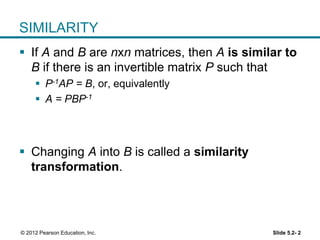
SIMILARITY
 If A and B are nxn matrices, then A is similar to
B if there is an invertible matrix P such that
 P-1AP = B, or, equivalently
 A = PBP-1
 Changing A into B is called a similarity
transformation.
Slide 5.2- 3© 2012 Pearson Education, Inc.
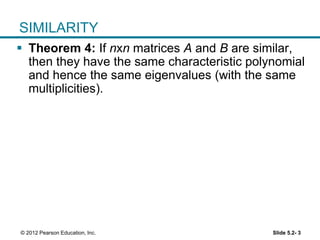
SIMILARITY
 Theorem 4: If nxn matrices A and B are similar,
then they have the same characteristic polynomial
and hence the same eigenvalues (with the same
multiplicities).
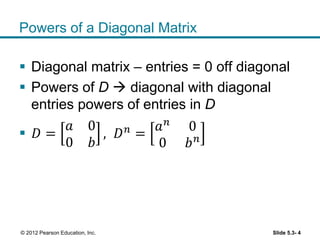
Powers of a Diagonal Matrix
 Diagonal matrix – entries = 0 off diagonal
 Powers of D  diagonal with diagonal
entries powers of entries in D
 𝐷 =
𝑎 0
0 𝑏
, 𝐷 𝑛
=
𝑎 𝑛
0
0 𝑏 𝑛
Slide 5.3- 4© 2012 Pearson Education, Inc.
Slide 5.3- 5© 2012 Pearson Education, Inc.
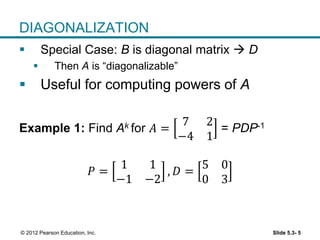
DIAGONALIZATION
 Special Case: B is diagonal matrix  D
 Then A is “diagonalizable”
 Useful for computing powers of A
Example 1: Find Ak for 𝐴 =
7 2
−4 1
= PDP-1
𝑃 =
1 1
−1 −2
, 𝐷 =
5 0
0 3
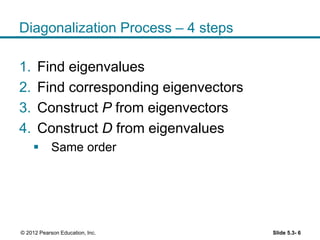
Diagonalization Process – 4 steps
1. Find eigenvalues
2. Find corresponding eigenvectors
3. Construct P from eigenvectors
4. Construct D from eigenvalues
 Same order
Slide 5.3- 6© 2012 Pearson Education, Inc.
Slide 5.3- 7© 2012 Pearson Education, Inc.
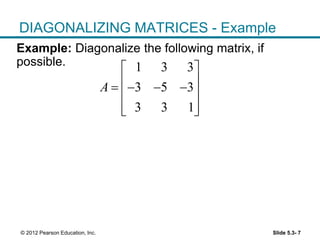
DIAGONALIZING MATRICES - Example
Example: Diagonalize the following matrix, if
possible. 1 3 3
3 5 3
3 3 1
A
 
    
 
  
DIAGONALIZING MATRICES - Example
Slide 5.3- 8© 2012 Pearson Education, Inc.
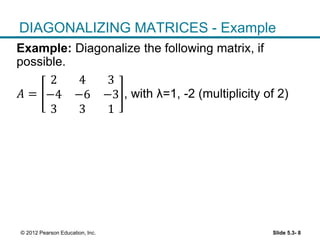
Example: Diagonalize the following matrix, if
possible.
𝐴 =
2 4 3
−4 −6 −3
3 3 1
, with λ=1, -2 (multiplicity of 2)
Slide 5.3- 9© 2012 Pearson Education, Inc.
DIAGONALIZING MATRICES
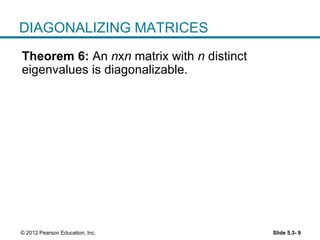
Theorem 6: An nxn matrix with n distinct
eigenvalues is diagonalizable.
Diagonalizing Matrices
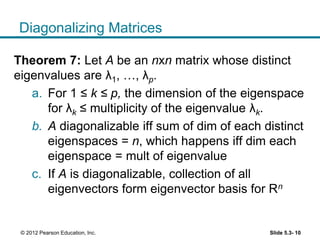
Theorem 7: Let A be an nxn matrix whose distinct
eigenvalues are λ1, …, λp.
a. For 1 ≤ k ≤ p, the dimension of the eigenspace
for λk ≤ multiplicity of the eigenvalue λk.
b. A diagonalizable iff sum of dim of each distinct
eigenspaces = n, which happens iff dim each
eigenspace = mult of eigenvalue
c. If A is diagonalizable, collection of all
eigenvectors form eigenvector basis for Rn
Slide 5.3- 10© 2012 Pearson Education, Inc.
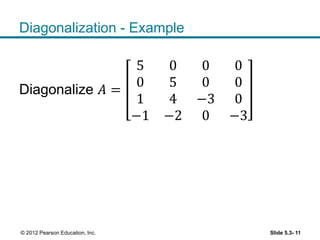
Diagonalization - Example
Diagonalize 𝐴 =
5 0 0 0
0 5 0 0
1 4 −3 0
−1 −2 0 −3
Slide 5.3- 11© 2012 Pearson Education, Inc.
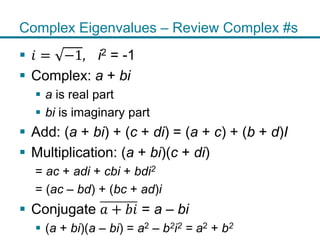
Complex Eigenvalues – Review Complex #s
 𝑖 = −1, i2 = -1
 Complex: a + bi
 a is real part
 bi is imaginary part
 Add: (a + bi) + (c + di) = (a + c) + (b + d)I
 Multiplication: (a + bi)(c + di)
= ac + adi + cbi + bdi2
= (ac – bd) + (bc + ad)i
 Conjugate 𝑎 + 𝑏𝑖 = a – bi
 (a + bi)(a – bi) = a2 – b2i2 = a2 + b2
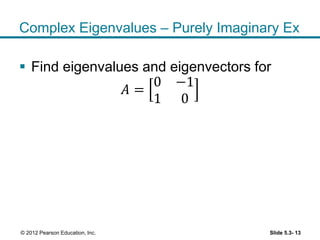
Complex Eigenvalues – Purely Imaginary Ex
 Find eigenvalues and eigenvectors for
𝐴 =
0 −1
1 0
Slide 5.3- 13© 2012 Pearson Education, Inc.
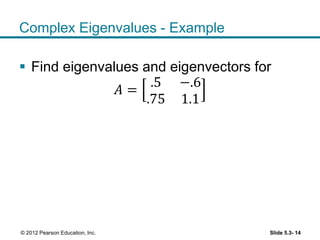
Complex Eigenvalues - Example
 Find eigenvalues and eigenvectors for
𝐴 =
.5 −.6
.75 1.1
Slide 5.3- 14© 2012 Pearson Education, Inc.
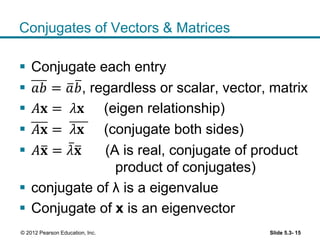
Conjugates of Vectors & Matrices
 Conjugate each entry
 𝑎𝑏 = 𝑎 𝑏, regardless or scalar, vector, matrix
 𝐴𝐱 = 𝜆𝐱 (eigen relationship)
 𝐴𝐱 = 𝜆𝐱 (conjugate both sides)
 𝐴 𝐱 = 𝜆 𝐱 (A is real, conjugate of product
product of conjugates)
 conjugate of λ is a eigenvalue
 Conjugate of x is an eigenvector
Slide 5.3- 15© 2012 Pearson Education, Inc.
Complex Eigenvalues – Theorem 9
Let A be a real 2x2 matrix with complex
eigenvalue λ = a – bi (b ≠ 0) and an
associated eigenvector v in C2. Then
A = PCP-1 where
P = [Re(v) Im(v)]
𝐶 =
𝑎 −𝑏
𝑏 𝑎
Slide 5.3- 16© 2012 Pearson Education, Inc.

Lecture 11 diagonalization & complex eigenvalues - 5-3 & 5-5

  • 1.
    5 5.3 © 2012 PearsonEducation, Inc. Eigenvalues and Eigenvectors DIAGONALIZATION
  • 2.
    Slide 5.2- 2©2012 Pearson Education, Inc. SIMILARITY  If A and B are nxn matrices, then A is similar to B if there is an invertible matrix P such that  P-1AP = B, or, equivalently  A = PBP-1  Changing A into B is called a similarity transformation.
  • 3.
    Slide 5.2- 3©2012 Pearson Education, Inc. SIMILARITY  Theorem 4: If nxn matrices A and B are similar, then they have the same characteristic polynomial and hence the same eigenvalues (with the same multiplicities).
  • 4.
    Powers of aDiagonal Matrix  Diagonal matrix – entries = 0 off diagonal  Powers of D  diagonal with diagonal entries powers of entries in D  𝐷 = 𝑎 0 0 𝑏 , 𝐷 𝑛 = 𝑎 𝑛 0 0 𝑏 𝑛 Slide 5.3- 4© 2012 Pearson Education, Inc.
  • 5.
    Slide 5.3- 5©2012 Pearson Education, Inc. DIAGONALIZATION  Special Case: B is diagonal matrix  D  Then A is “diagonalizable”  Useful for computing powers of A Example 1: Find Ak for 𝐴 = 7 2 −4 1 = PDP-1 𝑃 = 1 1 −1 −2 , 𝐷 = 5 0 0 3
  • 6.
    Diagonalization Process –4 steps 1. Find eigenvalues 2. Find corresponding eigenvectors 3. Construct P from eigenvectors 4. Construct D from eigenvalues  Same order Slide 5.3- 6© 2012 Pearson Education, Inc.
  • 7.
    Slide 5.3- 7©2012 Pearson Education, Inc. DIAGONALIZING MATRICES - Example Example: Diagonalize the following matrix, if possible. 1 3 3 3 5 3 3 3 1 A            
  • 8.
    DIAGONALIZING MATRICES -Example Slide 5.3- 8© 2012 Pearson Education, Inc. Example: Diagonalize the following matrix, if possible. 𝐴 = 2 4 3 −4 −6 −3 3 3 1 , with λ=1, -2 (multiplicity of 2)
  • 9.
    Slide 5.3- 9©2012 Pearson Education, Inc. DIAGONALIZING MATRICES Theorem 6: An nxn matrix with n distinct eigenvalues is diagonalizable.
  • 10.
    Diagonalizing Matrices Theorem 7:Let A be an nxn matrix whose distinct eigenvalues are λ1, …, λp. a. For 1 ≤ k ≤ p, the dimension of the eigenspace for λk ≤ multiplicity of the eigenvalue λk. b. A diagonalizable iff sum of dim of each distinct eigenspaces = n, which happens iff dim each eigenspace = mult of eigenvalue c. If A is diagonalizable, collection of all eigenvectors form eigenvector basis for Rn Slide 5.3- 10© 2012 Pearson Education, Inc.
  • 11.
    Diagonalization - Example Diagonalize𝐴 = 5 0 0 0 0 5 0 0 1 4 −3 0 −1 −2 0 −3 Slide 5.3- 11© 2012 Pearson Education, Inc.
  • 12.
    Complex Eigenvalues –Review Complex #s  𝑖 = −1, i2 = -1  Complex: a + bi  a is real part  bi is imaginary part  Add: (a + bi) + (c + di) = (a + c) + (b + d)I  Multiplication: (a + bi)(c + di) = ac + adi + cbi + bdi2 = (ac – bd) + (bc + ad)i  Conjugate 𝑎 + 𝑏𝑖 = a – bi  (a + bi)(a – bi) = a2 – b2i2 = a2 + b2
  • 13.
    Complex Eigenvalues –Purely Imaginary Ex  Find eigenvalues and eigenvectors for 𝐴 = 0 −1 1 0 Slide 5.3- 13© 2012 Pearson Education, Inc.
  • 14.
    Complex Eigenvalues -Example  Find eigenvalues and eigenvectors for 𝐴 = .5 −.6 .75 1.1 Slide 5.3- 14© 2012 Pearson Education, Inc.
  • 15.
    Conjugates of Vectors& Matrices  Conjugate each entry  𝑎𝑏 = 𝑎 𝑏, regardless or scalar, vector, matrix  𝐴𝐱 = 𝜆𝐱 (eigen relationship)  𝐴𝐱 = 𝜆𝐱 (conjugate both sides)  𝐴 𝐱 = 𝜆 𝐱 (A is real, conjugate of product product of conjugates)  conjugate of λ is a eigenvalue  Conjugate of x is an eigenvector Slide 5.3- 15© 2012 Pearson Education, Inc.
  • 16.
    Complex Eigenvalues –Theorem 9 Let A be a real 2x2 matrix with complex eigenvalue λ = a – bi (b ≠ 0) and an associated eigenvector v in C2. Then A = PCP-1 where P = [Re(v) Im(v)] 𝐶 = 𝑎 −𝑏 𝑏 𝑎 Slide 5.3- 16© 2012 Pearson Education, Inc.