Copyright © Cengage Learning. All rights reserved.
12 Limits and an Introduction
to Calculus
Copyright © Cengage Learning. All rights reserved.
Limits at Infinity and Limits
of Sequences
12.4
3
 Evaluate limits of functions at infinity.
 Find limits of sequences.
Objectives
4
Limits at Infinity and Horizontal
Asymptotes
5
Limits at Infinity and Horizontal Asymptotes
As pointed out at the beginning of this chapter, there are
two basic problems in calculus: finding tangent lines and
finding the area of a region.
You saw how limits can help you solve the tangent line
problem. In this section, you will see how a different type of
limit, a limit at infinity, can help you solve the area problem.
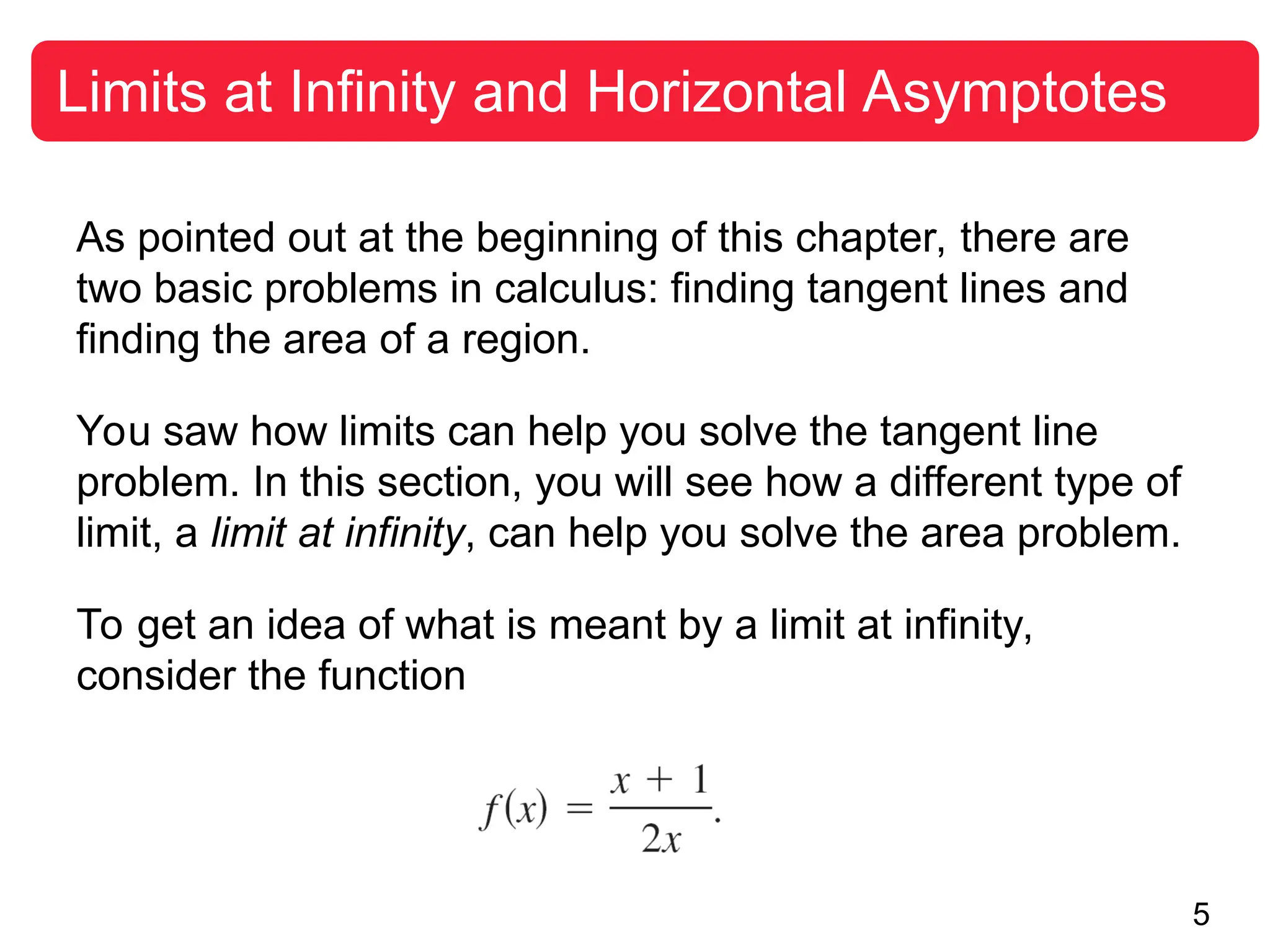
To get an idea of what is meant by a limit at infinity,
consider the function
6
Limits at Infinity and Horizontal Asymptotes
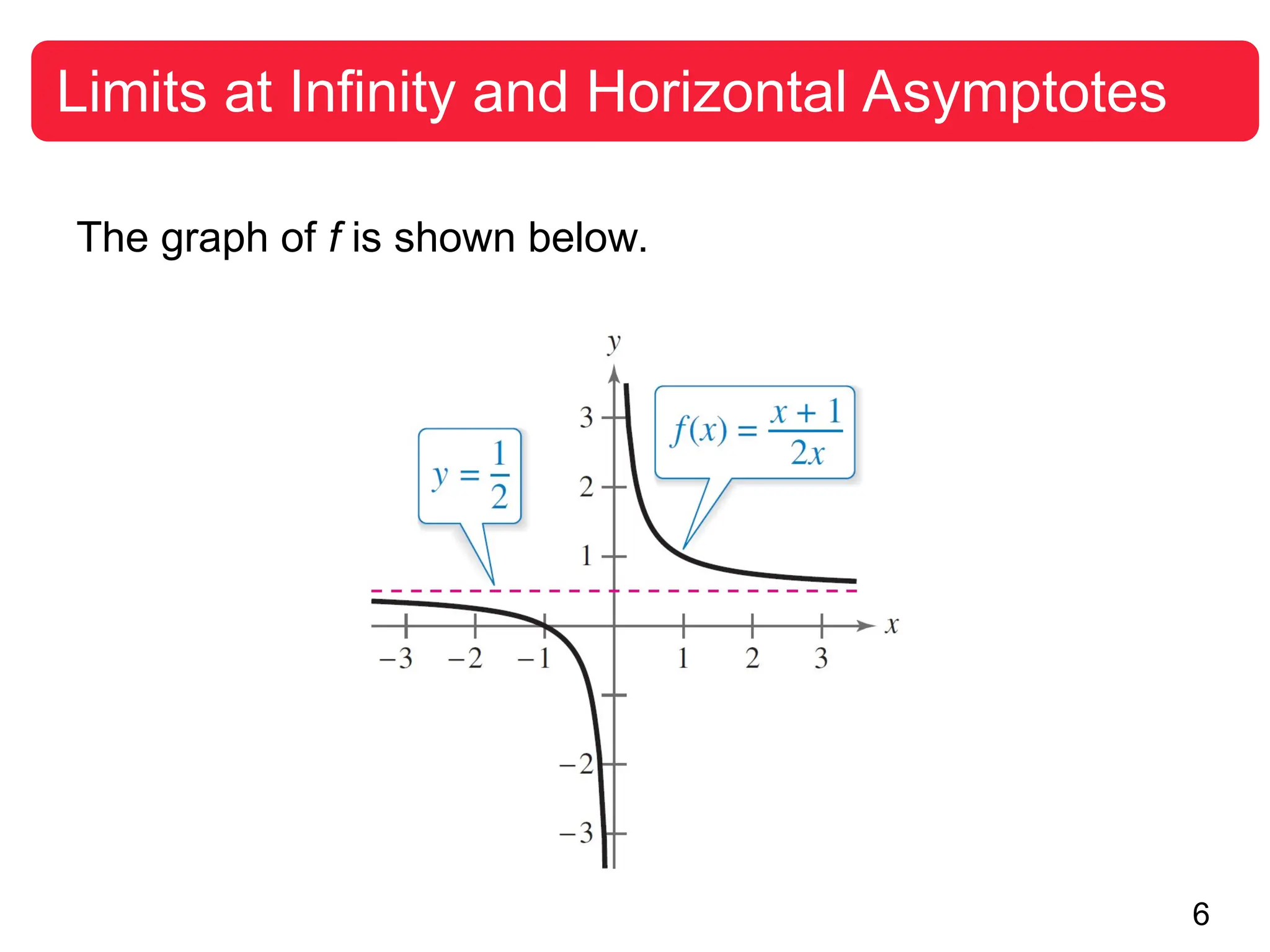
The graph of f is shown below.
7
Limits at Infinity and Horizontal Asymptotes
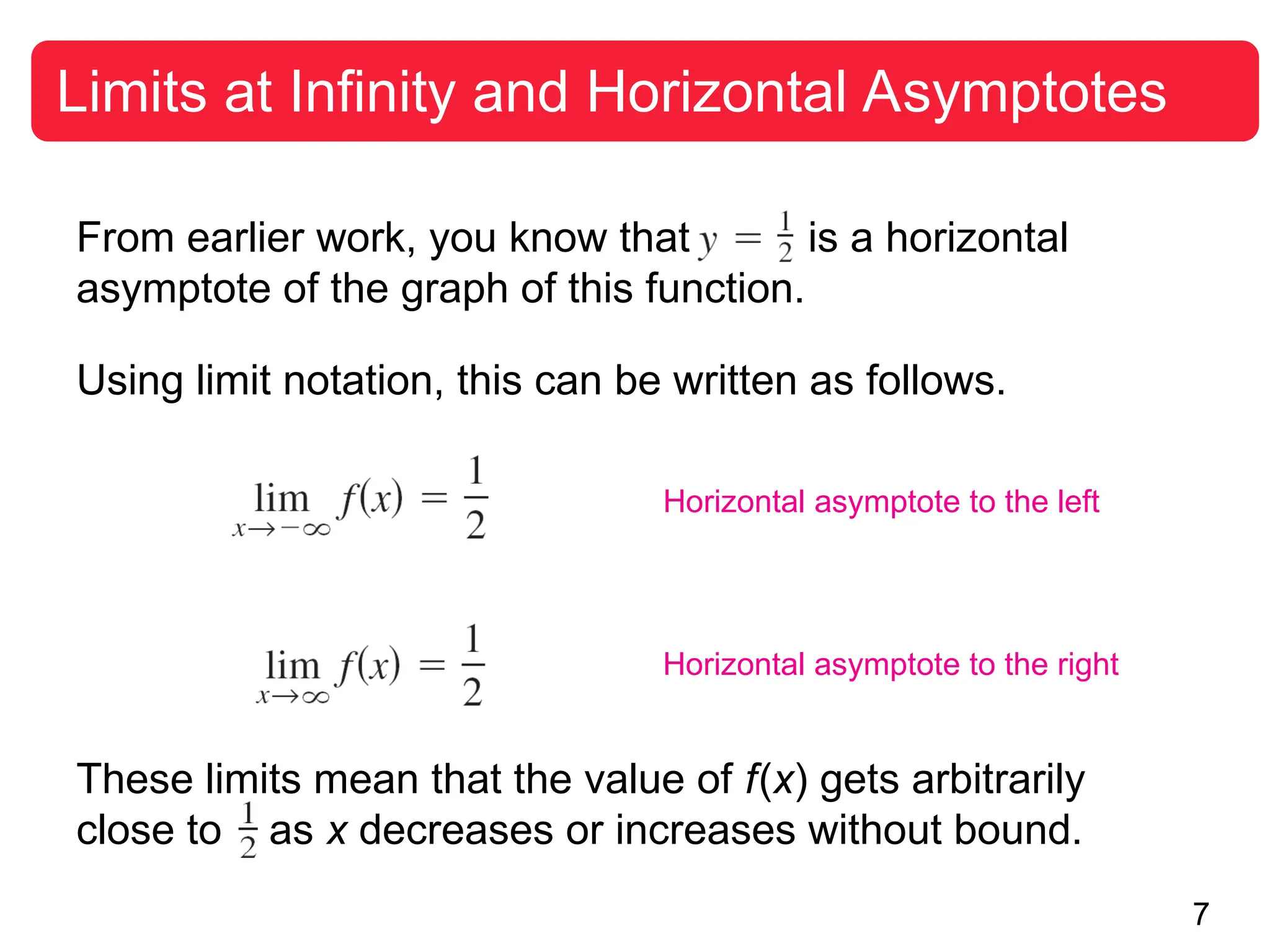
From earlier work, you know that is a horizontal
asymptote of the graph of this function.
Using limit notation, this can be written as follows.
These limits mean that the value of f(x) gets arbitrarily
close to as x decreases or increases without bound.
Horizontal asymptote to the left
Horizontal asymptote to the right
8
Limits at Infinity and Horizontal Asymptotes
9
Limits at Infinity and Horizontal Asymptotes
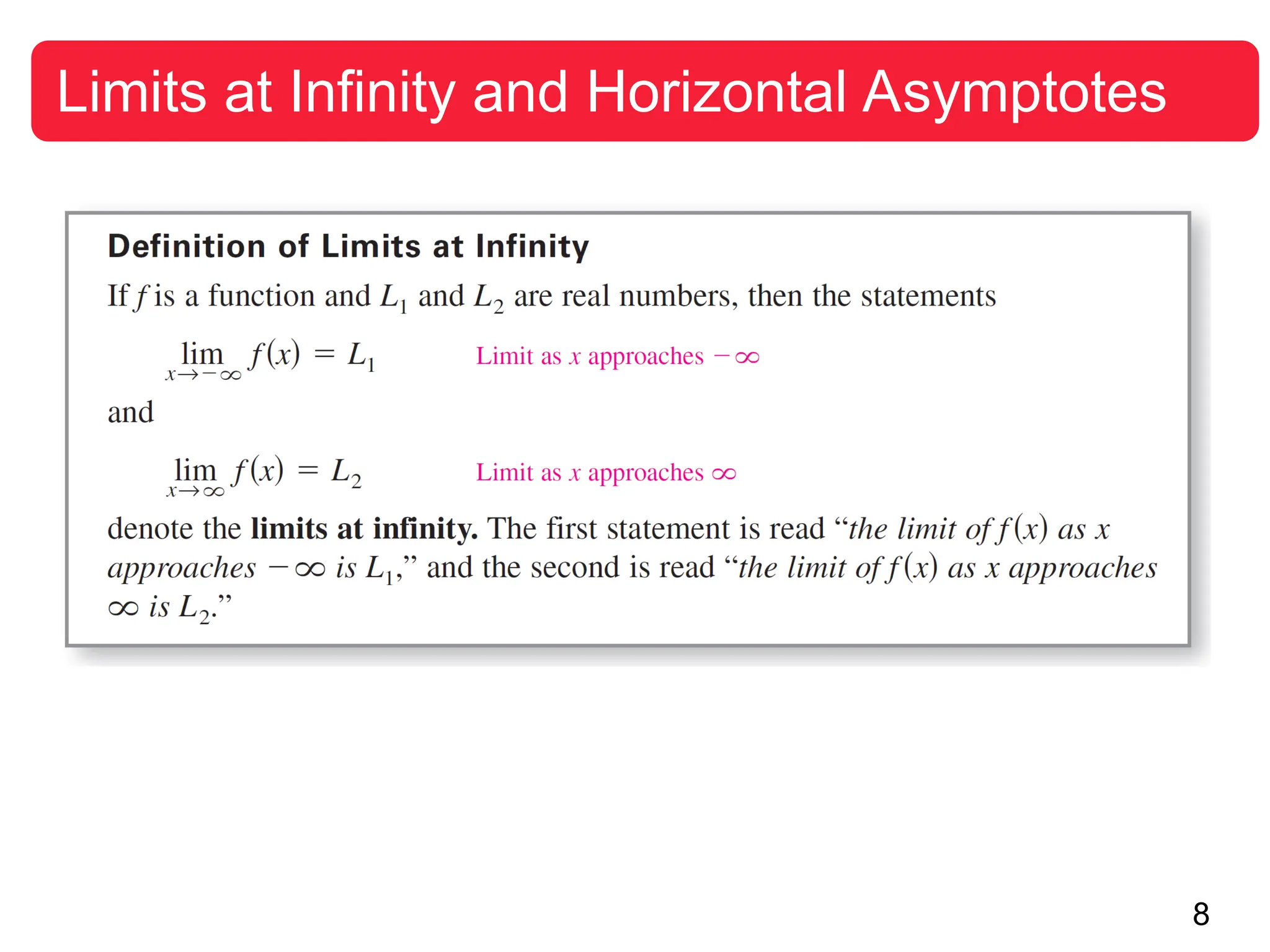
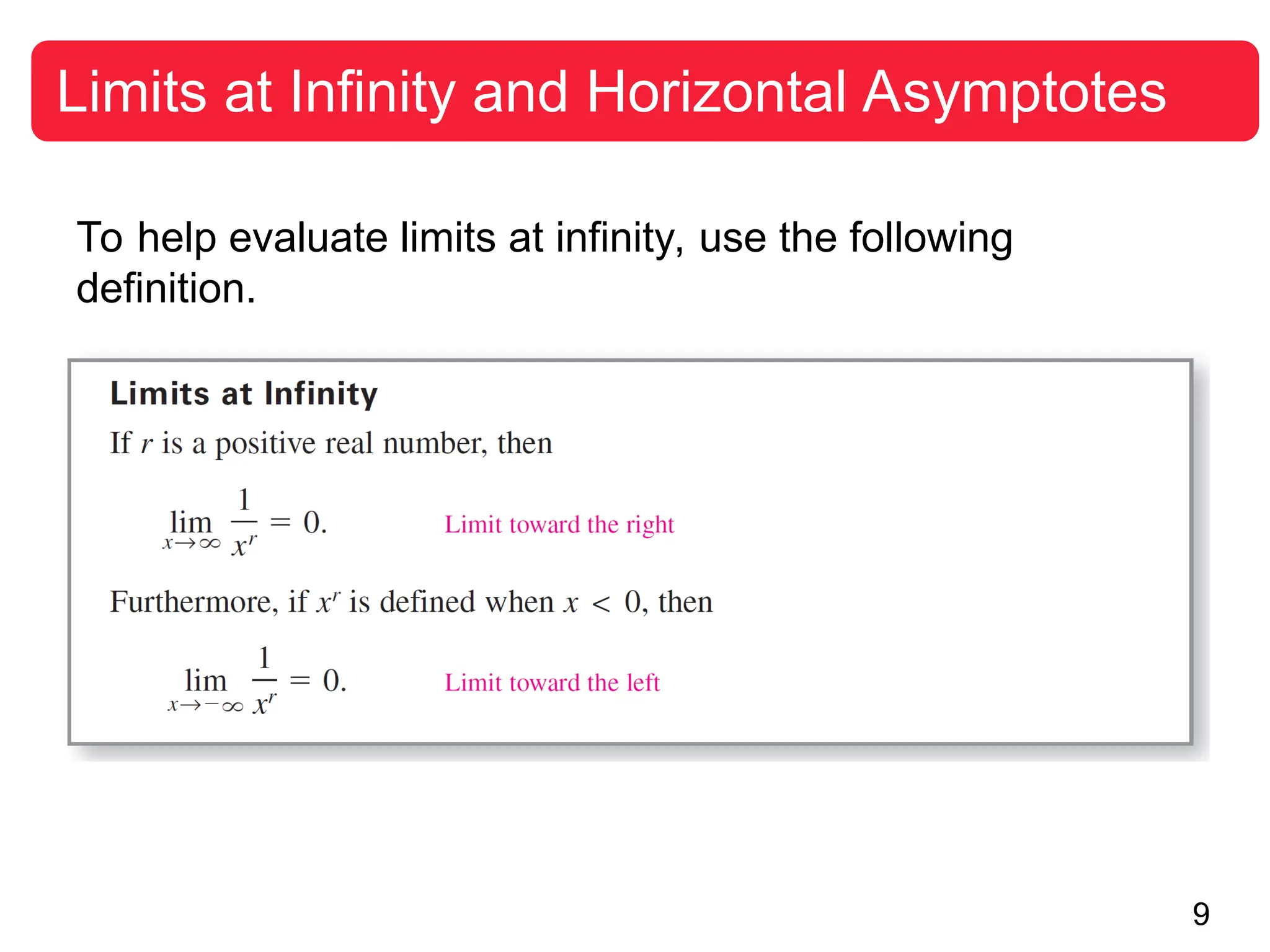
To help evaluate limits at infinity, use the following
definition.
10
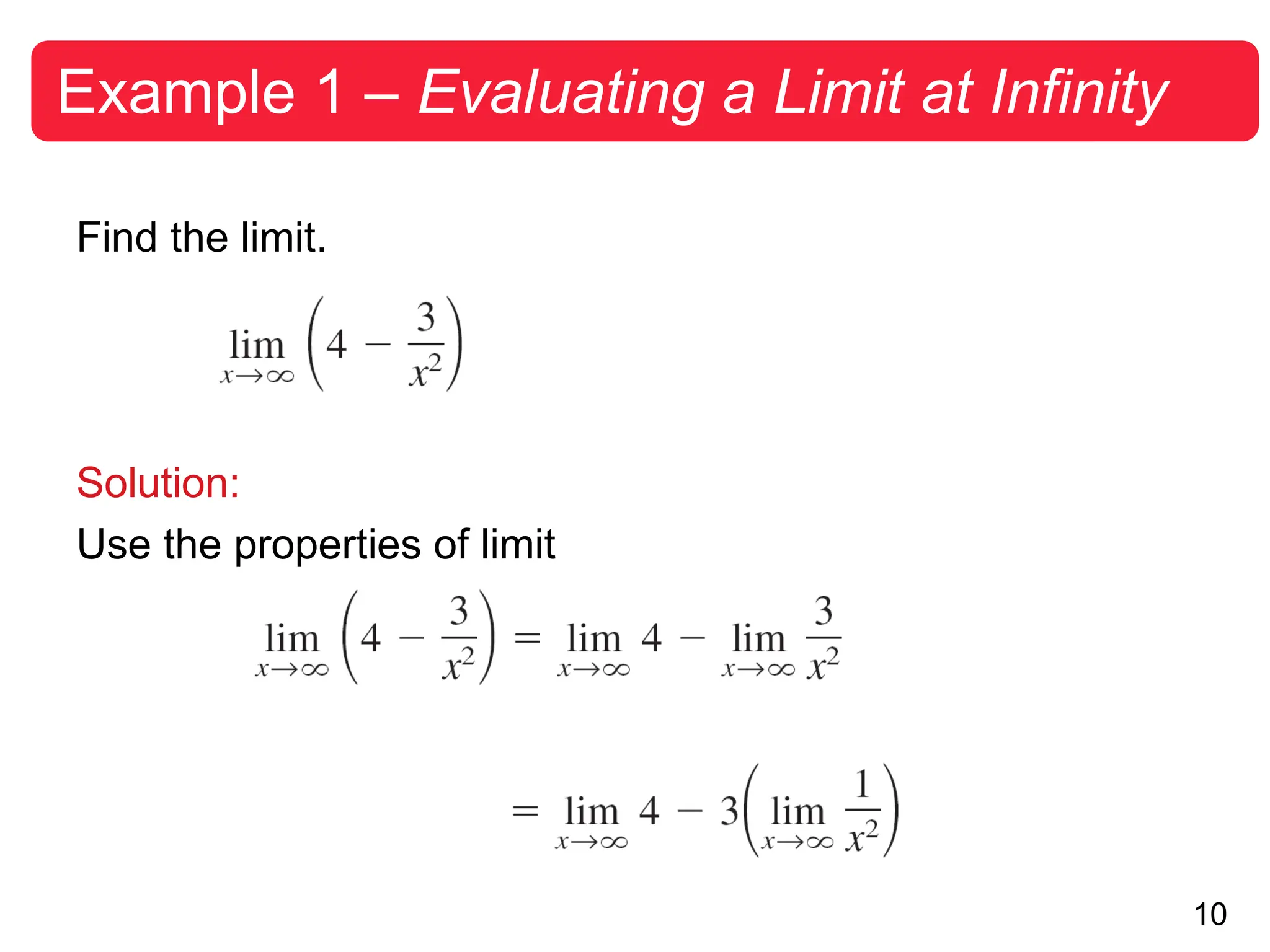
Example 1 – Evaluating a Limit at Infinity
Find the limit.
Solution:
Use the properties of limit
11
Example 1 – Solution
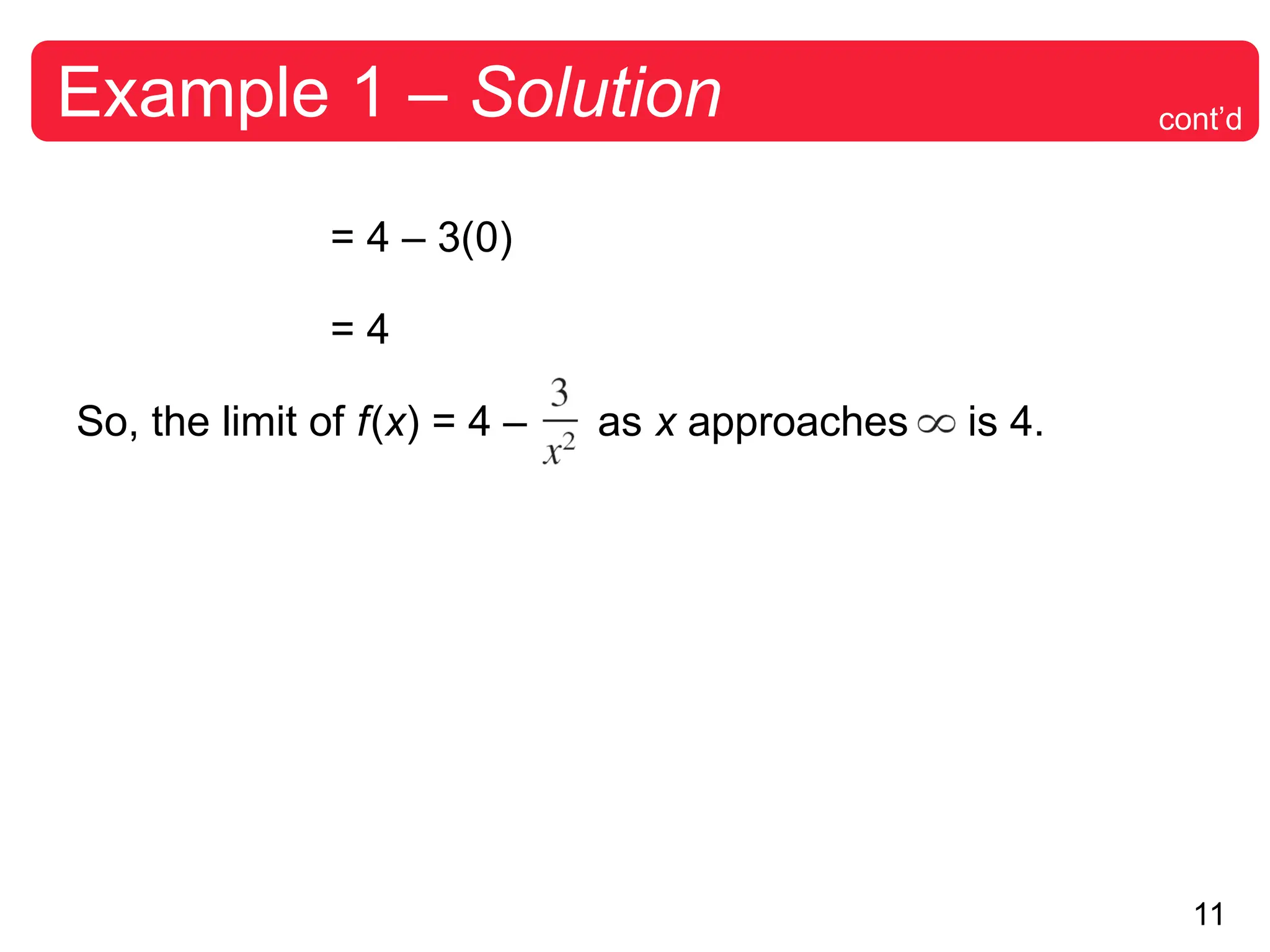
= 4 – 3(0)
= 4
So, the limit of f(x) = 4 – as x approaches is 4.
cont’d
12
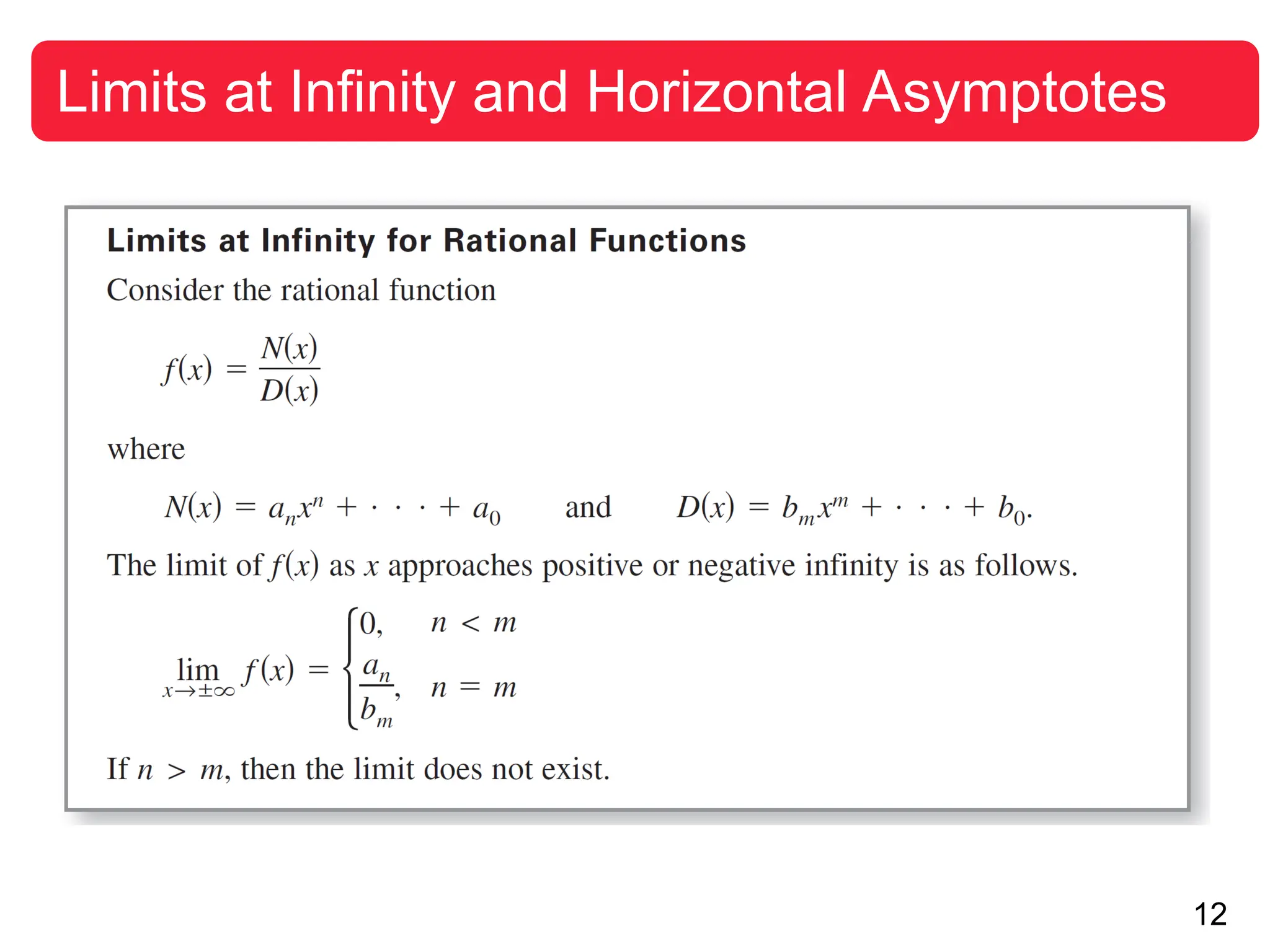
Limits at Infinity and Horizontal Asymptotes
13
Limits of Sequences
14
Limits of Sequences
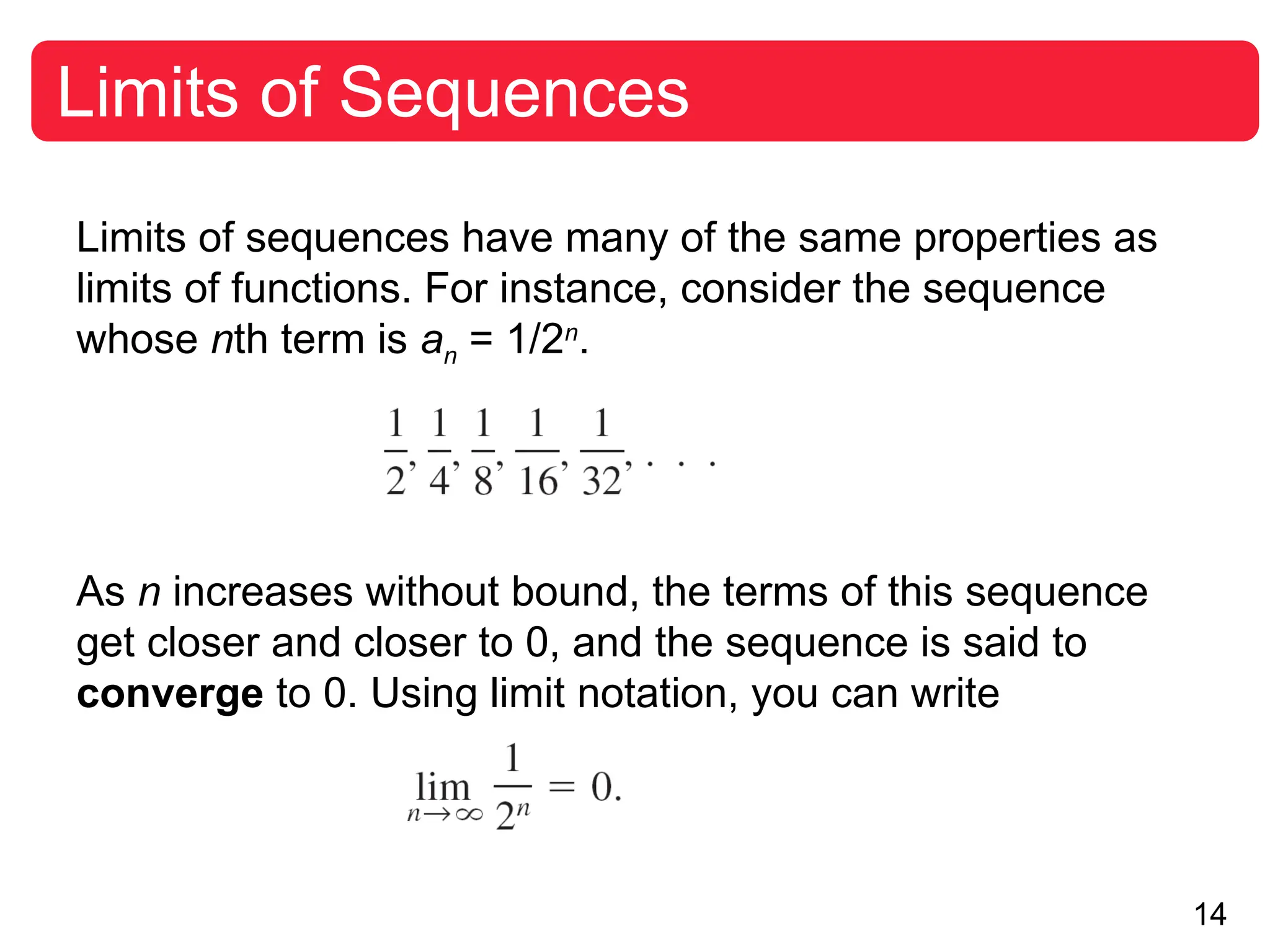
Limits of sequences have many of the same properties as
limits of functions. For instance, consider the sequence
whose nth term is an = 1/2n
.
As n increases without bound, the terms of this sequence
get closer and closer to 0, and the sequence is said to
converge to 0. Using limit notation, you can write
15
Limits of Sequences
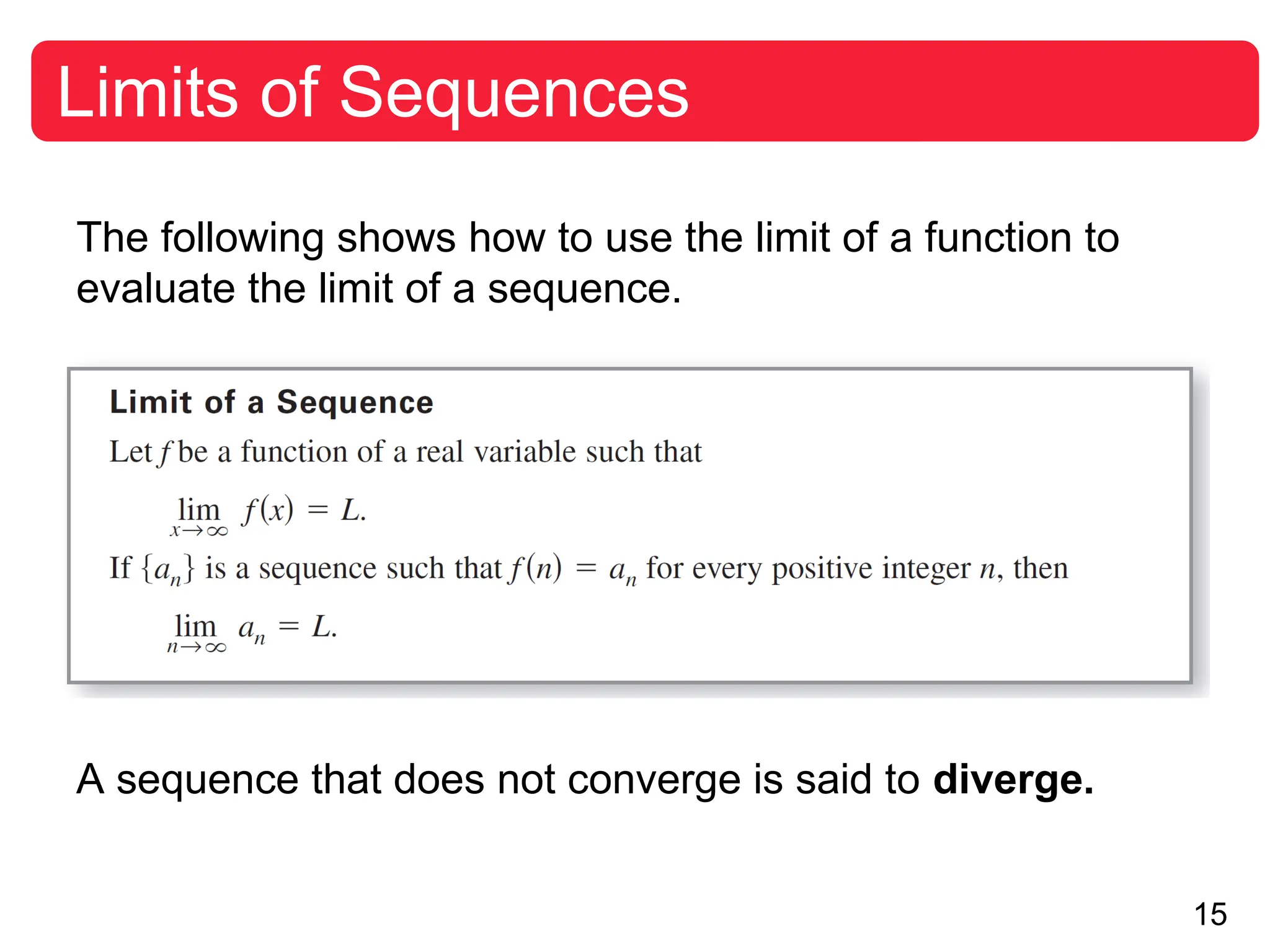
The following shows how to use the limit of a function to
evaluate the limit of a sequence.
A sequence that does not converge is said to diverge.
16
Limits of Sequences
For instance, the terms of the sequence 1, –1, 1, –1, 1, . . .
oscillate between 1 and –1.
This sequence diverges because it does not approach a
unique number.
17
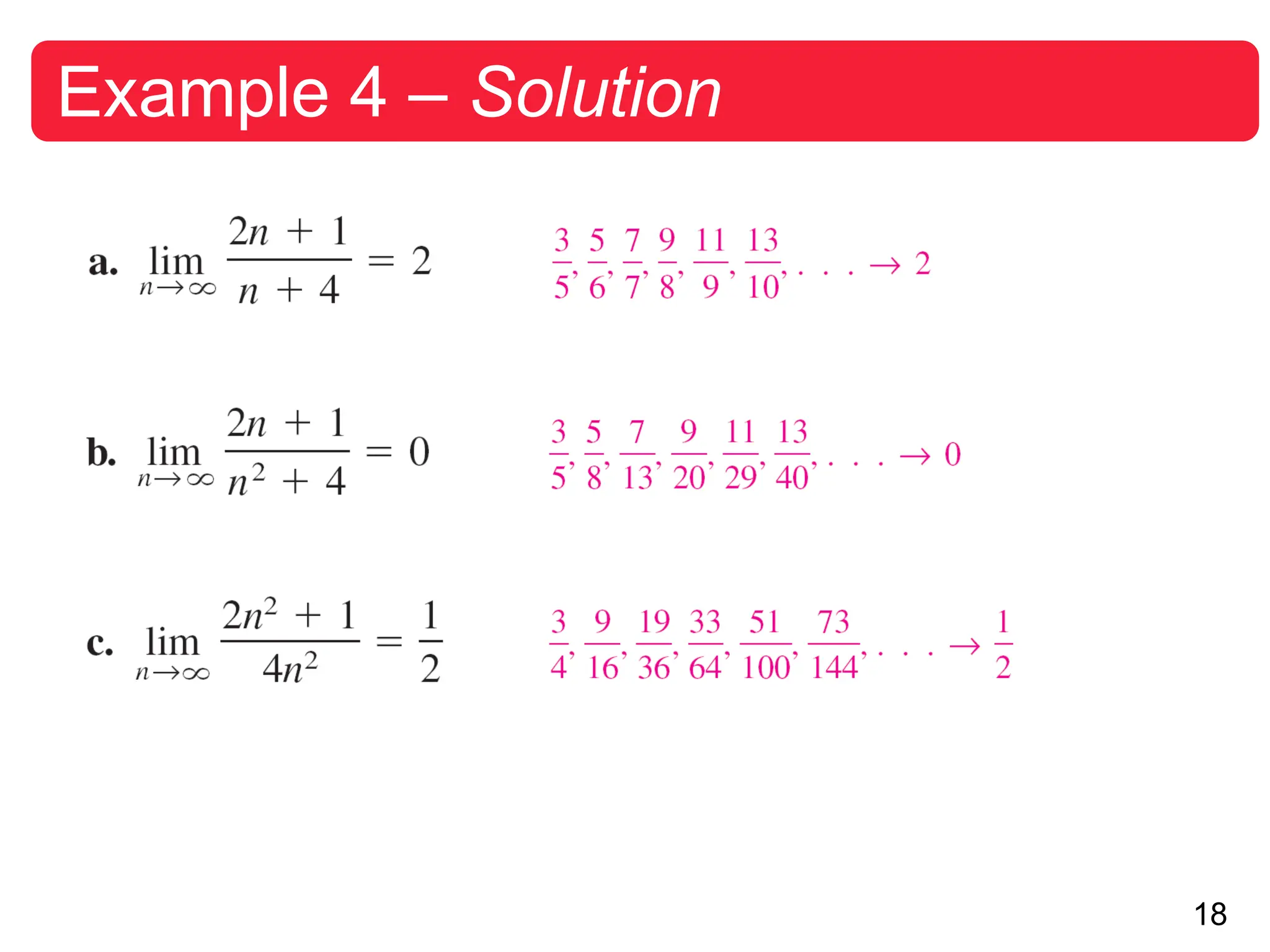
Example 4 – Finding the Limit of a Sequence
Find the limit of each sequence. (Assume n begins with 1.)
18
Example 4 – Solution

limits of function. limits of function./

  • 1.
    Copyright © CengageLearning. All rights reserved. 12 Limits and an Introduction to Calculus
  • 2.
    Copyright © CengageLearning. All rights reserved. Limits at Infinity and Limits of Sequences 12.4
  • 3.
    3  Evaluate limitsof functions at infinity.  Find limits of sequences. Objectives
  • 4.
    4 Limits at Infinityand Horizontal Asymptotes
  • 5.
    5 Limits at Infinityand Horizontal Asymptotes As pointed out at the beginning of this chapter, there are two basic problems in calculus: finding tangent lines and finding the area of a region. You saw how limits can help you solve the tangent line problem. In this section, you will see how a different type of limit, a limit at infinity, can help you solve the area problem. To get an idea of what is meant by a limit at infinity, consider the function
  • 6.
    6 Limits at Infinityand Horizontal Asymptotes The graph of f is shown below.
  • 7.
    7 Limits at Infinityand Horizontal Asymptotes From earlier work, you know that is a horizontal asymptote of the graph of this function. Using limit notation, this can be written as follows. These limits mean that the value of f(x) gets arbitrarily close to as x decreases or increases without bound. Horizontal asymptote to the left Horizontal asymptote to the right
  • 8.
    8 Limits at Infinityand Horizontal Asymptotes
  • 9.
    9 Limits at Infinityand Horizontal Asymptotes To help evaluate limits at infinity, use the following definition.
  • 10.
    10 Example 1 –Evaluating a Limit at Infinity Find the limit. Solution: Use the properties of limit
  • 11.
    11 Example 1 –Solution = 4 – 3(0) = 4 So, the limit of f(x) = 4 – as x approaches is 4. cont’d
  • 12.
    12 Limits at Infinityand Horizontal Asymptotes
  • 13.
  • 14.
    14 Limits of Sequences Limitsof sequences have many of the same properties as limits of functions. For instance, consider the sequence whose nth term is an = 1/2n . As n increases without bound, the terms of this sequence get closer and closer to 0, and the sequence is said to converge to 0. Using limit notation, you can write
  • 15.
    15 Limits of Sequences Thefollowing shows how to use the limit of a function to evaluate the limit of a sequence. A sequence that does not converge is said to diverge.
  • 16.
    16 Limits of Sequences Forinstance, the terms of the sequence 1, –1, 1, –1, 1, . . . oscillate between 1 and –1. This sequence diverges because it does not approach a unique number.
  • 17.
    17 Example 4 –Finding the Limit of a Sequence Find the limit of each sequence. (Assume n begins with 1.)
  • 18.