
P A DABHI
Contents 
Content to be covered iii 
Chapter 1. Measure and Integration 1 
1. - algebra and measure 1 
2. Measurable Functions 5 
3. Integration DABHI 
9 
Chapter 2. Signed measure and decompositions 23 
4. Signed measure 23 
5. Decompositions of signed measure space 26 
A P i
P A DABHI
Content to be covered 
Unit I 
Measure space and dierent examples,
nite, -
nite, complete and saturated measures, 
measurable functions and Lusin's DABHI 
theorem and applications. Integration, general convergence 
theorems. 
Unit II 
Signed measure, Hahn decomposition, Jordan decomposition. Lebesgue decomposition the- 
orem , Radon-Nikodym theorem, Radon-Nikodym derivatives, Lebesgue Stiltjes integral. 
Unit III 
Cumulative distributions and properties, Lp-Spaces, Holder's inequality, Minkowski inequal- 
ity, Riesz-Fischer's theorem, Riesz representation theorem, density in Lp-Spaces. 
Unit IV 
Caratheodory's extension theorem, product measure, Fubini's Theorem, Tonelli's theorem, 
regularity of Baire and Borel Measures. 
Reference Books 
(i) H.L.Royden, Real Analysis (3rd Edition) Mc. Millan, 1998. 
(ii) G. de Berra, Introduction to Measure Theory, van-Nordstrand, 1974. 
(iii) P.R. Halmos, A Measure Theory, van-Nordstran, 1970. 
P iii
P A DABHI
Real DABHI 
Analysis II Notes 
Author: 
Prakash A. Dabhi 
A P
P A DABHI
CHAPTER 1 
Measure and Integration 
1. - algebra and measure 
De
nition 1.1.1. Let X be a set. A subset A of the powerset P(X) of X is called a - 
algebra if ; 2 A , A is closed with respect to the formation of complement in X and A is 
closed with respect to the formation of countable unions. 
If A is a - algebra of subsets DABHI 
of X, then the pair (X;A ) is called a measurable space. 
Let A be a - algebra of subsets of X. A subset A of X is called measurable if A 2 A . 
Note that f;;Xg and P(X) are the smallest and the largest - algebras of subsets of 
X respectively. 
Exercise 1.1.2. Show that the condition (3) in the de
nition 1.1.1 can be replaced by the 
formation of countable intersections. 
De
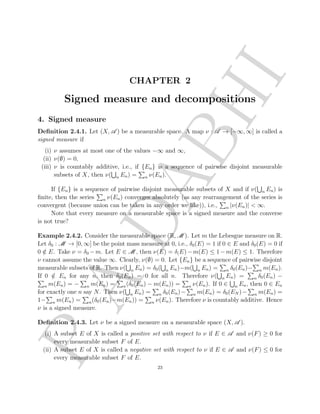
nition 1.1.3. Let A be a - algebra of subsets of X. A map  : A ! [0;1] is called 
a measure if 
(i) (;) = 0, 
(ii)  is countably additive, S 
i.e., if P 
fEng is a sequence of pairwise disjoint measurable 
subsets of X, then ( 
En) = 
(En) 
n n If  is a measure on a measurable space (X;A ), then the triplet (X;A ; ) is called a 
measure space. 
Examples 1.1.4. 
(i) Let M A be the - algebra of all measurable subsets of R, and let m be the Lebesgue 
measure of R. Then (R;M;m) is a measure space. 
(ii) Let A be the collection of all measurable subsets of [0; 1] and let m be the Lebesgue 
P measure on [0; 1]. Then ([0; 1];A ;m) is a measure space. 
(iii) Let B be the Borel  algebra on R, and let m be the Lebesgue measure on R. Then 
(R;B;m) is a measure space. 
(iv) Let X be any set, and let A = f;;Xg. Let   0. De
ne  : A ! [0;1] by 
(;) = 0 and (X) = . Then (X;A ; ) is a measure space. 
(v) Let X be a any set. Let  : P(X) ! [0;1] be as follows. For a subset A of X put 
(A) = 1 is A is an in
nite set and put (A) to be the number of elements in A. Then 
1
2 1. MEASURE AND INTEGRATION 
 is a measure on X, called the counting measure (on X). The triplet (X; P(X); ) is 
a measure space. 
(vi) Let X be an uncountable set. Let A = fE  X : either E or Ec is countableg. Then 
A is a - algebra of subsets of X. Let   0 De
ne  : ![0;1] by (A) = 0 if A 
is uncountable and (A) =  if A is countable. Then (X;A ; ) is a measure space. 
(vii) Let X be a nonempty set, and let x 2 X. De
ne x : P(X) ! [0;1] by x(A) = 1 if 
x 2 A and x(A) = 0 if x =2 A. Then x is a measure on (X; P(X)), called the Dirac 
measure concentrated at x. Then (X; P(X); x) is a measure space. 
(viii) Let (X;A ; ) be a measure space, and let X0 be a measurable subset of X. Let 
A0 = fU  X : U 2 A ; U  X0g = fU  X0 : U 2 A g. Then A0 is a - algebra of 
subsets of X0. De
ne 0 : A0 ! [0;1] by 0(E) = (E); E 2 A0. In fact, 0 = jA0 
. 
Then (X0;A0; 0) is a DABHI 
measure space. 
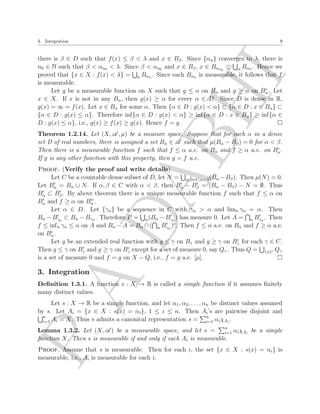
Lemma 1.1.5 (Monotonicity of a measure). Let (X;A ; ) be a measure space, and let E and 
F be measurable subsets of X with F  E. Then (F)  (E). Furthermore, if (F)  1, 
then (E  F) = (E)  (F). 
Proof. Clearly, E = F [ (E  F). As both E and F are measurable, E  F = E  Fc is 
measurable. Since F and E  F are disjoint, (E) = (F) + (E  F)  (F). 
Let (F)  1. Since (E) = (F) + (E  F) and (F)  1, we have (E  F) = 
(E)  (F).  
Note that we cannot drop the condition that (F)  1 in the above lemma. For 
example, let E = F = R in (R;M;m). Then m(E) = m(F) = 1 and m(EF) = m(;) = 0 
but m(E)  m(F) does not exist. 
Lemma 1.1.6. A Let (X;A S 
; ) be P 
a measure space, and let fEng be a sequence of measurable 
subsets of X. Then ( 
En)  
(En). 
n n SProof. Let F1 = E1 and for S 
n  1, let n1 
S 
Fn = Fn  ( 
Fk). Then each Fn is measurable, 
k=1 Fn  Fm = ; if n6= m and 
Fn n S 
= 
En. n S 
Also note P 
that Fn  En P 
for all n. Therefore 
(Fn)  (En) for all n. Now, ( 
En) = ( 
Fn) = 
(Fn)  
(En).  
n n n n Lemma 1.1.7. Let fEng be an increasing sequence of measurable subsets of a measure space 
P S 
(X;A ; ). Then ( 
En) = limn (En) = supn (En). 
n S 
Proof. Since fEng is increasing, (En)  (En+1) for all n. Also, (En)  ( 
En). 
n If (En0S 
) = 1 for some n0, then ((En) = 1 for all n  n0) clearly limn (En) = 1 
and ( 
En) = 1. We are through in this case. Now assume that (En)  1 for all 
n n. Let F1 = E1 and for n  1, let Fn S 
= En  En1. S 
Then fFng is a sequence of pairwise 
disjoint measurable subsets of X with 
Fn = 
En. Since (En)  1 for all n, we have 
n n
1. - algebra and measure 3 
(Fn) = (En)  (En1) for all n  1 and (F1) = (E1). Now 
X 
Xn 
([nEn) = ([nFn) = 
(Fn) = lim 
(Fk) 
n 
n 
k=1 
Xn 
= lim 
[(E1) + 
((Ek)  (Ek1))] 
n 
k=2 
= lim 
(En): 
n 
Since the sequence f(En)g is increasing, limn (En) = supn (En).  
Corollary S 
1.1.8. Let fEng Sbe a sequence of measurable subsets of a measure space (X;A ; ). 
Then ( 
En) = limn ( 
n 
Ek) 
n k=1 SProof. For each n 
S 
n set Fn S 
= 
DABHI 
Ek. Then fFng is an increasing sequence of measurable 
k=1 subsets S 
of X and 
S 
Fn = 
En. By above corollary n n Swe have 
( 
En) = ( 
Fn) = limn (Fn) = limn ( 
n 
Ek).  
n n k=1 Lemma 1.1.9. Let fEng be a decreasing T 
sequence of measurable subsets of a measure space 
(X;A ; ). If (E1)  1, then ( 
En) = limn (En). 
n Proof. For each n, let Fn = E1  En. Since fEng is a decreasing sequence, the sequence 
fFng is an increasing sequence of measurable sets. As (E1)  S 
1 (and hence T 
(En)  1 
for all n), we have (Fn) = (E1)(En). It is also clear that 
Fn = E1( 
En). Now, 
 
 
[ 
n n (E1)  ( 
En) = (E1  ( 
En)) = ( 
Fn) 
n 
n 
n 
= lim 
(Fn) = lim 
((E1)  (Fn)) = (E1)  lim 
(En): 
T 
n 
n 
n 
Hence ( 
En) = limn (En).  
n We cannot drop the condition that (E1)  1 in the above lemma. For example 
consider En = [n;1) in (R;M;m). Then fEng is a decreasing sequence T 
of measurable 
subsets T 
of R. A Note that m(En) = 1 for all n and so limnm(En) = 1 while 
En = ; gives 
n m( 
En) = 0. 
n De
nition 1.1.10. Let (X;A ; ) be a measure space. The measure  is called a
nite 
P measure (or the measure space (X;A ; ) is called a
nite measure space) if (X)  1. 
The measure  is called a -
nite measure (or the measure space (X;A ; ) is called a 
-
nite measure space) if X can be written has a countable union of measurable sets each 
having
nite measure, i.e., S 
there is a sequence fEng of measurable subsets of X such that 
(En)  1 for all n and 
En = X. 
n A subset E of a measure space (X;A ; ) is said to have -
nite measure if it can be 
written as a countable union of measurable subsets of X each having
nite measure.
4 1. MEASURE AND INTEGRATION 
Exercise 1.1.11. 
(i) If (X;A ; ) is a
nite measure space, then it is a -
nite measure space. Give an 
example to show that the converse is not true. 
(ii) Any measurable subset of
nite measure space has a
nite measure. 
(iii) If E is a measurable subset of -
nite measure space, then E is of -
nite measure. 
(iv) If E1; : : : ;En are sets of
nite measure in a measure space, then their union is a set of
nite measure. 
(v) Countable union of sets of -
nite measures is of -
nite measure. 
De
nition 1.1.12. A measure space (X;A ; ) (or the measure ) is called complete if A 
contains all subsets of sets of measure zero. 
Example 1.1.13. 
DABHI 
(i) The measure space (R;M;m) is complete. 
Let E 2 M be such that m(E) = 0, and let F be a subset of E. Since F  E, 
0  m(F)  m(E) = m(E) = 0, i.e., m(F) = 0. Let A be any subset of R. Then 
A  F  F gives m(A  F) = 0. Now A  Fc  A gives m(A  Fc)  m(A). 
Therefore m(A)  m(A  F) = m(A  Fc) + m(A  F). Hence F is measurable, 
i.e., F 2 M. 
(ii) The measure space (R;B;m) is not a complete measure space as the Cantor set C has 
measure 0 and it contains a subset which is not a Borel set (Construct such a set!!!). 
Theorem 1.1.14 (Completion of a measure space). Let (X;A ; ) be a measure space. Then 
there is a complete measure space (X;A0; 0) such that 
(i) A  A0, 
(ii) 0(E) = (E) for every E 2 A , 
(iii) If E 2 A0, then E = A [ B for some A 2 A and B  C for some C 2 A with 
(C) = 0. 
Proof. Let A A0 = fE  X : E = A [ B; A 2 A ; B  C for some C 2 A with (C) = 0g: 
Clearly, A  A0 ( if E 2 A , then E = E [; 2 A0). Let E = a[B 2 A0. Then A 2 A and 
B  C for some C 2 A with (C) = 0. Then Ec = Ac  Bc = (Ac  Cc) [ (Ac  (C  B)). 
P Clearly, Ac  Cc 2 A , (Ac  (C  B)  C. Therefore Ec 2 A0. Let fEng be a countable 
collection of elements of A0. Then S 
En = An S 
[ Bn, where S 
S 
An 2 A and Bn S 
 Cn for some 
Cn S 2 A S 
with (Cn) S 
= 0. Now 
En n S 
= ( 
An) 
P 
( 
Bn). Clearly, 
An 2 A and 
n n n Bn  
Cn, 
Cn 2 A and 0  ( 
Cn)  
(Cn) = 0. Hence is a - algebra 
n n n n n A0 of subsets of X. De
ne 0 on A0 as follows. If E = A[B 2 A0, then we put 0(E) = (A). 
Clearly, if E 2 A , then 0(E) = 0(E [ ;) = (E). By de
nition 0(E)  0 for every 
E 2 A0. Let fEng be a sequence of pairwise disjoint elements of A0. Then En = An [ Bn,

Real Analysis II (Measure Theory) Notes

  • 1.
  • 2.
    Contents Content tobe covered iii Chapter 1. Measure and Integration 1 1. - algebra and measure 1 2. Measurable Functions 5 3. Integration DABHI 9 Chapter 2. Signed measure and decompositions 23 4. Signed measure 23 5. Decompositions of signed measure space 26 A P i
  • 3.
  • 4.
    Content to becovered Unit I Measure space and dierent examples,
  • 5.
  • 6.
    nite, complete andsaturated measures, measurable functions and Lusin's DABHI theorem and applications. Integration, general convergence theorems. Unit II Signed measure, Hahn decomposition, Jordan decomposition. Lebesgue decomposition the- orem , Radon-Nikodym theorem, Radon-Nikodym derivatives, Lebesgue Stiltjes integral. Unit III Cumulative distributions and properties, Lp-Spaces, Holder's inequality, Minkowski inequal- ity, Riesz-Fischer's theorem, Riesz representation theorem, density in Lp-Spaces. Unit IV Caratheodory's extension theorem, product measure, Fubini's Theorem, Tonelli's theorem, regularity of Baire and Borel Measures. Reference Books (i) H.L.Royden, Real Analysis (3rd Edition) Mc. Millan, 1998. (ii) G. de Berra, Introduction to Measure Theory, van-Nordstrand, 1974. (iii) P.R. Halmos, A Measure Theory, van-Nordstran, 1970. P iii
  • 7.
  • 8.
    Real DABHI AnalysisII Notes Author: Prakash A. Dabhi A P
  • 9.
  • 10.
    CHAPTER 1 Measureand Integration 1. - algebra and measure De
  • 11.
    nition 1.1.1. LetX be a set. A subset A of the powerset P(X) of X is called a - algebra if ; 2 A , A is closed with respect to the formation of complement in X and A is closed with respect to the formation of countable unions. If A is a - algebra of subsets DABHI of X, then the pair (X;A ) is called a measurable space. Let A be a - algebra of subsets of X. A subset A of X is called measurable if A 2 A . Note that f;;Xg and P(X) are the smallest and the largest - algebras of subsets of X respectively. Exercise 1.1.2. Show that the condition (3) in the de
  • 12.
    nition 1.1.1 canbe replaced by the formation of countable intersections. De
  • 13.
    nition 1.1.3. LetA be a - algebra of subsets of X. A map : A ! [0;1] is called a measure if (i) (;) = 0, (ii) is countably additive, S i.e., if P fEng is a sequence of pairwise disjoint measurable subsets of X, then ( En) = (En) n n If is a measure on a measurable space (X;A ), then the triplet (X;A ; ) is called a measure space. Examples 1.1.4. (i) Let M A be the - algebra of all measurable subsets of R, and let m be the Lebesgue measure of R. Then (R;M;m) is a measure space. (ii) Let A be the collection of all measurable subsets of [0; 1] and let m be the Lebesgue P measure on [0; 1]. Then ([0; 1];A ;m) is a measure space. (iii) Let B be the Borel algebra on R, and let m be the Lebesgue measure on R. Then (R;B;m) is a measure space. (iv) Let X be any set, and let A = f;;Xg. Let 0. De
  • 14.
    ne :A ! [0;1] by (;) = 0 and (X) = . Then (X;A ; ) is a measure space. (v) Let X be a any set. Let : P(X) ! [0;1] be as follows. For a subset A of X put (A) = 1 is A is an in
  • 15.
    nite set andput (A) to be the number of elements in A. Then 1
  • 16.
    2 1. MEASUREAND INTEGRATION is a measure on X, called the counting measure (on X). The triplet (X; P(X); ) is a measure space. (vi) Let X be an uncountable set. Let A = fE X : either E or Ec is countableg. Then A is a - algebra of subsets of X. Let 0 De
  • 17.
    ne :![0;1] by (A) = 0 if A is uncountable and (A) = if A is countable. Then (X;A ; ) is a measure space. (vii) Let X be a nonempty set, and let x 2 X. De
  • 18.
    ne x :P(X) ! [0;1] by x(A) = 1 if x 2 A and x(A) = 0 if x =2 A. Then x is a measure on (X; P(X)), called the Dirac measure concentrated at x. Then (X; P(X); x) is a measure space. (viii) Let (X;A ; ) be a measure space, and let X0 be a measurable subset of X. Let A0 = fU X : U 2 A ; U X0g = fU X0 : U 2 A g. Then A0 is a - algebra of subsets of X0. De
  • 19.
    ne 0 :A0 ! [0;1] by 0(E) = (E); E 2 A0. In fact, 0 = jA0 . Then (X0;A0; 0) is a DABHI measure space. Lemma 1.1.5 (Monotonicity of a measure). Let (X;A ; ) be a measure space, and let E and F be measurable subsets of X with F E. Then (F) (E). Furthermore, if (F) 1, then (E F) = (E) (F). Proof. Clearly, E = F [ (E F). As both E and F are measurable, E F = E Fc is measurable. Since F and E F are disjoint, (E) = (F) + (E F) (F). Let (F) 1. Since (E) = (F) + (E F) and (F) 1, we have (E F) = (E) (F). Note that we cannot drop the condition that (F) 1 in the above lemma. For example, let E = F = R in (R;M;m). Then m(E) = m(F) = 1 and m(EF) = m(;) = 0 but m(E) m(F) does not exist. Lemma 1.1.6. A Let (X;A S ; ) be P a measure space, and let fEng be a sequence of measurable subsets of X. Then ( En) (En). n n SProof. Let F1 = E1 and for S n 1, let n1 S Fn = Fn ( Fk). Then each Fn is measurable, k=1 Fn Fm = ; if n6= m and Fn n S = En. n S Also note P that Fn En P for all n. Therefore (Fn) (En) for all n. Now, ( En) = ( Fn) = (Fn) (En). n n n n Lemma 1.1.7. Let fEng be an increasing sequence of measurable subsets of a measure space P S (X;A ; ). Then ( En) = limn (En) = supn (En). n S Proof. Since fEng is increasing, (En) (En+1) for all n. Also, (En) ( En). n If (En0S ) = 1 for some n0, then ((En) = 1 for all n n0) clearly limn (En) = 1 and ( En) = 1. We are through in this case. Now assume that (En) 1 for all n n. Let F1 = E1 and for n 1, let Fn S = En En1. S Then fFng is a sequence of pairwise disjoint measurable subsets of X with Fn = En. Since (En) 1 for all n, we have n n
  • 20.
    1. - algebraand measure 3 (Fn) = (En) (En1) for all n 1 and (F1) = (E1). Now X Xn ([nEn) = ([nFn) = (Fn) = lim (Fk) n n k=1 Xn = lim [(E1) + ((Ek) (Ek1))] n k=2 = lim (En): n Since the sequence f(En)g is increasing, limn (En) = supn (En). Corollary S 1.1.8. Let fEng Sbe a sequence of measurable subsets of a measure space (X;A ; ). Then ( En) = limn ( n Ek) n k=1 SProof. For each n S n set Fn S = DABHI Ek. Then fFng is an increasing sequence of measurable k=1 subsets S of X and S Fn = En. By above corollary n n Swe have ( En) = ( Fn) = limn (Fn) = limn ( n Ek). n n k=1 Lemma 1.1.9. Let fEng be a decreasing T sequence of measurable subsets of a measure space (X;A ; ). If (E1) 1, then ( En) = limn (En). n Proof. For each n, let Fn = E1 En. Since fEng is a decreasing sequence, the sequence fFng is an increasing sequence of measurable sets. As (E1) S 1 (and hence T (En) 1 for all n), we have (Fn) = (E1)(En). It is also clear that Fn = E1( En). Now, [ n n (E1) ( En) = (E1 ( En)) = ( Fn) n n n = lim (Fn) = lim ((E1) (Fn)) = (E1) lim (En): T n n n Hence ( En) = limn (En). n We cannot drop the condition that (E1) 1 in the above lemma. For example consider En = [n;1) in (R;M;m). Then fEng is a decreasing sequence T of measurable subsets T of R. A Note that m(En) = 1 for all n and so limnm(En) = 1 while En = ; gives n m( En) = 0. n De
  • 21.
    nition 1.1.10. Let(X;A ; ) be a measure space. The measure is called a
  • 22.
    nite P measure(or the measure space (X;A ; ) is called a
  • 23.
    nite measure space)if (X) 1. The measure is called a -
  • 24.
    nite measure (orthe measure space (X;A ; ) is called a -
  • 25.
    nite measure space)if X can be written has a countable union of measurable sets each having
  • 26.
    nite measure, i.e.,S there is a sequence fEng of measurable subsets of X such that (En) 1 for all n and En = X. n A subset E of a measure space (X;A ; ) is said to have -
  • 27.
    nite measure ifit can be written as a countable union of measurable subsets of X each having
  • 28.
  • 29.
    4 1. MEASUREAND INTEGRATION Exercise 1.1.11. (i) If (X;A ; ) is a
  • 30.
    nite measure space,then it is a -
  • 31.
    nite measure space.Give an example to show that the converse is not true. (ii) Any measurable subset of
  • 32.
  • 33.
    nite measure. (iii)If E is a measurable subset of -
  • 34.
    nite measure space,then E is of -
  • 35.
    nite measure. (iv)If E1; : : : ;En are sets of
  • 36.
    nite measure ina measure space, then their union is a set of
  • 37.
    nite measure. (v)Countable union of sets of -
  • 38.
  • 39.
  • 40.
    nition 1.1.12. Ameasure space (X;A ; ) (or the measure ) is called complete if A contains all subsets of sets of measure zero. Example 1.1.13. DABHI (i) The measure space (R;M;m) is complete. Let E 2 M be such that m(E) = 0, and let F be a subset of E. Since F E, 0 m(F) m(E) = m(E) = 0, i.e., m(F) = 0. Let A be any subset of R. Then A F F gives m(A F) = 0. Now A Fc A gives m(A Fc) m(A). Therefore m(A) m(A F) = m(A Fc) + m(A F). Hence F is measurable, i.e., F 2 M. (ii) The measure space (R;B;m) is not a complete measure space as the Cantor set C has measure 0 and it contains a subset which is not a Borel set (Construct such a set!!!). Theorem 1.1.14 (Completion of a measure space). Let (X;A ; ) be a measure space. Then there is a complete measure space (X;A0; 0) such that (i) A A0, (ii) 0(E) = (E) for every E 2 A , (iii) If E 2 A0, then E = A [ B for some A 2 A and B C for some C 2 A with (C) = 0. Proof. Let A A0 = fE X : E = A [ B; A 2 A ; B C for some C 2 A with (C) = 0g: Clearly, A A0 ( if E 2 A , then E = E [; 2 A0). Let E = a[B 2 A0. Then A 2 A and B C for some C 2 A with (C) = 0. Then Ec = Ac Bc = (Ac Cc) [ (Ac (C B)). P Clearly, Ac Cc 2 A , (Ac (C B) C. Therefore Ec 2 A0. Let fEng be a countable collection of elements of A0. Then S En = An S [ Bn, where S S An 2 A and Bn S Cn for some Cn S 2 A S with (Cn) S = 0. Now En n S = ( An) P ( Bn). Clearly, An 2 A and n n n Bn Cn, Cn 2 A and 0 ( Cn) (Cn) = 0. Hence is a - algebra n n n n n A0 of subsets of X. De
  • 41.
    ne 0 onA0 as follows. If E = A[B 2 A0, then we put 0(E) = (A). Clearly, if E 2 A , then 0(E) = 0(E [ ;) = (E). By de
  • 42.
    nition 0(E) 0 for every E 2 A0. Let fEng be a sequence of pairwise disjoint elements of A0. Then En = An [ Bn,