Inverse of One-to-One
Functions
PREPARED BY:
JOCELYN D. ARAGON
TEACHER 1
March 31, 2021
PRAYER
CLASSROOM STANDARDS
1. Raise your hand before speaking.
2. Listen to others and participate in class
discussion.
3. Listen to directions.
4. No talking when the teacher is talking.
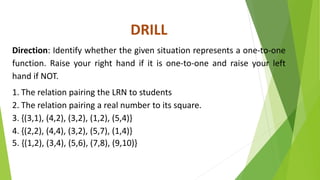
DRILL
Direction: Identify whether the given situation represents a one-to-one
function. Raise your right hand if it is one-to-one and raise your left
hand if NOT.
1. The relation pairing the LRN to students
2. The relation pairing a real number to its square.
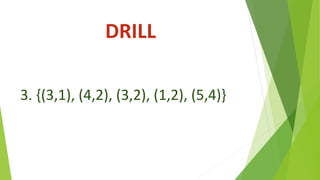
3. {(3,1), (4,2), (3,2), (1,2), (5,4)}
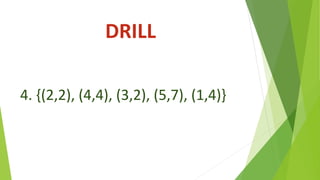
4. {(2,2), (4,4), (3,2), (5,7), (1,4)}
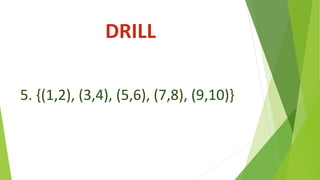
5. {(1,2), (3,4), (5,6), (7,8), (9,10)}
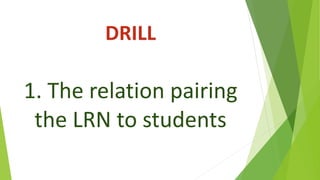
DRILL
1. The relation pairing
the LRN to students
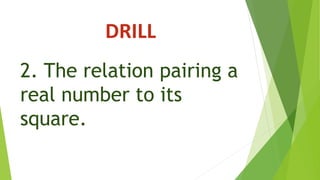
DRILL
2. The relation pairing a
real number to its
square.
DRILL
3. {(3,1), (4,2), (3,2), (1,2), (5,4)}
DRILL
4. {(2,2), (4,4), (3,2), (5,7), (1,4)}
DRILL
5. {(1,2), (3,4), (5,6), (7,8), (9,10)}
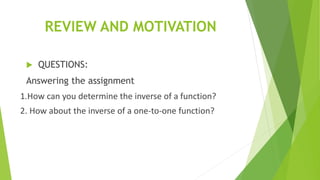
REVIEW AND MOTIVATION
 QUESTIONS:
Answering the assignment
1.How can you determine the inverse of a function?
2. How about the inverse of a one-to-one function?
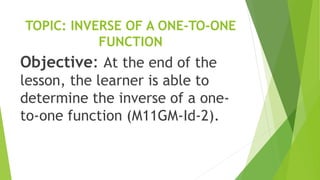
TOPIC: INVERSE OF A ONE-TO-ONE
FUNCTION
Objective: At the end of the
lesson, the learner is able to
determine the inverse of a one-
to-one function (M11GM-Id-2).
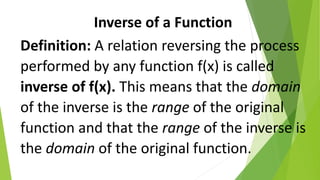
Inverse of a Function
Definition: A relation reversing the process
performed by any function f(x) is called
inverse of f(x). This means that the domain
of the inverse is the range of the original
function and that the range of the inverse is
the domain of the original function.
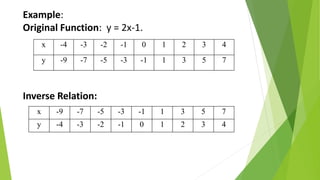
x -4 -3 -2 -1 0 1 2 3 4
y -9 -7 -5 -3 -1 1 3 5 7
x -9 -7 -5 -3 -1 1 3 5 7
y -4 -3 -2 -1 0 1 2 3 4
Example:
Original Function: y = 2x-1.
Inverse Relation:
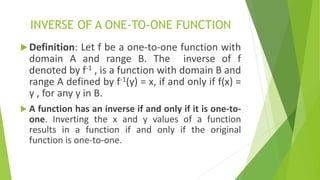
INVERSE OF A ONE-TO-ONE FUNCTION
Definition: Let f be a one-to-one function with
domain A and range B. The inverse of f
denoted by f-1 , is a function with domain B and
range A defined by f-1(y) = x, if and only if f(x) =
y , for any y in B.
 A function has an inverse if and only if it is one-to-
one. Inverting the x and y values of a function
results in a function if and only if the original
function is one-to-one.
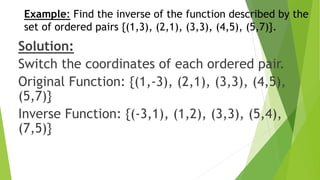
Example: Find the inverse of the function described by the
set of ordered pairs {(1,3), (2,1), (3,3), (4,5), (5,7)}.
Solution:
Switch the coordinates of each ordered pair.
Original Function: {(1,-3), (2,1), (3,3), (4,5),
(5,7)}
Inverse Function: {(-3,1), (1,2), (3,3), (5,4),
(7,5)}
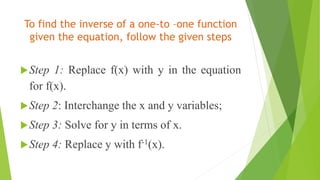
To find the inverse of a one-to –one function
given the equation, follow the given steps
Step 1: Replace f(x) with y in the equation
for f(x).
Step 2: Interchange the x and y variables;
Step 3: Solve for y in terms of x.
Step 4: Replace y with f-1(x).
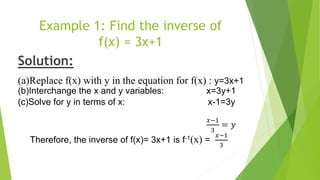
Example 1: Find the inverse of
f(x) = 3x+1
Solution:
(a)Replace f(x) with y in the equation for f(x) : y=3x+1
(b)Interchange the x and y variables: x=3y+1
(c)Solve for y in terms of x: x-1=3y
𝑥−1
3
= 𝑦
Therefore, the inverse of f(x)= 3x+1 is f-1(x) =
𝑥−1
3
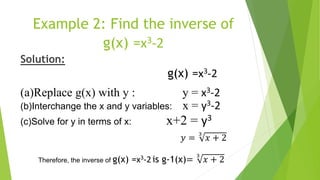
Example 2: Find the inverse of
g(x) =x3-2
Solution:
g(x) =x3-2
(a)Replace g(x) with y : y = x3-2
(b)Interchange the x and y variables: x = y3-2
(c)Solve for y in terms of x: x+2 = y3
𝑦 =
3
𝑥 + 2
Therefore, the inverse of g(x) =x3-2is g-1(x)=
3
𝑥 + 2
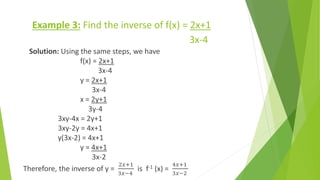
Example 3: Find the inverse of f(x) = 2x+1
3x-4
Solution: Using the same steps, we have
f(x) = 2x+1
3x-4
y = 2x+1
3x-4
x = 2y+1
3y-4
3xy-4x = 2y+1
3xy-2y = 4x+1
y(3x-2) = 4x+1
y = 4x+1
3x-2
Therefore, the inverse of y =
2𝑥+1
3𝑥−4
is f-1 (x) =
4𝑥+1
3𝑥−2
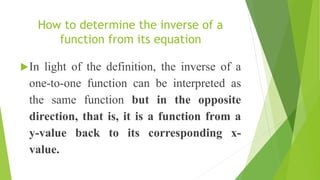
How to determine the inverse of a
function from its equation
In light of the definition, the inverse of a
one-to-one function can be interpreted as
the same function but in the opposite
direction, that is, it is a function from a
y-value back to its corresponding x-
value.
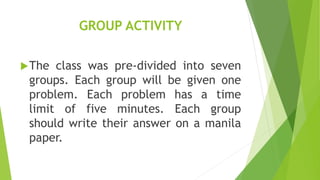
GROUP ACTIVITY
The class was pre-divided into seven
groups. Each group will be given one
problem. Each problem has a time
limit of five minutes. Each group
should write their answer on a manila
paper.
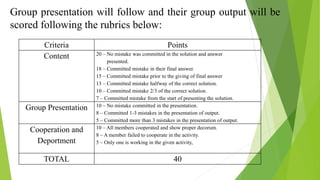
Criteria Points
Content 20 – No mistake was committed in the solution and answer
presented.
18 – Committed mistake in their final answer.
15 – Committed mistake prior to the giving of final answer
13 – Committed mistake halfway of the correct solution.
10 – Committed mistake 2/3 of the correct solution.
7 – Committed mistake from the start of presenting the solution.
Group Presentation 10 – No mistake committed in the presentation.
8 – Committed 1-3 mistakes in the presentation of output.
5 – Committed more than 3 mistakes in the presentation of output.
Cooperation and
Deportment
10 – All members cooperated and show proper decorum.
8 – A member failed to cooperate in the activity.
5 – Only one is working in the given activity,
TOTAL 40
Group presentation will follow and their group output will be
scored following the rubrics below:
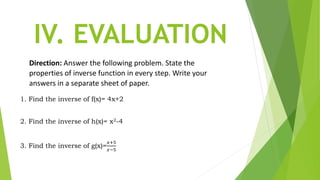
IV. EVALUATION
Direction: Answer the following problem. State the
properties of inverse function in every step. Write your
answers in a separate sheet of paper.
1. Find the inverse of f(x)= 4x+2
2. Find the inverse of h(x)= x2-4
3. Find the inverse of g(x)=
𝑥+5
𝑥−5
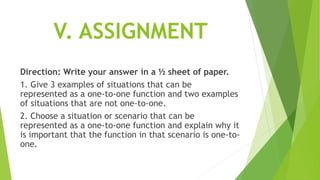
V. ASSIGNMENT
Direction: Write your answer in a ½ sheet of paper.
1. Give 3 examples of situations that can be
represented as a one-to-one function and two examples
of situations that are not one-to-one.
2. Choose a situation or scenario that can be
represented as a one-to-one function and explain why it
is important that the function in that scenario is one-to-
one.

INVERSE TO ONE TO ONE FUNCTIONS.pptx

  • 1.
    Inverse of One-to-One Functions PREPAREDBY: JOCELYN D. ARAGON TEACHER 1 March 31, 2021
  • 2.
  • 3.
    CLASSROOM STANDARDS 1. Raiseyour hand before speaking. 2. Listen to others and participate in class discussion. 3. Listen to directions. 4. No talking when the teacher is talking.
  • 4.
    DRILL Direction: Identify whetherthe given situation represents a one-to-one function. Raise your right hand if it is one-to-one and raise your left hand if NOT. 1. The relation pairing the LRN to students 2. The relation pairing a real number to its square. 3. {(3,1), (4,2), (3,2), (1,2), (5,4)} 4. {(2,2), (4,4), (3,2), (5,7), (1,4)} 5. {(1,2), (3,4), (5,6), (7,8), (9,10)}
  • 5.
    DRILL 1. The relationpairing the LRN to students
  • 6.
    DRILL 2. The relationpairing a real number to its square.
  • 7.
    DRILL 3. {(3,1), (4,2),(3,2), (1,2), (5,4)}
  • 8.
    DRILL 4. {(2,2), (4,4),(3,2), (5,7), (1,4)}
  • 9.
    DRILL 5. {(1,2), (3,4),(5,6), (7,8), (9,10)}
  • 10.
    REVIEW AND MOTIVATION QUESTIONS: Answering the assignment 1.How can you determine the inverse of a function? 2. How about the inverse of a one-to-one function?
  • 11.
    TOPIC: INVERSE OFA ONE-TO-ONE FUNCTION Objective: At the end of the lesson, the learner is able to determine the inverse of a one- to-one function (M11GM-Id-2).
  • 12.
    Inverse of aFunction Definition: A relation reversing the process performed by any function f(x) is called inverse of f(x). This means that the domain of the inverse is the range of the original function and that the range of the inverse is the domain of the original function.
  • 13.
    x -4 -3-2 -1 0 1 2 3 4 y -9 -7 -5 -3 -1 1 3 5 7 x -9 -7 -5 -3 -1 1 3 5 7 y -4 -3 -2 -1 0 1 2 3 4 Example: Original Function: y = 2x-1. Inverse Relation:
  • 14.
    INVERSE OF AONE-TO-ONE FUNCTION Definition: Let f be a one-to-one function with domain A and range B. The inverse of f denoted by f-1 , is a function with domain B and range A defined by f-1(y) = x, if and only if f(x) = y , for any y in B.  A function has an inverse if and only if it is one-to- one. Inverting the x and y values of a function results in a function if and only if the original function is one-to-one.
  • 15.
    Example: Find theinverse of the function described by the set of ordered pairs {(1,3), (2,1), (3,3), (4,5), (5,7)}. Solution: Switch the coordinates of each ordered pair. Original Function: {(1,-3), (2,1), (3,3), (4,5), (5,7)} Inverse Function: {(-3,1), (1,2), (3,3), (5,4), (7,5)}
  • 16.
    To find theinverse of a one-to –one function given the equation, follow the given steps Step 1: Replace f(x) with y in the equation for f(x). Step 2: Interchange the x and y variables; Step 3: Solve for y in terms of x. Step 4: Replace y with f-1(x).
  • 17.
    Example 1: Findthe inverse of f(x) = 3x+1 Solution: (a)Replace f(x) with y in the equation for f(x) : y=3x+1 (b)Interchange the x and y variables: x=3y+1 (c)Solve for y in terms of x: x-1=3y 𝑥−1 3 = 𝑦 Therefore, the inverse of f(x)= 3x+1 is f-1(x) = 𝑥−1 3
  • 18.
    Example 2: Findthe inverse of g(x) =x3-2 Solution: g(x) =x3-2 (a)Replace g(x) with y : y = x3-2 (b)Interchange the x and y variables: x = y3-2 (c)Solve for y in terms of x: x+2 = y3 𝑦 = 3 𝑥 + 2 Therefore, the inverse of g(x) =x3-2is g-1(x)= 3 𝑥 + 2
  • 19.
    Example 3: Findthe inverse of f(x) = 2x+1 3x-4 Solution: Using the same steps, we have f(x) = 2x+1 3x-4 y = 2x+1 3x-4 x = 2y+1 3y-4 3xy-4x = 2y+1 3xy-2y = 4x+1 y(3x-2) = 4x+1 y = 4x+1 3x-2 Therefore, the inverse of y = 2𝑥+1 3𝑥−4 is f-1 (x) = 4𝑥+1 3𝑥−2
  • 20.
    How to determinethe inverse of a function from its equation In light of the definition, the inverse of a one-to-one function can be interpreted as the same function but in the opposite direction, that is, it is a function from a y-value back to its corresponding x- value.
  • 21.
    GROUP ACTIVITY The classwas pre-divided into seven groups. Each group will be given one problem. Each problem has a time limit of five minutes. Each group should write their answer on a manila paper.
  • 22.
    Criteria Points Content 20– No mistake was committed in the solution and answer presented. 18 – Committed mistake in their final answer. 15 – Committed mistake prior to the giving of final answer 13 – Committed mistake halfway of the correct solution. 10 – Committed mistake 2/3 of the correct solution. 7 – Committed mistake from the start of presenting the solution. Group Presentation 10 – No mistake committed in the presentation. 8 – Committed 1-3 mistakes in the presentation of output. 5 – Committed more than 3 mistakes in the presentation of output. Cooperation and Deportment 10 – All members cooperated and show proper decorum. 8 – A member failed to cooperate in the activity. 5 – Only one is working in the given activity, TOTAL 40 Group presentation will follow and their group output will be scored following the rubrics below:
  • 23.
    IV. EVALUATION Direction: Answerthe following problem. State the properties of inverse function in every step. Write your answers in a separate sheet of paper. 1. Find the inverse of f(x)= 4x+2 2. Find the inverse of h(x)= x2-4 3. Find the inverse of g(x)= 𝑥+5 𝑥−5
  • 24.
    V. ASSIGNMENT Direction: Writeyour answer in a ½ sheet of paper. 1. Give 3 examples of situations that can be represented as a one-to-one function and two examples of situations that are not one-to-one. 2. Choose a situation or scenario that can be represented as a one-to-one function and explain why it is important that the function in that scenario is one-to- one.