
Data Communications & Networking
                      Lecture-14

              Course Instructor : Sehrish Rafiq
              Department Of Computer Science
              University Of Peshawar
Lecture overview
Types of TDM
Synchronous TDM/Interleaving
Asynchronous TDM/Statistical TDM
Bit stuffing or Padding
Synchronous TDM/Interleaving
 TDM can be visualized as two fast rotating switches, one
  on the multiplexing side and the other on the
  demultiplexing side.
 The switches are synchronized and rotate at the same
  speed.
 On the multiplexing side, as the switch opens in front of a
  connection, that connection has the opportunity to send a
  unit on to the path .
 This process is called interleaving.
 On the demultiplexing side, as the switch opens in front of
  a connection that connection has the opportunity to
  receive a unit from the path.
Synchronous TDM/Interleaving
Synchronization in TDM
 The implementation of TDM is not as easy as that of FDM.


 If the multiplexer and the demultiplexer are out of
  synchronization, a bit belonging to one channel may be received
  by the wrong channel.

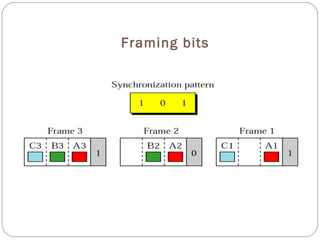
 For this reason one or more synchronization bits are usually added
  to the beginning of each frame.

 These bits are called framing bits.
Synchronization in TDM cont…
These bits follow a pattern from frame to frame, that allows
  the demultiplexer to synchronize with the incoming stream
  so that it can separate the time slots accurately.

In most cases this synchronization information consists of 1
  bit per frame, alternating between 0 and 1.
Framing bits
Example 8
We have four sources, each creating 250 characters per second.
If the interleaved unit is a character and 1 synchronizing bit is
added to each frame,
find
(1)the data rate of each source,
(2) the duration of each character in each source,
(3) the frame rate,
(4) the duration of each frame,
(5) the number of bits in each frame, and
(6) the data rate of the link.
Solution
We can answer the questions as follows:

1. The data rate of each source is 250x8=2000 bps = 2Kbps.
2. The duration of a character is 1/250 s, or 4 ms.
3. The link needs to send 250 frames per second.
4. The duration of each frame is 1/250 s, or 4 ms.
5. Each frame is 4 x 8 + 1 = 33 bits.
6. The data rate of the link is 250 x 33, or 8250 bps.
Different data rates in TDM
 It is possible to multiplex data from devices of different data rates.


 If device B is two times faster than other devices than each device
  could use one slot while device B will use two slots.

 The number of slots in each frame and the input lines to which
  they are assigned remain fixed throughout a given system but
  devices of different data rates may control different numbers of
  those slots.
What should we do for this technique
to work?
Each time slot length is fixed.


The requirement is that the different data rates must be
  integer multiples of each other.

For example we can accommodate a device five times faster
  than the others by allocating it five slots.
Bit stuffing/Padding/Pulse
stuffing
 However we cannot accommodate a device that is 5 n half times
  faster because we cannot introduce one half of a time slot to a
  frame.

 When the speeds are not integer multiples of each other, they can
  be made to behave as if they were by a technique called bit
  stuffing/bit padding/pulse stuffing.

 In bit padding,the multiplexer adds extra bits to a device’s source
  stream to force the speed relationships among the various devices
  in to integer multiples of each other.
Limitations of synchronous TDM /interleaving
 Synchronous TDM does not guarantee that the capacity of
   the link is fully used.

 It is more likely that only a portion of the time slots is in use
   at a given instant.

 Because the time slots are preassigned and fixed whenever
   the connected device is not transmitting, the corresponding
   slot is empty and that much of the path is wasted.
Asynchronous TDM/ Statistical TDM
 Asynchronous TDM/ Statistical TDM is designed to avoid the
  waste in synchronous TDM.
 The term asynchronous means flexible not fixed here.
 In asynchronous system if we have n input lines,the frame contains
  a fixed number of atleast n time slots.
 In asynchronous system,if we have n lines, the frame contains no
  more than m slots with m less than n.
 In this way asynchronous TDM supports the same number of lines
  as synchronous with a lower capicity link.
 Or given the same link asynchronous TDM can support more
  devices than synchronous TDM.
Asynchronous TDM/ Statistical TDM
The number of slots m in asynchronous TDM frame is based
 on a statistical analysis of the number of input lines that are
 likely to be transmitting at any given time.
Rather than being preassigned each slot is available to any of
 the attached input devices that has data to send.
The multiplexer scans the input lines accepts portions of data
 until a frame is filled.
Then it sends the frame across the link.
Asynchronous TDM/ Statistical TDM
If there are not enough data to fill all the slots in a frame,the
 frame is only partially filled.
Thus full link capacity may not be used 100 percent of the
 time.
But the ability to allocate time slots dynamically,coupled
 with lower ratio of time slots to input lines greatly reduces
 the likely hood and degree of waste.
Synchronous and asynchronous TDM
Digital Signal(DS) Service
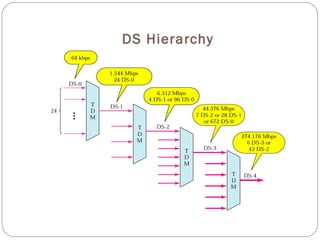
Telephone companies implement TDM through a hierarchy
  of digital signals called digital signal(DS) service.
DS Hierarchy
T Lines
 DS-0,DS-1 and so on are the names of services.
 To implement those services, the telephone companies use T
  lines(T1-T4).
 These are lines with capacities precisely attached to the data rates
  of the DS-1 to DS-4 services.

                            Rate
     Service     Line                   Voice Channels
                           (Mbps)
      DS-1       T-1        1.544              24

       DS-2      T-2        6.312              96

       DS-3      T-3        44.736             672
      DS-4       T-4       274.176            4032
Thanks!!!

Lecture 15

  • 1.
    Data Communications &Networking Lecture-14 Course Instructor : Sehrish Rafiq Department Of Computer Science University Of Peshawar
  • 2.
    Lecture overview Types ofTDM Synchronous TDM/Interleaving Asynchronous TDM/Statistical TDM Bit stuffing or Padding
  • 3.
    Synchronous TDM/Interleaving  TDMcan be visualized as two fast rotating switches, one on the multiplexing side and the other on the demultiplexing side.  The switches are synchronized and rotate at the same speed.  On the multiplexing side, as the switch opens in front of a connection, that connection has the opportunity to send a unit on to the path .  This process is called interleaving.  On the demultiplexing side, as the switch opens in front of a connection that connection has the opportunity to receive a unit from the path.
  • 4.
  • 5.
    Synchronization in TDM The implementation of TDM is not as easy as that of FDM.  If the multiplexer and the demultiplexer are out of synchronization, a bit belonging to one channel may be received by the wrong channel.  For this reason one or more synchronization bits are usually added to the beginning of each frame.  These bits are called framing bits.
  • 6.
    Synchronization in TDMcont… These bits follow a pattern from frame to frame, that allows the demultiplexer to synchronize with the incoming stream so that it can separate the time slots accurately. In most cases this synchronization information consists of 1 bit per frame, alternating between 0 and 1.
  • 7.
  • 8.
    Example 8 We havefour sources, each creating 250 characters per second. If the interleaved unit is a character and 1 synchronizing bit is added to each frame, find (1)the data rate of each source, (2) the duration of each character in each source, (3) the frame rate, (4) the duration of each frame, (5) the number of bits in each frame, and (6) the data rate of the link.
  • 9.
    Solution We can answerthe questions as follows: 1. The data rate of each source is 250x8=2000 bps = 2Kbps. 2. The duration of a character is 1/250 s, or 4 ms. 3. The link needs to send 250 frames per second. 4. The duration of each frame is 1/250 s, or 4 ms. 5. Each frame is 4 x 8 + 1 = 33 bits. 6. The data rate of the link is 250 x 33, or 8250 bps.
  • 10.
    Different data ratesin TDM  It is possible to multiplex data from devices of different data rates.  If device B is two times faster than other devices than each device could use one slot while device B will use two slots.  The number of slots in each frame and the input lines to which they are assigned remain fixed throughout a given system but devices of different data rates may control different numbers of those slots.
  • 11.
    What should wedo for this technique to work? Each time slot length is fixed. The requirement is that the different data rates must be integer multiples of each other. For example we can accommodate a device five times faster than the others by allocating it five slots.
  • 12.
    Bit stuffing/Padding/Pulse stuffing  Howeverwe cannot accommodate a device that is 5 n half times faster because we cannot introduce one half of a time slot to a frame.  When the speeds are not integer multiples of each other, they can be made to behave as if they were by a technique called bit stuffing/bit padding/pulse stuffing.  In bit padding,the multiplexer adds extra bits to a device’s source stream to force the speed relationships among the various devices in to integer multiples of each other.
  • 13.
    Limitations of synchronousTDM /interleaving Synchronous TDM does not guarantee that the capacity of the link is fully used. It is more likely that only a portion of the time slots is in use at a given instant. Because the time slots are preassigned and fixed whenever the connected device is not transmitting, the corresponding slot is empty and that much of the path is wasted.
  • 14.
    Asynchronous TDM/ StatisticalTDM  Asynchronous TDM/ Statistical TDM is designed to avoid the waste in synchronous TDM.  The term asynchronous means flexible not fixed here.  In asynchronous system if we have n input lines,the frame contains a fixed number of atleast n time slots.  In asynchronous system,if we have n lines, the frame contains no more than m slots with m less than n.  In this way asynchronous TDM supports the same number of lines as synchronous with a lower capicity link.  Or given the same link asynchronous TDM can support more devices than synchronous TDM.
  • 15.
    Asynchronous TDM/ StatisticalTDM The number of slots m in asynchronous TDM frame is based on a statistical analysis of the number of input lines that are likely to be transmitting at any given time. Rather than being preassigned each slot is available to any of the attached input devices that has data to send. The multiplexer scans the input lines accepts portions of data until a frame is filled. Then it sends the frame across the link.
  • 16.
    Asynchronous TDM/ StatisticalTDM If there are not enough data to fill all the slots in a frame,the frame is only partially filled. Thus full link capacity may not be used 100 percent of the time. But the ability to allocate time slots dynamically,coupled with lower ratio of time slots to input lines greatly reduces the likely hood and degree of waste.
  • 17.
  • 18.
    Digital Signal(DS) Service Telephonecompanies implement TDM through a hierarchy of digital signals called digital signal(DS) service.
  • 19.
  • 20.
    T Lines  DS-0,DS-1and so on are the names of services.  To implement those services, the telephone companies use T lines(T1-T4).  These are lines with capacities precisely attached to the data rates of the DS-1 to DS-4 services. Rate Service Line Voice Channels (Mbps) DS-1 T-1 1.544 24 DS-2 T-2 6.312 96 DS-3 T-3 44.736 672 DS-4 T-4 274.176 4032
  • 22.