
DATA COMMUNICATIONS &
NETWORKING
LECTURE-
14
Course Instructor : Sehrish Rafiq
Department Of Computer Science
University Of Peshawar
LECTURE OVERVIEW
 Communication Between Devices
 Switching
 Circuit switching
 Space Division Switching
 Cross-Bar switch
 Multistage Switch
COMMUNICATION BETWEEN
DEVICES
 Whenever we have multiple devices we have the
problem of how to connect them to make one to
one communication possible.
 One solution is to install a point-to-point
connection between each pair of devices(a mesh
topology) .
OR
 A point-to-point connection between a central
device and every other device in a star topology.
LIMITATIONS OF THE
PREVIOUS SOLUTION
 These methods however, are impractical and
waste ful when applied to very large networks.
 The number and length of the links require too
much infrastructure to be cost efficient and the
majority of those links would be idle most of the
time.
 Other topologies employing multipoint
connections such as bus are ruled out because the
distances between devices and total number of
devices increase beyond the capacities of the
media and equipment.
WHAT SHOULD BE THE
SOLUTION???
 A better solution is switching.
 A switched network consists of a series of
interlinked nodes , called switches.
 Switches are hardware and/or software devices
capable of creating temporary connections
between two or more devices linked to the switch
but not to each other.
 In a switched network, some of those nodes are
connected to the communicating devices.
 Others are used only for routing.
TYPES OF SWITCHING
 Circuit switching
 Packet switching
 Message switching
CIRCUIT SWITCHING
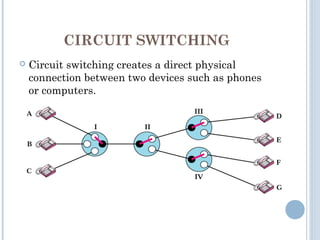
 Circuit switching creates a direct physical
connection between two devices such as phones
or computers.
CIRCUIT SWITCH
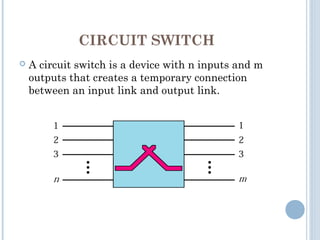
 A circuit switch is a device with n inputs and m
outputs that creates a temporary connection
between an input link and output link.
FOLDED SWITCH
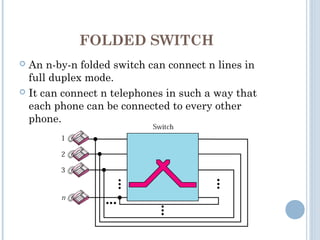
 An n-by-n folded switch can connect n lines in
full duplex mode.
 It can connect n telephones in such a way that
each phone can be connected to every other
phone.
CIRCUIT SWITCHING
TECHNOLOGIES
 Circuit switching can use either of two
technologies.
 Space division switch
 Time division switch
SPACE DIVISION SWITCHING
 In space division switching, the paths in the
circuit are separated from each other spatially.
 This technology was originally designed for use
in analog networks but is used currently in both
analog and digital networks.
CROSS-BAR SWITCH
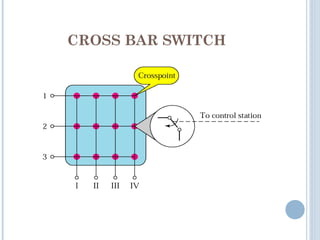
 A crossbar switch connects n-inputs to m-
outputs in a special grid, using electronic micro
switches(transistors) at each cross point.
 The major limitations of this design is the
number of cross points required.
 Connecting n inputs to m outputs using a cross-
bar switch requires n x m cross points.
CROSS BAR SWITCH
LIMITATIONS OF CROSS BAR
SWITCH
 A cross bar switch with a very large number of
cross points is impractical.
 Such a switch is also inefficient because
statistics show that in practice fewer than 25% of
the cross points are in use at any given time.
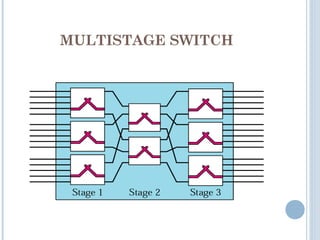
MULTISTAGE SWITCH
 The solutions to the limitations of the cross bar
switch is the multistage switch which combines
cross bar switches in several stages.
 In multistage switching, devices are linked to
switches that in turn are linked to other
switches.
 The design of a multistage switch depends on the
number of stages and the number of switches
required or (desired) at each stage.
 Normally the middle stages have fewer switches
than do the first and last stages.
MULTISTAGE SWITCH
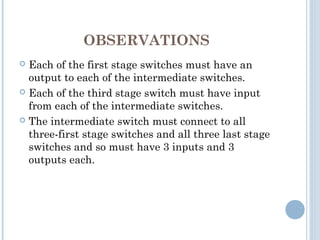
OBSERVATIONS
 Each of the first stage switches must have an
output to each of the intermediate switches.
 Each of the third stage switch must have input
from each of the intermediate switches.
 The intermediate switch must connect to all
three-first stage switches and all three last stage
switches and so must have 3 inputs and 3
outputs each.
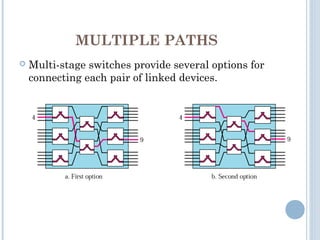
MULTIPLE PATHS
 Multi-stage switches provide several options for
connecting each pair of linked devices.
HAVE NICE TIME AT
HOME!!!

Data Communications and Networking Lecture 16

  • 1.
    DATA COMMUNICATIONS & NETWORKING LECTURE- 14 CourseInstructor : Sehrish Rafiq Department Of Computer Science University Of Peshawar
  • 2.
    LECTURE OVERVIEW  CommunicationBetween Devices  Switching  Circuit switching  Space Division Switching  Cross-Bar switch  Multistage Switch
  • 3.
    COMMUNICATION BETWEEN DEVICES  Wheneverwe have multiple devices we have the problem of how to connect them to make one to one communication possible.  One solution is to install a point-to-point connection between each pair of devices(a mesh topology) . OR  A point-to-point connection between a central device and every other device in a star topology.
  • 4.
    LIMITATIONS OF THE PREVIOUSSOLUTION  These methods however, are impractical and waste ful when applied to very large networks.  The number and length of the links require too much infrastructure to be cost efficient and the majority of those links would be idle most of the time.  Other topologies employing multipoint connections such as bus are ruled out because the distances between devices and total number of devices increase beyond the capacities of the media and equipment.
  • 5.
    WHAT SHOULD BETHE SOLUTION???  A better solution is switching.  A switched network consists of a series of interlinked nodes , called switches.  Switches are hardware and/or software devices capable of creating temporary connections between two or more devices linked to the switch but not to each other.  In a switched network, some of those nodes are connected to the communicating devices.  Others are used only for routing.
  • 6.
    TYPES OF SWITCHING Circuit switching  Packet switching  Message switching
  • 7.
    CIRCUIT SWITCHING  Circuitswitching creates a direct physical connection between two devices such as phones or computers.
  • 8.
    CIRCUIT SWITCH  Acircuit switch is a device with n inputs and m outputs that creates a temporary connection between an input link and output link.
  • 9.
    FOLDED SWITCH  Ann-by-n folded switch can connect n lines in full duplex mode.  It can connect n telephones in such a way that each phone can be connected to every other phone.
  • 10.
    CIRCUIT SWITCHING TECHNOLOGIES  Circuitswitching can use either of two technologies.  Space division switch  Time division switch
  • 11.
    SPACE DIVISION SWITCHING In space division switching, the paths in the circuit are separated from each other spatially.  This technology was originally designed for use in analog networks but is used currently in both analog and digital networks.
  • 12.
    CROSS-BAR SWITCH  Acrossbar switch connects n-inputs to m- outputs in a special grid, using electronic micro switches(transistors) at each cross point.  The major limitations of this design is the number of cross points required.  Connecting n inputs to m outputs using a cross- bar switch requires n x m cross points.
  • 13.
  • 14.
    LIMITATIONS OF CROSSBAR SWITCH  A cross bar switch with a very large number of cross points is impractical.  Such a switch is also inefficient because statistics show that in practice fewer than 25% of the cross points are in use at any given time.
  • 15.
    MULTISTAGE SWITCH  Thesolutions to the limitations of the cross bar switch is the multistage switch which combines cross bar switches in several stages.  In multistage switching, devices are linked to switches that in turn are linked to other switches.  The design of a multistage switch depends on the number of stages and the number of switches required or (desired) at each stage.  Normally the middle stages have fewer switches than do the first and last stages.
  • 16.
  • 17.
    OBSERVATIONS  Each ofthe first stage switches must have an output to each of the intermediate switches.  Each of the third stage switch must have input from each of the intermediate switches.  The intermediate switch must connect to all three-first stage switches and all three last stage switches and so must have 3 inputs and 3 outputs each.
  • 18.
    MULTIPLE PATHS  Multi-stageswitches provide several options for connecting each pair of linked devices.
  • 19.
    HAVE NICE TIMEAT HOME!!!