DIGITAL
COMMUNICATIONS
K.NAGAHANUMACHARI
ASST.PROFESSOR
RISE KRISHNA SAI GANDHI GROUP OF
INSTITUTIONS
DELTA MODULATION
• In PCM the signaling rate and transmission
channel bandwidth are quite large since it
transmits all the bits which are used to code a
sample. To overcome this problem, Delta
modulation is used.
Working Principle
• Delta modulation transmits only one bit per
sample. Here, the present sample value is
compared with the previous sample value and
this result whether the amplitude is increased or
decreased is transmitted.
• First,input signal x(t) is approximated to step signal
by the delta modulator. This step size is kept fixed.
• Now the delta modulator finds out the difference
between the input signal x(t) and staircase
approximated signal.If the difference is positive,
then approximated signal is increased by one step,
i.e., ‘Δ’. If the difference is negative, then
approximated signal is reduced by ‘Δ’ .
• When the step is reduced, ‘0’ is transmitted and if
the step is increased, ‘1’ is transmitted.
• Hence, for each sample, only one binary bit is
transmitted.
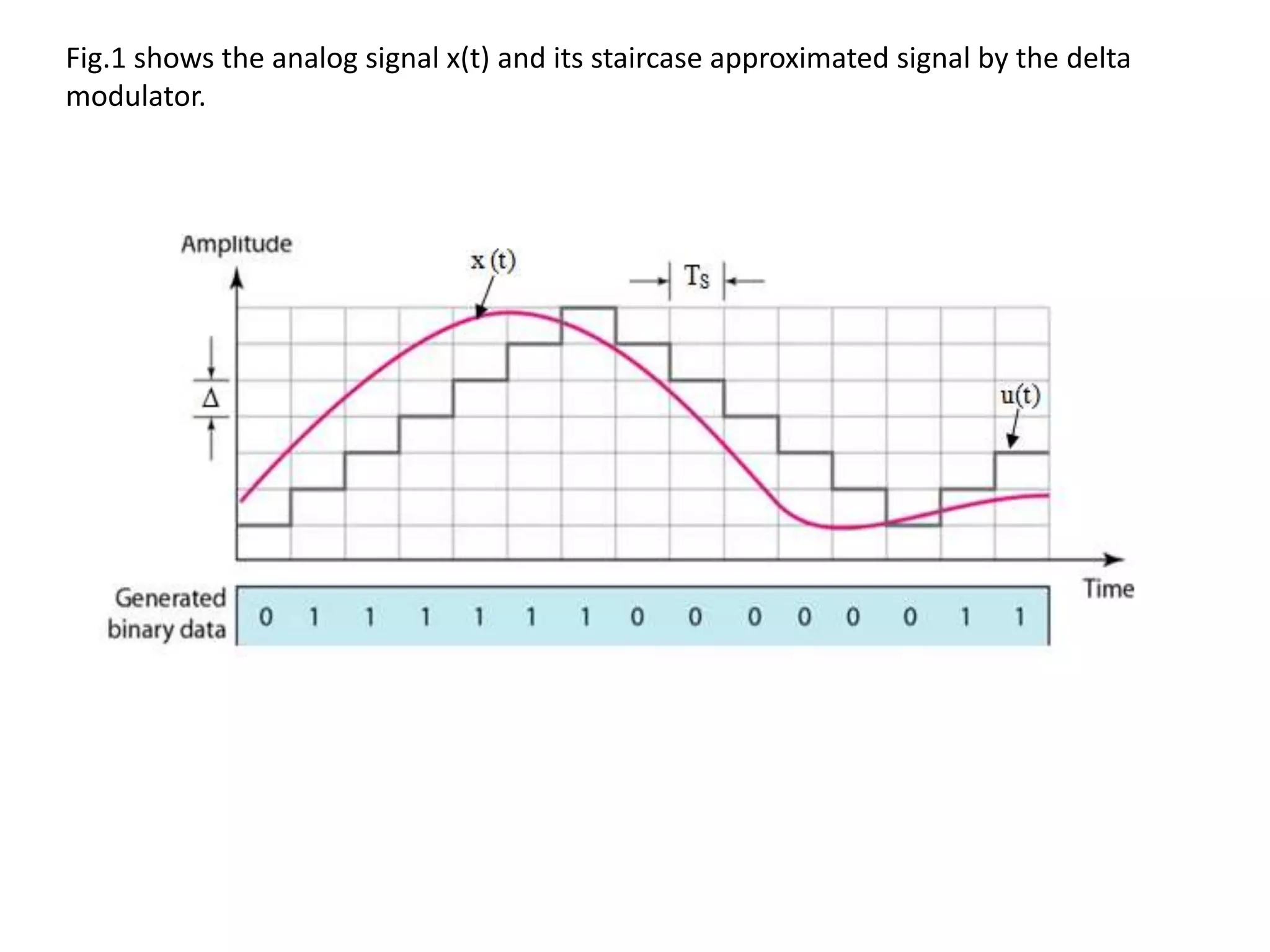
Fig.1 shows the analog signal x(t) and its staircase approximated signal by the delta
modulator.
• Mathematical Expressions
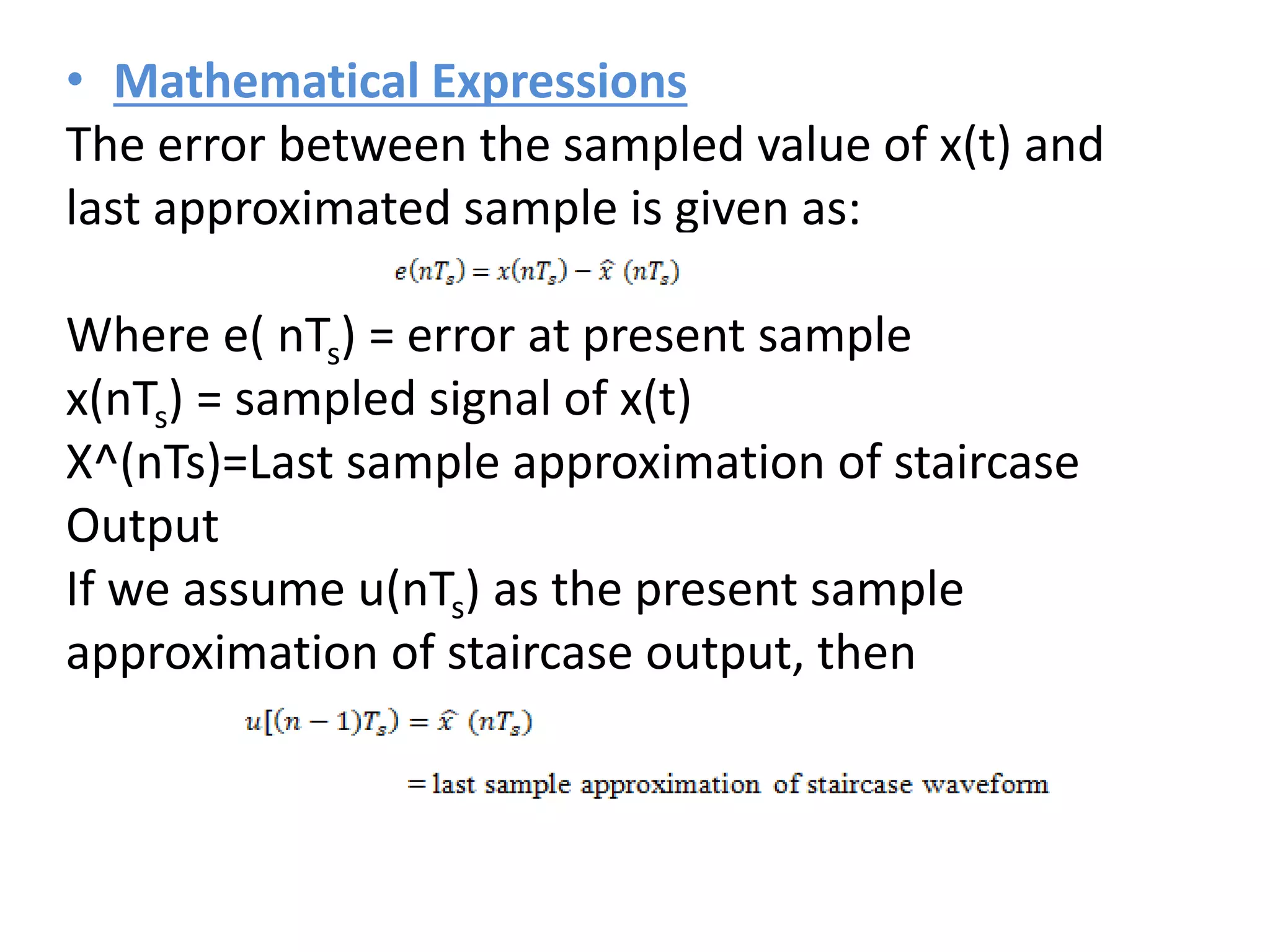
The error between the sampled value of x(t) and
last approximated sample is given as:
Where e( nTs) = error at present sample
x(nTs) = sampled signal of x(t)
X^(nTs)=Last sample approximation of staircase
Output
If we assume u(nTs) as the present sample
approximation of staircase output, then
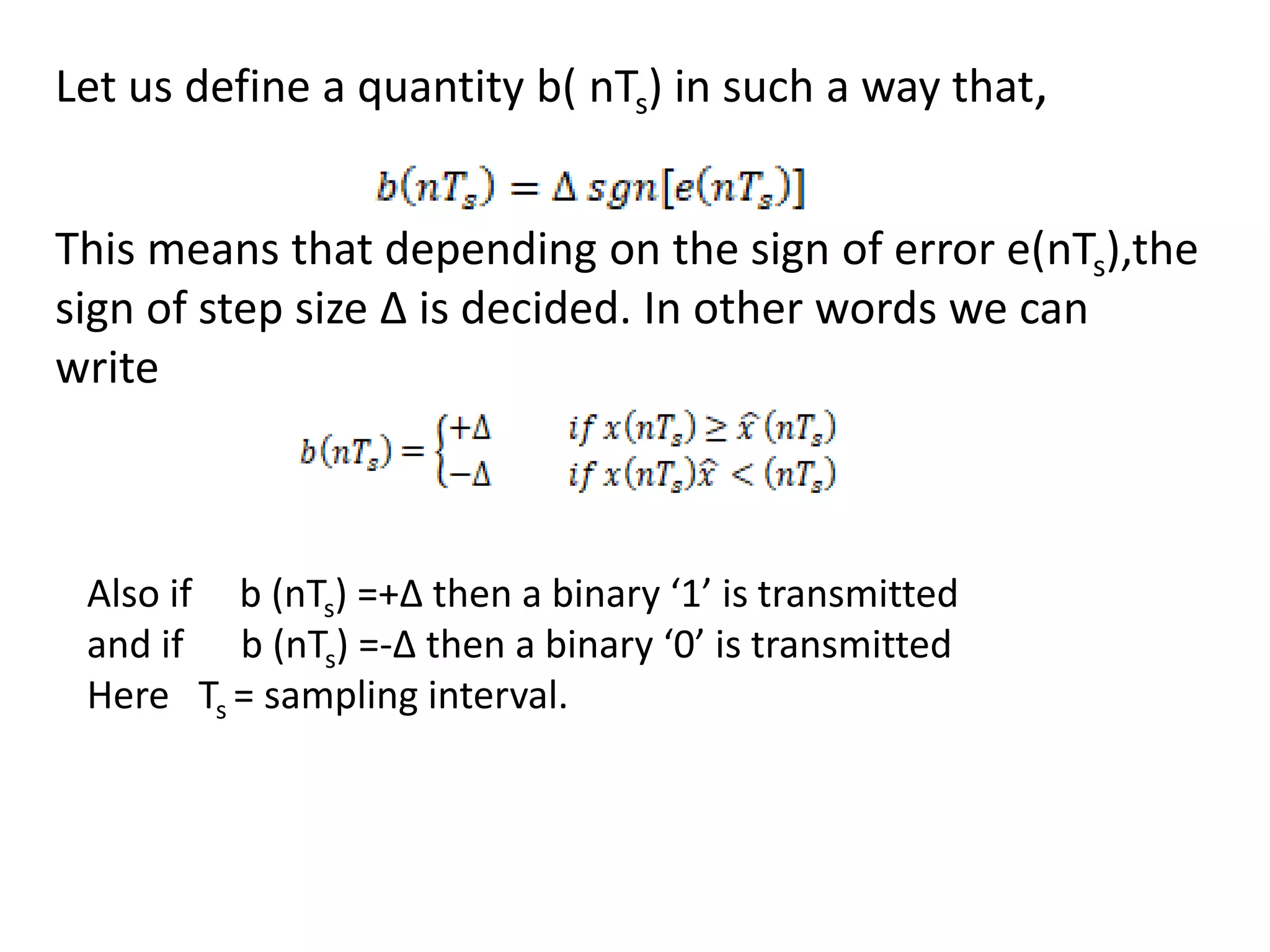
Let us define a quantity b( nTs) in such a way that,
This means that depending on the sign of error e(nTs),the
sign of step size Δ is decided. In other words we can
write
Also if b (nTs) =+Δ then a binary ‘1’ is transmitted
and if b (nTs) =-Δ then a binary ‘0’ is transmitted
Here Ts = sampling interval.
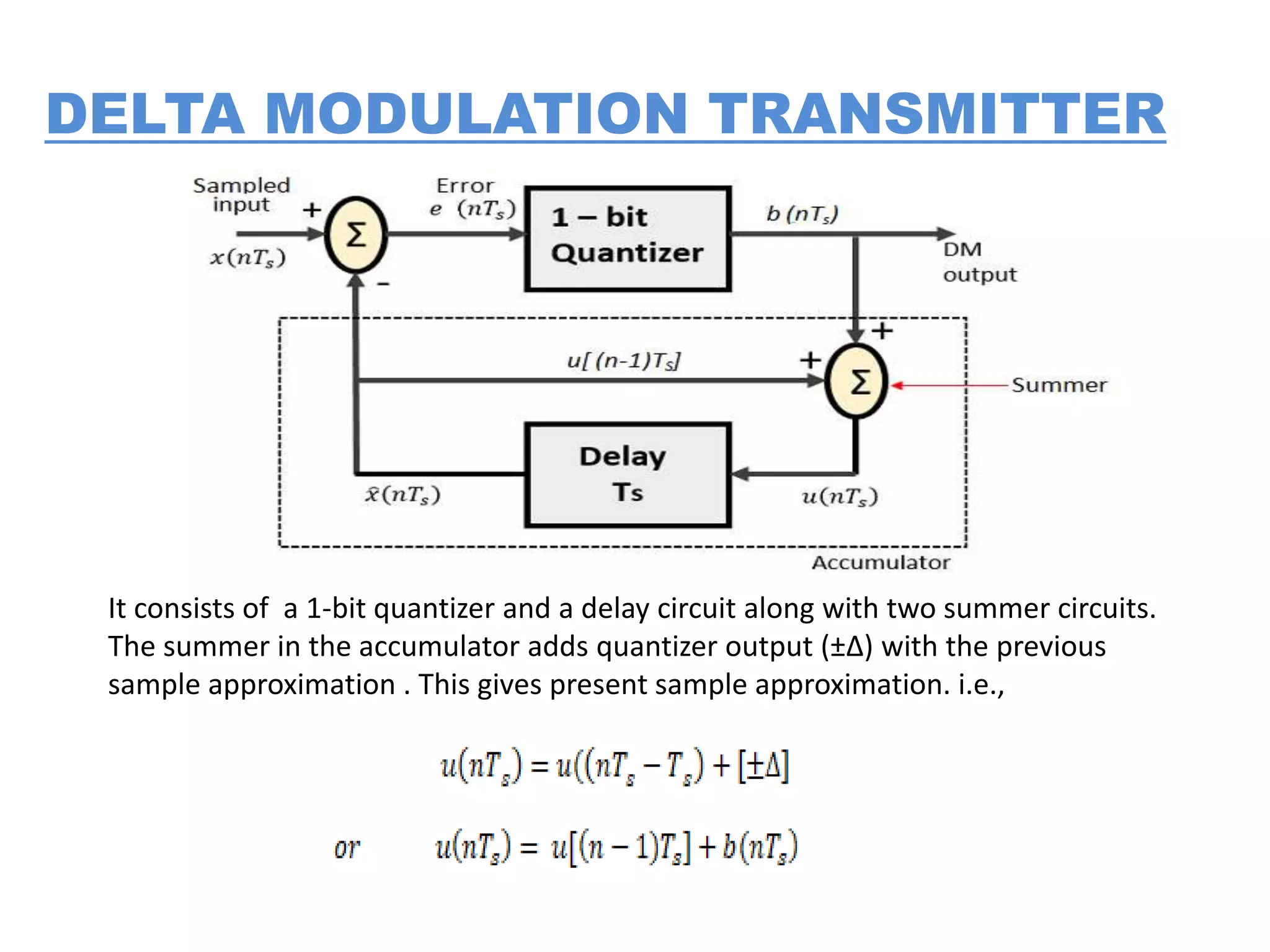
DELTA MODULATION TRANSMITTER
It consists of a 1-bit quantizer and a delay circuit along with two summer circuits.
The summer in the accumulator adds quantizer output (±Δ) with the previous
sample approximation . This gives present sample approximation. i.e.,
• The previous sample approximation u[(n-1)Ts ]
is restored by delaying one sample period Ts .
• The samples input signal x(nTs ) and staircase
approximated signal xˆ(nTs ) are subtracted to
get error signal e(nTs ).
• Thus, depending on the sign of e(nTs ), one bit
quantizer generates an output of +Δ or -Δ .
• If the step size is +Δ, then binary ‘1’ is
transmitted and if it is -Δ, then binary ‘0’ is
transmitted
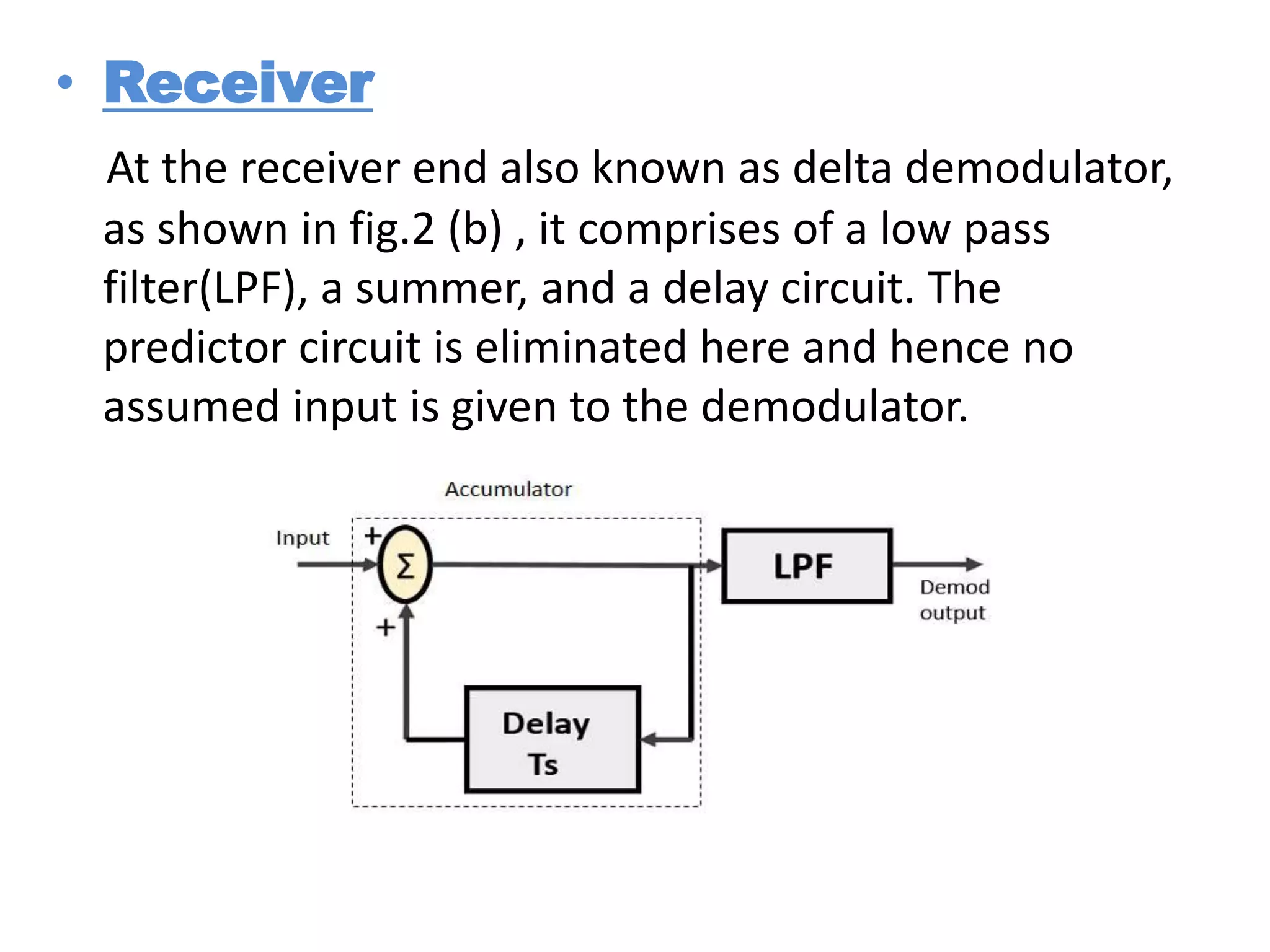
• Receiver
At the receiver end also known as delta demodulator,
as shown in fig.2 (b) , it comprises of a low pass
filter(LPF), a summer, and a delay circuit. The
predictor circuit is eliminated here and hence no
assumed input is given to the demodulator.
• The accumulator generates the staircase
approximated signal output and is delayed by
one sampling period Ts.
• It is then added to the input signal.
• If the input is binary ‘1’ then it adds +Δ step to
the previous output (which is delayed).
• If the input is binary ‘0’ then one step ‘Δ’ is
subtracted from the delayed signal.
• Also, the low pass filter smoothens the
staircase signal to reconstruct the original
message signal x(t) .

Delta modulation

  • 1.
  • 2.
    DELTA MODULATION • InPCM the signaling rate and transmission channel bandwidth are quite large since it transmits all the bits which are used to code a sample. To overcome this problem, Delta modulation is used. Working Principle • Delta modulation transmits only one bit per sample. Here, the present sample value is compared with the previous sample value and this result whether the amplitude is increased or decreased is transmitted.
  • 3.
    • First,input signalx(t) is approximated to step signal by the delta modulator. This step size is kept fixed. • Now the delta modulator finds out the difference between the input signal x(t) and staircase approximated signal.If the difference is positive, then approximated signal is increased by one step, i.e., ‘Δ’. If the difference is negative, then approximated signal is reduced by ‘Δ’ . • When the step is reduced, ‘0’ is transmitted and if the step is increased, ‘1’ is transmitted. • Hence, for each sample, only one binary bit is transmitted.
  • 4.
    Fig.1 shows theanalog signal x(t) and its staircase approximated signal by the delta modulator.
  • 5.
    • Mathematical Expressions Theerror between the sampled value of x(t) and last approximated sample is given as: Where e( nTs) = error at present sample x(nTs) = sampled signal of x(t) X^(nTs)=Last sample approximation of staircase Output If we assume u(nTs) as the present sample approximation of staircase output, then
  • 6.
    Let us definea quantity b( nTs) in such a way that, This means that depending on the sign of error e(nTs),the sign of step size Δ is decided. In other words we can write Also if b (nTs) =+Δ then a binary ‘1’ is transmitted and if b (nTs) =-Δ then a binary ‘0’ is transmitted Here Ts = sampling interval.
  • 7.
    DELTA MODULATION TRANSMITTER Itconsists of a 1-bit quantizer and a delay circuit along with two summer circuits. The summer in the accumulator adds quantizer output (±Δ) with the previous sample approximation . This gives present sample approximation. i.e.,
  • 8.
    • The previoussample approximation u[(n-1)Ts ] is restored by delaying one sample period Ts . • The samples input signal x(nTs ) and staircase approximated signal xˆ(nTs ) are subtracted to get error signal e(nTs ). • Thus, depending on the sign of e(nTs ), one bit quantizer generates an output of +Δ or -Δ . • If the step size is +Δ, then binary ‘1’ is transmitted and if it is -Δ, then binary ‘0’ is transmitted
  • 9.
    • Receiver At thereceiver end also known as delta demodulator, as shown in fig.2 (b) , it comprises of a low pass filter(LPF), a summer, and a delay circuit. The predictor circuit is eliminated here and hence no assumed input is given to the demodulator.
  • 10.
    • The accumulatorgenerates the staircase approximated signal output and is delayed by one sampling period Ts. • It is then added to the input signal. • If the input is binary ‘1’ then it adds +Δ step to the previous output (which is delayed). • If the input is binary ‘0’ then one step ‘Δ’ is subtracted from the delayed signal. • Also, the low pass filter smoothens the staircase signal to reconstruct the original message signal x(t) .