DATA COMMUNICATIONS &
NETWORKING
LECTURE-
18
Course Instructor : Sehrish Rafiq
Department Of Computer Science
University Of Peshawar
TELEPHONE
NETWORKS
TELEPHONE NETWORKS
 Telephone networks use circuit switching.
 The telephone network had its beginning in the
late 1800s.
 The entire network which is referred to as the
plain old telephone system (POTS),was originally
an analog system using analog signals to
transmit voice.
 With the advent of the computer era, the network
in the 1980’s began to carry data in addition to
voice
 The network is now digital as well as analog.
MAJOR COMPONENTS OF A
TELEPHONE NETWORK
 Local loops
 Trunks
 Switching offices
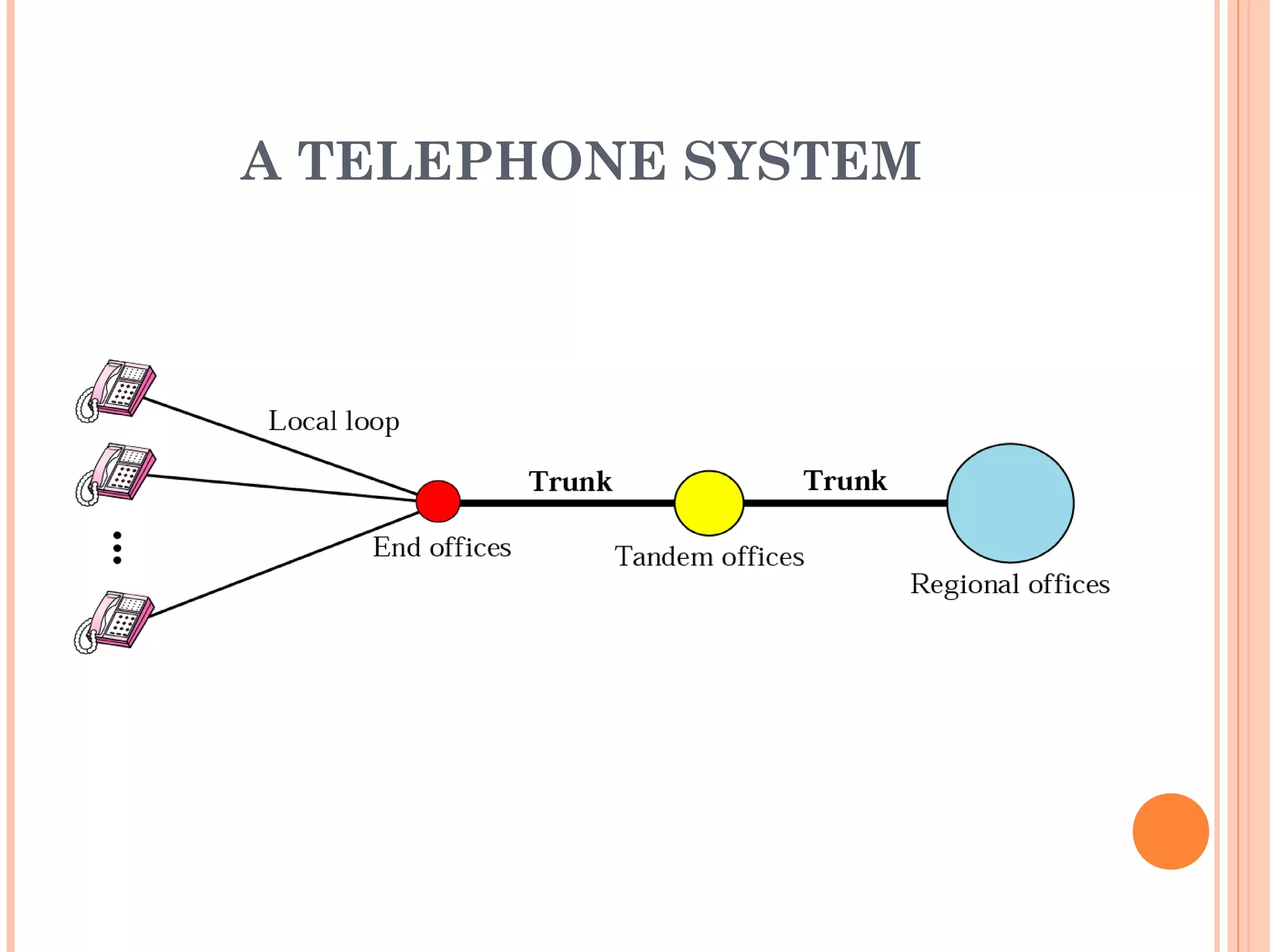
Note: The telephone network has several levels of
switching offices such as end offices,tandem
offices and regional offices.
LOCAL LOOP
 A local loop is a twisted pair cable that connects
the subscriber telephone to the nearest endoffice
or local central office.
 The local loop when used for voice has a
bandwidth of 4000Hz(4 KHz).
TRUNKS
 Trunks are transmission media that handle the
communication between offices.
 A trunk normally handles hundreds or thousands
of connections through multiplexing.
 Transmission is usually through optical fibers or
satellite links.
SWITCHING OFFICE
 To avoid having a permanent physical link
between any two subscribers, the telephone
company has switches located in a switching
office.
 A switch connects several local loops or trunks
and allows a connection between different
subscribers.
A TELEPHONE SYSTEM
LATAS
 In 1984, the United States of America was
divided in to more than 200 Local Access
Transport Areas(LATAs).
 AREA OF LATA
 A LATA can be a small or large metropolitan area.
 A small state may have one single LATA.
 A large state may have several LATAs.
 A LATA boundary may overlap the boundary of a state.
 A part of a LATA can be in one state, part in another state.
INTRA LATA SERVICES
 The services offered by telephone companies
inside a LATA is called intra-LATA services.
 The carrier that handles these services is called a
Local Exchange Carrier(LEC).
 Before the Telecommunication act of 1996,intra
lata services were granted to one single carrier.
 After 1996 more than one carrier could provide
services inside a LATA.
 The carrier that provided services before 1996
owns the cabling system (Local loops) and is
called the Incumbent Local Exchange
Carrier(ILEC).
INTRA LATA SERVICES
 The new carriers that can provide services are
called Compeitive local exchange
carriers(CLECs).
 To avoid the cost of new cabling It was agreed
that ILEC’s would continue to provide the main
services,and the CLEC would provide other
services such as mobile telephone service,toll
calls inside a LATA and so on.
SWITCHING OFFICES IN A LATA
INTRA LATA SERVICES
 Communication inside a LATA is handled by end
switches and tandem switches.
 A call that can be completed using only end-
offices is considered toll free and that has to go
through a tandem office (intra-LATA toll office) is
charged.
INTER-LATA SERVICES
 The services between LATAs are handled by
interexchange carriers(IXCs).
 These carriers are sometimes called long-
distance companies.
 These carriers provide communication services
between two companies in different LATA’s.
 Carriers providing inter-LATA services include
AT&T, MCI, WorldCom, Sprint and Verizon.
 A telephone call going through an IXC is
normally digitized .
POINTS OF PRESENCE(POPS)
 Intra-LATA services can be provided by several
LECs.
 Inter-LATA Services can be provided by several
IXCs.
 How do these carriers interact with one
another???
 Answer: POP(Points Of Presence) switching
office.
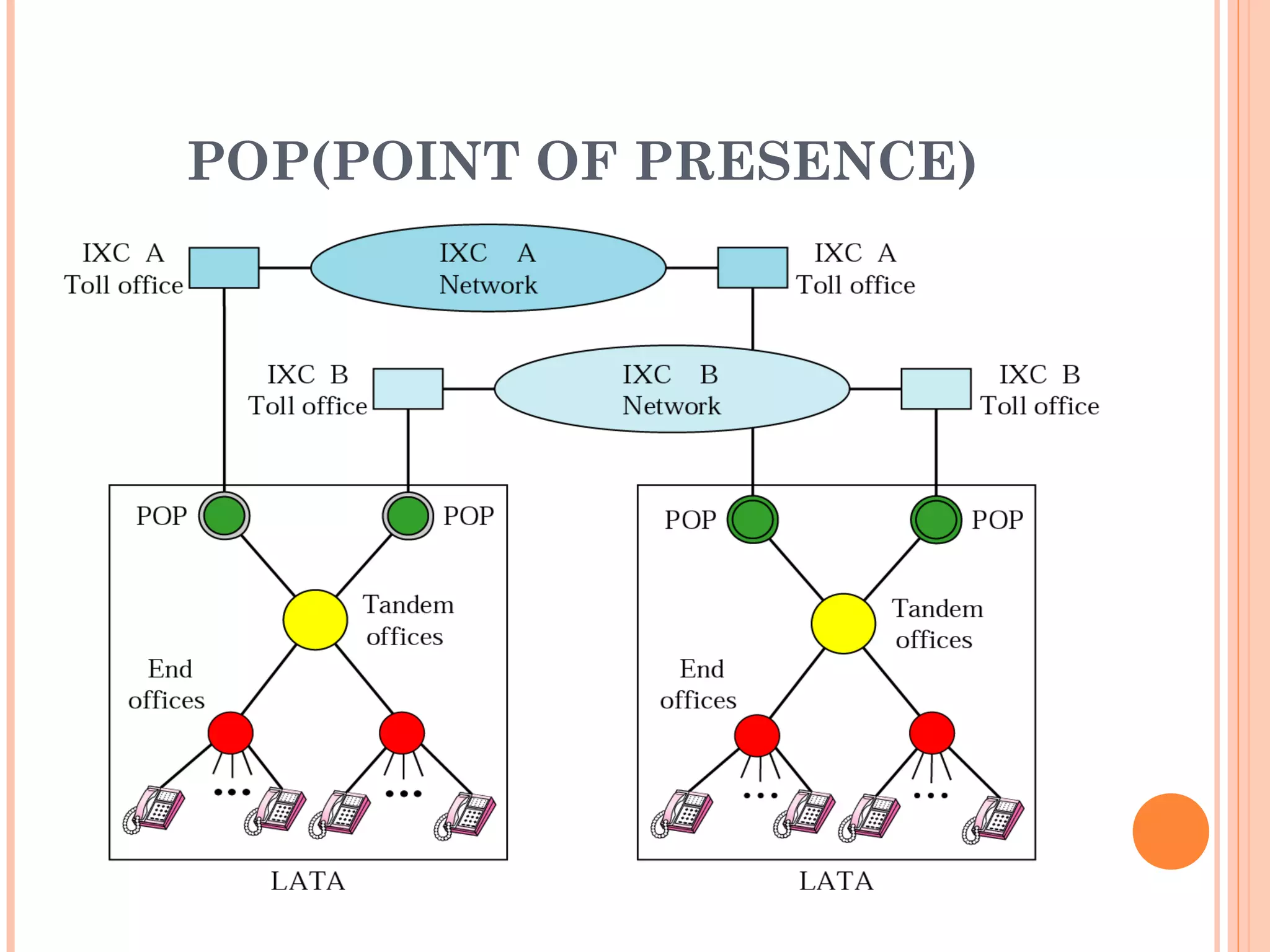
 Each IXC that wants to provide inter-LATA
services in a LATA must have a POP in that
LATA.
 The LEC’s that provide services inside the LATA
must provide connections so that every
POP(POINT OF PRESENCE)
MAKING A CONNECTION
 Subscriber telephones are connected through
local loops to end offices .
 Accessing the switching station is accomplished
through dialing.
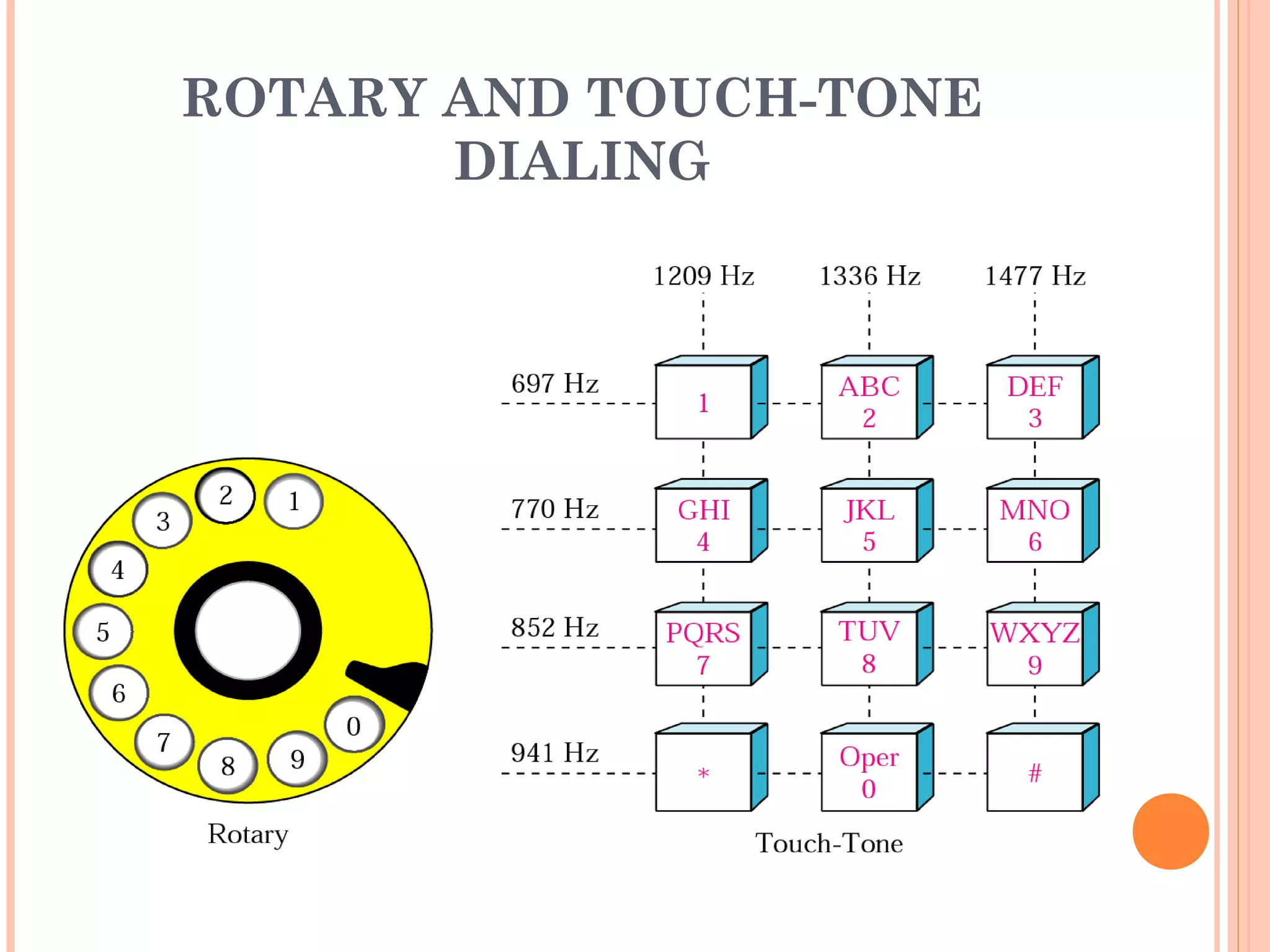
ROTARY DIALING
 In the past telephones featured rotary or pulse
dialing, in which a digital signal was sent to the
end office for each number dialed.
TOUCH-TONE TECHNIQUE
 Today Dialing is accomplished through touch-
tone technique.
 In this method instead of sending a digital
signal ,the user sends two small bursts of analog
signals called dual tone.
 The frequency of the signals sent depends on the
row and column of the pressed pad.
ROTARY AND TOUCH-TONE
DIALING
THANKS!!!

Lecture 18

  • 1.
    DATA COMMUNICATIONS & NETWORKING LECTURE- 18 CourseInstructor : Sehrish Rafiq Department Of Computer Science University Of Peshawar
  • 2.
  • 3.
    TELEPHONE NETWORKS  Telephonenetworks use circuit switching.  The telephone network had its beginning in the late 1800s.  The entire network which is referred to as the plain old telephone system (POTS),was originally an analog system using analog signals to transmit voice.  With the advent of the computer era, the network in the 1980’s began to carry data in addition to voice  The network is now digital as well as analog.
  • 4.
    MAJOR COMPONENTS OFA TELEPHONE NETWORK  Local loops  Trunks  Switching offices Note: The telephone network has several levels of switching offices such as end offices,tandem offices and regional offices.
  • 5.
    LOCAL LOOP  Alocal loop is a twisted pair cable that connects the subscriber telephone to the nearest endoffice or local central office.  The local loop when used for voice has a bandwidth of 4000Hz(4 KHz).
  • 6.
    TRUNKS  Trunks aretransmission media that handle the communication between offices.  A trunk normally handles hundreds or thousands of connections through multiplexing.  Transmission is usually through optical fibers or satellite links.
  • 7.
    SWITCHING OFFICE  Toavoid having a permanent physical link between any two subscribers, the telephone company has switches located in a switching office.  A switch connects several local loops or trunks and allows a connection between different subscribers.
  • 8.
  • 9.
    LATAS  In 1984,the United States of America was divided in to more than 200 Local Access Transport Areas(LATAs).  AREA OF LATA  A LATA can be a small or large metropolitan area.  A small state may have one single LATA.  A large state may have several LATAs.  A LATA boundary may overlap the boundary of a state.  A part of a LATA can be in one state, part in another state.
  • 10.
    INTRA LATA SERVICES The services offered by telephone companies inside a LATA is called intra-LATA services.  The carrier that handles these services is called a Local Exchange Carrier(LEC).  Before the Telecommunication act of 1996,intra lata services were granted to one single carrier.  After 1996 more than one carrier could provide services inside a LATA.  The carrier that provided services before 1996 owns the cabling system (Local loops) and is called the Incumbent Local Exchange Carrier(ILEC).
  • 11.
    INTRA LATA SERVICES The new carriers that can provide services are called Compeitive local exchange carriers(CLECs).  To avoid the cost of new cabling It was agreed that ILEC’s would continue to provide the main services,and the CLEC would provide other services such as mobile telephone service,toll calls inside a LATA and so on.
  • 12.
  • 13.
    INTRA LATA SERVICES Communication inside a LATA is handled by end switches and tandem switches.  A call that can be completed using only end- offices is considered toll free and that has to go through a tandem office (intra-LATA toll office) is charged.
  • 14.
    INTER-LATA SERVICES  Theservices between LATAs are handled by interexchange carriers(IXCs).  These carriers are sometimes called long- distance companies.  These carriers provide communication services between two companies in different LATA’s.  Carriers providing inter-LATA services include AT&T, MCI, WorldCom, Sprint and Verizon.  A telephone call going through an IXC is normally digitized .
  • 15.
    POINTS OF PRESENCE(POPS) Intra-LATA services can be provided by several LECs.  Inter-LATA Services can be provided by several IXCs.  How do these carriers interact with one another???  Answer: POP(Points Of Presence) switching office.  Each IXC that wants to provide inter-LATA services in a LATA must have a POP in that LATA.  The LEC’s that provide services inside the LATA must provide connections so that every
  • 16.
  • 17.
    MAKING A CONNECTION Subscriber telephones are connected through local loops to end offices .  Accessing the switching station is accomplished through dialing.
  • 18.
    ROTARY DIALING  Inthe past telephones featured rotary or pulse dialing, in which a digital signal was sent to the end office for each number dialed.
  • 19.
    TOUCH-TONE TECHNIQUE  TodayDialing is accomplished through touch- tone technique.  In this method instead of sending a digital signal ,the user sends two small bursts of analog signals called dual tone.  The frequency of the signals sent depends on the row and column of the pressed pad.
  • 20.
  • 21.