Presentation on
Handover
By-
Ankita Khadatkar
Pooja Jaiswal
Puja Thosar
Nikita Borikar
THE TERM HANDOVER
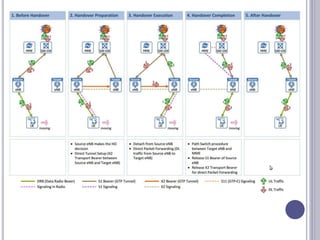
The process of transferring an ongoing call
or data session from one channel to another
in a cellular network
The core network performs handovers at
various levels of the system architecture
It is a key component in cellular network
mobility management as it requires a
specific latency on server interruption time.
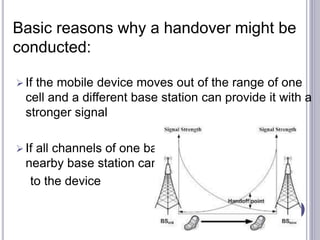
Basic reasons why a handover might be
conducted:
 If the mobile device moves out of the range of one
cell and a different base station can provide it with a
stronger signal
 If all channels of one base station are busy then a
nearby base station can provide service
to the device
Handover process
Important one in any cellular network
Must be completed efficiently and without
inconvenience to the user
Different networks use different types of handover
techniques
Two main types of handover
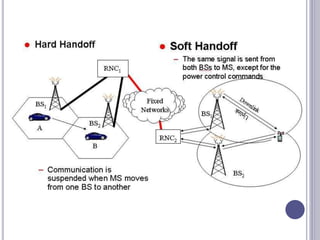
Hard handover
- GSM systems
Soft handover
- CDMA systems
Hard Handover
Existing radio link must be dropped for a small
period of time
Then taken over by another base station
A call in progress redirected not only from a base
station to another base station but also from its
current transmit–receive frequency pair to another
frequency pair
An ongoing call can not exchange data or voice
for this duration
Call drop in hard handover
Break in call transmission
Handover takes place in a few ms (at best in 60 ms)
Interruption is hardly discernible by the user
Handover to another cell is required when the signal
strength is low and error rate is high. GSM systems
perform hard handovers
Soft Handover
A soft handover is one in which the channel in the
source cell is retained and used for a while in parallel
with the channel in the target cell
 In this case the connection to the target is
established before the connection to the source is
broken, hence this handover is called make-before-
break
Soft handovers may involve using connections to
more than two cells: connections to three, four or more
cells can be maintained by one phone at the same time
 When a call is in a state of soft handover, the signal
of the best of all used channels can be used for the call
at a given moment or all the signals can be combined
to produce a clearer copy of the signal
Softer handovers are possible when the cells involved
in the handovers have a single cell site.
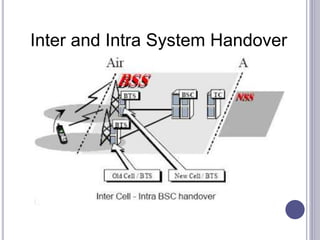
Inter and Intra System Handover
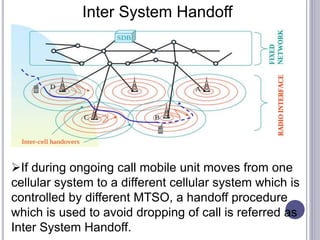
Inter System Handoff
If during ongoing call mobile unit moves from one
cellular system to a different cellular system which is
controlled by different MTSO, a handoff procedure
which is used to avoid dropping of call is referred as
Inter System Handoff.
An MTSO engages in this handoff system. When a
mobile signal becomes weak in a given cell and
MTSO can not find other cell within its system to
which it can transfer the call then it uses Inter
system handoff.
Before implementation of Inter System Handoff
MTSO compatibility must be checked
In Inter System Handoff local call may become
long distance call.
Intra System Handover
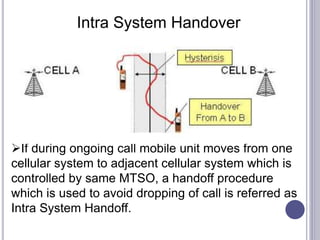
If during ongoing call mobile unit moves from one
cellular system to adjacent cellular system which is
controlled by same MTSO, a handoff procedure
which is used to avoid dropping of call is referred as
Intra System Handoff.
 An MTSO engages in this handoff system
 In Intra System Handoff local calls always remain
local call only since after handoff also the call is
handled by same MTSO
 When a mobile signal becomes weak in a given
cell and MTSO finds other cell within its system to
which it can transfer the call then it uses Intra system
handoff.
Advantages
Overcome fading through micro diversity
Reduce Node Power which in turn decreases
interference and increases capacity
Increases battery life
Disadvantages
Using several radio links requires more channelize
at ion codes
High handover signalling resulting in slower
handover initiation
Summary
Handover when the mobile device moves out of
the range of one cell (base station) and a different
base station can provide it with a stronger signal or
when present cell traffic high
Hard handover in GSM
Call drop for hard handover
Soft handover in CDMA
References :
Wikipedia, The Free Encyclopedia, [Online]:
http://en.wikipedia.org
MobileCompChap03L11GSMHandover
handoverinnetworks-13071790379332-phpapp01-
110604041918-phpapp01
trial_lecture on handover

Handover in Telecom

  • 1.
    Presentation on Handover By- Ankita Khadatkar PoojaJaiswal Puja Thosar Nikita Borikar
  • 2.
    THE TERM HANDOVER Theprocess of transferring an ongoing call or data session from one channel to another in a cellular network The core network performs handovers at various levels of the system architecture It is a key component in cellular network mobility management as it requires a specific latency on server interruption time.
  • 3.
    Basic reasons whya handover might be conducted:  If the mobile device moves out of the range of one cell and a different base station can provide it with a stronger signal  If all channels of one base station are busy then a nearby base station can provide service to the device
  • 4.
    Handover process Important onein any cellular network Must be completed efficiently and without inconvenience to the user Different networks use different types of handover techniques
  • 6.
    Two main typesof handover Hard handover - GSM systems Soft handover - CDMA systems
  • 8.
    Hard Handover Existing radiolink must be dropped for a small period of time Then taken over by another base station A call in progress redirected not only from a base station to another base station but also from its current transmit–receive frequency pair to another frequency pair An ongoing call can not exchange data or voice for this duration
  • 9.
    Call drop inhard handover Break in call transmission Handover takes place in a few ms (at best in 60 ms) Interruption is hardly discernible by the user Handover to another cell is required when the signal strength is low and error rate is high. GSM systems perform hard handovers
  • 10.
    Soft Handover A softhandover is one in which the channel in the source cell is retained and used for a while in parallel with the channel in the target cell  In this case the connection to the target is established before the connection to the source is broken, hence this handover is called make-before- break
  • 11.
    Soft handovers mayinvolve using connections to more than two cells: connections to three, four or more cells can be maintained by one phone at the same time  When a call is in a state of soft handover, the signal of the best of all used channels can be used for the call at a given moment or all the signals can be combined to produce a clearer copy of the signal Softer handovers are possible when the cells involved in the handovers have a single cell site.
  • 12.
    Inter and IntraSystem Handover
  • 13.
    Inter System Handoff Ifduring ongoing call mobile unit moves from one cellular system to a different cellular system which is controlled by different MTSO, a handoff procedure which is used to avoid dropping of call is referred as Inter System Handoff.
  • 14.
    An MTSO engagesin this handoff system. When a mobile signal becomes weak in a given cell and MTSO can not find other cell within its system to which it can transfer the call then it uses Inter system handoff. Before implementation of Inter System Handoff MTSO compatibility must be checked In Inter System Handoff local call may become long distance call.
  • 15.
    Intra System Handover Ifduring ongoing call mobile unit moves from one cellular system to adjacent cellular system which is controlled by same MTSO, a handoff procedure which is used to avoid dropping of call is referred as Intra System Handoff.
  • 16.
     An MTSOengages in this handoff system  In Intra System Handoff local calls always remain local call only since after handoff also the call is handled by same MTSO  When a mobile signal becomes weak in a given cell and MTSO finds other cell within its system to which it can transfer the call then it uses Intra system handoff.
  • 17.
    Advantages Overcome fading throughmicro diversity Reduce Node Power which in turn decreases interference and increases capacity Increases battery life
  • 18.
    Disadvantages Using several radiolinks requires more channelize at ion codes High handover signalling resulting in slower handover initiation
  • 19.
    Summary Handover when themobile device moves out of the range of one cell (base station) and a different base station can provide it with a stronger signal or when present cell traffic high Hard handover in GSM Call drop for hard handover Soft handover in CDMA
  • 20.
    References : Wikipedia, TheFree Encyclopedia, [Online]: http://en.wikipedia.org MobileCompChap03L11GSMHandover handoverinnetworks-13071790379332-phpapp01- 110604041918-phpapp01 trial_lecture on handover