Multiple Access Techniques For
Wireless Communication
Dr. V.Umadevi M.sc (CS&IT),M.Tech (IT), M.Phil.,
PhD., D.Lit.,
Director
Jairams Arts and Science College, Karur
• Introduction
• History
• Multiple Access Techniques
– FDMA
– TDMA
– CDMA
– SDMA
– CSMA
• Wireless Access Collision Avoidance
INTRODUCTION
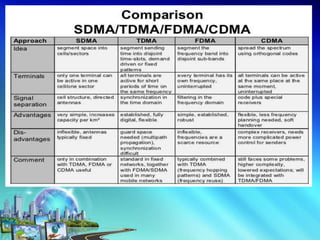
• Multiple access schemes allow many users
to share a finite amount of radio spectrum
in efficient manner
• As the spectrum is limited, so the sharing is
required to increase the capacity of cell or
over a geographical area by allowing the
available bandwidth to be used at the same
time by different users.
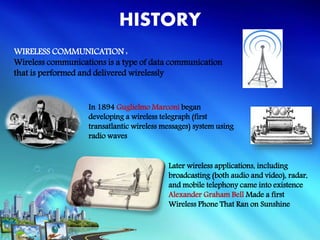
HISTORY
WIRELESS COMMUNICATION :
Wireless communications is a type of data communication
that is performed and delivered wirelessly
In 1894 Guglielmo Marconi began
developing a wireless telegraph (first
transatlantic wireless messages) system using
radio waves
Later wireless applications, including
broadcasting (both audio and video), radar,
and mobile telephony came into existence
Alexander Graham Bell Made a first
Wireless Phone That Ran on Sunshine
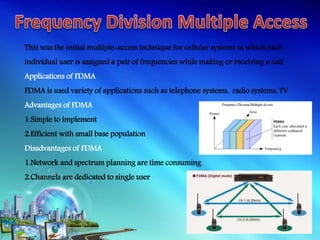
This was the initial multiple-access technique for cellular systems in which each
individual user is assigned a pair of frequencies while making or receiving a call
Applications of FDMA
FDMA is used variety of applications such as telephone systems, radio systems, TV
Advantages of FDMA
1.Simple to implement
2.Efficient with small base population
Disadvantages of FDMA
1.Network and spectrum planning are time consuming
2.Channels are dedicated to single user
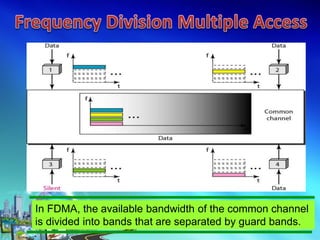
In FDMA, the available bandwidth of the common channel
is divided into bands that are separated by guard bands.
Continuous transmission
Narrow bandwidth
Low overhead
Simple hardware at mobile unit and BS : (1) no digital processing needed (2) ease of
framing and synchronization.
FDMA can be used with both analogue and digital signal.
FDMA requires high-performing filters in the radio hardware, in contrast to TDMA
and CDMA.
FDMA is not vulnerable to the timing problems that TDMA has.
 Due to the frequency filtering, FDMA is not sensitive to near far problem.
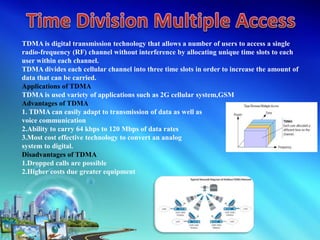
TDMA is digital transmission technology that allows a number of users to access a single
radio-frequency (RF) channel without interference by allocating unique time slots to each
user within each channel.
TDMA divides each cellular channel into three time slots in order to increase the amount of
data that can be carried.
Applications of TDMA
TDMA is used variety of applications such as 2G cellular system,GSM
Advantages of TDMA
1. TDMA can easily adapt to transmission of data as well as
voice communication
2.Ability to carry 64 kbps to 120 Mbps of data rates
3.Most cost effective technology to convert an analog
system to digital.
Disadvantages of TDMA
1.Dropped calls are possible
2.Higher costs due greater equipment
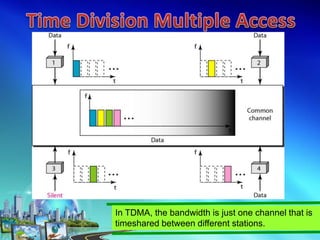
In TDMA, the bandwidth is just one channel that is
timeshared between different stations.
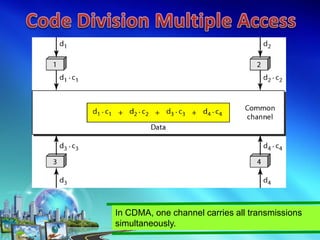
In CDMA, one channel carries all transmissions
simultaneously.
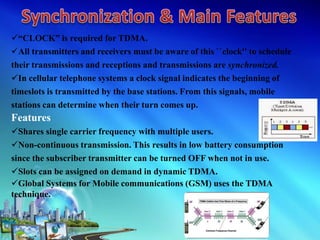
“CLOCK” is required for TDMA.
All transmitters and receivers must be aware of this ``clock'' to schedule
their transmissions and receptions and transmissions are synchronized.
In cellular telephone systems a clock signal indicates the beginning of
timeslots is transmitted by the base stations. From this signals, mobile
stations can determine when their turn comes up.
Features
Shares single carrier frequency with multiple users.
Non-continuous transmission. This results in low battery consumption
since the subscriber transmitter can be turned OFF when not in use.
Slots can be assigned on demand in dynamic TDMA.
Global Systems for Mobile communications (GSM) uses the TDMA
technique.
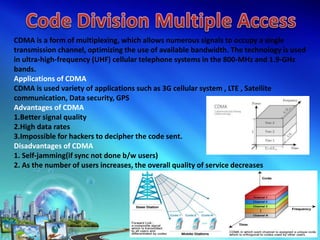
CDMA is a form of multiplexing, which allows numerous signals to occupy a single
transmission channel, optimizing the use of available bandwidth. The technology is used
in ultra-high-frequency (UHF) cellular telephone systems in the 800-MHz and 1.9-GHz
bands.
Applications of CDMA
CDMA is used variety of applications such as 3G cellular system , LTE , Satellite
communication, Data security, GPS
Advantages of CDMA
1.Better signal quality
2.High data rates
3.Impossible for hackers to decipher the code sent.
Disadvantages of CDMA
1. Self-jamming(if sync not done b/w users)
2. As the number of users increases, the overall quality of service decreases
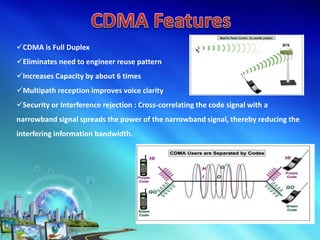
CDMA is Full Duplex
Eliminates need to engineer reuse pattern
Increases Capacity by about 6 times
Multipath reception improves voice clarity
Security or Interference rejection : Cross-correlating the code signal with a
narrowband signal spreads the power of the narrowband signal, thereby reducing the
interfering information bandwidth.
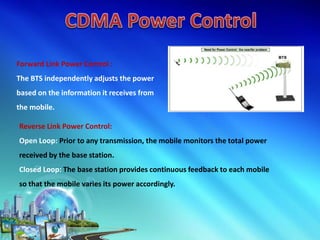
Forward Link Power Control :
The BTS independently adjusts the power
based on the information it receives from
the mobile.
Reverse Link Power Control:
Open Loop: Prior to any transmission, the mobile monitors the total power
received by the base station.
Closed Loop: The base station provides continuous feedback to each mobile
so that the mobile varies its power accordingly.
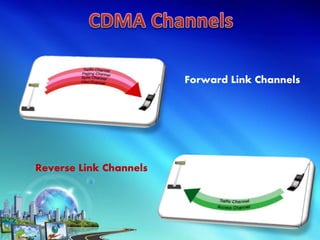
Forward Link Channels
Reverse Link Channels
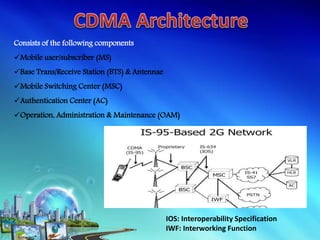
Consists of the following components
Mobile user/subscriber (MS)
Base Trans/Receive Station (BTS) & Antennae
Mobile Switching Center (MSC)
Authentication Center (AC)
Operation, Administration & Maintenance (OAM)
IOS: Interoperability Specification
IWF: Interworking Function
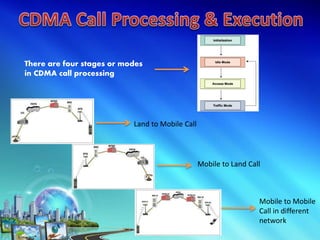
There are four stages or modes
in CDMA call processing
Land to Mobile Call
Mobile to Land Call
Mobile to Mobile
Call in different
network
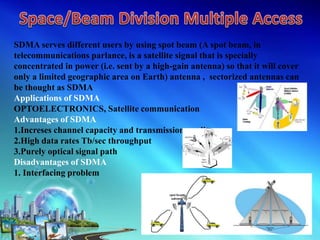
SDMA serves different users by using spot beam (A spot beam, in
telecommunications parlance, is a satellite signal that is specially
concentrated in power (i.e. sent by a high-gain antenna) so that it will cover
only a limited geographic area on Earth) antenna , sectorized antennas can
be thought as SDMA
Applications of SDMA
OPTOELECTRONICS, Satellite communication
Advantages of SDMA
1.Increses channel capacity and transmission quality
2.High data rates Tb/sec throughput
3.Purely optical signal path
Disadvantages of SDMA
1. Interfacing problem
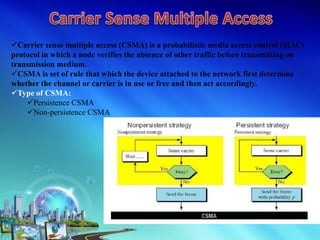
Carrier sense multiple access (CSMA) is a probabilistic media access control (MAC)
protocol in which a node verifies the absence of other traffic before transmitting on
transmission medium.
CSMA is set of rule that which the device attached to the network first determine
whether the channel or carrier is in use or free and then act accordingly.
Type of CSMA:
Persistence CSMA
Non-persistence CSMA
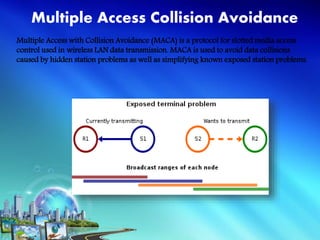
Multiple Access Collision Avoidance
Multiple Access with Collision Avoidance (MACA) is a protocol for slotted media access
control used in wireless LAN data transmission. MACA is used to avoid data collisions
caused by hidden station problems as well as simplifying known exposed station problems.
Thank you!

Multiple access techniques for wireless communication

  • 1.
    Multiple Access TechniquesFor Wireless Communication Dr. V.Umadevi M.sc (CS&IT),M.Tech (IT), M.Phil., PhD., D.Lit., Director Jairams Arts and Science College, Karur
  • 2.
    • Introduction • History •Multiple Access Techniques – FDMA – TDMA – CDMA – SDMA – CSMA • Wireless Access Collision Avoidance
  • 3.
    INTRODUCTION • Multiple accessschemes allow many users to share a finite amount of radio spectrum in efficient manner • As the spectrum is limited, so the sharing is required to increase the capacity of cell or over a geographical area by allowing the available bandwidth to be used at the same time by different users.
  • 4.
    HISTORY WIRELESS COMMUNICATION : Wirelesscommunications is a type of data communication that is performed and delivered wirelessly In 1894 Guglielmo Marconi began developing a wireless telegraph (first transatlantic wireless messages) system using radio waves Later wireless applications, including broadcasting (both audio and video), radar, and mobile telephony came into existence Alexander Graham Bell Made a first Wireless Phone That Ran on Sunshine
  • 5.
    This was theinitial multiple-access technique for cellular systems in which each individual user is assigned a pair of frequencies while making or receiving a call Applications of FDMA FDMA is used variety of applications such as telephone systems, radio systems, TV Advantages of FDMA 1.Simple to implement 2.Efficient with small base population Disadvantages of FDMA 1.Network and spectrum planning are time consuming 2.Channels are dedicated to single user
  • 6.
    In FDMA, theavailable bandwidth of the common channel is divided into bands that are separated by guard bands.
  • 7.
    Continuous transmission Narrow bandwidth Lowoverhead Simple hardware at mobile unit and BS : (1) no digital processing needed (2) ease of framing and synchronization. FDMA can be used with both analogue and digital signal. FDMA requires high-performing filters in the radio hardware, in contrast to TDMA and CDMA. FDMA is not vulnerable to the timing problems that TDMA has.  Due to the frequency filtering, FDMA is not sensitive to near far problem.
  • 8.
    TDMA is digitaltransmission technology that allows a number of users to access a single radio-frequency (RF) channel without interference by allocating unique time slots to each user within each channel. TDMA divides each cellular channel into three time slots in order to increase the amount of data that can be carried. Applications of TDMA TDMA is used variety of applications such as 2G cellular system,GSM Advantages of TDMA 1. TDMA can easily adapt to transmission of data as well as voice communication 2.Ability to carry 64 kbps to 120 Mbps of data rates 3.Most cost effective technology to convert an analog system to digital. Disadvantages of TDMA 1.Dropped calls are possible 2.Higher costs due greater equipment
  • 9.
    In TDMA, thebandwidth is just one channel that is timeshared between different stations.
  • 10.
    In CDMA, onechannel carries all transmissions simultaneously.
  • 11.
    “CLOCK” is requiredfor TDMA. All transmitters and receivers must be aware of this ``clock'' to schedule their transmissions and receptions and transmissions are synchronized. In cellular telephone systems a clock signal indicates the beginning of timeslots is transmitted by the base stations. From this signals, mobile stations can determine when their turn comes up. Features Shares single carrier frequency with multiple users. Non-continuous transmission. This results in low battery consumption since the subscriber transmitter can be turned OFF when not in use. Slots can be assigned on demand in dynamic TDMA. Global Systems for Mobile communications (GSM) uses the TDMA technique.
  • 12.
    CDMA is aform of multiplexing, which allows numerous signals to occupy a single transmission channel, optimizing the use of available bandwidth. The technology is used in ultra-high-frequency (UHF) cellular telephone systems in the 800-MHz and 1.9-GHz bands. Applications of CDMA CDMA is used variety of applications such as 3G cellular system , LTE , Satellite communication, Data security, GPS Advantages of CDMA 1.Better signal quality 2.High data rates 3.Impossible for hackers to decipher the code sent. Disadvantages of CDMA 1. Self-jamming(if sync not done b/w users) 2. As the number of users increases, the overall quality of service decreases
  • 13.
    CDMA is FullDuplex Eliminates need to engineer reuse pattern Increases Capacity by about 6 times Multipath reception improves voice clarity Security or Interference rejection : Cross-correlating the code signal with a narrowband signal spreads the power of the narrowband signal, thereby reducing the interfering information bandwidth.
  • 14.
    Forward Link PowerControl : The BTS independently adjusts the power based on the information it receives from the mobile. Reverse Link Power Control: Open Loop: Prior to any transmission, the mobile monitors the total power received by the base station. Closed Loop: The base station provides continuous feedback to each mobile so that the mobile varies its power accordingly.
  • 15.
  • 16.
    Consists of thefollowing components Mobile user/subscriber (MS) Base Trans/Receive Station (BTS) & Antennae Mobile Switching Center (MSC) Authentication Center (AC) Operation, Administration & Maintenance (OAM) IOS: Interoperability Specification IWF: Interworking Function
  • 17.
    There are fourstages or modes in CDMA call processing Land to Mobile Call Mobile to Land Call Mobile to Mobile Call in different network
  • 18.
    SDMA serves differentusers by using spot beam (A spot beam, in telecommunications parlance, is a satellite signal that is specially concentrated in power (i.e. sent by a high-gain antenna) so that it will cover only a limited geographic area on Earth) antenna , sectorized antennas can be thought as SDMA Applications of SDMA OPTOELECTRONICS, Satellite communication Advantages of SDMA 1.Increses channel capacity and transmission quality 2.High data rates Tb/sec throughput 3.Purely optical signal path Disadvantages of SDMA 1. Interfacing problem
  • 19.
    Carrier sense multipleaccess (CSMA) is a probabilistic media access control (MAC) protocol in which a node verifies the absence of other traffic before transmitting on transmission medium. CSMA is set of rule that which the device attached to the network first determine whether the channel or carrier is in use or free and then act accordingly. Type of CSMA: Persistence CSMA Non-persistence CSMA
  • 21.
    Multiple Access CollisionAvoidance Multiple Access with Collision Avoidance (MACA) is a protocol for slotted media access control used in wireless LAN data transmission. MACA is used to avoid data collisions caused by hidden station problems as well as simplifying known exposed station problems.
  • 22.