

Data Communications & Networking
                       Lecture-14


                 Course Instructor : Sehrish Rafiq
                Department Of Computer Science
                          University Of Peshawar
Lecture Overview

 WDM
 Similarityto FDM
 Applications of WDM
 TDM
 Data rate in TDM
 Interleaving
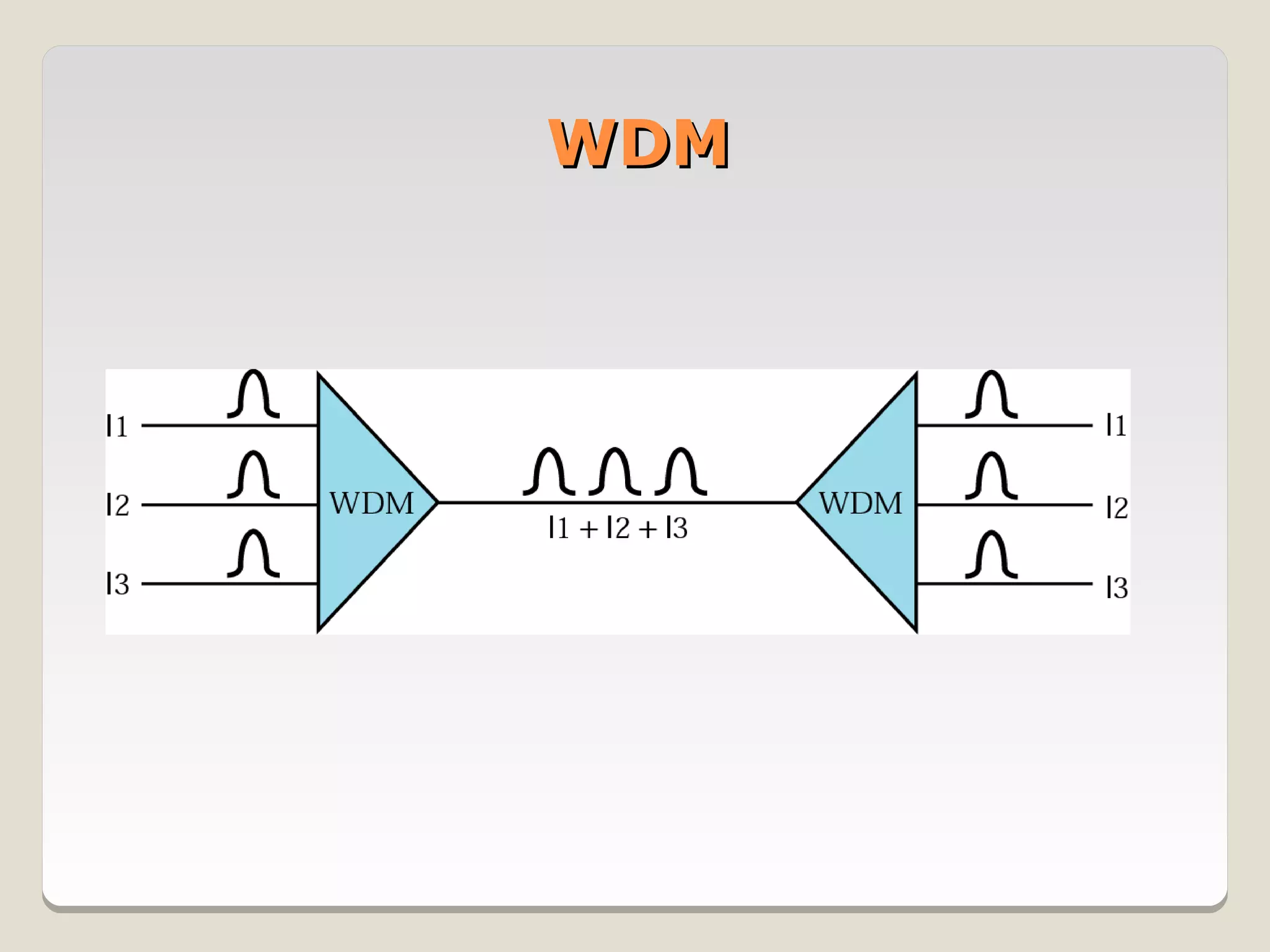
WDM
    (Wave Division Multiplexing)
 WDM is designed to use the high data rate
 capability of fiber optic cable.

 Usinga fiber-optic cable for one single line wastes
 the available bandwidth.

 Multiplexing   allows us to connect several lines in
 to one.
Similarity to FDM

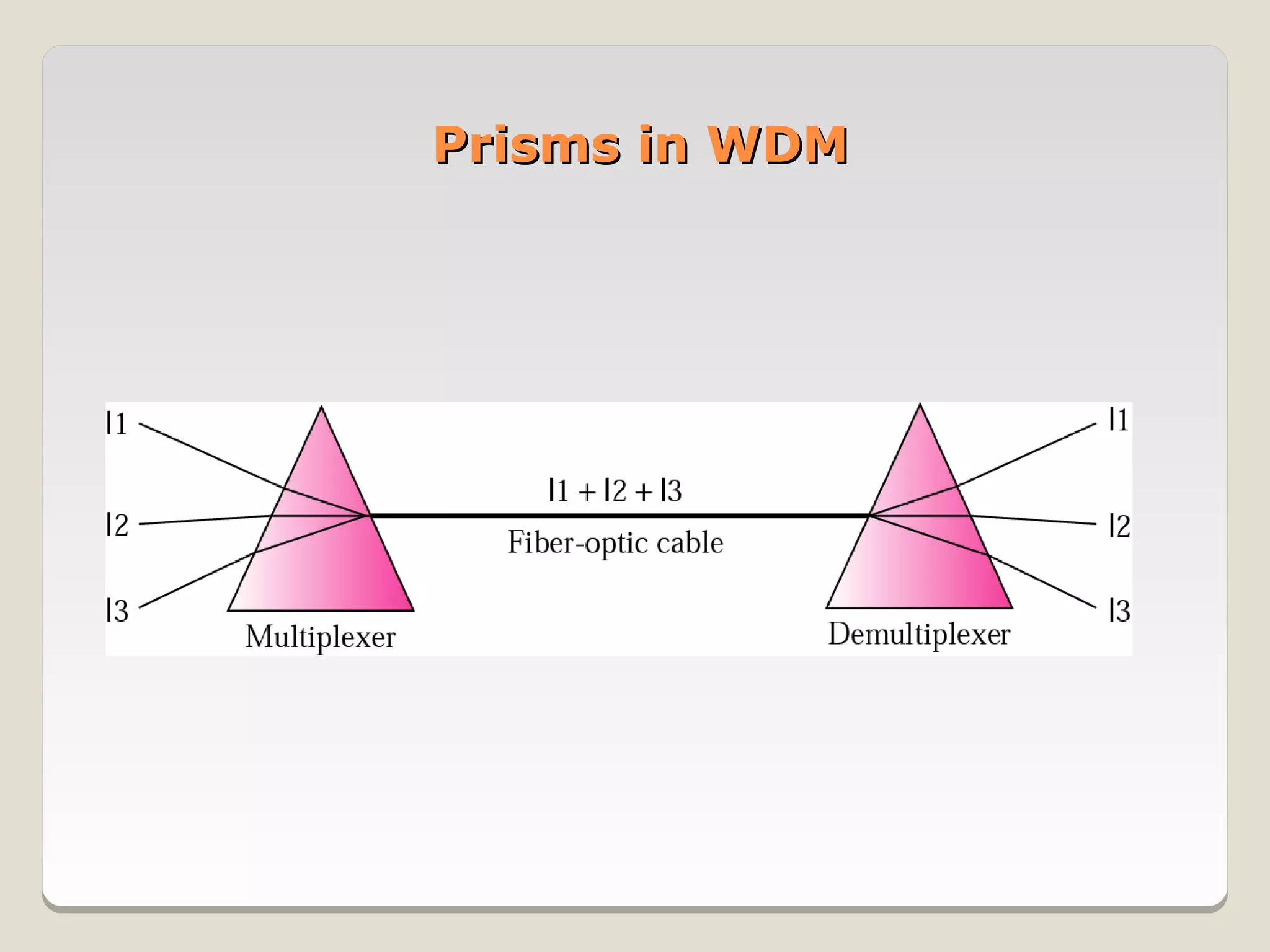
 WDM  is conceptually the same as FDM,except
 that the multiplexing and demultiplexing involve
 optical signals transmitted through fiber-optic
 channels.

 We are combining different signals of different
 frequencies.

 However the difference is that the frequencies are
 very high.
WDM
Prisms in WDM
Applications of WDM

 Oneapplication of WDM is the SONET network in
 which multiple optical fiber lines are multiplexed
 and demultiplexed.


 Note:-A new Method called DWDM(dense WDM)
 can Multiplex a very large number of channels by
 spacing channels closer to one another. It
 achieves even greater efficiency.
TDM
    (Time Division Multiplexing)
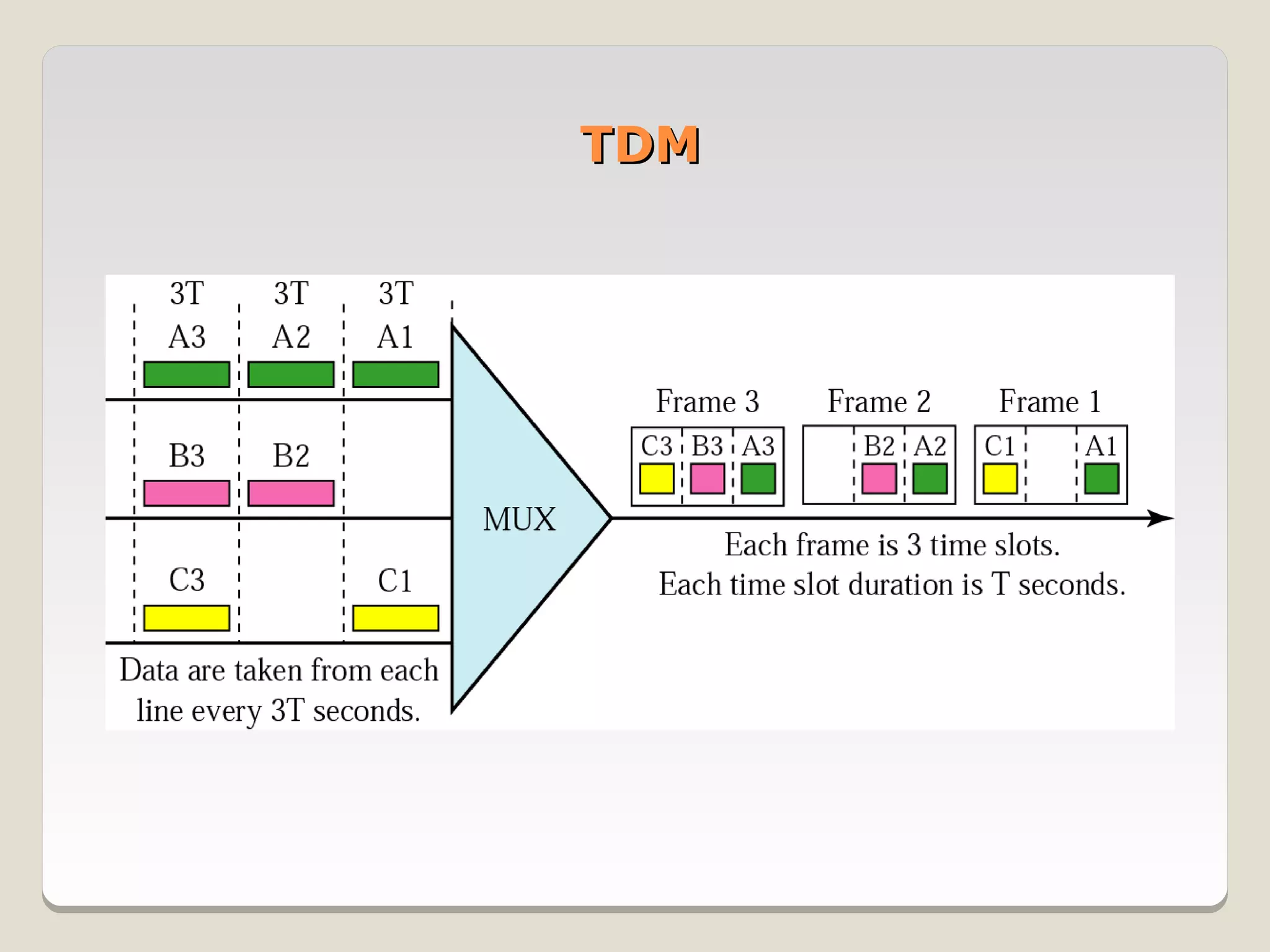
 TDMis a digital process that allows several
 connections to share the high bandwidth of a link.

 Instead
        of sharing a portion of bandwidth as in
 FDM,time is shared.

 Each   connection occupies a portion of time in the
 link.
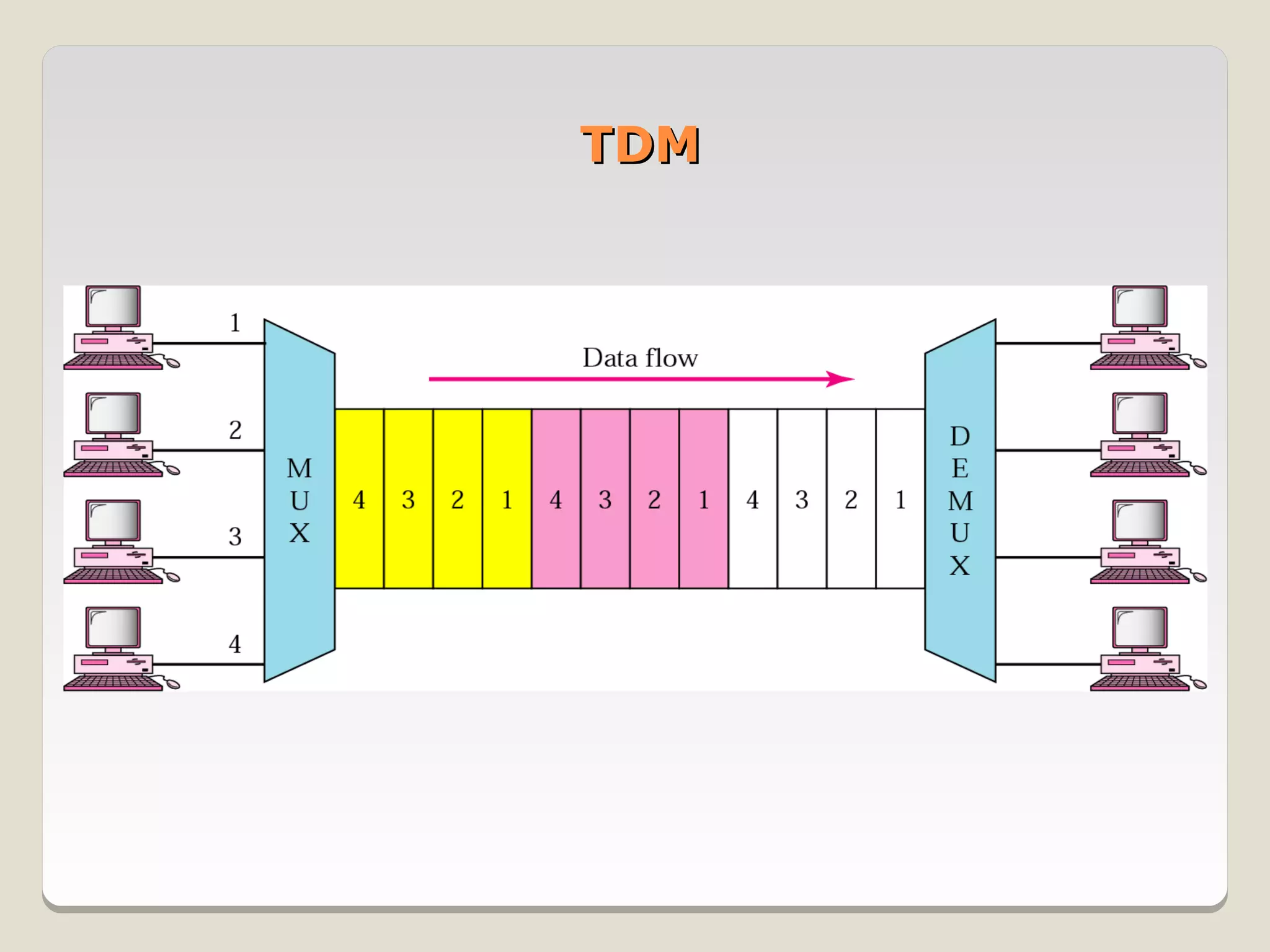
TDM
Time slots and frames
   The dataflow of each connection is divided in to units and
    the link combines one unit of each connection to make a
    frame.

   The size of the unit can be 1 bit or several bits.

   For n input connections, a frame is organized in to a
    minimum of n time slots.

 Each slot carrying one unit from each connection.
 Time slots are combined in to frames.


   A frame consists of one complete cycle of time slots with
    one slot dedicated to each sending device.
Data rate in TDM

 In TDM, the data rate of the link that carries data
  from n connections must be n times the data rate
  of a connection to guarantee the flow of data.

 The duration of a unit in a connection is n times
  the duration of a time slot in a frame.

 Ifwe consider that the bit rate and bit duration
  are inverses of each other then the above
  requirement makes sense.
TDM
Example 1
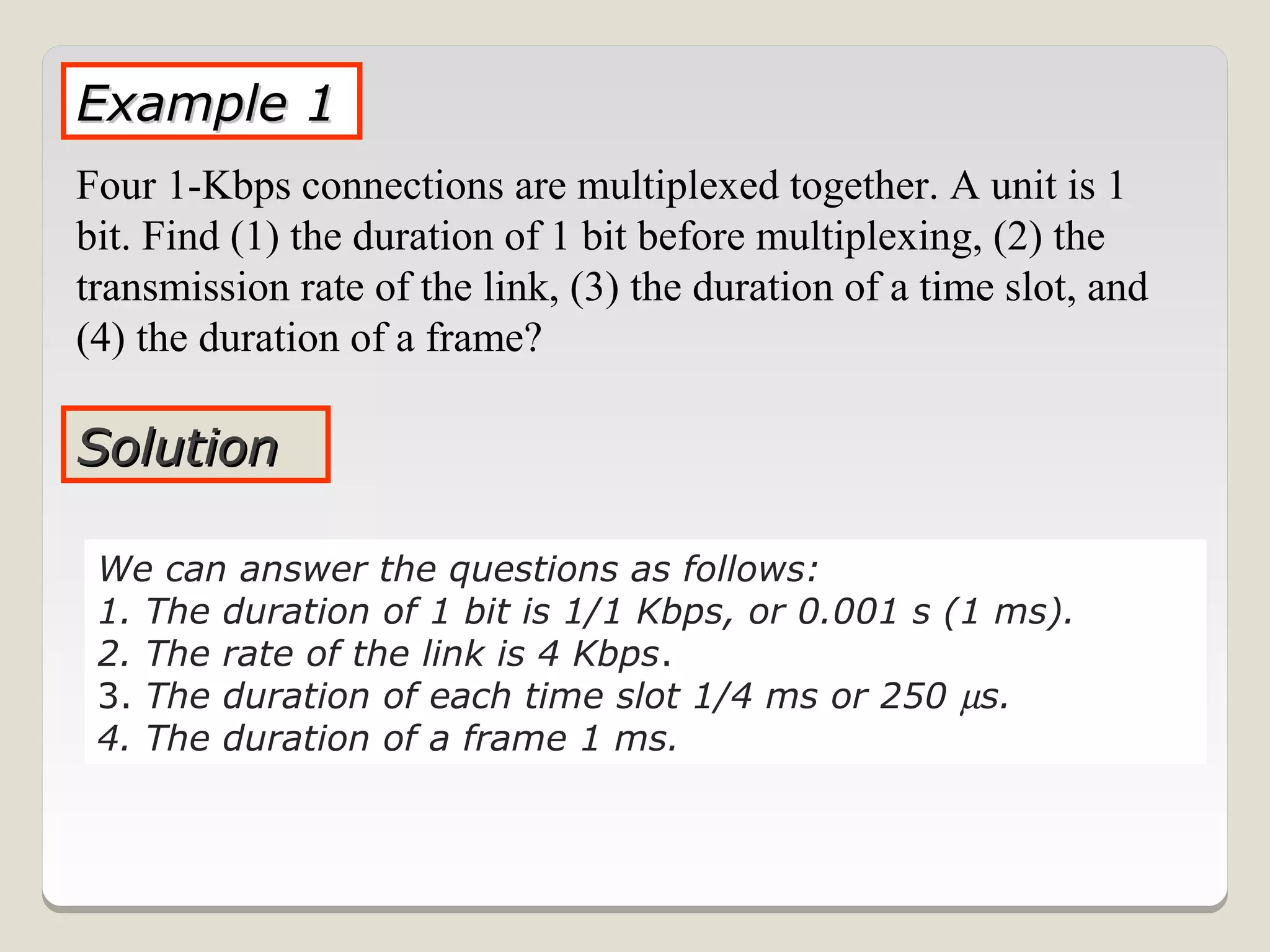
Four 1-Kbps connections are multiplexed together. A unit is 1
bit. Find (1) the duration of 1 bit before multiplexing, (2) the
transmission rate of the link, (3) the duration of a time slot, and
(4) the duration of a frame?

Solution

 We can answer the questions as follows:
 1. The duration of 1 bit is 1/1 Kbps, or 0.001 s (1 ms).
 2. The rate of the link is 4 Kbps.
 3. The duration of each time slot 1/4 ms or 250 µs.
 4. The duration of a frame 1 ms.
Interleaving
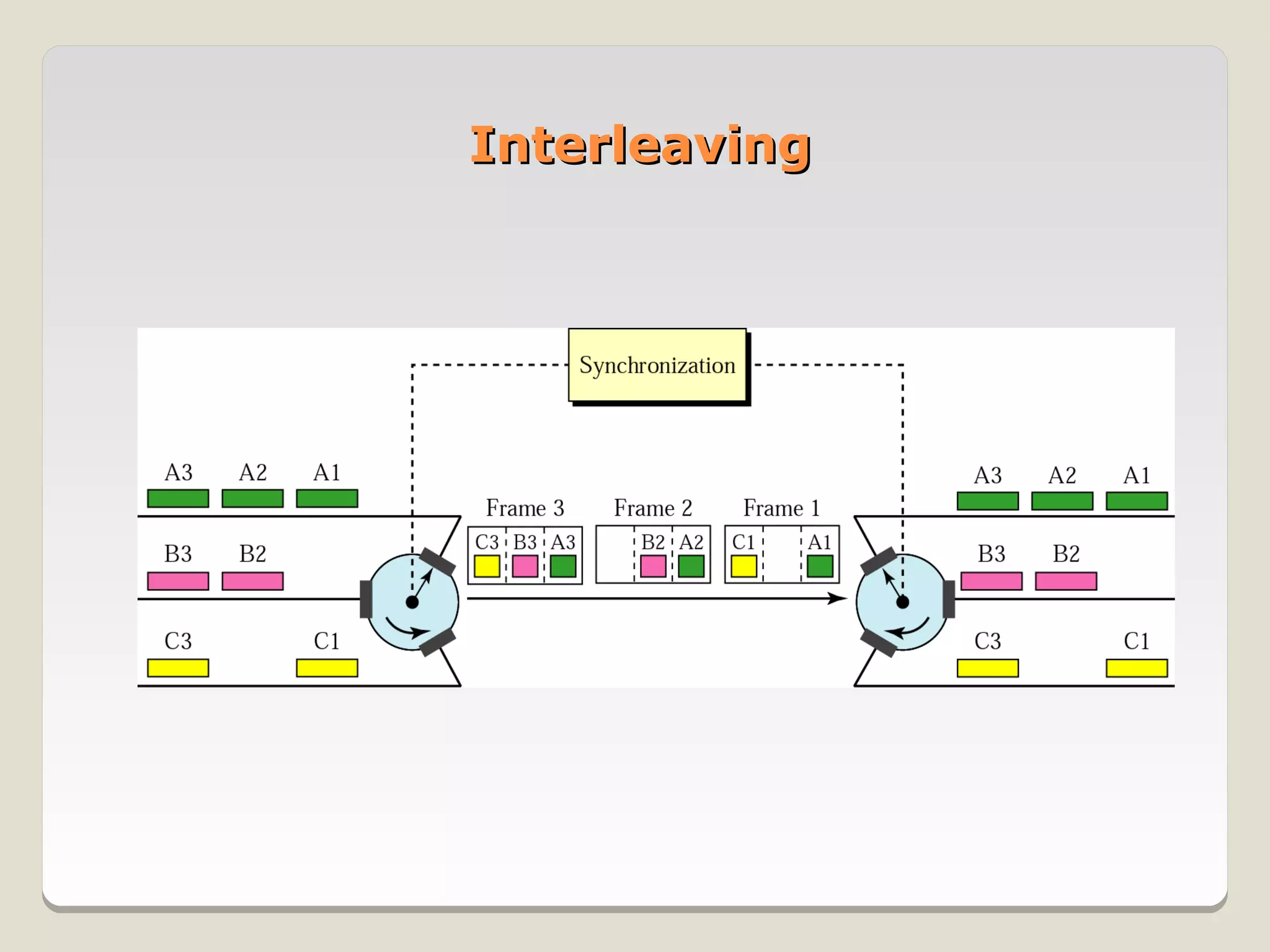
 TDM can be visualized as two fast rotating switches, one on
  the multiplexing side and the other on the demultiplexing
  side.
 The switches are synchronized and rotate at the same
  speed.
 On the multiplexing side, as the switch opens in front of a
  connection, that connection has the opportunity to send a
  unit on to the path .
 This process is called interleaving.
 On the demultiplexing side, as the switch opens in front of
  a connection that connection has the opportunity to receive
  a unit from the path.
Interleaving
Example 2
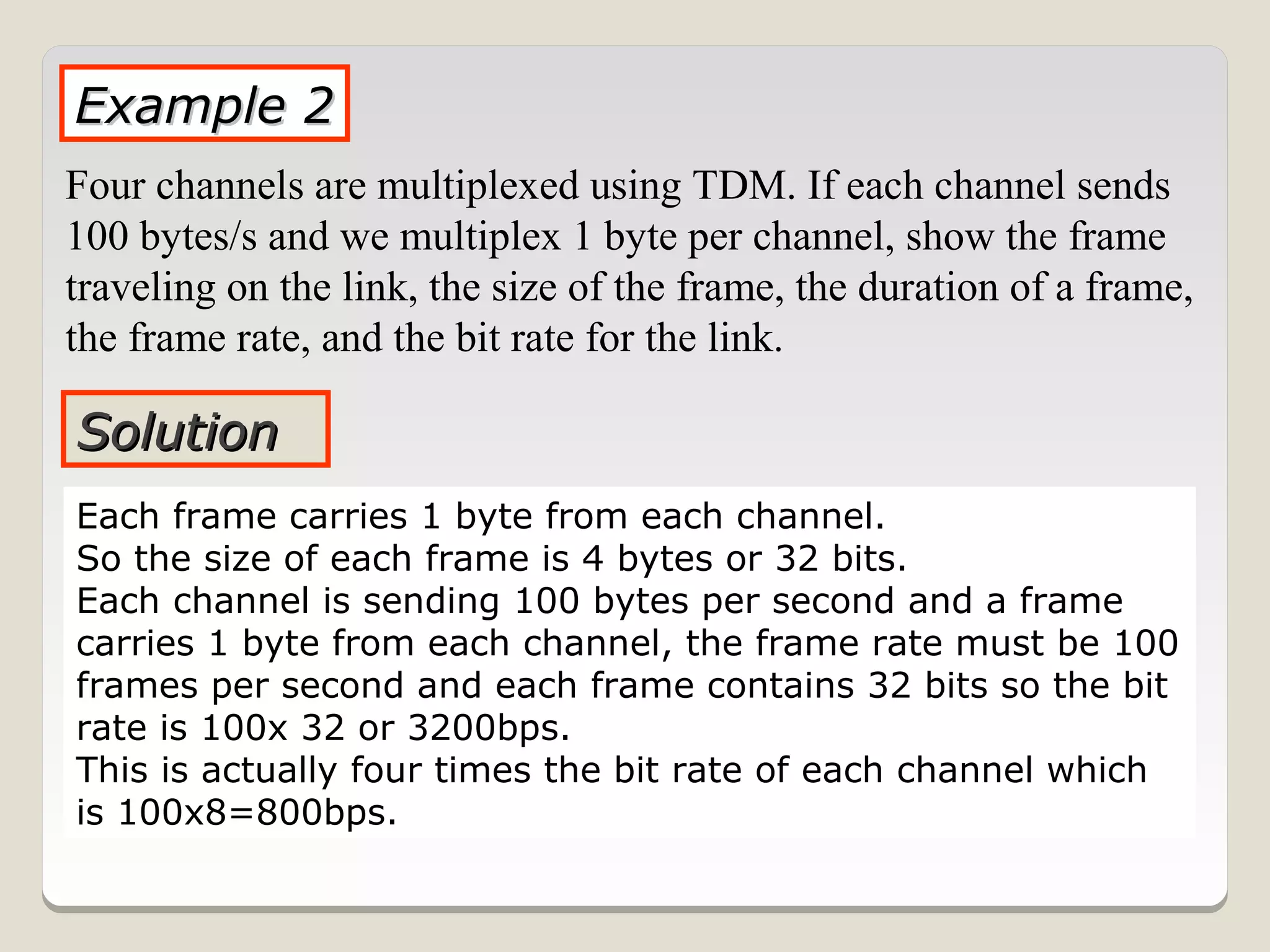
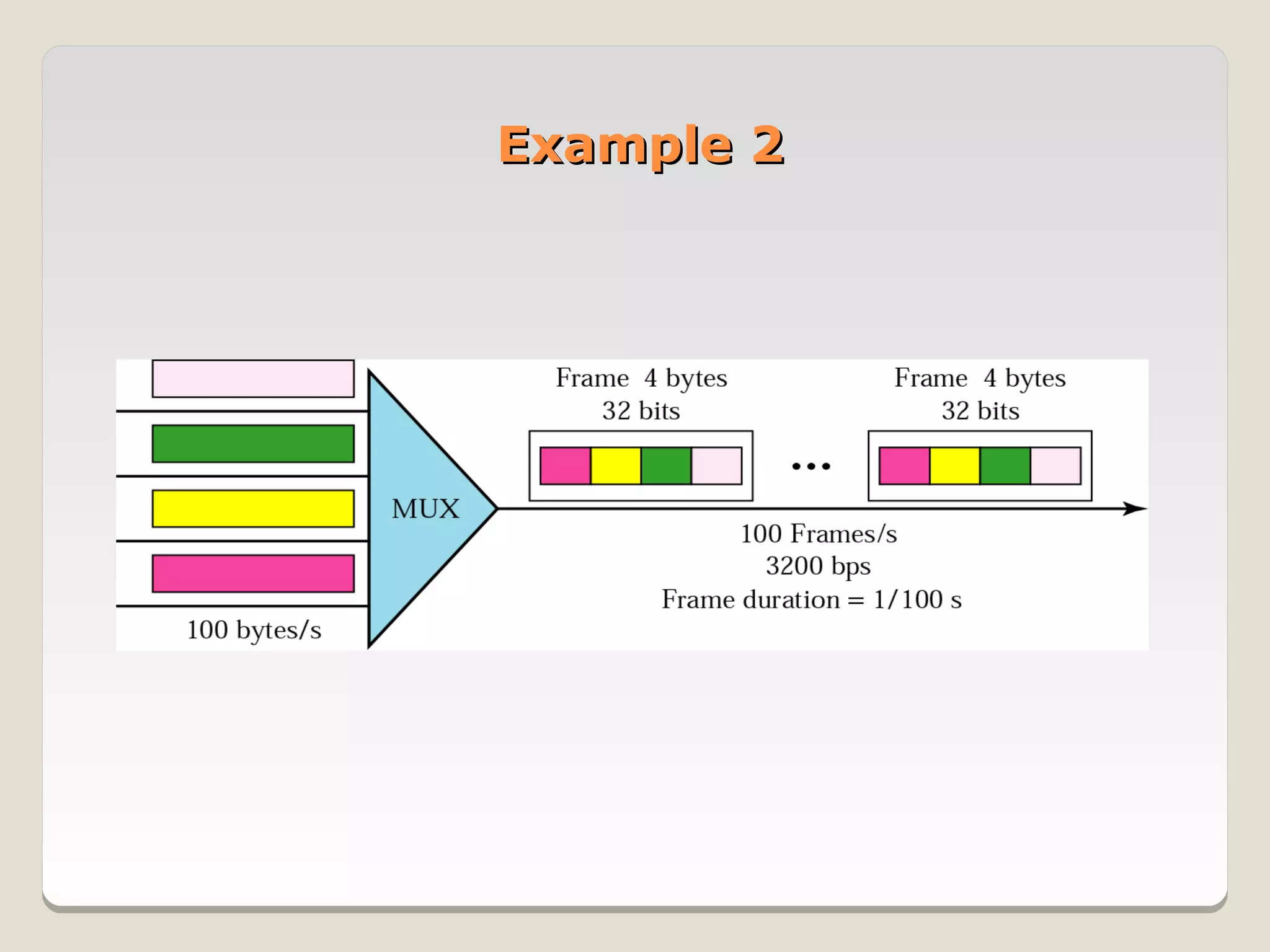
Four channels are multiplexed using TDM. If each channel sends
100 bytes/s and we multiplex 1 byte per channel, show the frame
traveling on the link, the size of the frame, the duration of a frame,
the frame rate, and the bit rate for the link.

Solution
Each frame carries 1 byte from each channel.
So the size of each frame is 4 bytes or 32 bits.
Each channel is sending 100 bytes per second and a frame
carries 1 byte from each channel, the frame rate must be 100
frames per second and each frame contains 32 bits so the bit
rate is 100x 32 or 3200bps.
This is actually four times the bit rate of each channel which
is 100x8=800bps.
Example 2
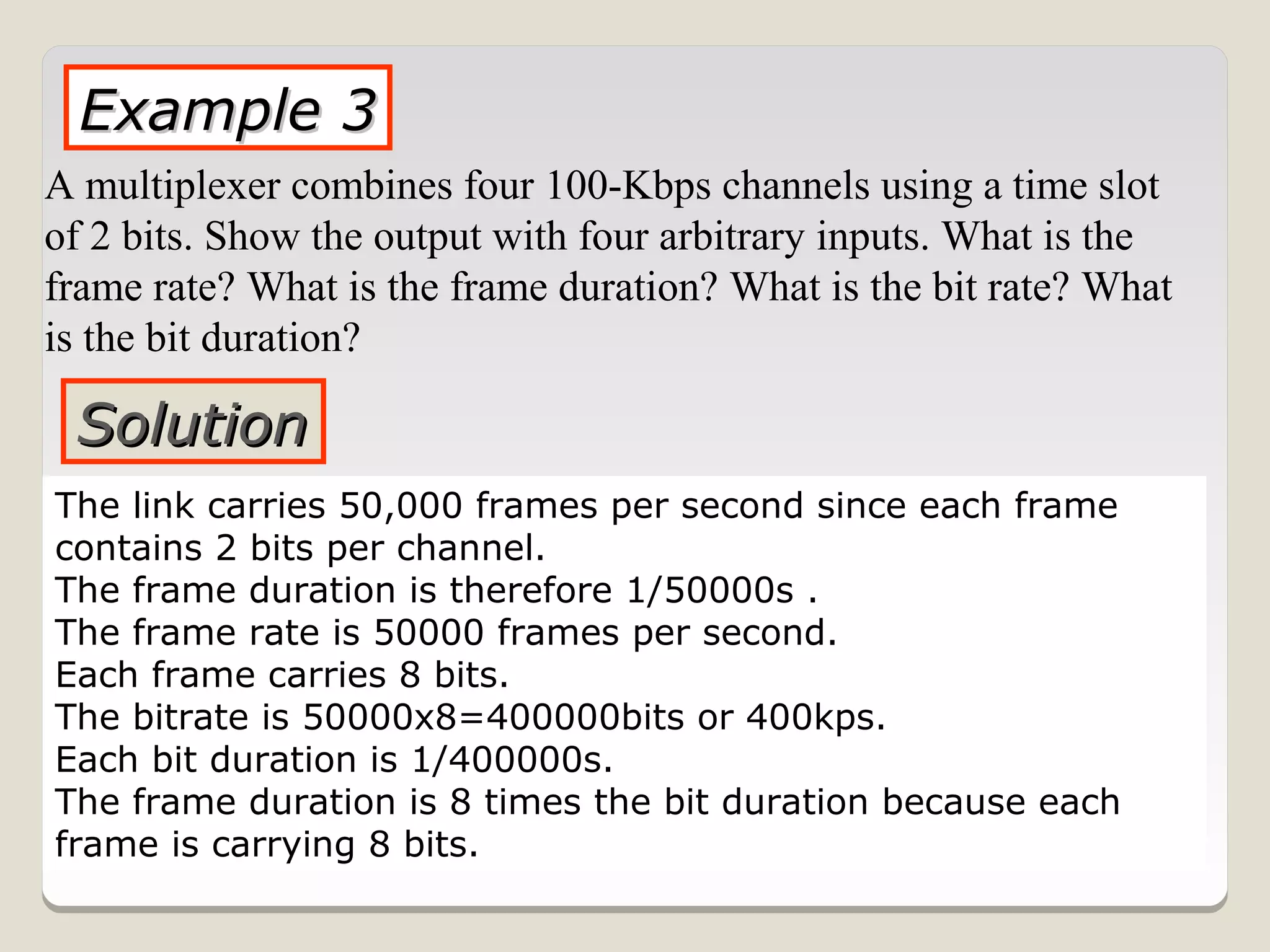
Example 3
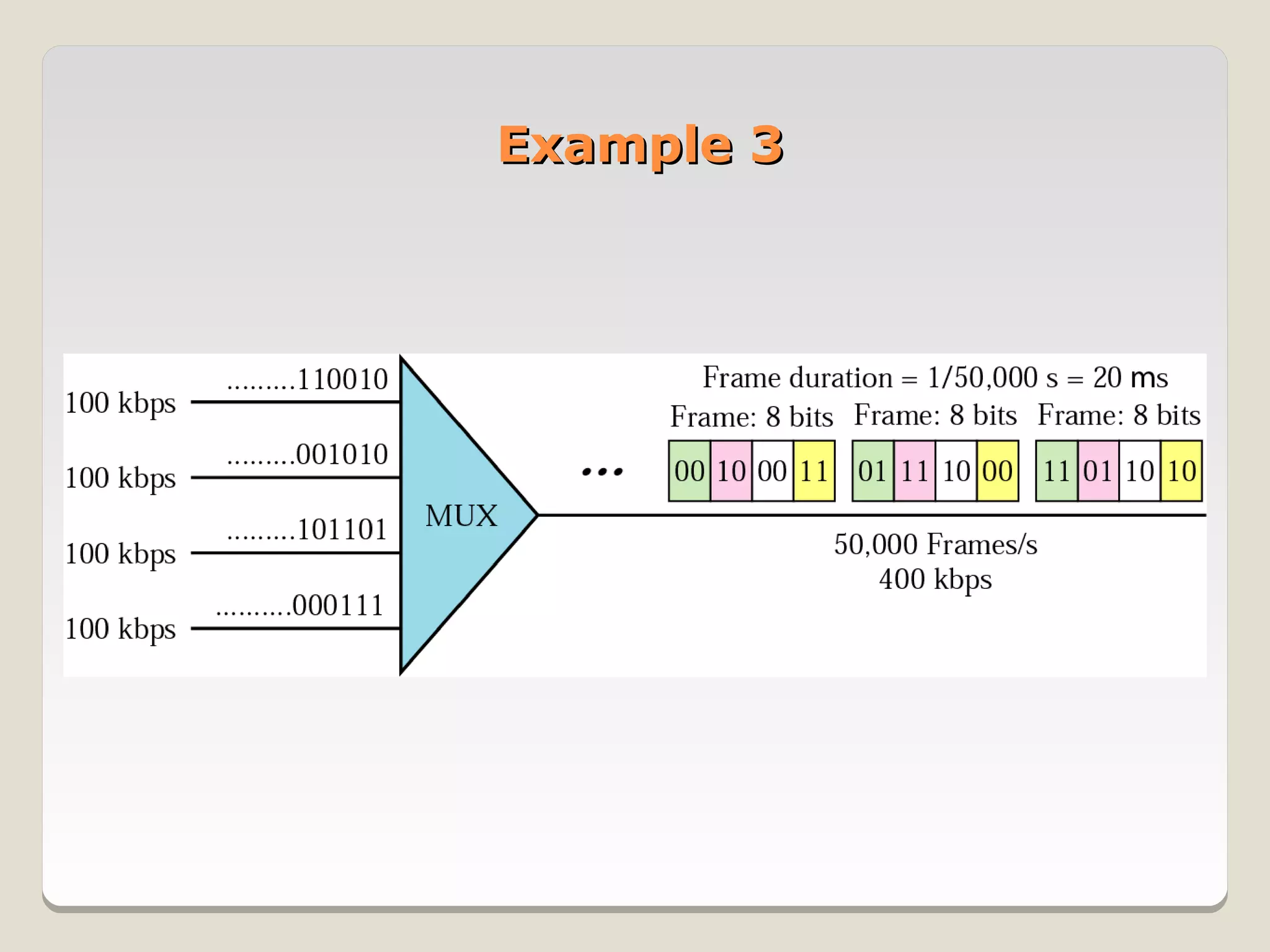
A multiplexer combines four 100-Kbps channels using a time slot
of 2 bits. Show the output with four arbitrary inputs. What is the
frame rate? What is the frame duration? What is the bit rate? What
is the bit duration?

 Solution
The link carries 50,000 frames per second since each frame
contains 2 bits per channel.
The frame duration is therefore 1/50000s .
The frame rate is 50000 frames per second.
Each frame carries 8 bits.
The bitrate is 50000x8=400000bits or 400kps.
Each bit duration is 1/400000s.
The frame duration is 8 times the bit duration because each
frame is carrying 8 bits.
Example 3
Thanks!!!

Lecture 14

  • 1.
    Data Communications &Networking Lecture-14 Course Instructor : Sehrish Rafiq Department Of Computer Science University Of Peshawar
  • 2.
    Lecture Overview  WDM Similarityto FDM  Applications of WDM  TDM  Data rate in TDM  Interleaving
  • 3.
    WDM (Wave Division Multiplexing)  WDM is designed to use the high data rate capability of fiber optic cable.  Usinga fiber-optic cable for one single line wastes the available bandwidth.  Multiplexing allows us to connect several lines in to one.
  • 4.
    Similarity to FDM WDM is conceptually the same as FDM,except that the multiplexing and demultiplexing involve optical signals transmitted through fiber-optic channels.  We are combining different signals of different frequencies.  However the difference is that the frequencies are very high.
  • 5.
  • 6.
  • 7.
    Applications of WDM Oneapplication of WDM is the SONET network in which multiple optical fiber lines are multiplexed and demultiplexed.  Note:-A new Method called DWDM(dense WDM) can Multiplex a very large number of channels by spacing channels closer to one another. It achieves even greater efficiency.
  • 8.
    TDM (Time Division Multiplexing)  TDMis a digital process that allows several connections to share the high bandwidth of a link.  Instead of sharing a portion of bandwidth as in FDM,time is shared.  Each connection occupies a portion of time in the link.
  • 9.
  • 10.
    Time slots andframes  The dataflow of each connection is divided in to units and the link combines one unit of each connection to make a frame.  The size of the unit can be 1 bit or several bits.  For n input connections, a frame is organized in to a minimum of n time slots.  Each slot carrying one unit from each connection.  Time slots are combined in to frames.  A frame consists of one complete cycle of time slots with one slot dedicated to each sending device.
  • 11.
    Data rate inTDM  In TDM, the data rate of the link that carries data from n connections must be n times the data rate of a connection to guarantee the flow of data.  The duration of a unit in a connection is n times the duration of a time slot in a frame.  Ifwe consider that the bit rate and bit duration are inverses of each other then the above requirement makes sense.
  • 12.
  • 13.
    Example 1 Four 1-Kbpsconnections are multiplexed together. A unit is 1 bit. Find (1) the duration of 1 bit before multiplexing, (2) the transmission rate of the link, (3) the duration of a time slot, and (4) the duration of a frame? Solution We can answer the questions as follows: 1. The duration of 1 bit is 1/1 Kbps, or 0.001 s (1 ms). 2. The rate of the link is 4 Kbps. 3. The duration of each time slot 1/4 ms or 250 µs. 4. The duration of a frame 1 ms.
  • 14.
    Interleaving  TDM canbe visualized as two fast rotating switches, one on the multiplexing side and the other on the demultiplexing side.  The switches are synchronized and rotate at the same speed.  On the multiplexing side, as the switch opens in front of a connection, that connection has the opportunity to send a unit on to the path .  This process is called interleaving.  On the demultiplexing side, as the switch opens in front of a connection that connection has the opportunity to receive a unit from the path.
  • 15.
  • 16.
    Example 2 Four channelsare multiplexed using TDM. If each channel sends 100 bytes/s and we multiplex 1 byte per channel, show the frame traveling on the link, the size of the frame, the duration of a frame, the frame rate, and the bit rate for the link. Solution Each frame carries 1 byte from each channel. So the size of each frame is 4 bytes or 32 bits. Each channel is sending 100 bytes per second and a frame carries 1 byte from each channel, the frame rate must be 100 frames per second and each frame contains 32 bits so the bit rate is 100x 32 or 3200bps. This is actually four times the bit rate of each channel which is 100x8=800bps.
  • 17.
  • 18.
    Example 3 A multiplexercombines four 100-Kbps channels using a time slot of 2 bits. Show the output with four arbitrary inputs. What is the frame rate? What is the frame duration? What is the bit rate? What is the bit duration? Solution The link carries 50,000 frames per second since each frame contains 2 bits per channel. The frame duration is therefore 1/50000s . The frame rate is 50000 frames per second. Each frame carries 8 bits. The bitrate is 50000x8=400000bits or 400kps. Each bit duration is 1/400000s. The frame duration is 8 times the bit duration because each frame is carrying 8 bits.
  • 19.
  • 20.