Course Instructor : Sehrish Rafiq
Department Of Computer Science
University Of Peshawar
Data Communications & Networking
Lecture-01
Readings recommended
 Data Communications & Networking 3rd Edition by Behrouz
A.Forouzon
 Data & Computer Communications 6th edition by william stallings
Lecture Overview
 What is Data communication?
 Importance of Data communication
 Fundamental characteristics of a data communication system
 Components of a data Communication system
 Networks & distributed processing
What is Data Communication?
 The word data refers to facts,concepts and instructions presented in
whatever form is agreed upon by the parties creating and using the
data.
 In context of computer information systems data are represented by
binary information units(or bits) produced and consumed in the form of
0’s and 1’s.
 Data Communication is the exchange of data (in the form of 0’s and 1’s)
between devices via some form of transmission medium(such as a wire
cable).
 Local and remote data communication
 For data communication to occur the communicating devices must be a
part of a communication system made up of a combination of hardware
& software.
Why study data communication?
 Entertainment
 Business
 Education & research
 Space missions
 PC revolution
 Telecommunications
Fundamental characteristics of a data
communication system
 The effectiveness of a data communication system depends on
three fundamental characteristics:
 Delivery
 Accuracy
 Timeliness
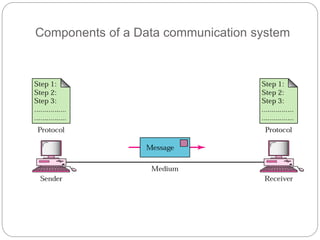
Components of a Data communication system
Networks
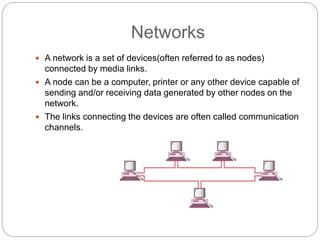
 A network is a set of devices(often referred to as nodes)
connected by media links.
 A node can be a computer, printer or any other device capable of
sending and/or receiving data generated by other nodes on the
network.
 The links connecting the devices are often called communication
channels.
Distributed Processing
 In distributed processing a task is divided among multiple
computers.
 Instead of a single large machine being responsible for all
aspects of a process,each separate computer handles a subset.
 Advantages of distributed processing:
 Security/Encapsulation e.g. ATM
 Distributed databases e.g. World Wide Web
 Faster Problem solving e.g. Encryption Codes
 Security through redundancy e.g. space programs
 Collaborative processing e.g. Games in a multi-user environment
HAVE A NICE DAY!!!

Data communication - Lecture-01

  • 1.
    Course Instructor :Sehrish Rafiq Department Of Computer Science University Of Peshawar Data Communications & Networking Lecture-01
  • 2.
    Readings recommended  DataCommunications & Networking 3rd Edition by Behrouz A.Forouzon  Data & Computer Communications 6th edition by william stallings
  • 3.
    Lecture Overview  Whatis Data communication?  Importance of Data communication  Fundamental characteristics of a data communication system  Components of a data Communication system  Networks & distributed processing
  • 4.
    What is DataCommunication?  The word data refers to facts,concepts and instructions presented in whatever form is agreed upon by the parties creating and using the data.  In context of computer information systems data are represented by binary information units(or bits) produced and consumed in the form of 0’s and 1’s.  Data Communication is the exchange of data (in the form of 0’s and 1’s) between devices via some form of transmission medium(such as a wire cable).  Local and remote data communication  For data communication to occur the communicating devices must be a part of a communication system made up of a combination of hardware & software.
  • 5.
    Why study datacommunication?  Entertainment  Business  Education & research  Space missions  PC revolution  Telecommunications
  • 6.
    Fundamental characteristics ofa data communication system  The effectiveness of a data communication system depends on three fundamental characteristics:  Delivery  Accuracy  Timeliness
  • 7.
    Components of aData communication system
  • 8.
    Networks  A networkis a set of devices(often referred to as nodes) connected by media links.  A node can be a computer, printer or any other device capable of sending and/or receiving data generated by other nodes on the network.  The links connecting the devices are often called communication channels.
  • 9.
    Distributed Processing  Indistributed processing a task is divided among multiple computers.  Instead of a single large machine being responsible for all aspects of a process,each separate computer handles a subset.  Advantages of distributed processing:  Security/Encapsulation e.g. ATM  Distributed databases e.g. World Wide Web  Faster Problem solving e.g. Encryption Codes  Security through redundancy e.g. space programs  Collaborative processing e.g. Games in a multi-user environment
  • 10.