Course Instructor : Sehrish Rafiq
Department Of Computer Science
University Of Peshawar
Data Communications & Networking
Lecture-06
Lecture overview
Functionalities of Network layer
Functionalities of Transport layer
Functionalities of Session layer
Functionalities of Presentation layer
Functionalities of Application layer
TCP/IP protocol suite or Internet model
Network Layer
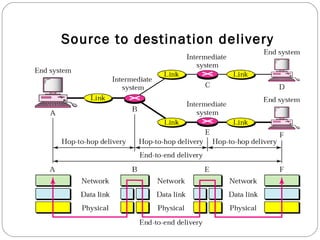
A network layer is responsible for the source-to-destination
delivery of a packet possibly across multiple networks(links).
The data link layer oversees the delivery of the packet between
two systems on the same network.
The network layer ensures that each packet gets from its point of
origin to its final destination.
If two systems are connected to the same link, there is usually no
need for a network layer.
Note:- If the two systems are attached to different networks(links) with
connecting devices between networks, there is often a need for the network
layer to accomplish source-to-destination delivery.
Network Layer
Responsibilities of the network layer
Logical addressing
 The physical addressing implemented by the data link layer handles the
addressing problem locally.
 If a packet passes the network boundaries we need another addressing system to
help distinguish the source and destination systems.
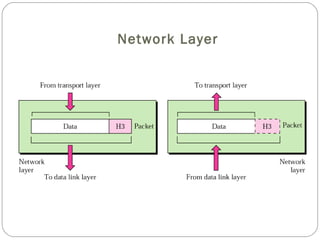
 The network layer adds a header to the packet coming from transport layer that
among other things includes the logical addresses of the sender and receiver.
Routing
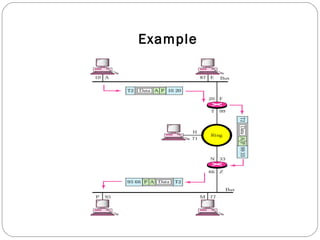
 When independent networks or links are connected together to create an
internetwork or a large network, the connecting devices (called routers or gate
ways) route the packets to their final destination.
 One of the functions of the network layer is to provide this mechanism.
Source to destination delivery
Example
Transport Layer
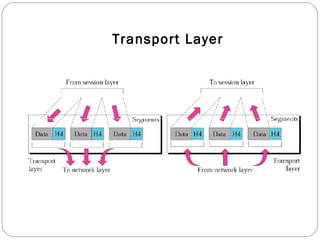
 The transport layer is responsible for source-to-destination(end-to-end)
delivery of the entire message.
 The network layer oversees end-to-end delivery of individual packets, it does
not recognize any relationship between those packets.
 The network layer treats each packet independently ,as though each piece
belong to a separate message whether or not it does.
 The transport layer, on the other hand ensures that the whole message arrives
intact and in order, overseeing both error control and flow control at the
source-destination level.
Transport Layer
Transport Layer
 For added security, the transport layer may create a connection between the
two ports.
 A connection is a single logical path between the source & destination that
associated with all packets in a message.
 Creating a connection involves 3 steps:
 Connection establishment
 Data transfer
 Connection release
 By confining transmission of all packets to a single pathway, the transport layer
has more control over sequencing, flow and error detection and correction.
Responsibilities of the transport
layer
Service point addressing
 Computers often run several programs at the same time.
 For this reason source –to-destination delivery means delivery not only from
one computer to the next but also from a specific process on one computer to a
specific process on the other.
 The transport layer header therefore must include a type of address called a
service-point address(or port address).
 The network layer gets each packet to the correct computer, the transport
layer gets the entire message to the correct process on that computer.
Segmentation & reassembly
 A message is divided in to transmittable segments, each segment containing a
sequence number.
Responsibilities of the transport
layer
 These numbers enable the transport layer to reassemble the message correctly
upon arriving at the destination and identify and replace packets that were lost
in the transmission.
Connection control
 The transport layer can be either connectionless or connection oriented.
 A connectionless transport layer treats each segment as an independent packet
and delivers it to the transport layer at the destination machine.
 A connection-oriented transport layer makes a connection with the transport
layer at the destination machine first before delivering the packets.
 After all the data is transmitted, the connection is terminated.
Responsibilities of the transport
layer
Flow control
 Like the data link layer the transport layer is responsible for flow control.
 However, flow control at this level is performed end-to-end rather than across
a single link
Error control
 Like the data Link layer, the transport layer is responsible for error control.
 However error control at this layer is performed end-to-end.
 The sending transport layer makes sure that the entire message arrives at the
receiving transport layer without error( damage, loss or duplication).
 Error correction is usually achieved through retransmission.
Session Layer
Services Provided by the first three layers( physical, data link and
network) are sufficient for some processes.
The session layer is the network dialog controller, establishes,
controls, maintains and synchronizes the interaction between
communicating systems.
Responsibilities of the Session Layer
 Dialog control
 The session layer allows two systems to enter in to a dialog.
 It allows the communication between two processes to take place either in half
duplex mode or full duplex mode.
 Half duplex example: Main frame and terminal.
 Synchronization
 The session Layer allows a process to add check points(synchronization points)
in to a stream of data.
Presentation Layer
The Presentation layer is concerned with the syntax and
semantics of the information exchanged between two
systems.
Responsibilities of the Presentation Layer
Translation
 The processes in two systems are usually exchanging information in the form of
character strings,numbers and so on.
 The information should be changed to bit streams before being transmitted.
 Because different computers use different encoding schemes,the presentation
layer is responsible for interoperability between these different encoding
methods.
 The presentation Layer at the sender changes the information from its sender-
dependent format in to a common format.
 The presentation Layer at the receiving machine changes the common format in
to its receiver dependent format.
Presentation Layer continued…
Encryption
 To carry sensitive information, a system must be able to assure privacy.
 Encryption means that the sender transforms the original information in to
another form and sends the resulting message out over the network.
 Decryption reverses the original process to transform the message back to its
original form.
Compression
 Data compression reduces the number of bits to be transmitted.
 Data compression becomes particularly important in the transmission of multi-
media such as text, audio and video.
Application Layer
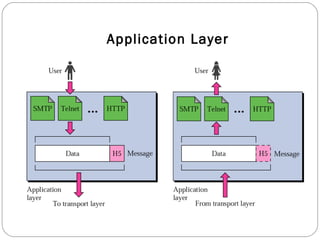
The application layer enables the user whether human or software
to access the network.
It provides user interfaces and support for services such as
electronic mail, remote file access and transfer, shared database
management and other types of distributed information services.
No headers or trailers are added at this layer.
Application Layer
Services provided by the application
layer
Network virtual terminal
 A network virtual terminal is a software version of a physical terminal and
allows a user to log on to a remote host.
 To do so, the application creates a software emulation of a terminal at the
remote host.
 The user’s computer talks to the software terminal which in turn talks to the
host and vice versa.
 The remote host believes that it is communicating with one of its own
terminals and allows you log on.
 File Transfer, Access and Management (FTAM)
 This application allows to access files in a remote computer (to make changes
or read data),to retrieve files from a remote computer and to manage or
control files in a remote computer.
Application layer continued…
Mail services
 This application provides the basis for e-mail forwarding and
storage.
Directory Services
 This application provides distributed database sources and access
for global information about various objects and services.
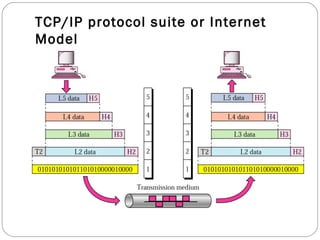
TCP/IP protocol suite or Internet
Model
TCP/IP protocol suite or Internet
Model
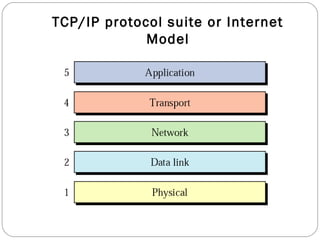
The TCP/IP protocol suite used in the Internet was developed
prior to the OSI model.
Therefore, the layers in the TCP/IP suite do not match exactly
with those in the OSI model.
The first four layers provide physical standards, network
interface, internetworking and transport functions that
corresponds to the first four layers of the OSI model.
The three top most layers(application layer, presentation layer,
session layer) are represented in TCP/IP by a single layer called
the application layer.
TCP/IP protocol suite or Internet
Model
TCP/IP protocol suite or Internet
Model
The TCP/IP protocol suite contain relatively independent
protocols that can be mixed and matched depending on the needs
of the system.
The term hierarical means that each upper level protocol is
supported by one or more lower level protocols.
At the transport layer TCP/IP defines two protocols TCP and
UDP.
At the network layer the main protocol defined by TCP/IP is IP,
although there are some other protocols that support data
movement in this layer.

Lecture 06

  • 1.
    Course Instructor :Sehrish Rafiq Department Of Computer Science University Of Peshawar Data Communications & Networking Lecture-06
  • 2.
    Lecture overview Functionalities ofNetwork layer Functionalities of Transport layer Functionalities of Session layer Functionalities of Presentation layer Functionalities of Application layer TCP/IP protocol suite or Internet model
  • 3.
    Network Layer A networklayer is responsible for the source-to-destination delivery of a packet possibly across multiple networks(links). The data link layer oversees the delivery of the packet between two systems on the same network. The network layer ensures that each packet gets from its point of origin to its final destination. If two systems are connected to the same link, there is usually no need for a network layer. Note:- If the two systems are attached to different networks(links) with connecting devices between networks, there is often a need for the network layer to accomplish source-to-destination delivery.
  • 4.
  • 5.
    Responsibilities of thenetwork layer Logical addressing  The physical addressing implemented by the data link layer handles the addressing problem locally.  If a packet passes the network boundaries we need another addressing system to help distinguish the source and destination systems.  The network layer adds a header to the packet coming from transport layer that among other things includes the logical addresses of the sender and receiver. Routing  When independent networks or links are connected together to create an internetwork or a large network, the connecting devices (called routers or gate ways) route the packets to their final destination.  One of the functions of the network layer is to provide this mechanism.
  • 6.
  • 7.
  • 8.
    Transport Layer  Thetransport layer is responsible for source-to-destination(end-to-end) delivery of the entire message.  The network layer oversees end-to-end delivery of individual packets, it does not recognize any relationship between those packets.  The network layer treats each packet independently ,as though each piece belong to a separate message whether or not it does.  The transport layer, on the other hand ensures that the whole message arrives intact and in order, overseeing both error control and flow control at the source-destination level.
  • 9.
  • 10.
    Transport Layer  Foradded security, the transport layer may create a connection between the two ports.  A connection is a single logical path between the source & destination that associated with all packets in a message.  Creating a connection involves 3 steps:  Connection establishment  Data transfer  Connection release  By confining transmission of all packets to a single pathway, the transport layer has more control over sequencing, flow and error detection and correction.
  • 11.
    Responsibilities of thetransport layer Service point addressing  Computers often run several programs at the same time.  For this reason source –to-destination delivery means delivery not only from one computer to the next but also from a specific process on one computer to a specific process on the other.  The transport layer header therefore must include a type of address called a service-point address(or port address).  The network layer gets each packet to the correct computer, the transport layer gets the entire message to the correct process on that computer. Segmentation & reassembly  A message is divided in to transmittable segments, each segment containing a sequence number.
  • 12.
    Responsibilities of thetransport layer  These numbers enable the transport layer to reassemble the message correctly upon arriving at the destination and identify and replace packets that were lost in the transmission. Connection control  The transport layer can be either connectionless or connection oriented.  A connectionless transport layer treats each segment as an independent packet and delivers it to the transport layer at the destination machine.  A connection-oriented transport layer makes a connection with the transport layer at the destination machine first before delivering the packets.  After all the data is transmitted, the connection is terminated.
  • 13.
    Responsibilities of thetransport layer Flow control  Like the data link layer the transport layer is responsible for flow control.  However, flow control at this level is performed end-to-end rather than across a single link Error control  Like the data Link layer, the transport layer is responsible for error control.  However error control at this layer is performed end-to-end.  The sending transport layer makes sure that the entire message arrives at the receiving transport layer without error( damage, loss or duplication).  Error correction is usually achieved through retransmission.
  • 14.
    Session Layer Services Providedby the first three layers( physical, data link and network) are sufficient for some processes. The session layer is the network dialog controller, establishes, controls, maintains and synchronizes the interaction between communicating systems.
  • 15.
    Responsibilities of theSession Layer  Dialog control  The session layer allows two systems to enter in to a dialog.  It allows the communication between two processes to take place either in half duplex mode or full duplex mode.  Half duplex example: Main frame and terminal.  Synchronization  The session Layer allows a process to add check points(synchronization points) in to a stream of data.
  • 16.
    Presentation Layer The Presentationlayer is concerned with the syntax and semantics of the information exchanged between two systems.
  • 17.
    Responsibilities of thePresentation Layer Translation  The processes in two systems are usually exchanging information in the form of character strings,numbers and so on.  The information should be changed to bit streams before being transmitted.  Because different computers use different encoding schemes,the presentation layer is responsible for interoperability between these different encoding methods.  The presentation Layer at the sender changes the information from its sender- dependent format in to a common format.  The presentation Layer at the receiving machine changes the common format in to its receiver dependent format.
  • 18.
    Presentation Layer continued… Encryption To carry sensitive information, a system must be able to assure privacy.  Encryption means that the sender transforms the original information in to another form and sends the resulting message out over the network.  Decryption reverses the original process to transform the message back to its original form. Compression  Data compression reduces the number of bits to be transmitted.  Data compression becomes particularly important in the transmission of multi- media such as text, audio and video.
  • 19.
    Application Layer The applicationlayer enables the user whether human or software to access the network. It provides user interfaces and support for services such as electronic mail, remote file access and transfer, shared database management and other types of distributed information services. No headers or trailers are added at this layer.
  • 20.
  • 21.
    Services provided bythe application layer Network virtual terminal  A network virtual terminal is a software version of a physical terminal and allows a user to log on to a remote host.  To do so, the application creates a software emulation of a terminal at the remote host.  The user’s computer talks to the software terminal which in turn talks to the host and vice versa.  The remote host believes that it is communicating with one of its own terminals and allows you log on.  File Transfer, Access and Management (FTAM)  This application allows to access files in a remote computer (to make changes or read data),to retrieve files from a remote computer and to manage or control files in a remote computer.
  • 22.
    Application layer continued… Mailservices  This application provides the basis for e-mail forwarding and storage. Directory Services  This application provides distributed database sources and access for global information about various objects and services.
  • 23.
    TCP/IP protocol suiteor Internet Model
  • 24.
    TCP/IP protocol suiteor Internet Model The TCP/IP protocol suite used in the Internet was developed prior to the OSI model. Therefore, the layers in the TCP/IP suite do not match exactly with those in the OSI model. The first four layers provide physical standards, network interface, internetworking and transport functions that corresponds to the first four layers of the OSI model. The three top most layers(application layer, presentation layer, session layer) are represented in TCP/IP by a single layer called the application layer.
  • 25.
    TCP/IP protocol suiteor Internet Model
  • 26.
    TCP/IP protocol suiteor Internet Model The TCP/IP protocol suite contain relatively independent protocols that can be mixed and matched depending on the needs of the system. The term hierarical means that each upper level protocol is supported by one or more lower level protocols. At the transport layer TCP/IP defines two protocols TCP and UDP. At the network layer the main protocol defined by TCP/IP is IP, although there are some other protocols that support data movement in this layer.