Lecture 11
Heat and phase changes.
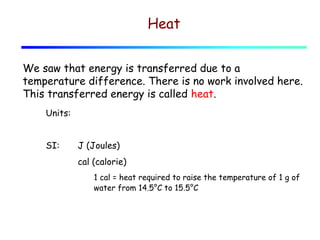
Heat
We saw that energy is transferred due to a
temperature difference. There is no work involved here.
This transferred energy is called heat.
Units:
SI:

J (Joules)
cal (calorie)
1 cal = heat required to raise the temperature of 1 g of
water from 14.5°C to 15.5°C
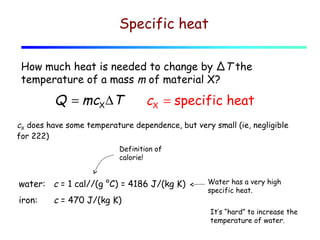
Specific heat
How much heat is needed to change by ΔT the
temperature of a mass m of material X?

Q = mcX ∆T

cX = specific heat

cX does have some temperature dependence, but very small (ie, negligible
for 222)
Definition of
calorie!

water: c = 1 cal//(g °C) = 4186 J/(kg K)
iron:

c = 470 J/(kg K)

Water has a very high
specific heat.
It’s “hard” to increase the
temperature of water.
Example: Kettle
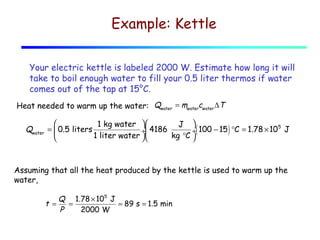
Your electric kettle is labeled 2000 W. Estimate how long it will
take to boil enough water to fill your 0.5 liter thermos if water
comes out of the tap at 15°C.
Heat needed to warm up the water: Qwater = mwatercwater ∆T

Qwater


1 kg water  
J 
5
=  0.5 liters
÷( 100 − 15 ) °C = 1.78 × 10 J
÷ 4186
1 liter water 
kg °C 


Assuming that all the heat produced by the kettle is used to warm up the
water,
Q 1.78 × 10⁵ J
t =
=
= 89 s = 1.5 min
P
2000 W
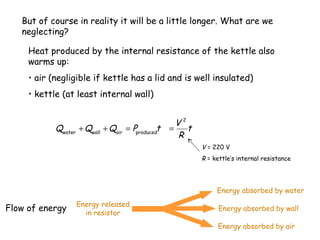
But of course in reality it will be a little longer. What are we
neglecting?
Heat produced by the internal resistance of the kettle also
warms up:
• air (negligible if kettle has a lid and is well insulated)
• kettle (at least internal wall)

Qwater + Qwall + Qair = Pproducedt

V2
=
t
R
V = 220 V
R = kettle’s internal resistance

Energy absorbed by water

Flow of energy

Energy released
in resistor

Energy absorbed by wall
Energy absorbed by air
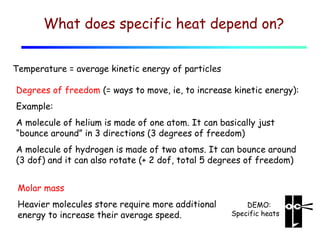
What does specific heat depend on?
Temperature = average kinetic energy of particles
Degrees of freedom (= ways to move, ie, to increase kinetic energy):
Example:
A molecule of helium is made of one atom. It can basically just
“bounce around” in 3 directions (3 degrees of freedom)
A molecule of hydrogen is made of two atoms. It can bounce around
(3 dof) and it can also rotate (+ 2 dof, total 5 degrees of freedom)
Molar mass
Heavier molecules store require more additional
energy to increase their average speed.

DEMO:
Specific heats
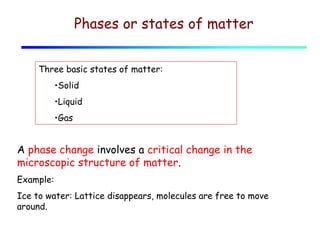
Phases or states of matter
Three basic states of matter:
•Solid
•Liquid
•Gas

A phase change involves a critical change in the
microscopic structure of matter.
Example:
Ice to water: Lattice disappears, molecules are free to move
around.
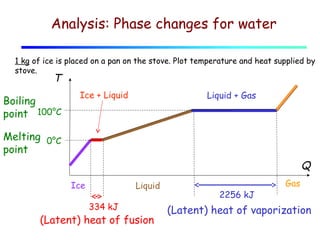
Analysis: Phase changes for water
1 kg of ice is placed on a pan on the stove. Plot temperature and heat supplied by
stove.

T

Boiling
point 100°C

Ice + Liquid

Liquid + Gas

Melting 0°C
point

Q
Ice

Liquid
334 kJ

(Latent) heat of fusion

2256 kJ

Gas

(Latent) heat of vaporization
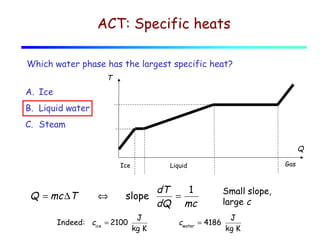
ACT: Specific heats
Which water phase has the largest specific heat?
T

A. Ice
B. Liquid water
C. Steam
Q
Ice

Q = mc ∆T

⇔

slope

Indeed: cice = 2100

Gas

Liquid

J
kg K

dT
1
=
dQ mc
cwater = 4186

Small slope,
large c
J
kg K
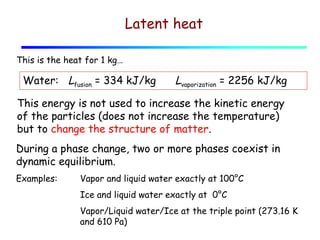
Latent heat
This is the heat for 1 kg…

Water: Lfusion = 334 kJ/kg

Lvaporization = 2256 kJ/kg

This energy is not used to increase the kinetic energy
of the particles (does not increase the temperature)
but to change the structure of matter.
During a phase change, two or more phases coexist in
dynamic equilibrium.
Examples:

Vapor and liquid water exactly at 100°C
Ice and liquid water exactly at 0°C
Vapor/Liquid water/Ice at the triple point (273.16 K
and 610 Pa)
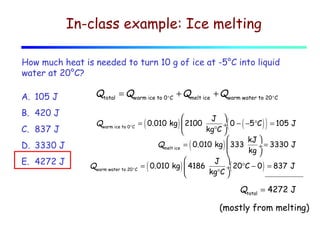
In-class example: Ice melting
How much heat is needed to turn 10 g of ice at -5°C into liquid
water at 20°C?
A. 105 J
B. 420 J
C. 837 J
D. 3330 J
E. 4272 J

Qtotal = Qwarm ice to 0 °C + Qmelt ice + Qwarm water to 20 °C

J 
Qwarm ice to 0 °C = ( 0.010 kg )  2100
÷ 0 − ( −5°C ) = 105 J
kg°C 


kJ 
Qmelt ice = ( 0.010 kg )  333
÷ = 3330 J
kg 


J 
Qwarm water to 20 °C = ( 0.010 kg )  4186
÷( 20°C − 0 ) = 837 J
kg°C 


(

)

Qtotal = 4272 J

(mostly from melting)
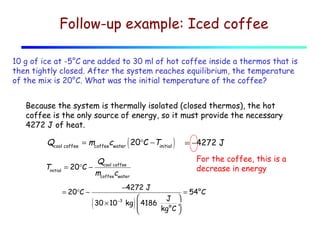
Follow-up example: Iced coffee
10 g of ice at -5°C are added to 30 ml of hot coffee inside a thermos that is
then tightly closed. After the system reaches equilibrium, the temperature
of the mix is 20°C. What was the initial temperature of the coffee?
Because the system is thermally isolated (closed thermos), the hot
coffee is the only source of energy, so it must provide the necessary
4272 J of heat.

Qcool coffee = mcoffeecwater ( 20°C −Tinitial )
Tinitial

For the coffee, this is a
decrease in energy

Q
= 20°C − cool coffee
mcoffeecwater
= 20°C −

(

= −4272 J

−4272 J
= 54°C


J
30 × 10 −3 kg  4186
÷
kg°C 


)
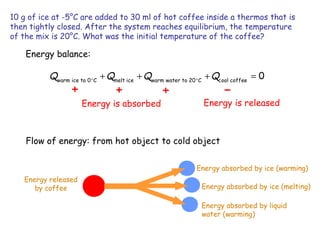
10 g of ice at -5°C are added to 30 ml of hot coffee inside a thermos that is
then tightly closed. After the system reaches equilibrium, the temperature
of the mix is 20°C. What was the initial temperature of the coffee?

Energy balance:

Qwarm ice to 0 °C + Qmelt ice + Qwarm water to 20 °C + Qcool coffee = 0

+

+

Energy is absorbed

+

−

Energy is released

Flow of energy: from hot object to cold object
Energy absorbed by ice (warming)
Energy released
by coffee

Energy absorbed by ice (melting)
Energy absorbed by liquid
water (warming)
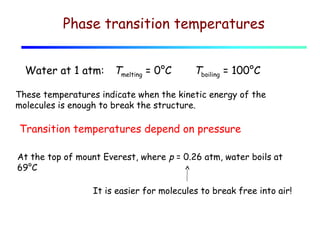
Phase transition temperatures
Water at 1 atm: Tmelting = 0°C

Tboiling = 100°C

These temperatures indicate when the kinetic energy of the
molecules is enough to break the structure.

Transition temperatures depend on pressure
At the top of mount Everest, where p = 0.26 atm, water boils at
69°C
It is easier for molecules to break free into air!
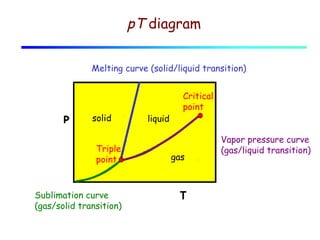
pT diagram
Melting curve (solid/liquid transition)

solid
Triple
point

Sublimation curve
(gas/solid transition)

liquid

Critical
point

gas

Vapor pressure curve
(gas/liquid transition)
pT diagram (water)
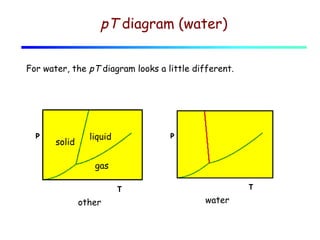
For water, the pT diagram looks a little different.

solid

liquid
gas

other

water
pT diagram (water)
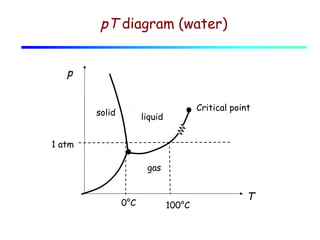
p
solid

Critical point

liquid

1 atm
gas

0°C

100°C

T
Triple point (water)
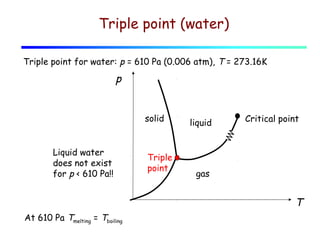
Triple point for water: p = 610 Pa (0.006 atm), T = 273.16K

p
solid
Liquid water
does not exist
for p < 610 Pa!!

Triple
point

liquid

Critical point

gas

T
At 610 Pa Tmelting = Tboiling
Critical point (water)
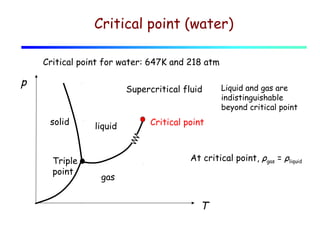
Critical point for water: 647K and 218 atm

p

Supercritical fluid
solid

Triple
point

liquid

Liquid and gas are
indistinguishable
beyond critical point

Critical point

At critical point, ρgas = ρliquid
gas

T

Lecture 11 heat and phase changes

  • 1.
    Lecture 11 Heat andphase changes.
  • 2.
    Heat We saw thatenergy is transferred due to a temperature difference. There is no work involved here. This transferred energy is called heat. Units: SI: J (Joules) cal (calorie) 1 cal = heat required to raise the temperature of 1 g of water from 14.5°C to 15.5°C
  • 3.
    Specific heat How muchheat is needed to change by ΔT the temperature of a mass m of material X? Q = mcX ∆T cX = specific heat cX does have some temperature dependence, but very small (ie, negligible for 222) Definition of calorie! water: c = 1 cal//(g °C) = 4186 J/(kg K) iron: c = 470 J/(kg K) Water has a very high specific heat. It’s “hard” to increase the temperature of water.
  • 4.
    Example: Kettle Your electrickettle is labeled 2000 W. Estimate how long it will take to boil enough water to fill your 0.5 liter thermos if water comes out of the tap at 15°C. Heat needed to warm up the water: Qwater = mwatercwater ∆T Qwater  1 kg water   J  5 =  0.5 liters ÷( 100 − 15 ) °C = 1.78 × 10 J ÷ 4186 1 liter water  kg °C   Assuming that all the heat produced by the kettle is used to warm up the water, Q 1.78 × 10⁵ J t = = = 89 s = 1.5 min P 2000 W
  • 5.
    But of coursein reality it will be a little longer. What are we neglecting? Heat produced by the internal resistance of the kettle also warms up: • air (negligible if kettle has a lid and is well insulated) • kettle (at least internal wall) Qwater + Qwall + Qair = Pproducedt V2 = t R V = 220 V R = kettle’s internal resistance Energy absorbed by water Flow of energy Energy released in resistor Energy absorbed by wall Energy absorbed by air
  • 6.
    What does specificheat depend on? Temperature = average kinetic energy of particles Degrees of freedom (= ways to move, ie, to increase kinetic energy): Example: A molecule of helium is made of one atom. It can basically just “bounce around” in 3 directions (3 degrees of freedom) A molecule of hydrogen is made of two atoms. It can bounce around (3 dof) and it can also rotate (+ 2 dof, total 5 degrees of freedom) Molar mass Heavier molecules store require more additional energy to increase their average speed. DEMO: Specific heats
  • 7.
    Phases or statesof matter Three basic states of matter: •Solid •Liquid •Gas A phase change involves a critical change in the microscopic structure of matter. Example: Ice to water: Lattice disappears, molecules are free to move around.
  • 8.
    Analysis: Phase changesfor water 1 kg of ice is placed on a pan on the stove. Plot temperature and heat supplied by stove. T Boiling point 100°C Ice + Liquid Liquid + Gas Melting 0°C point Q Ice Liquid 334 kJ (Latent) heat of fusion 2256 kJ Gas (Latent) heat of vaporization
  • 9.
    ACT: Specific heats Whichwater phase has the largest specific heat? T A. Ice B. Liquid water C. Steam Q Ice Q = mc ∆T ⇔ slope Indeed: cice = 2100 Gas Liquid J kg K dT 1 = dQ mc cwater = 4186 Small slope, large c J kg K
  • 10.
    Latent heat This isthe heat for 1 kg… Water: Lfusion = 334 kJ/kg Lvaporization = 2256 kJ/kg This energy is not used to increase the kinetic energy of the particles (does not increase the temperature) but to change the structure of matter. During a phase change, two or more phases coexist in dynamic equilibrium. Examples: Vapor and liquid water exactly at 100°C Ice and liquid water exactly at 0°C Vapor/Liquid water/Ice at the triple point (273.16 K and 610 Pa)
  • 11.
    In-class example: Icemelting How much heat is needed to turn 10 g of ice at -5°C into liquid water at 20°C? A. 105 J B. 420 J C. 837 J D. 3330 J E. 4272 J Qtotal = Qwarm ice to 0 °C + Qmelt ice + Qwarm water to 20 °C  J  Qwarm ice to 0 °C = ( 0.010 kg )  2100 ÷ 0 − ( −5°C ) = 105 J kg°C    kJ  Qmelt ice = ( 0.010 kg )  333 ÷ = 3330 J kg    J  Qwarm water to 20 °C = ( 0.010 kg )  4186 ÷( 20°C − 0 ) = 837 J kg°C   ( ) Qtotal = 4272 J (mostly from melting)
  • 12.
    Follow-up example: Icedcoffee 10 g of ice at -5°C are added to 30 ml of hot coffee inside a thermos that is then tightly closed. After the system reaches equilibrium, the temperature of the mix is 20°C. What was the initial temperature of the coffee? Because the system is thermally isolated (closed thermos), the hot coffee is the only source of energy, so it must provide the necessary 4272 J of heat. Qcool coffee = mcoffeecwater ( 20°C −Tinitial ) Tinitial For the coffee, this is a decrease in energy Q = 20°C − cool coffee mcoffeecwater = 20°C − ( = −4272 J −4272 J = 54°C   J 30 × 10 −3 kg  4186 ÷ kg°C   )
  • 13.
    10 g ofice at -5°C are added to 30 ml of hot coffee inside a thermos that is then tightly closed. After the system reaches equilibrium, the temperature of the mix is 20°C. What was the initial temperature of the coffee? Energy balance: Qwarm ice to 0 °C + Qmelt ice + Qwarm water to 20 °C + Qcool coffee = 0 + + Energy is absorbed + − Energy is released Flow of energy: from hot object to cold object Energy absorbed by ice (warming) Energy released by coffee Energy absorbed by ice (melting) Energy absorbed by liquid water (warming)
  • 14.
    Phase transition temperatures Waterat 1 atm: Tmelting = 0°C Tboiling = 100°C These temperatures indicate when the kinetic energy of the molecules is enough to break the structure. Transition temperatures depend on pressure At the top of mount Everest, where p = 0.26 atm, water boils at 69°C It is easier for molecules to break free into air!
  • 15.
    pT diagram Melting curve(solid/liquid transition) solid Triple point Sublimation curve (gas/solid transition) liquid Critical point gas Vapor pressure curve (gas/liquid transition)
  • 16.
    pT diagram (water) Forwater, the pT diagram looks a little different. solid liquid gas other water
  • 17.
    pT diagram (water) p solid Criticalpoint liquid 1 atm gas 0°C 100°C T
  • 18.
    Triple point (water) Triplepoint for water: p = 610 Pa (0.006 atm), T = 273.16K p solid Liquid water does not exist for p < 610 Pa!! Triple point liquid Critical point gas T At 610 Pa Tmelting = Tboiling
  • 19.
    Critical point (water) Criticalpoint for water: 647K and 218 atm p Supercritical fluid solid Triple point liquid Liquid and gas are indistinguishable beyond critical point Critical point At critical point, ρgas = ρliquid gas T