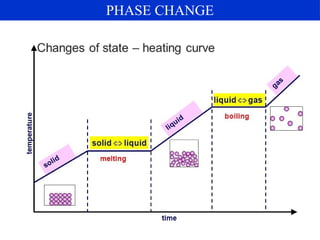
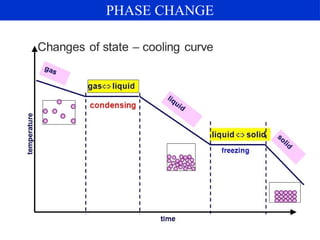
During phase changes,two physical states of the
substance exist at the same time.
When addition or removal of heat is stopped at
this temperature, the two physical states will
interconvert from one state to the other, and will
be at equilibrium.
PHASE CHANGE
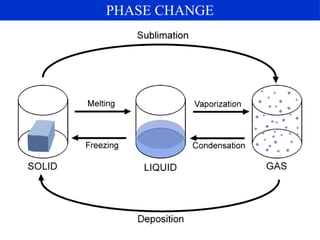
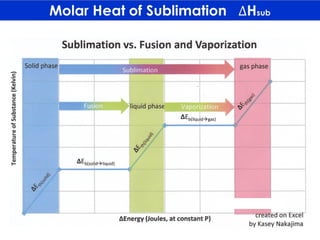
It is theamount of energy that must be added to a
mole of solid at constant pressure to turn it directly
into a gas, without passing through the liquid phase
This enthalpy change associated with sublimation
is always greater than that of vaporization even if
both sublimation and evaporation involve changing
a substance into its gaseous state because in
sublimation, the starting physical state of the
substance is the solid state, which is lower in energy
than the liquid state where vaporization starts.
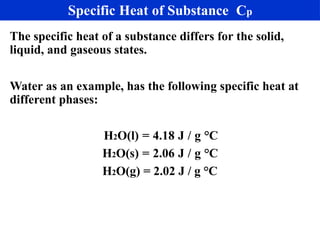
The specific heatof a substance differs for the solid,
liquid, and gaseous states.
Water as an example, has the following specific heat at
different phases:
H2O(l) = 4.18 J / g °C
H2O(s) = 2.06 J / g °C
H2O(g) = 2.02 J / g °C
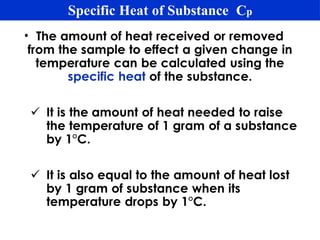
Specific Heat of Substance Cp
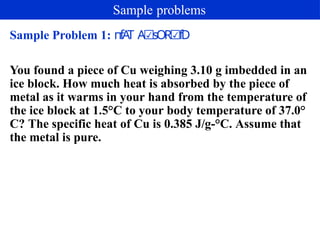
Sample Problem 1:пfA
T A sOR fD
☑ ☑
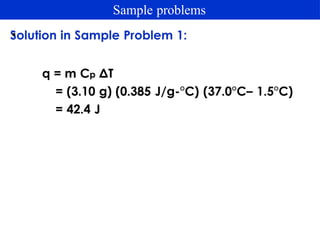
You found a piece of Cu weighing 3.10 g imbedded in an
ice block. How much heat is absorbed by the piece of
metal as it warms in your hand from the temperature of
the ice block at 1.5°C to your body temperature of 37.0°
C? The specific heat of Cu is 0.385 J/g-°C. Assume that
the metal is pure.
Sample problems
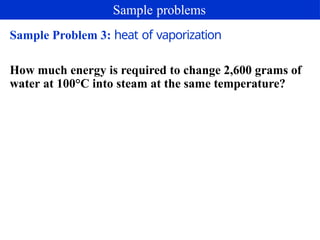
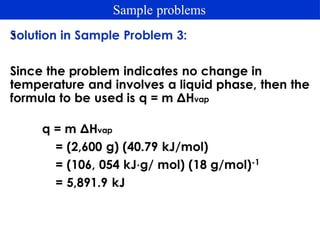
Sample Problem 3:heat of vaporization
How much energy is required to change 2,600 grams of
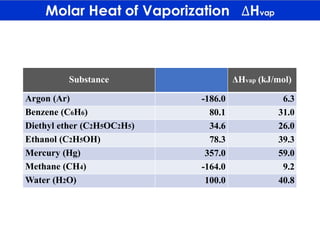
water at 100°C into steam at the same temperature?
Sample problems
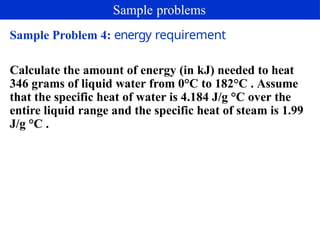
Sample Problem 4:energy requirement
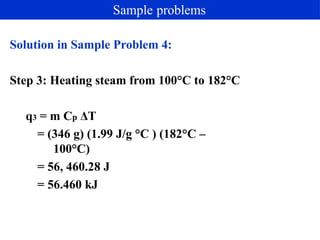
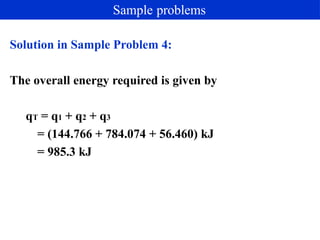
Calculate the amount of energy (in kJ) needed to heat
346 grams of liquid water from 0°C to 182°C . Assume
that the specific heat of water is 4.184 J/g °C over the
entire liquid range and the specific heat of steam is 1.99
J/g °C .
Sample problems
28.
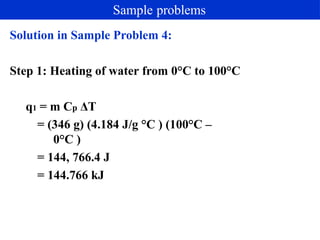
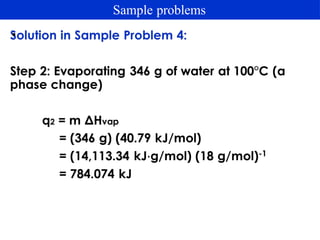
Solution in SampleProblem 4:
Step 1: Heating of water from 0°C to 100°C
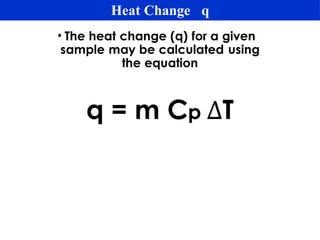
q1 = m Cp ΔT
= (346 g) (4.184 J/g °C ) (100°C –
0°C )
= 144, 766.4 J
= 144.766 kJ
Sample problems
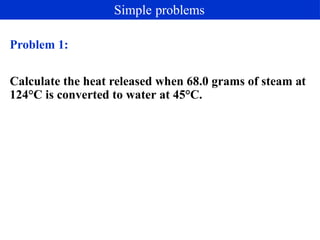
Problem 1:
Calculate theheat released when 68.0 grams of steam at
124°C is converted to water at 45°C.
Simple problems
34.
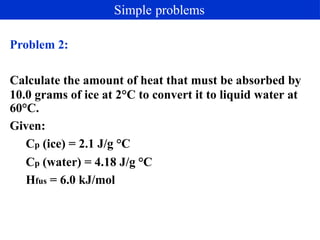
Problem 2:
Calculate theamount of heat that must be absorbed by
10.0 grams of ice at 2°C to convert it to liquid water at
60°C.
Given:
Cp (ice) = 2.1 J/g °C
Cp (water) = 4.18 J/g °C
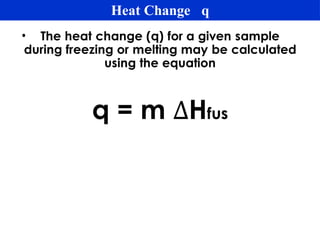
Hfus = 6.0 kJ/mol
Simple problems
35.
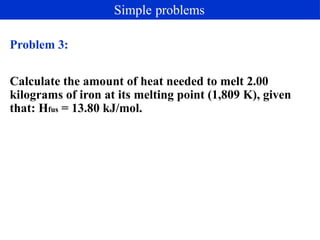
Problem 3:
Calculate theamount of heat needed to melt 2.00
kilograms of iron at its melting point (1,809 K), given
that: Hfus = 13.80 kJ/mol.
Simple problems
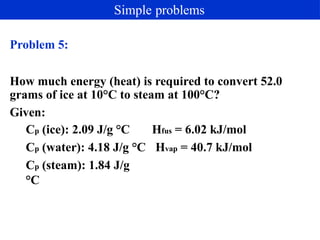
Problem 5:
How muchenergy (heat) is required to convert 52.0
grams of ice at 10°C to steam at 100°C?
Given:
Hfus = 6.02 kJ/mol
Hvap = 40.7 kJ/mol
Cp (ice): 2.09 J/g °C
Cp (water): 4.18 J/g °C
Cp (steam): 1.84 J/g
°C
Simple problems
38.
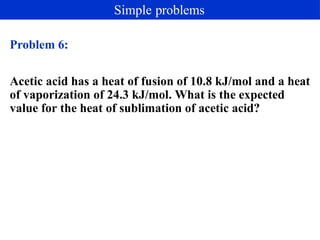
Problem 6:
Acetic acidhas a heat of fusion of 10.8 kJ/mol and a heat
of vaporization of 24.3 kJ/mol. What is the expected
value for the heat of sublimation of acetic acid?
Simple problems





![谷歌留痕技术 [ 𝙩𝙤𝙥 𝟮𝟯𝟯. 𝙘 𝙤𝙢 ]](https://cdn.slidesharecdn.com/ss_thumbnails/top233-260130174328-3833018c-thumbnail.jpg?width=640&height=640&fit=bounds)


