Present by:

  ‘izzat najmi bin ibrahim

Noor fatinah binti muhd rusli

  Punitha A/P Nagappan
DEFINITITION
   A material's heat capacity is a measure of how much energy
    must be exchanged between an object and its environment
    to produce a change in temperature. In other words, it is a
    measure of an object's "capacity" to hold "heat." Materials
    with high heat capacities, such as water, require large
    amounts of energy to produce a small temperature change.


          Heat Capacity
          Heat capacity is the amount of heat required to increase
          the temperature of an object by 1 oC (or 1 K).
TYPE OF HEAT CAPACITY

 Molar heat capacity
 Specific heat

 Heat capacity
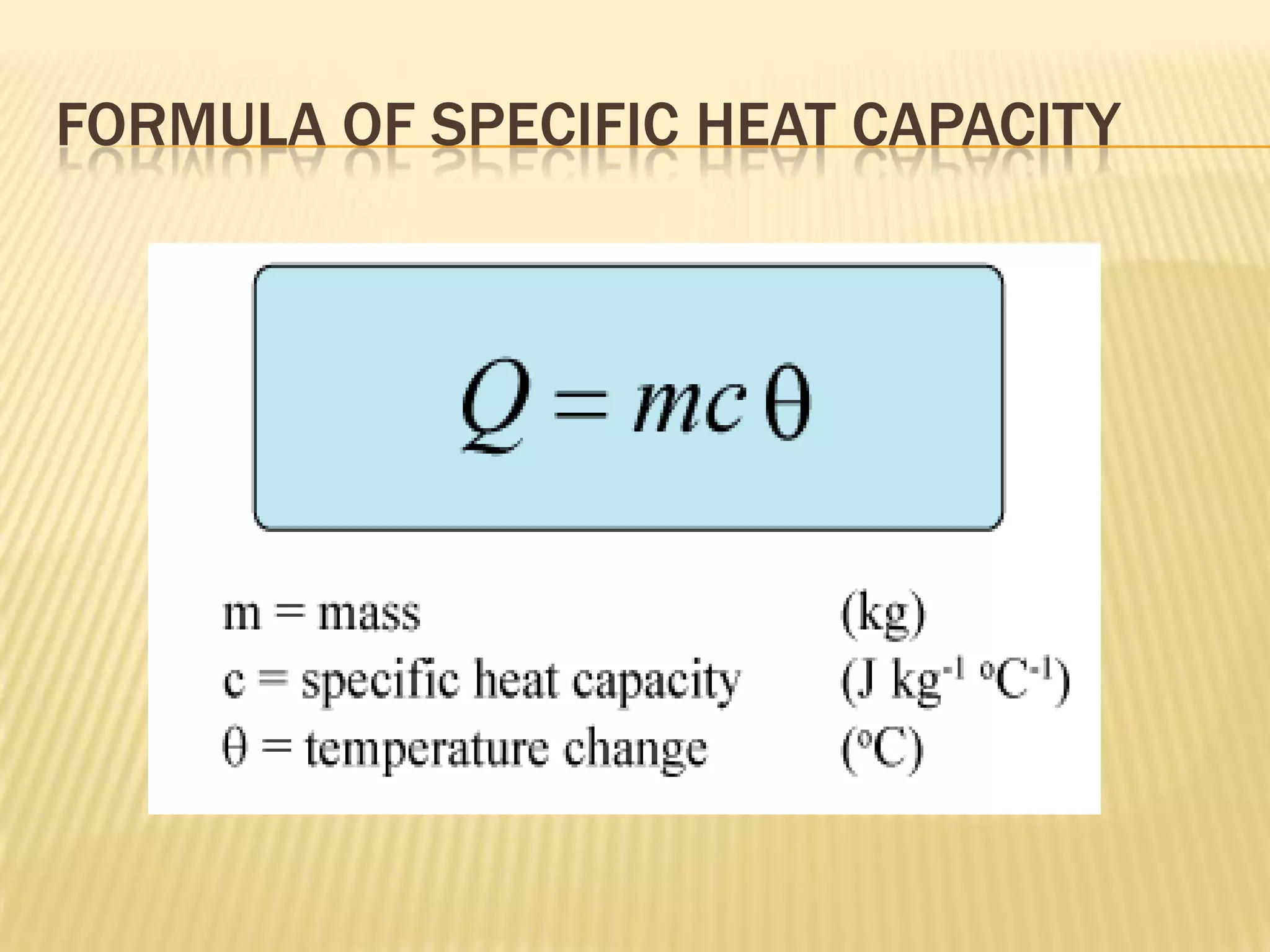
FORMULA OF SPECIFIC HEAT CAPACITY
EXAMPLE
How much thermal energy is required to raise the temperature of a 2
  kg aluminium block from 25     C to 30       C? [The specific heat
  capacity of aluminium is 900 Jkg-1 oC-1]
Answer:
Mass, m = 2kg
  Specific heat capacity, c = 900 Jkg-1 oC-1
  Temperature change, θ = 30 - 25 = 5 oC
Thermal energy required,
  Q = mcθ = (2)(900)(5) = 9000J.
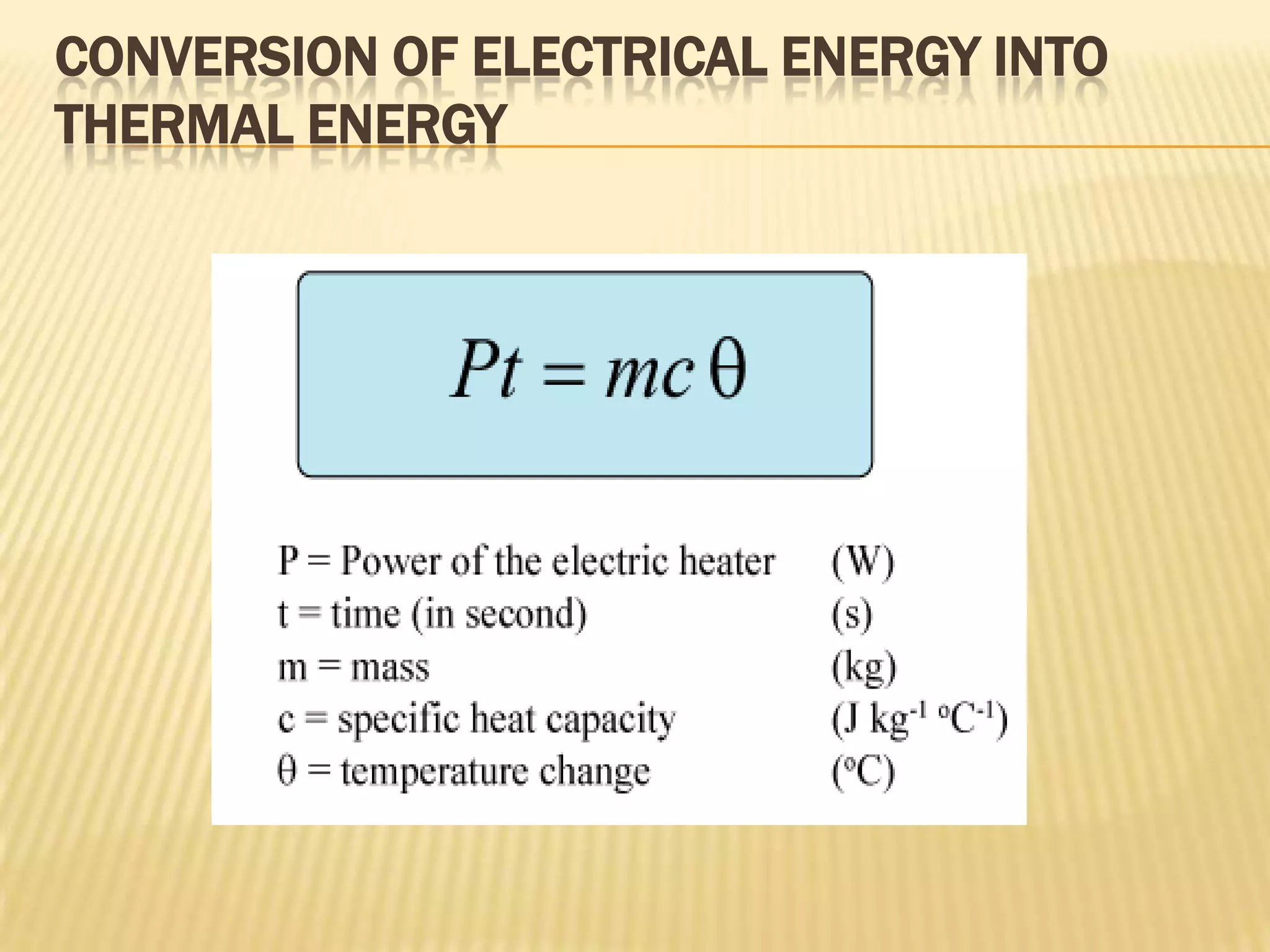
CONVERSION OF ELECTRICAL ENERGY INTO
THERMAL ENERGY
EXAMPLE
   A lead shot of mass 5g is placed at the bottom of a vertical cylinder that
is 1m long and closed at both ends. The cylinder is inverted so that the shot
falls 1 m. By how much will the temperature of the shot increase if this
process is repeated 100 times? [The specific heat capacity of lead is
130Jkg-1K-1]
 Answer:

 m = 5g
h = 1m × 100 = 100m
g = 10 ms-2
c = 130Jkg-1K-1
θ=?
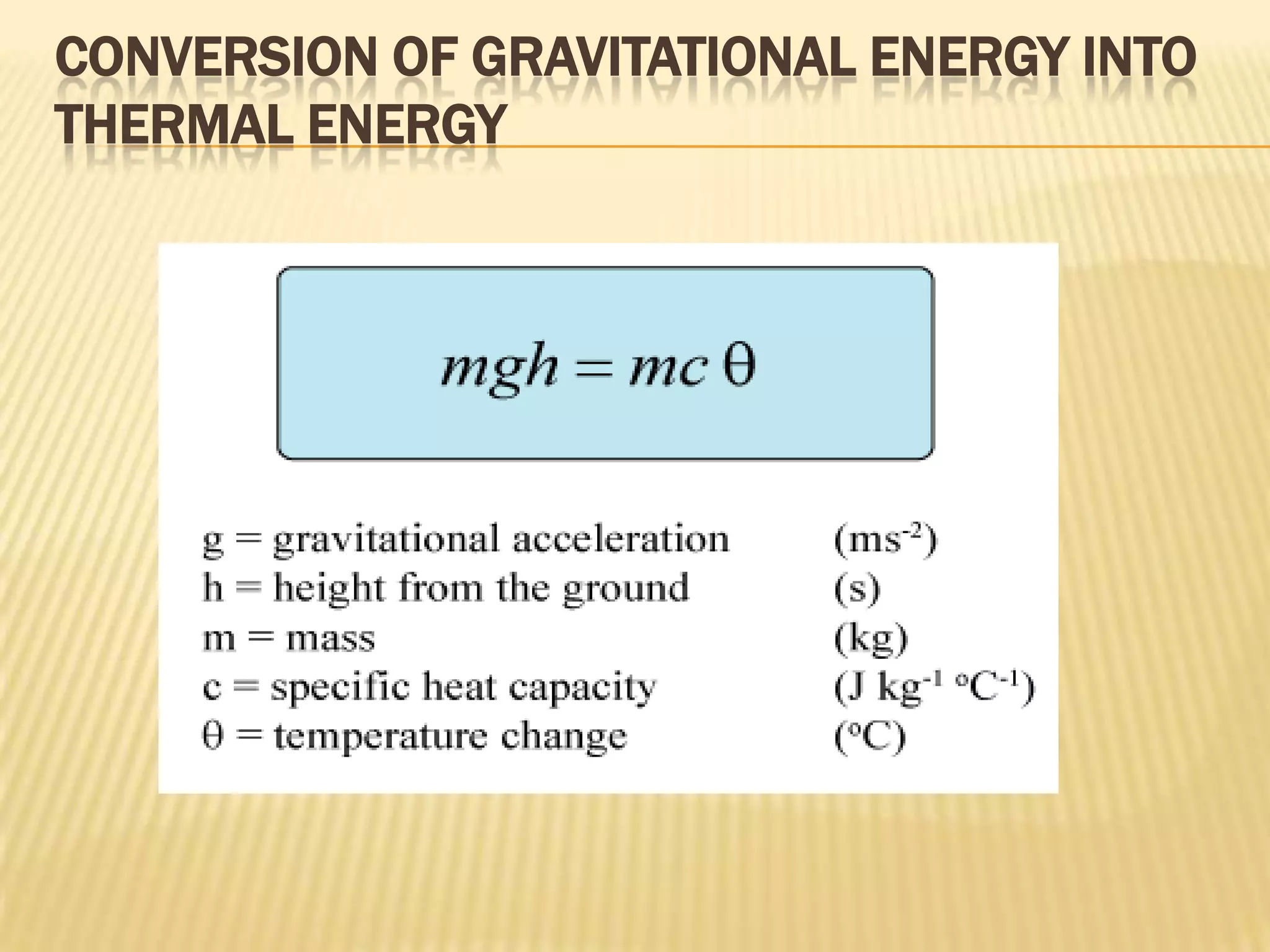
 In this case, the energy conversion is from potential energy to heat
energy. We assume that all potential energy is converted into heat energy.
Therefore
 mgh = mcθ
gh = cθ
CONVERSION OF GRAVITATIONAL ENERGY INTO
THERMAL ENERGY
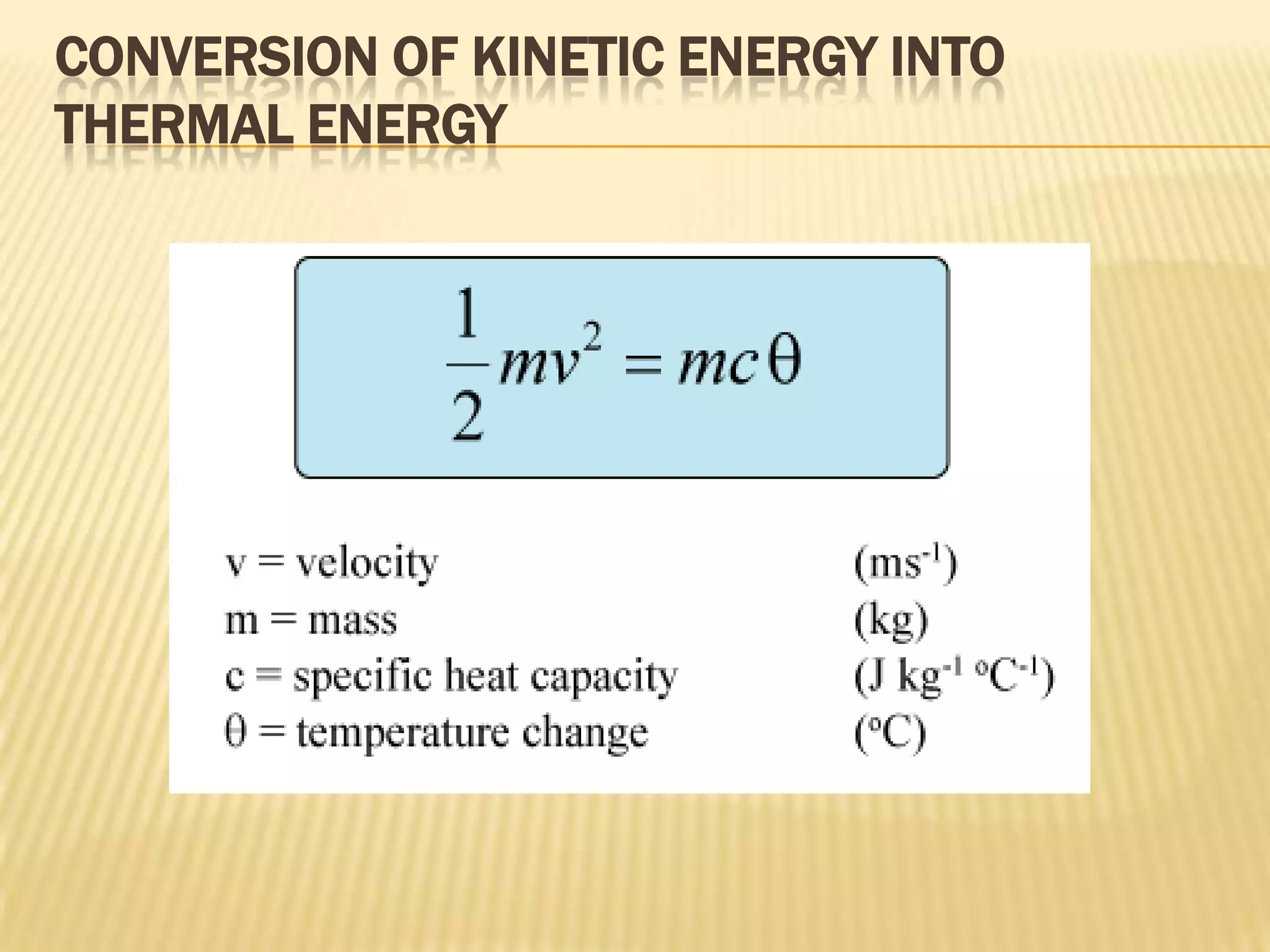
CONVERSION OF KINETIC ENERGY INTO
THERMAL ENERGY
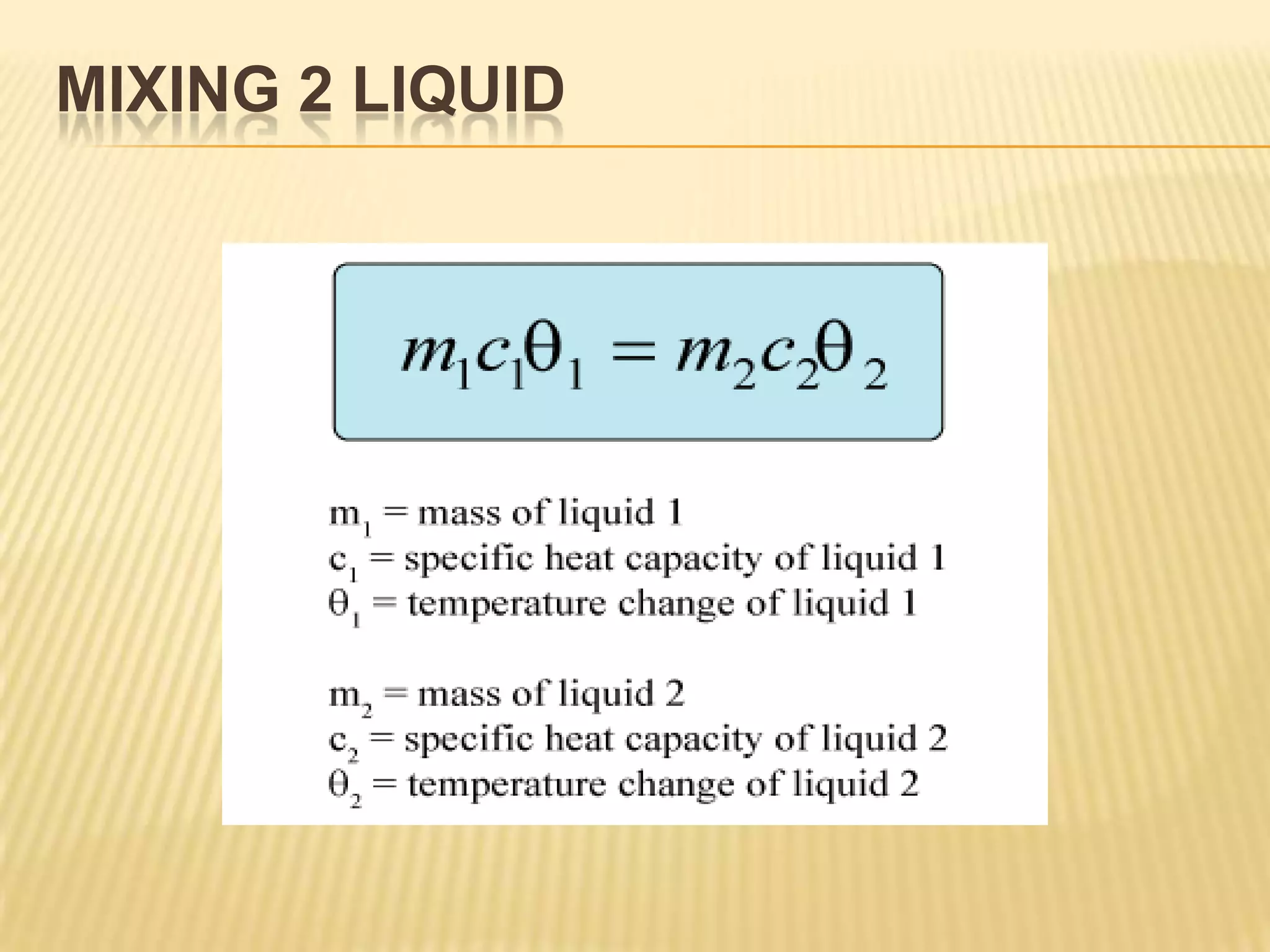
MIXING 2 LIQUID
EXAMPLE
Example 4
What will be the final temperature if 500 cm3 of water at 0 �C is added to
   200cm3 of water at 90 �C? [Density of water = 1gcm-3]
Answer:
The density of water is 1g/cm3, which means the mass of 1 cm3 of water is
   equal to 1g.
Let the final temperature = θ
   m1 = 500g = 0.5kg
   c1 = c
   θ1 = θ - 0 = θ
   m2 = 200g = 0.2kg
   c2 = c
   θ2 = 90 - θ
m1c1θ1 = m2c2θ2
   (0.5) c ( θ ) = (0.2) c ( 90 - θ )
   0.5 θ = 18 - 0.2 θ
   0.5 θ + 0.2 θ = 18
   0.7 θ = 18
   θ = 25.71 oC
THE END

specific heat capacity

  • 1.
    Present by: ‘izzat najmi bin ibrahim Noor fatinah binti muhd rusli Punitha A/P Nagappan
  • 2.
    DEFINITITION  A material's heat capacity is a measure of how much energy must be exchanged between an object and its environment to produce a change in temperature. In other words, it is a measure of an object's "capacity" to hold "heat." Materials with high heat capacities, such as water, require large amounts of energy to produce a small temperature change. Heat Capacity Heat capacity is the amount of heat required to increase the temperature of an object by 1 oC (or 1 K).
  • 3.
    TYPE OF HEATCAPACITY  Molar heat capacity  Specific heat  Heat capacity
  • 4.
    FORMULA OF SPECIFICHEAT CAPACITY
  • 5.
    EXAMPLE How much thermalenergy is required to raise the temperature of a 2 kg aluminium block from 25 C to 30 C? [The specific heat capacity of aluminium is 900 Jkg-1 oC-1] Answer: Mass, m = 2kg Specific heat capacity, c = 900 Jkg-1 oC-1 Temperature change, θ = 30 - 25 = 5 oC Thermal energy required, Q = mcθ = (2)(900)(5) = 9000J.
  • 6.
    CONVERSION OF ELECTRICALENERGY INTO THERMAL ENERGY
  • 7.
    EXAMPLE  A lead shot of mass 5g is placed at the bottom of a vertical cylinder that is 1m long and closed at both ends. The cylinder is inverted so that the shot falls 1 m. By how much will the temperature of the shot increase if this process is repeated 100 times? [The specific heat capacity of lead is 130Jkg-1K-1]  Answer:  m = 5g h = 1m × 100 = 100m g = 10 ms-2 c = 130Jkg-1K-1 θ=?  In this case, the energy conversion is from potential energy to heat energy. We assume that all potential energy is converted into heat energy. Therefore  mgh = mcθ gh = cθ
  • 8.
    CONVERSION OF GRAVITATIONALENERGY INTO THERMAL ENERGY
  • 9.
    CONVERSION OF KINETICENERGY INTO THERMAL ENERGY
  • 10.
  • 11.
    EXAMPLE Example 4 What willbe the final temperature if 500 cm3 of water at 0 �C is added to 200cm3 of water at 90 �C? [Density of water = 1gcm-3] Answer: The density of water is 1g/cm3, which means the mass of 1 cm3 of water is equal to 1g. Let the final temperature = θ m1 = 500g = 0.5kg c1 = c θ1 = θ - 0 = θ m2 = 200g = 0.2kg c2 = c θ2 = 90 - θ m1c1θ1 = m2c2θ2 (0.5) c ( θ ) = (0.2) c ( 90 - θ ) 0.5 θ = 18 - 0.2 θ 0.5 θ + 0.2 θ = 18 0.7 θ = 18 θ = 25.71 oC
  • 12.