By iTutor.com
T- 1-855-694-8886
Email- info@iTutor.com
Energy that flows from something warm to
something cooler
A hotter substance gives KE to a cooler one
Heat is the transfer of energy between two objects
due to temperature differences
Heat is measured in Joules (J) because it is a form
of energy
Heat
Heat
 The name of the transfer process is heat. What gets
transferred is energy.
 Heat is NOT a substance although it is very
convenient to think of it that way.
In fact, it used to be thought that heat was a
substance.
There is a circular nature to the definitions used:
(a) energy does work or produces heat, but
(b) heat is a transfer of energy.
Temperature
 Temperature is the property which determines the
direction heat will flow when two objects are
brought into contact
 Based on the motion of the particles in a
substance
Fast motion = high temperature
Slower motion = lower temperature
 Relatively describes how the particles collide with
the surface of the thermometer
 Collisions transfer energy
Temperature Scales
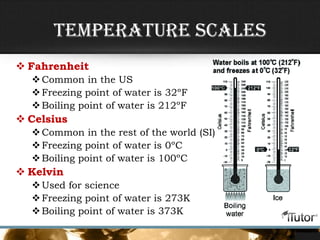
 Fahrenheit
Common in the US
Freezing point of water is 32ºF
Boiling point of water is 212ºF
 Celsius
Common in the rest of the world (SI)
Freezing point of water is 0ºC
Boiling point of water is 100ºC
 Kelvin
Used for science
Freezing point of water is 273K
Boiling point of water is 373K
Temperature and the Phases
of Matter
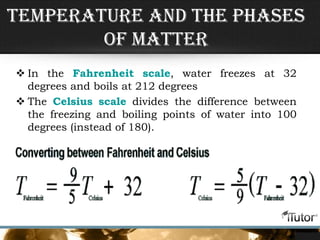
 In the Fahrenheit scale, water freezes at 32
degrees and boils at 212 degrees
 The Celsius scale divides the difference between
the freezing and boiling points of water into 100
degrees (instead of 180).
Temperature and the Phases
of Matter
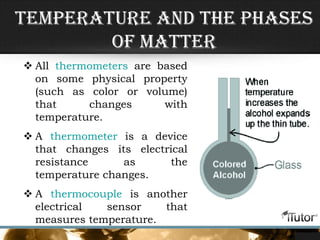
 All thermometers are based
on some physical property
(such as color or volume)
that changes with
temperature.
 A thermometer is a device
that changes its electrical
resistance as the
temperature changes.
 A thermocouple is another
electrical sensor that
measures temperature.
Heat and Thermal Energy
 Temperature is NOT the same as thermal energy.
 Thermal energy is energy stored in materials
because of differences in temperature.
 The thermal energy of an object is the total
amount of random kinetic energy for all the atoms
in the object.
 Remember, temperature measures the random
kinetic energy of each atom.
Heat and Thermal Energy
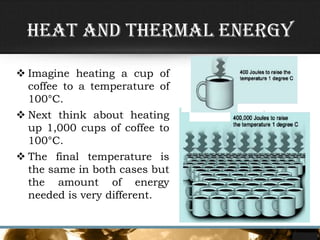
 Imagine heating a cup of
coffee to a temperature of
100°C.
 Next think about heating
up 1,000 cups of coffee to
100°C.
 The final temperature is
the same in both cases but
the amount of energy
needed is very different.
First Law of Thermodynamics
 Energy loss is equal to energy gain.
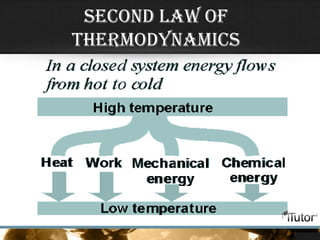
Second Law of
Thermodynamics
Energy and Heat flow
There Energy, in the process we call heat or heat flow,
is constantly flowing into and out of all objects,
including living objects.
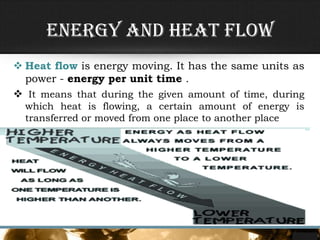
 Heat flow moves energy from a higher temperature to
a lower temperature.
The bigger the difference in temperature between two
objects, the faster heat flows between them.
When temperatures are the same there is no change in
energy due to heat flow.
Radiation and Conduction are the two methods of heat
transfer. Convection is a special type of conduction.
Heat has the units of energy; heat flow has the units of
power.
 Heat flow is energy moving. It has the same units as
power - energy per unit time .
 It means that during the given amount of time, during
which heat is flowing, a certain amount of energy is
transferred or moved from one place to another place
Energy and Heat flow
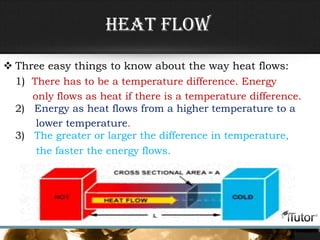
 Three easy things to know about the way heat flows:
1) There has to be a temperature difference. Energy
only flows as heat if there is a temperature difference.
2) Energy as heat flows from a higher temperature to a
lower temperature.
3) The greater or larger the difference in temperature,
the faster the energy flows.
Heat flow
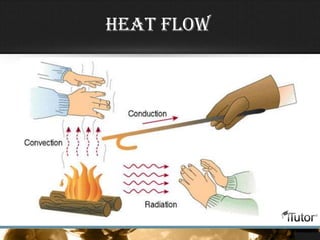
 The science of how heat flows is called heat transfer.
 There are three ways heat transfer works:
conduction, convection, and radiation.
 Heat flow depends on the temperature difference.
Heat flow
Heat flow
Heat Conduction
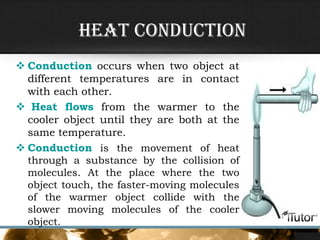
 Conduction occurs when two object at
different temperatures are in contact
with each other.
 Heat flows from the warmer to the
cooler object until they are both at the
same temperature.
 Conduction is the movement of heat
through a substance by the collision of
molecules. At the place where the two
object touch, the faster-moving molecules
of the warmer object collide with the
slower moving molecules of the cooler
object.
Heat Conduction
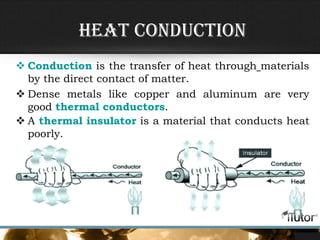
 Conduction is the transfer of heat through materials
by the direct contact of matter.
 Dense metals like copper and aluminum are very
good thermal conductors.
 A thermal insulator is a material that conducts heat
poorly.
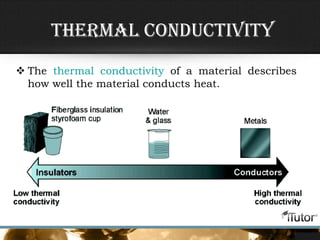
Thermal Conductivity
 The thermal conductivity of a material describes
how well the material conducts heat.
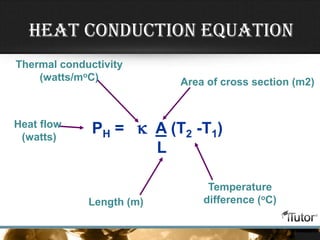
Heat Conduction Equation
PH = k A (T2 -T1)
L
Area of cross section (m2)
Length (m)
Thermal conductivity
(watts/moC)
Heat flow
(watts)
Temperature
difference (oC)
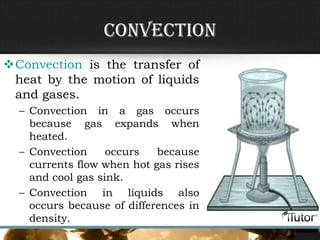
Convection
Convection is the transfer of
heat by the motion of liquids
and gases.
– Convection in a gas occurs
because gas expands when
heated.
– Convection occurs because
currents flow when hot gas rises
and cool gas sink.
– Convection in liquids also
occurs because of differences in
density.
Convection
 When the flow of gas or
liquid comes from
differences in density and
temperature, it is called
free convection.
 When the flow of gas or
liquid is circulated by
pumps or fans it is called
forced convection.
Convection
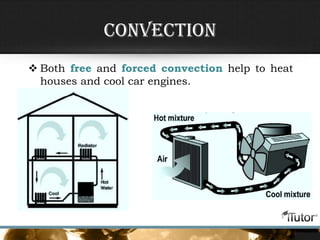
 Both free and forced convection help to heat
houses and cool car engines.
Convection
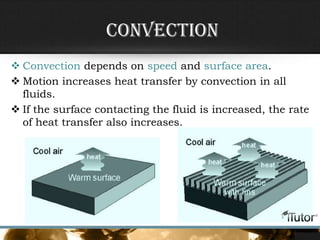
 Convection depends on speed and surface area.
 Motion increases heat transfer by convection in all
fluids.
 If the surface contacting the fluid is increased, the rate
of heat transfer also increases.
Convection and Sea
Breezes
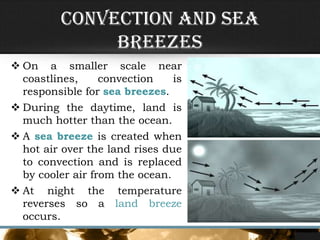
 On a smaller scale near
coastlines, convection is
responsible for sea breezes.
 During the daytime, land is
much hotter than the ocean.
 A sea breeze is created when
hot air over the land rises due
to convection and is replaced
by cooler air from the ocean.
 At night the temperature
reverses so a land breeze
occurs.
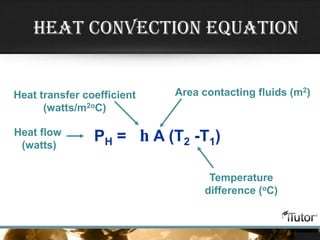
Heat Convection Equation
PH = h A (T2 -T1)
Area contacting fluids (m2)Heat transfer coefficient
(watts/m2oC)
Heat flow
(watts)
Temperature
difference (oC)
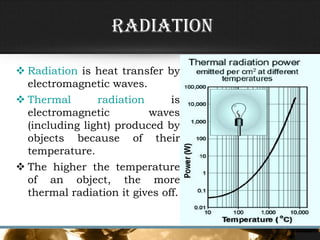
Radiation
 Radiation is heat transfer by
electromagnetic waves.
 Thermal radiation is
electromagnetic waves
(including light) produced by
objects because of their
temperature.
 The higher the temperature
of an object, the more
thermal radiation it gives off.
• Radiation
Radiation
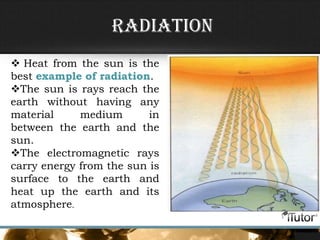
 Heat from the sun is the
best example of radiation.
The sun is rays reach the
earth without having any
material medium in
between the earth and the
sun.
The electromagnetic rays
carry energy from the sun is
surface to the earth and
heat up the earth and its
atmosphere.
Radiant Heat
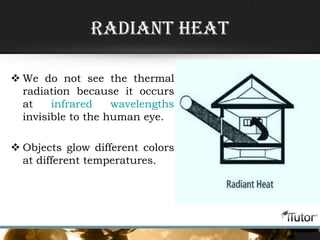
 We do not see the thermal
radiation because it occurs
at infrared wavelengths
invisible to the human eye.
 Objects glow different colors
at different temperatures.
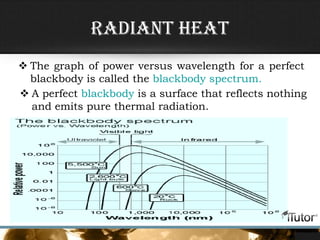
 The graph of power versus wavelength for a perfect
blackbody is called the blackbody spectrum.
Radiant Heat
 A perfect blackbody is a surface that reflects nothing
and emits pure thermal radiation.
Radiant Heat
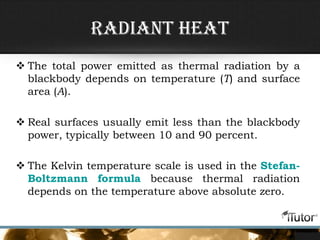
 The total power emitted as thermal radiation by a
blackbody depends on temperature (T) and surface
area (A).
 Real surfaces usually emit less than the blackbody
power, typically between 10 and 90 percent.
 The Kelvin temperature scale is used in the Stefan-
Boltzmann formula because thermal radiation
depends on the temperature above absolute zero.
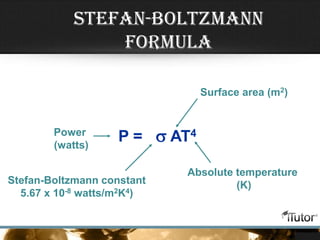
Stefan-Boltzmann
formula
P = s AT4
Surface area (m2)
Stefan-Boltzmann constant
5.67 x 10⁻⁸ watts/m2K4)
Power
(watts)
Absolute temperature
(K)
The End
www.iTutor.com

Heat & Thermodynamics

  • 1.
  • 2.
    Energy that flowsfrom something warm to something cooler A hotter substance gives KE to a cooler one Heat is the transfer of energy between two objects due to temperature differences Heat is measured in Joules (J) because it is a form of energy Heat
  • 3.
    Heat  The nameof the transfer process is heat. What gets transferred is energy.  Heat is NOT a substance although it is very convenient to think of it that way. In fact, it used to be thought that heat was a substance. There is a circular nature to the definitions used: (a) energy does work or produces heat, but (b) heat is a transfer of energy.
  • 4.
    Temperature  Temperature isthe property which determines the direction heat will flow when two objects are brought into contact  Based on the motion of the particles in a substance Fast motion = high temperature Slower motion = lower temperature  Relatively describes how the particles collide with the surface of the thermometer  Collisions transfer energy
  • 5.
    Temperature Scales  Fahrenheit Commonin the US Freezing point of water is 32ºF Boiling point of water is 212ºF  Celsius Common in the rest of the world (SI) Freezing point of water is 0ºC Boiling point of water is 100ºC  Kelvin Used for science Freezing point of water is 273K Boiling point of water is 373K
  • 6.
    Temperature and thePhases of Matter  In the Fahrenheit scale, water freezes at 32 degrees and boils at 212 degrees  The Celsius scale divides the difference between the freezing and boiling points of water into 100 degrees (instead of 180).
  • 7.
    Temperature and thePhases of Matter  All thermometers are based on some physical property (such as color or volume) that changes with temperature.  A thermometer is a device that changes its electrical resistance as the temperature changes.  A thermocouple is another electrical sensor that measures temperature.
  • 8.
    Heat and ThermalEnergy  Temperature is NOT the same as thermal energy.  Thermal energy is energy stored in materials because of differences in temperature.  The thermal energy of an object is the total amount of random kinetic energy for all the atoms in the object.  Remember, temperature measures the random kinetic energy of each atom.
  • 9.
    Heat and ThermalEnergy  Imagine heating a cup of coffee to a temperature of 100°C.  Next think about heating up 1,000 cups of coffee to 100°C.  The final temperature is the same in both cases but the amount of energy needed is very different.
  • 10.
    First Law ofThermodynamics  Energy loss is equal to energy gain.
  • 11.
  • 12.
    Energy and Heatflow There Energy, in the process we call heat or heat flow, is constantly flowing into and out of all objects, including living objects.  Heat flow moves energy from a higher temperature to a lower temperature. The bigger the difference in temperature between two objects, the faster heat flows between them. When temperatures are the same there is no change in energy due to heat flow. Radiation and Conduction are the two methods of heat transfer. Convection is a special type of conduction. Heat has the units of energy; heat flow has the units of power.
  • 13.
     Heat flowis energy moving. It has the same units as power - energy per unit time .  It means that during the given amount of time, during which heat is flowing, a certain amount of energy is transferred or moved from one place to another place Energy and Heat flow
  • 14.
     Three easythings to know about the way heat flows: 1) There has to be a temperature difference. Energy only flows as heat if there is a temperature difference. 2) Energy as heat flows from a higher temperature to a lower temperature. 3) The greater or larger the difference in temperature, the faster the energy flows. Heat flow
  • 15.
     The scienceof how heat flows is called heat transfer.  There are three ways heat transfer works: conduction, convection, and radiation.  Heat flow depends on the temperature difference. Heat flow
  • 16.
  • 17.
    Heat Conduction  Conductionoccurs when two object at different temperatures are in contact with each other.  Heat flows from the warmer to the cooler object until they are both at the same temperature.  Conduction is the movement of heat through a substance by the collision of molecules. At the place where the two object touch, the faster-moving molecules of the warmer object collide with the slower moving molecules of the cooler object.
  • 18.
    Heat Conduction  Conductionis the transfer of heat through materials by the direct contact of matter.  Dense metals like copper and aluminum are very good thermal conductors.  A thermal insulator is a material that conducts heat poorly.
  • 19.
    Thermal Conductivity  Thethermal conductivity of a material describes how well the material conducts heat.
  • 20.
    Heat Conduction Equation PH= k A (T2 -T1) L Area of cross section (m2) Length (m) Thermal conductivity (watts/moC) Heat flow (watts) Temperature difference (oC)
  • 21.
    Convection Convection is thetransfer of heat by the motion of liquids and gases. – Convection in a gas occurs because gas expands when heated. – Convection occurs because currents flow when hot gas rises and cool gas sink. – Convection in liquids also occurs because of differences in density.
  • 22.
    Convection  When theflow of gas or liquid comes from differences in density and temperature, it is called free convection.  When the flow of gas or liquid is circulated by pumps or fans it is called forced convection.
  • 23.
    Convection  Both freeand forced convection help to heat houses and cool car engines.
  • 24.
    Convection  Convection dependson speed and surface area.  Motion increases heat transfer by convection in all fluids.  If the surface contacting the fluid is increased, the rate of heat transfer also increases.
  • 25.
    Convection and Sea Breezes On a smaller scale near coastlines, convection is responsible for sea breezes.  During the daytime, land is much hotter than the ocean.  A sea breeze is created when hot air over the land rises due to convection and is replaced by cooler air from the ocean.  At night the temperature reverses so a land breeze occurs.
  • 26.
    Heat Convection Equation PH= h A (T2 -T1) Area contacting fluids (m2)Heat transfer coefficient (watts/m2oC) Heat flow (watts) Temperature difference (oC)
  • 27.
    Radiation  Radiation isheat transfer by electromagnetic waves.  Thermal radiation is electromagnetic waves (including light) produced by objects because of their temperature.  The higher the temperature of an object, the more thermal radiation it gives off.
  • 28.
    • Radiation Radiation  Heatfrom the sun is the best example of radiation. The sun is rays reach the earth without having any material medium in between the earth and the sun. The electromagnetic rays carry energy from the sun is surface to the earth and heat up the earth and its atmosphere.
  • 29.
    Radiant Heat  Wedo not see the thermal radiation because it occurs at infrared wavelengths invisible to the human eye.  Objects glow different colors at different temperatures.
  • 30.
     The graphof power versus wavelength for a perfect blackbody is called the blackbody spectrum. Radiant Heat  A perfect blackbody is a surface that reflects nothing and emits pure thermal radiation.
  • 31.
    Radiant Heat  Thetotal power emitted as thermal radiation by a blackbody depends on temperature (T) and surface area (A).  Real surfaces usually emit less than the blackbody power, typically between 10 and 90 percent.  The Kelvin temperature scale is used in the Stefan- Boltzmann formula because thermal radiation depends on the temperature above absolute zero.
  • 32.
    Stefan-Boltzmann formula P = sAT4 Surface area (m2) Stefan-Boltzmann constant 5.67 x 10⁻⁸ watts/m2K4) Power (watts) Absolute temperature (K)
  • 33.