


Unit 5 PROTECTION  &  CONTROL
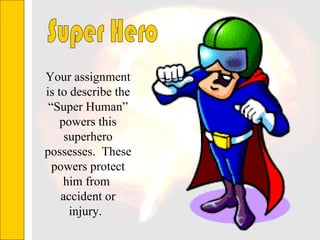
Your assignment is to describe the “Super Human” powers this superhero possesses.  These powers protect him from  accident or injury.   Super Hero
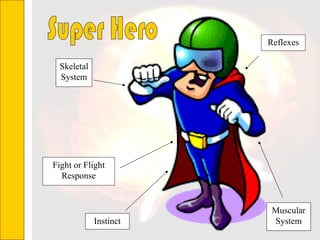
Skeletal System Fight or Flight Response Instinct Muscular System Reflexes Super Hero
Immune System Our immune system is our body's natural defense against disease. It includes our lymphatic system and all the various types of white blood cells that recognize, engulf and destroy pathogenic (disease-causing) viruses, fungi, bacteria, and parasites.
The “Bubble Boy ”
The Body's Natural Defenses  When you get a cut   When a mosquito bites you   Each day you inhale thousands of germs  Each day you also eat hundreds of germs  Allergies  Organ transplants
Lines of Defense We are equipped with special defenses against such opportunistic invaders. These defenses include the  skin ;  mucous  in such places as the lungs, nasal passages, etc.;  acids  and  enzymes  in the digestive tract; and when these mechanisms fail, the  immune system . The immune system can be divided into two categories:  nonspecific defenses  and  specific defenses .
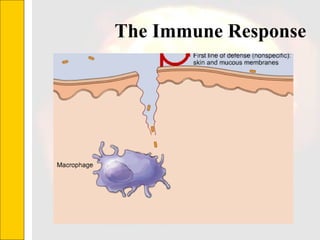
The Immune Response
Nonspecific Defenses Nonspecific defenses are effective against a wide variety of pathogens. They are subdivided into  first-line  defenses second-line  defenses.
First Line of Defense Physical and Chemical Barriers The  skin  is a passive barrier to infectious agents such as bacteria and viruses. Skin glands (oil and sweat) secrete chemicals that produce a pH of 3-5 and retard the growth of bacteria.  Many microorganisms are trapped by the  mucous  that lines the openings to the body such as the nasal passages, lungs, digestive system, urinary system and reproductive system. Organisms are trapped by this mucous and ejected from the body by mechanisms such as a cough or a sneeze.  Cilia  that line our respiratory tract also act by sweeping away foreign particles that enter.   Non-Specific
First Line of Defense Physical and Chemical Barriers Tears and saliva secrete enzymes called  lysozymes  that breakdown bacterial cell walls.  Organisms that enter through the mouth in our food or drink are usually killed by the  acids  in the stomach.  Non-Specific
First Line of Defense Non-Specific
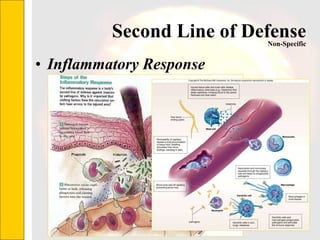
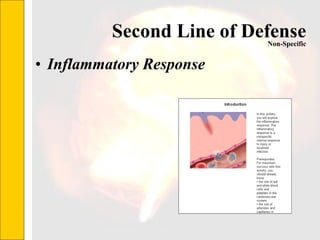
Second Line of Defense Inflammatory response When microorganisms penetrate the skin or the epithelium lining the respiratory, digestive, or urinary tracts, it results in inflammation. This reaction is called the  inflammatory response . Damaged cells release chemical signals such as  histamine  that increase capillary blood flow into the affected area (causing the areas to become heated and reddened).  The heat makes the environment unfavorable for microbes and raises the mobility of white blood cells. It also increases the metabolic rate of nearby cells. Capillaries pass fluid into interstitial areas, causing the infected/injured area to swell. Platelets move out of the capillary to seal the wounded area .  Non-Specific
Second Line of Defense Inflammatory response Pathogens  (disease causing organisms) are attacked by  phagocytes , a type of white blood cell that acts by ingesting invading microbes.  The most common type of phagocyte is the  neutrophil . Neutrophils circulate freely through blood vessels, and they can squeeze between cells in the walls of a capillary to reach the site of infection. They then engulf and destroy any pathogens they encounter.  Non-Specific
Second Line of Defense Inflammatory response Another type of phagocyte is the  macrophage , a type of monocyte. Macrophages consume and destroy any pathogens they encounter and rid the body of worn out cells and cellular debris. Some macrophages are stationed in the tissues of the body, awaiting pathogens, while others move through the tissues and seek out pathogens. Finally, macrophages clean up dead microbes, cells, and debris.  Non-Specific
Second Line of Defense Inflammatory response A serious infection may allow pathogen to spread throughout the body. The immune system now responds in two ways. It produces more WBC’s and phagocytes release chemicals such as histamine that stimulate the actions of these WBC’s by increasing body temperature. Widespread heating of the tissue causes a  fever , an increase in body temperature. Body temperatures above 37 o  C offer powerful protection against the spread of pathogens by slowing or stopping the growth of some microbes.  Non-Specific
Second Line of Defense Inflammatory Response Non-Specific
Second Line of Defense Natural Killer Cells Large, granular lymphocytes Kill virus infected cells and tumor cells Kill by cell to cell contact Detect antigenic changes in cancerous cells and infected cells Nonspecific Have no memory Do not increase in number upon antigen exposure Non-Specific
Second Line of Defense Complement System The complement system, like antibodies, is a series of proteins.  There are only a handful of proteins in the complement system, and they are floating freely in your blood.  Complements are manufactured in the liver. The complement proteins are activated by and work with (complement) the antibodies, hence the name. They cause lysing (bursting) of cells and signal to phagocytes that a cell needs to be removed.  Non-Specific
Specific Defenses The immune system also generates specific responses to specific invaders. A specific defense mechanism builds up resistance against a specific pathogen or antigen.  This system is more effective than the nonspecific methods as it has a memory component that improves response time when an invader of the same type (or species) is again encountered. Specific defenses are tailored to an individual threat. Two types of specific defenses are  antibody-mediated  and  cell-mediated responses.
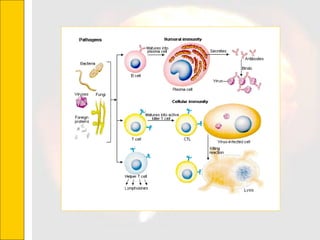
Antibody-Mediated (Humoral) Immunity  Results from the production of antibodies specific to a given antigen.  Antibodies  bind to the antigens on invaders and kill or inactivate them in several ways. Antigens  can be any molecule that causes antibody production.  Antibody-mediated immunity is provided by the B cells. Within a few days after an infection, an antigen causes the production of large amounts of the antibody capable of interacting with it.  Specific
Cell-Mediated Immunity  Requires direct physical contact with antigens. It is provided by T cells and does not involve the secretion of antibodies.  T cells are involved in the attacking of certain bacteria, viruses, fungi and immunity to cancer cells. Specific
Cell-Mediated Immunity  There are four kinds of T cells: Cytotoxic (Killer) T cell   Helper T cells   Suppressor T cells   Memory T cells   Specific
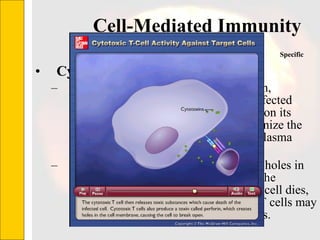
Cell-Mediated Immunity  Cytotoxic (Killer) T cell   Defends the body by destroying foreign, infected, and cancerous cells. A cell infected with a virus will display viral antigens on its plasma membrane. Killer T cells recognize the viral antigens and attach to that cell's plasma membrane.  The T cells secrete proteins that punch holes in the infected cell's plasma membrane. The infected cell's cytoplasm leaks out, the cell dies, and is removed by phagocytes. Killer T cells may also bind to cells of transplanted organs. Specific
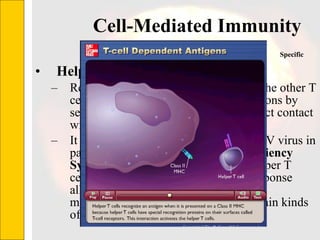
Cell-Mediated Immunity  Helper T cell   Regulate immune responses, enabling the other T cells and B cells to perform their functions by secreting messenger proteins or by direct contact with other cells.  It is this cell that is destroyed by the HIV virus in patients with  Acquired Immune Deficiency Syndrome (AIDS)  . Destruction of helper T cells results in a depressed immune response allowing infection by a variety of microorganisms and the growth of certain kinds of tumors. Specific
Cell-Mediated Immunity  Suppresor T cell   Reduce the immune response of B cells and T cells to keep them in check. Specific Memory T cell   Remain in the body awaiting the reintroduction of the antigen .
 
Primary vs Secondary Immune Response Primary Immune Response The production of antibodies from the first exposure to an antigen is known as the  primary immune response .  Secondary Immune Response A person who is resistant to a specific pathogen is said to have immunity to that pathogen. Once the body has been exposed to a disease, a large group of B cells and T cells remain capable of producing a  secondary immune response  if the pathogen re-appears in the body.
Primary vs Secondary Immune Response Secondary Immune Response The secondary immune response is a  naturally acquired immunity . A secondary immune response is more powerful than a primary immune response, producing antibodies so quickly that the disease never gets a chance to develop.  In secondary immunity, the resistance to certain diseases after having had them once, results from production of Memory B and T cells during the first exposure to the antigen. The secondary response is the basis for vaccination.
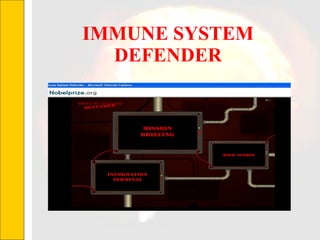
IMMUNE SYSTEM DEFENDER
IMMUNE ATTACK
What is a vaccination? A vaccine is a suspension of pathogens or portions of pathogens that is used to induce artificially acquired active immunity. Vaccines are made from killed pathogens or weakened strains that cause antibody production but not the disease. Vaccinations work in general by stimulating an immune response, and rely on the formation of memory cells of all kinds to be produced.
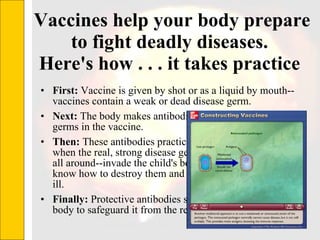
Vaccines help your body prepare to fight deadly diseases.   Here's how . . . it takes practice   First:  Vaccine is given by shot or as a liquid by mouth--vaccines contain a weak or dead disease germ.  Next:  The body makes antibodies to fight the weak or dead germs in the vaccine.  Then:  These antibodies practice on the weak germs so when the real, strong disease germs--which can be lurking all around--invade the child's body, the antibodies will know how to destroy them and the child will not become ill.  Finally:  Protective antibodies stay on guard in the child's body to safeguard it from the real disease germs.
Vaccines & Active Immunity Active immunity  develops after an illness or vaccine. Vaccines are weakened (or killed) viruses or bacteria that prompt the development of antibodies. Application of biotechnology allows development of vaccines that are the protein (antigen) which in no way can cause the disease.
Passive Immunity Passive immunity  is the type of immunity when the individual is given antibodies to combat a specific disease. Passive immunity is short-lived, usually only lasting for few weeks. Examples of passive immunity include: Milk from a mother's breast contains antibodies received by the baby. These antibodies will only last several weeks. A Gamma Globin shot is purely an injection of antibodies to provide temporary immunity. You might receive a Gamma Globin shot if you   travel outside of the country.
Lymphatic System
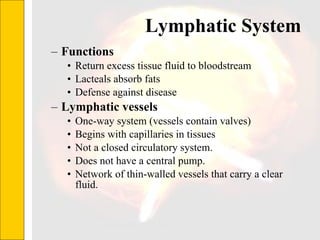
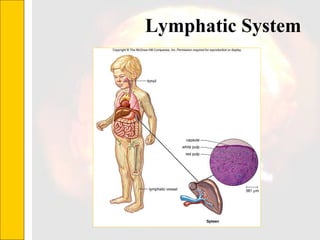
Lymphatic System  Functions Return excess tissue fluid to bloodstream Lacteals absorb fats  Defense against disease Lymphatic vessels One-way system (vessels contain valves) Begins with capillaries in tissues Not a closed circulatory system.  Does not have a central pump.  Network of thin-walled vessels that carry a clear fluid.
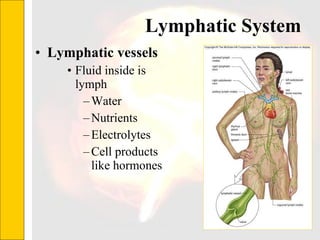
Lymphatic System  Lymphatic vessels Fluid inside is lymph Water Nutrients Electrolytes Cell products like hormones
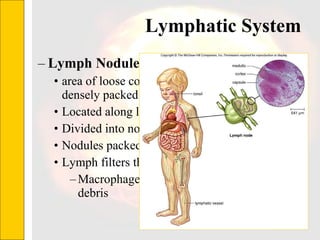
Lymphatic System  Lymph Nodules area of loose connective tissue containing densely packed lymphocytes Located along lymphatic vessels Divided into nodules by connective tissue Nodules packed with B and T lymphocytes Lymph filters through nodules Macrophages phagocytize pathogens and debris
Lymphatic System
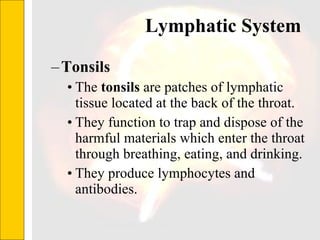
Lymphatic System  Tonsils The  tonsils  are patches of lymphatic tissue located at the back of the throat.  They function to trap and dispose of the harmful materials which enter the throat through breathing, eating, and drinking. They produce lymphocytes and antibodies.
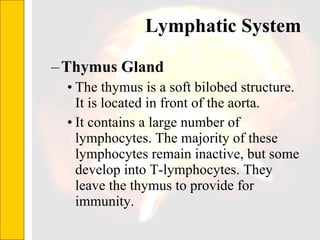
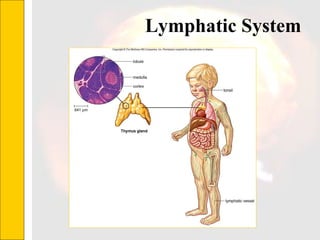
Lymphatic System  Thymus Gland The thymus is a soft bilobed structure.  It is located in front of the aorta. It contains a large number of lymphocytes. The majority of these lymphocytes remain inactive, but some develop into T-lymphocytes. They leave the thymus to provide for immunity.
Lymphatic System
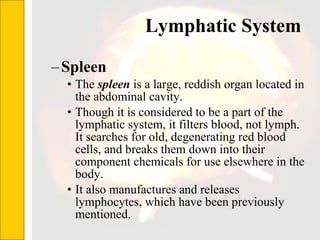
Lymphatic System  Spleen The  spleen  is a large, reddish organ located in the abdominal cavity.  Though it is considered to be a part of the lymphatic system, it filters blood, not lymph. It searches for old, degenerating red blood cells, and breaks them down into their component chemicals for use elsewhere in the body.  It also manufactures and releases lymphocytes, which have been previously mentioned.
Lymphatic System
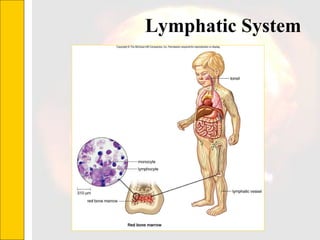
Lymphatic System  Bone Marrow Network of connective tissue fibers with sinuses  Stem cells produce blood cells Most bones in children contain red marrow Adults- ends of long bones, skull, pelvis, clavicle, vertebrae B lymphocytes mature in red marrow
Lymphatic System

Unit 5 Immune System

  • 1.
  • 2.
    Your assignment isto describe the “Super Human” powers this superhero possesses. These powers protect him from accident or injury. Super Hero
  • 3.
    Skeletal System Fightor Flight Response Instinct Muscular System Reflexes Super Hero
  • 4.
    Immune System Ourimmune system is our body's natural defense against disease. It includes our lymphatic system and all the various types of white blood cells that recognize, engulf and destroy pathogenic (disease-causing) viruses, fungi, bacteria, and parasites.
  • 5.
  • 6.
    The Body's NaturalDefenses When you get a cut When a mosquito bites you Each day you inhale thousands of germs Each day you also eat hundreds of germs Allergies Organ transplants
  • 7.
    Lines of DefenseWe are equipped with special defenses against such opportunistic invaders. These defenses include the skin ; mucous in such places as the lungs, nasal passages, etc.; acids and enzymes in the digestive tract; and when these mechanisms fail, the immune system . The immune system can be divided into two categories: nonspecific defenses and specific defenses .
  • 8.
  • 9.
    Nonspecific Defenses Nonspecificdefenses are effective against a wide variety of pathogens. They are subdivided into first-line defenses second-line defenses.
  • 10.
    First Line ofDefense Physical and Chemical Barriers The skin is a passive barrier to infectious agents such as bacteria and viruses. Skin glands (oil and sweat) secrete chemicals that produce a pH of 3-5 and retard the growth of bacteria. Many microorganisms are trapped by the mucous that lines the openings to the body such as the nasal passages, lungs, digestive system, urinary system and reproductive system. Organisms are trapped by this mucous and ejected from the body by mechanisms such as a cough or a sneeze. Cilia that line our respiratory tract also act by sweeping away foreign particles that enter. Non-Specific
  • 11.
    First Line ofDefense Physical and Chemical Barriers Tears and saliva secrete enzymes called lysozymes that breakdown bacterial cell walls. Organisms that enter through the mouth in our food or drink are usually killed by the acids in the stomach. Non-Specific
  • 12.
    First Line ofDefense Non-Specific
  • 13.
    First Line ofDefense Non-Specific
  • 14.
    Second Line ofDefense Inflammatory response When microorganisms penetrate the skin or the epithelium lining the respiratory, digestive, or urinary tracts, it results in inflammation. This reaction is called the inflammatory response . Damaged cells release chemical signals such as histamine that increase capillary blood flow into the affected area (causing the areas to become heated and reddened). The heat makes the environment unfavorable for microbes and raises the mobility of white blood cells. It also increases the metabolic rate of nearby cells. Capillaries pass fluid into interstitial areas, causing the infected/injured area to swell. Platelets move out of the capillary to seal the wounded area . Non-Specific
  • 15.
    Second Line ofDefense Inflammatory response Pathogens (disease causing organisms) are attacked by phagocytes , a type of white blood cell that acts by ingesting invading microbes. The most common type of phagocyte is the neutrophil . Neutrophils circulate freely through blood vessels, and they can squeeze between cells in the walls of a capillary to reach the site of infection. They then engulf and destroy any pathogens they encounter. Non-Specific
  • 16.
    Second Line ofDefense Inflammatory response Another type of phagocyte is the macrophage , a type of monocyte. Macrophages consume and destroy any pathogens they encounter and rid the body of worn out cells and cellular debris. Some macrophages are stationed in the tissues of the body, awaiting pathogens, while others move through the tissues and seek out pathogens. Finally, macrophages clean up dead microbes, cells, and debris. Non-Specific
  • 17.
    Second Line ofDefense Inflammatory response A serious infection may allow pathogen to spread throughout the body. The immune system now responds in two ways. It produces more WBC’s and phagocytes release chemicals such as histamine that stimulate the actions of these WBC’s by increasing body temperature. Widespread heating of the tissue causes a fever , an increase in body temperature. Body temperatures above 37 o C offer powerful protection against the spread of pathogens by slowing or stopping the growth of some microbes. Non-Specific
  • 18.
    Second Line ofDefense Inflammatory Response Non-Specific
  • 19.
    Second Line ofDefense Inflammatory Response Non-Specific
  • 20.
    Second Line ofDefense Natural Killer Cells Large, granular lymphocytes Kill virus infected cells and tumor cells Kill by cell to cell contact Detect antigenic changes in cancerous cells and infected cells Nonspecific Have no memory Do not increase in number upon antigen exposure Non-Specific
  • 21.
    Second Line ofDefense Complement System The complement system, like antibodies, is a series of proteins. There are only a handful of proteins in the complement system, and they are floating freely in your blood. Complements are manufactured in the liver. The complement proteins are activated by and work with (complement) the antibodies, hence the name. They cause lysing (bursting) of cells and signal to phagocytes that a cell needs to be removed. Non-Specific
  • 22.
    Specific Defenses Theimmune system also generates specific responses to specific invaders. A specific defense mechanism builds up resistance against a specific pathogen or antigen. This system is more effective than the nonspecific methods as it has a memory component that improves response time when an invader of the same type (or species) is again encountered. Specific defenses are tailored to an individual threat. Two types of specific defenses are antibody-mediated and cell-mediated responses.
  • 23.
    Antibody-Mediated (Humoral) Immunity Results from the production of antibodies specific to a given antigen. Antibodies bind to the antigens on invaders and kill or inactivate them in several ways. Antigens can be any molecule that causes antibody production. Antibody-mediated immunity is provided by the B cells. Within a few days after an infection, an antigen causes the production of large amounts of the antibody capable of interacting with it. Specific
  • 24.
    Cell-Mediated Immunity Requires direct physical contact with antigens. It is provided by T cells and does not involve the secretion of antibodies. T cells are involved in the attacking of certain bacteria, viruses, fungi and immunity to cancer cells. Specific
  • 25.
    Cell-Mediated Immunity There are four kinds of T cells: Cytotoxic (Killer) T cell Helper T cells Suppressor T cells Memory T cells Specific
  • 26.
    Cell-Mediated Immunity Cytotoxic (Killer) T cell Defends the body by destroying foreign, infected, and cancerous cells. A cell infected with a virus will display viral antigens on its plasma membrane. Killer T cells recognize the viral antigens and attach to that cell's plasma membrane. The T cells secrete proteins that punch holes in the infected cell's plasma membrane. The infected cell's cytoplasm leaks out, the cell dies, and is removed by phagocytes. Killer T cells may also bind to cells of transplanted organs. Specific
  • 27.
    Cell-Mediated Immunity Helper T cell Regulate immune responses, enabling the other T cells and B cells to perform their functions by secreting messenger proteins or by direct contact with other cells. It is this cell that is destroyed by the HIV virus in patients with Acquired Immune Deficiency Syndrome (AIDS) . Destruction of helper T cells results in a depressed immune response allowing infection by a variety of microorganisms and the growth of certain kinds of tumors. Specific
  • 28.
    Cell-Mediated Immunity Suppresor T cell Reduce the immune response of B cells and T cells to keep them in check. Specific Memory T cell Remain in the body awaiting the reintroduction of the antigen .
  • 29.
  • 30.
    Primary vs SecondaryImmune Response Primary Immune Response The production of antibodies from the first exposure to an antigen is known as the primary immune response . Secondary Immune Response A person who is resistant to a specific pathogen is said to have immunity to that pathogen. Once the body has been exposed to a disease, a large group of B cells and T cells remain capable of producing a secondary immune response if the pathogen re-appears in the body.
  • 31.
    Primary vs SecondaryImmune Response Secondary Immune Response The secondary immune response is a naturally acquired immunity . A secondary immune response is more powerful than a primary immune response, producing antibodies so quickly that the disease never gets a chance to develop. In secondary immunity, the resistance to certain diseases after having had them once, results from production of Memory B and T cells during the first exposure to the antigen. The secondary response is the basis for vaccination.
  • 32.
  • 33.
  • 34.
    What is avaccination? A vaccine is a suspension of pathogens or portions of pathogens that is used to induce artificially acquired active immunity. Vaccines are made from killed pathogens or weakened strains that cause antibody production but not the disease. Vaccinations work in general by stimulating an immune response, and rely on the formation of memory cells of all kinds to be produced.
  • 35.
    Vaccines help yourbody prepare to fight deadly diseases. Here's how . . . it takes practice First: Vaccine is given by shot or as a liquid by mouth--vaccines contain a weak or dead disease germ. Next: The body makes antibodies to fight the weak or dead germs in the vaccine. Then: These antibodies practice on the weak germs so when the real, strong disease germs--which can be lurking all around--invade the child's body, the antibodies will know how to destroy them and the child will not become ill. Finally: Protective antibodies stay on guard in the child's body to safeguard it from the real disease germs.
  • 36.
    Vaccines & ActiveImmunity Active immunity develops after an illness or vaccine. Vaccines are weakened (or killed) viruses or bacteria that prompt the development of antibodies. Application of biotechnology allows development of vaccines that are the protein (antigen) which in no way can cause the disease.
  • 37.
    Passive Immunity Passiveimmunity is the type of immunity when the individual is given antibodies to combat a specific disease. Passive immunity is short-lived, usually only lasting for few weeks. Examples of passive immunity include: Milk from a mother's breast contains antibodies received by the baby. These antibodies will only last several weeks. A Gamma Globin shot is purely an injection of antibodies to provide temporary immunity. You might receive a Gamma Globin shot if you travel outside of the country.
  • 38.
  • 39.
    Lymphatic System Functions Return excess tissue fluid to bloodstream Lacteals absorb fats Defense against disease Lymphatic vessels One-way system (vessels contain valves) Begins with capillaries in tissues Not a closed circulatory system. Does not have a central pump. Network of thin-walled vessels that carry a clear fluid.
  • 40.
    Lymphatic System Lymphatic vessels Fluid inside is lymph Water Nutrients Electrolytes Cell products like hormones
  • 41.
    Lymphatic System Lymph Nodules area of loose connective tissue containing densely packed lymphocytes Located along lymphatic vessels Divided into nodules by connective tissue Nodules packed with B and T lymphocytes Lymph filters through nodules Macrophages phagocytize pathogens and debris
  • 42.
  • 43.
    Lymphatic System Tonsils The tonsils are patches of lymphatic tissue located at the back of the throat. They function to trap and dispose of the harmful materials which enter the throat through breathing, eating, and drinking. They produce lymphocytes and antibodies.
  • 44.
    Lymphatic System Thymus Gland The thymus is a soft bilobed structure. It is located in front of the aorta. It contains a large number of lymphocytes. The majority of these lymphocytes remain inactive, but some develop into T-lymphocytes. They leave the thymus to provide for immunity.
  • 45.
  • 46.
    Lymphatic System Spleen The spleen is a large, reddish organ located in the abdominal cavity. Though it is considered to be a part of the lymphatic system, it filters blood, not lymph. It searches for old, degenerating red blood cells, and breaks them down into their component chemicals for use elsewhere in the body. It also manufactures and releases lymphocytes, which have been previously mentioned.
  • 47.
  • 48.
    Lymphatic System Bone Marrow Network of connective tissue fibers with sinuses Stem cells produce blood cells Most bones in children contain red marrow Adults- ends of long bones, skull, pelvis, clavicle, vertebrae B lymphocytes mature in red marrow
  • 49.

Editor's Notes

  • #35 Colloids Colloids are mixtures with particle sizes that consist of clumps of molecules. The particles have dimensions between 2 to 1000 nanometers. The colloid looks homogeneous to the naked eye. Fog and milk are examples of colloids. Colloids frequently appear "murky" or "opaque". The particles are large enough to scatter light. You have experience with the way fog interacts with the light from car headlights. Colloids generally do not separate on standing. They are not separated by filtration. Suspensions Suspensions are homogeneous mixtures with particles that have diameters greater than 1000 nm, 0.000001 meter. The size of the particles is great enough so they are visible to the naked eye. Blood and aerosol sprays are examples of suspensions. Suspensions are "murky" or "opaque". They do not transmit light. Suspensions separate on standing. The mixture of particles can be separated by filtration.