GENERATIONS OF COMPUTER
The computer has evolved from a large—sized simple calculating machine to a
smaller but much more powerful machine. The evolution of computer to the current
state is defined in terms of the generations of computer. Each generation of computer
is designed based on a new technological development, resulting in better, cheaper
and smaller computers that are more powerful, faster and efficient than their
predecessors.
In the following table, approximate dates against each generation has been
mentioned, which are normally accepted. Following are the main five generations
of computers.
Sr.
No.
Generation & Description
1
First Generation
The period of first generation: 1946-1959. Vacuum tube based.
2
Second Generation
The period of second generation: 1959-1965. Transistor based.
3
Third Generation
The period of third generation: 1965-1971. Integrated Circuit based.
4
Fourth Generation
The period of fourth generation: 1971-1980. VLSI microprocessor based.
5
Fifth Generation
The period of fifth generation: 1980-onwards. ULSI microprocessor based.
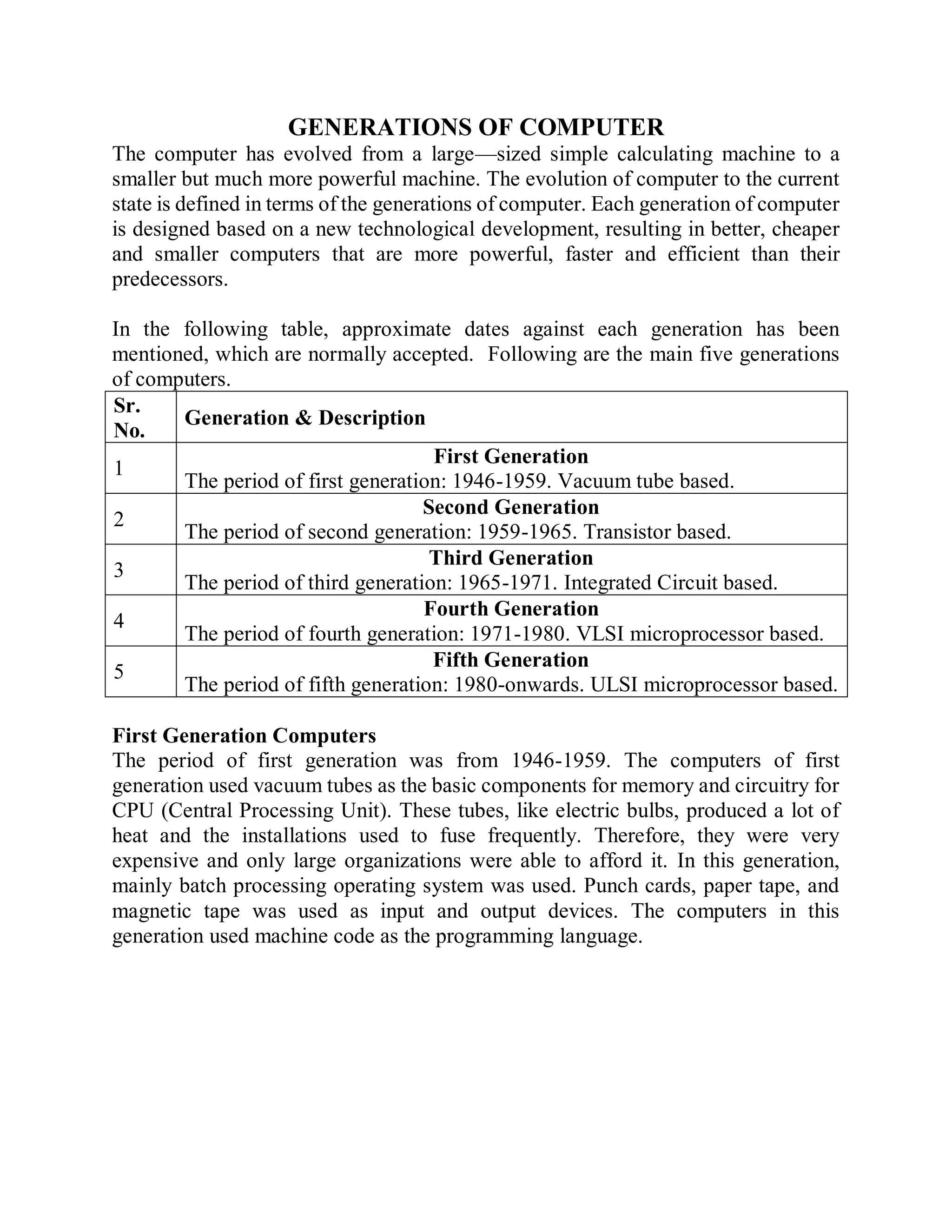
First Generation Computers
The period of first generation was from 1946-1959. The computers of first
generation used vacuum tubes as the basic components for memory and circuitry for
CPU (Central Processing Unit). These tubes, like electric bulbs, produced a lot of
heat and the installations used to fuse frequently. Therefore, they were very
expensive and only large organizations were able to afford it. In this generation,
mainly batch processing operating system was used. Punch cards, paper tape, and
magnetic tape was used as input and output devices. The computers in this
generation used machine code as the programming language.
The main features of the first generation are:
 Vacuum tube technology
 Unreliable
 Supported machine language only
 Very costly
 Generated a lot of heat
 Slow input and output devices
 Huge size
 Need of AC
 Non-portable
 Consumed a lot of electricity
Some computers of this generation were:
 ENIAC (Electronic Numerical Integrator And Calculator)
 EDVAC (Electronic Discrete Variable Automatic Computer)
 UNIVAC (UNIVersal Automatic Computer)
 IBM-701
 IBM-650
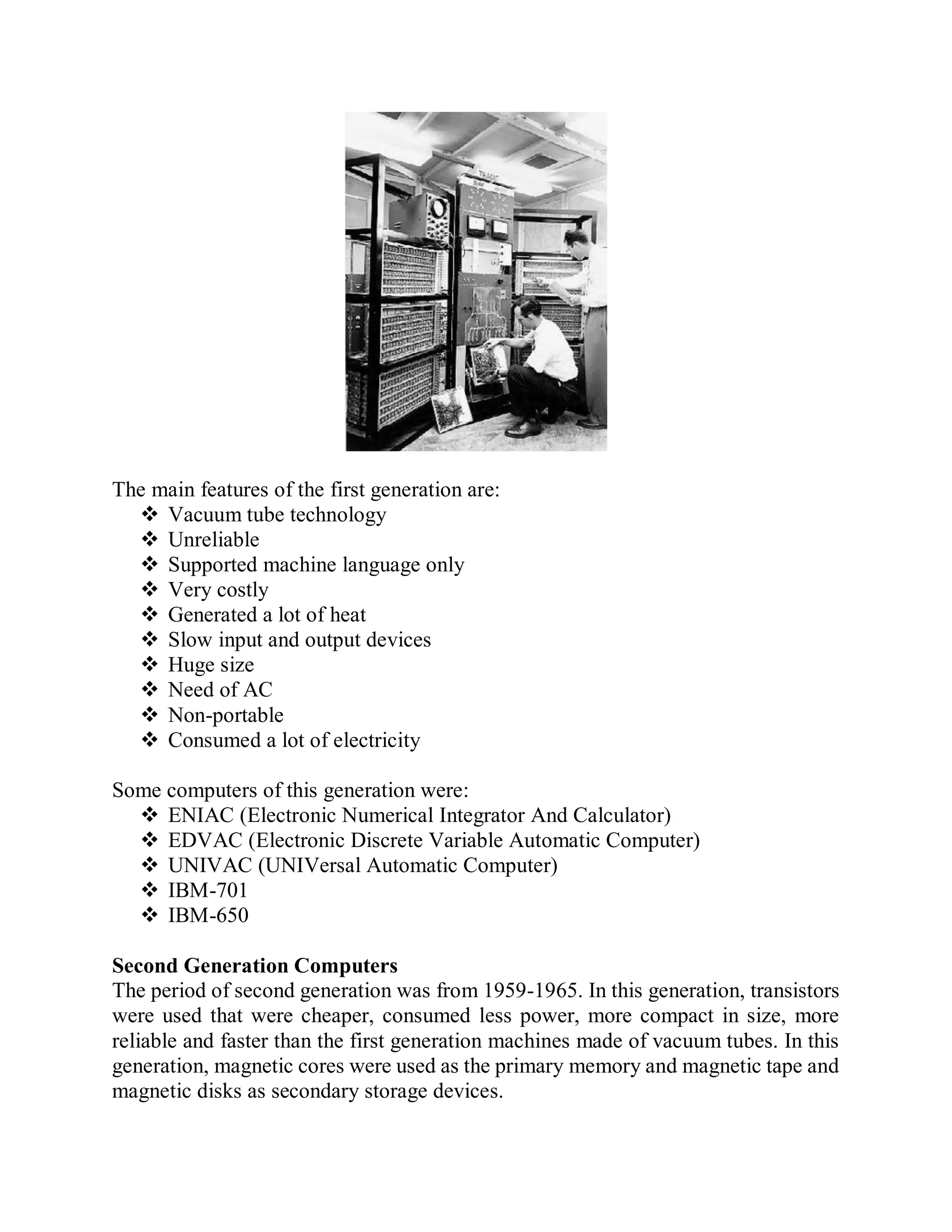
Second Generation Computers
The period of second generation was from 1959-1965. In this generation, transistors
were used that were cheaper, consumed less power, more compact in size, more
reliable and faster than the first generation machines made of vacuum tubes. In this
generation, magnetic cores were used as the primary memory and magnetic tape and
magnetic disks as secondary storage devices.
In this generation, assembly language and high-level programming languages like
FORTRAN, COBOL were used. The computers used batch processing and
multiprogramming operating system.
The main features of second generation are:
 Use of transistors
 Reliable in comparison to first generation computers
 Smaller size as compared to first generation computers
 Generated less heat as compared to first generation computers
 Consumed less electricity as compared to first generation computers
 Faster than first generation computers
 Still very costly
 AC required
 Supported machine and assembly languages
Some computers of this generation were:
 IBM 1620
 IBM 7094
 CDC 1604
 CDC 3600
 UNIVAC 1108
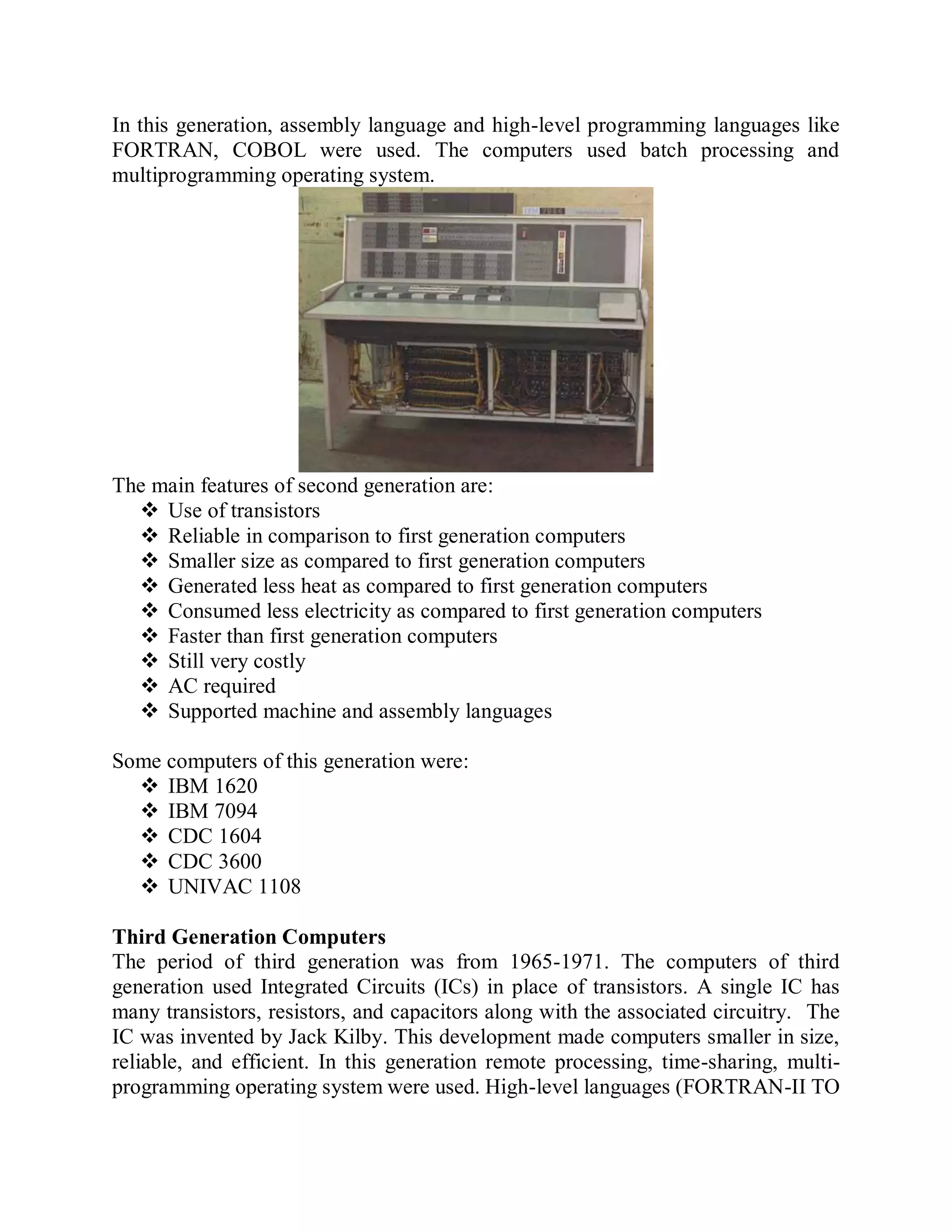
Third Generation Computers
The period of third generation was from 1965-1971. The computers of third
generation used Integrated Circuits (ICs) in place of transistors. A single IC has
many transistors, resistors, and capacitors along with the associated circuitry. The
IC was invented by Jack Kilby. This development made computers smaller in size,
reliable, and efficient. In this generation remote processing, time-sharing, multi-
programming operating system were used. High-level languages (FORTRAN-II TO
IV, COBOL, PASCAL PL/1, BASIC, ALGOL-68 etc.) were used during this
generation. 17
The main features of third generation are:
 IC used
 More reliable in comparison to previous two generations
 Smaller size
 Generated less heat
 Faster
 Lesser maintenance
 Costly
 AC required
 Consumed lesser electricity
 Supported high-level language
Some computers of this generation were:
 IBM-360 series
 Honeywell-6000 series
 PDP (Personal Data Processor)
 IBM-370/168
 TDC-316
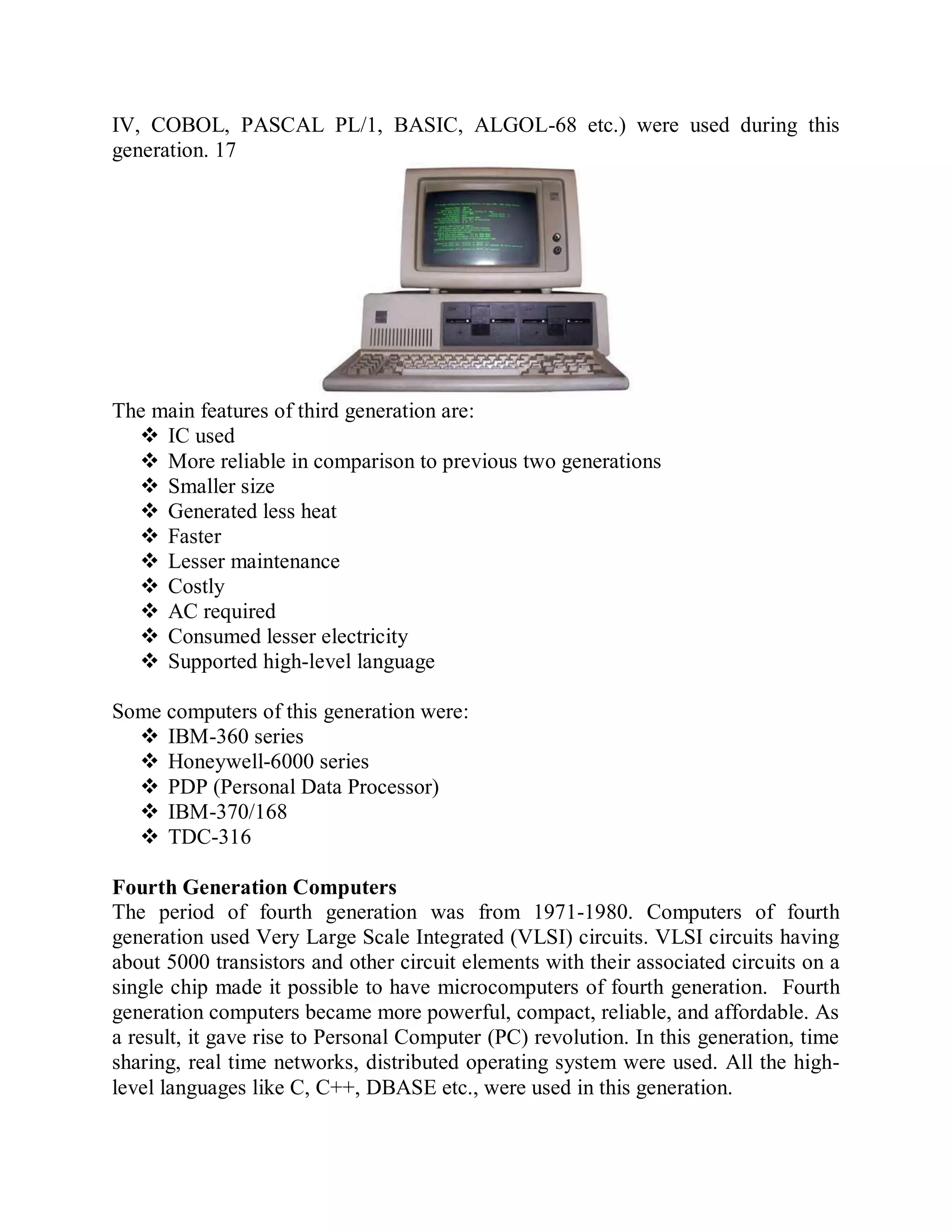
Fourth Generation Computers
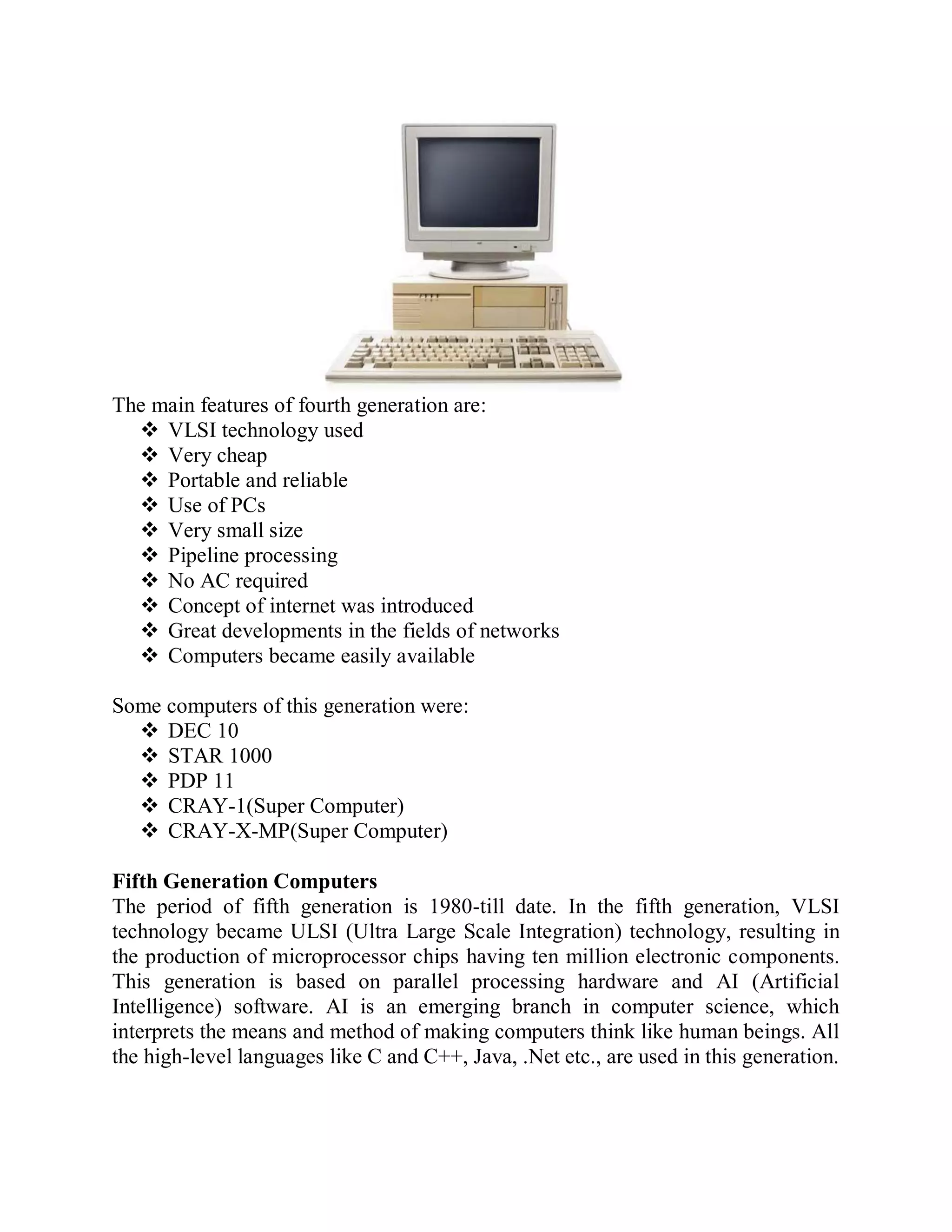
The period of fourth generation was from 1971-1980. Computers of fourth
generation used Very Large Scale Integrated (VLSI) circuits. VLSI circuits having
about 5000 transistors and other circuit elements with their associated circuits on a
single chip made it possible to have microcomputers of fourth generation. Fourth
generation computers became more powerful, compact, reliable, and affordable. As
a result, it gave rise to Personal Computer (PC) revolution. In this generation, time
sharing, real time networks, distributed operating system were used. All the high-
level languages like C, C++, DBASE etc., were used in this generation.
The main features of fourth generation are:
 VLSI technology used
 Very cheap
 Portable and reliable
 Use of PCs
 Very small size
 Pipeline processing
 No AC required
 Concept of internet was introduced
 Great developments in the fields of networks
 Computers became easily available
Some computers of this generation were:
 DEC 10
 STAR 1000
 PDP 11
 CRAY-1(Super Computer)
 CRAY-X-MP(Super Computer)
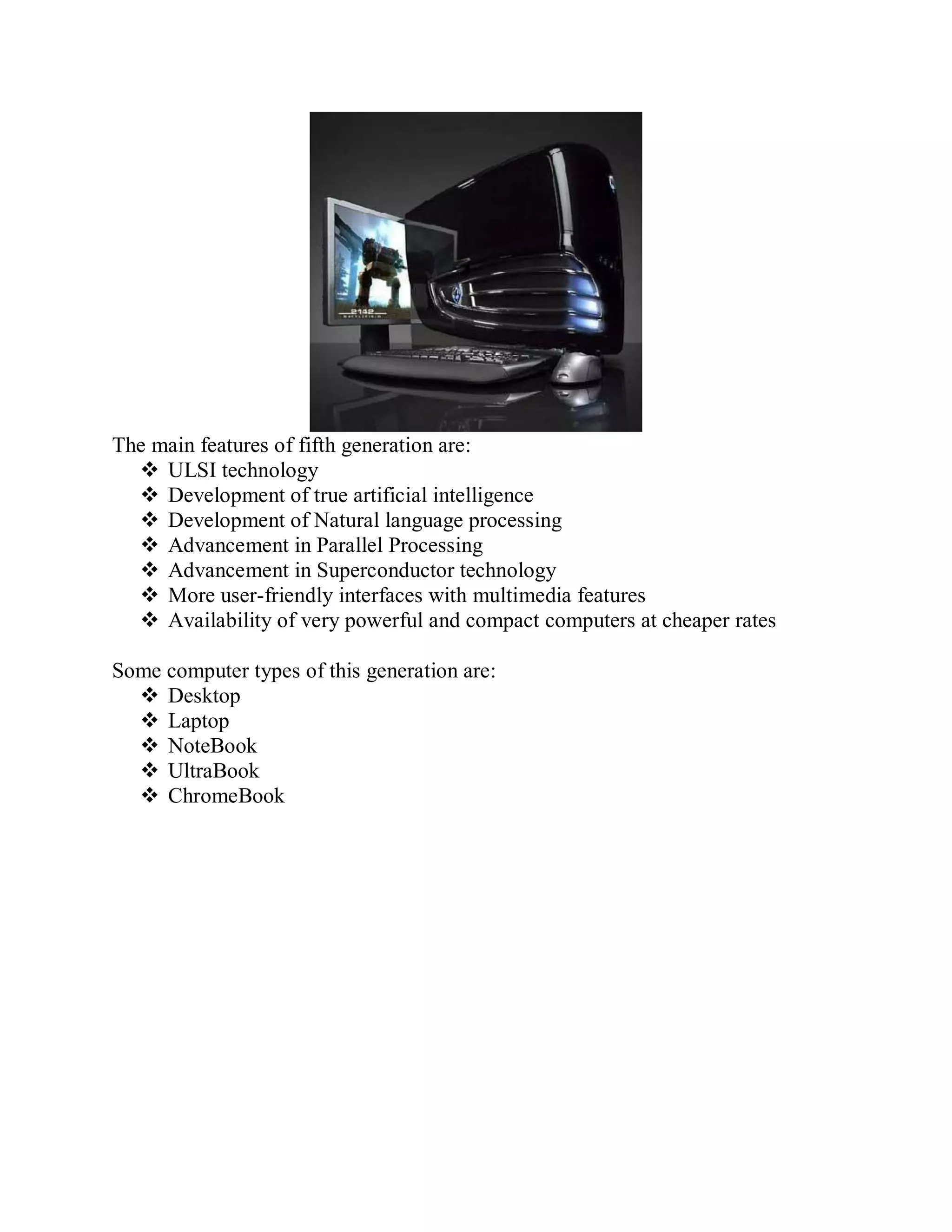
Fifth Generation Computers
The period of fifth generation is 1980-till date. In the fifth generation, VLSI
technology became ULSI (Ultra Large Scale Integration) technology, resulting in
the production of microprocessor chips having ten million electronic components.
This generation is based on parallel processing hardware and AI (Artificial
Intelligence) software. AI is an emerging branch in computer science, which
interprets the means and method of making computers think like human beings. All
the high-level languages like C and C++, Java, .Net etc., are used in this generation.
The main features of fifth generation are:
 ULSI technology
 Development of true artificial intelligence
 Development of Natural language processing
 Advancement in Parallel Processing
 Advancement in Superconductor technology
 More user-friendly interfaces with multimedia features
 Availability of very powerful and compact computers at cheaper rates
Some computer types of this generation are:
 Desktop
 Laptop
 NoteBook
 UltraBook
 ChromeBook
CLASSIFICATION OF COMPUTER
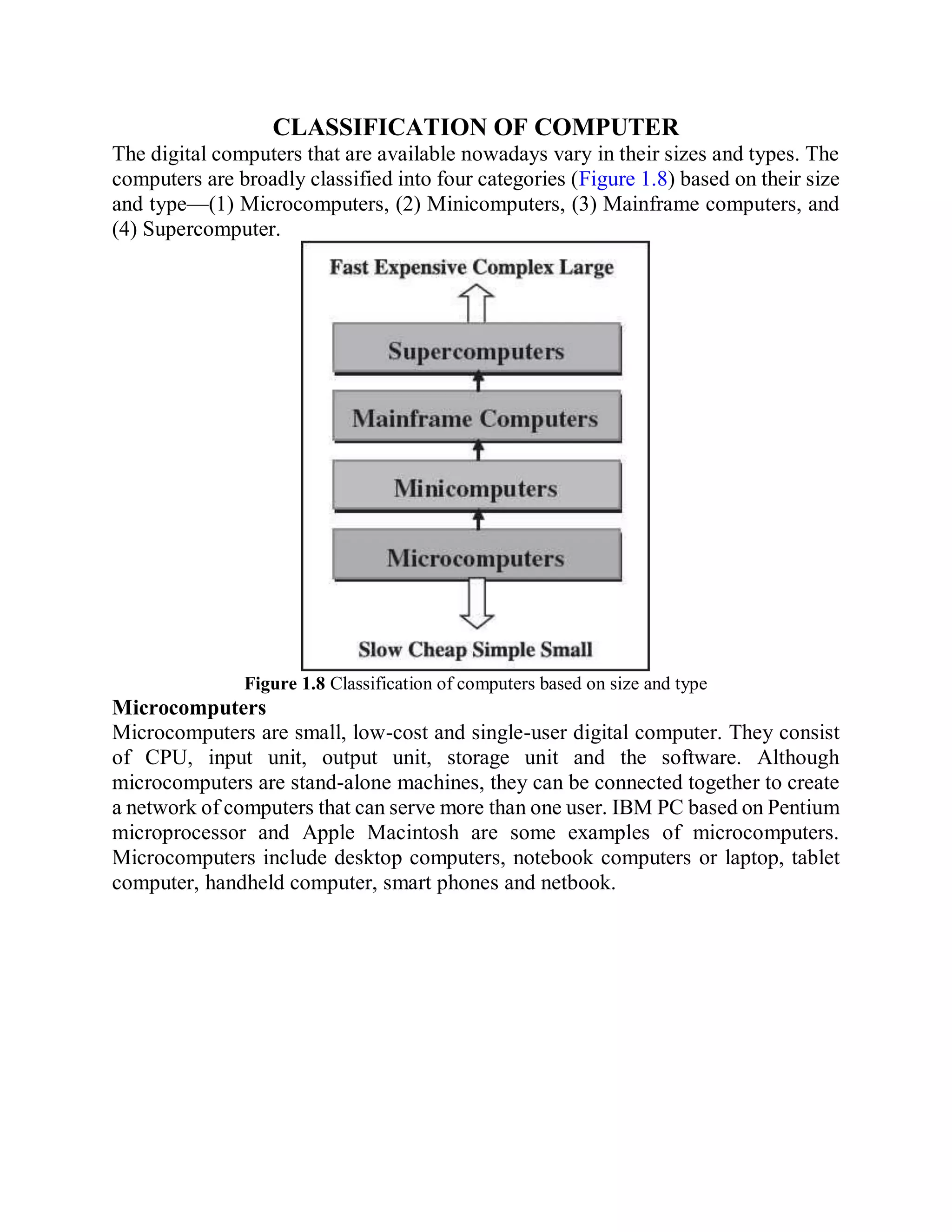
The digital computers that are available nowadays vary in their sizes and types. The
computers are broadly classified into four categories (Figure 1.8) based on their size
and type—(1) Microcomputers, (2) Minicomputers, (3) Mainframe computers, and
(4) Supercomputer.
Figure 1.8 Classification of computers based on size and type
Microcomputers
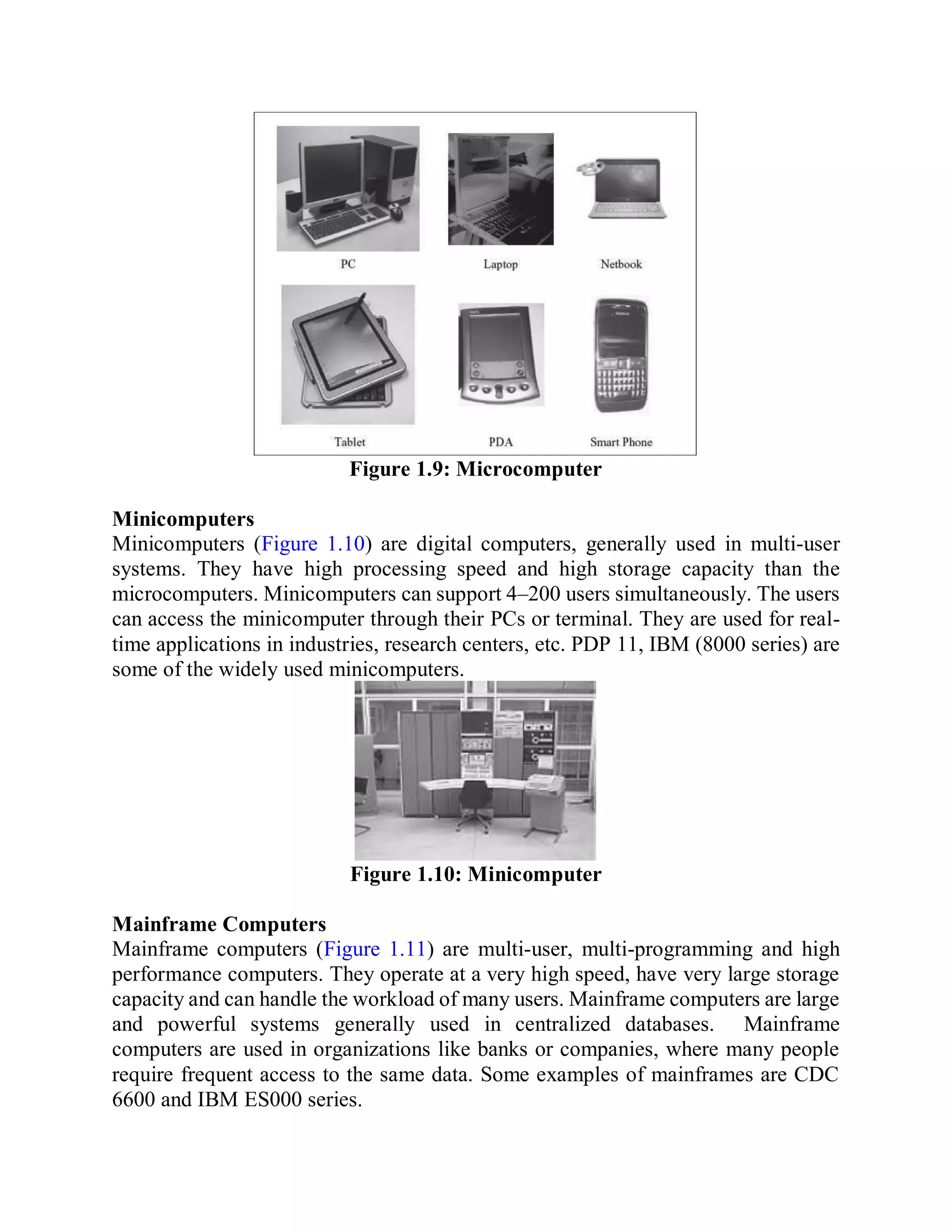
Microcomputers are small, low-cost and single-user digital computer. They consist
of CPU, input unit, output unit, storage unit and the software. Although
microcomputers are stand-alone machines, they can be connected together to create
a network of computers that can serve more than one user. IBM PC based on Pentium
microprocessor and Apple Macintosh are some examples of microcomputers.
Microcomputers include desktop computers, notebook computers or laptop, tablet
computer, handheld computer, smart phones and netbook.
Figure 1.9: Microcomputer
Minicomputers
Minicomputers (Figure 1.10) are digital computers, generally used in multi-user
systems. They have high processing speed and high storage capacity than the
microcomputers. Minicomputers can support 4–200 users simultaneously. The users
can access the minicomputer through their PCs or terminal. They are used for real-
time applications in industries, research centers, etc. PDP 11, IBM (8000 series) are
some of the widely used minicomputers.
Figure 1.10: Minicomputer
Mainframe Computers
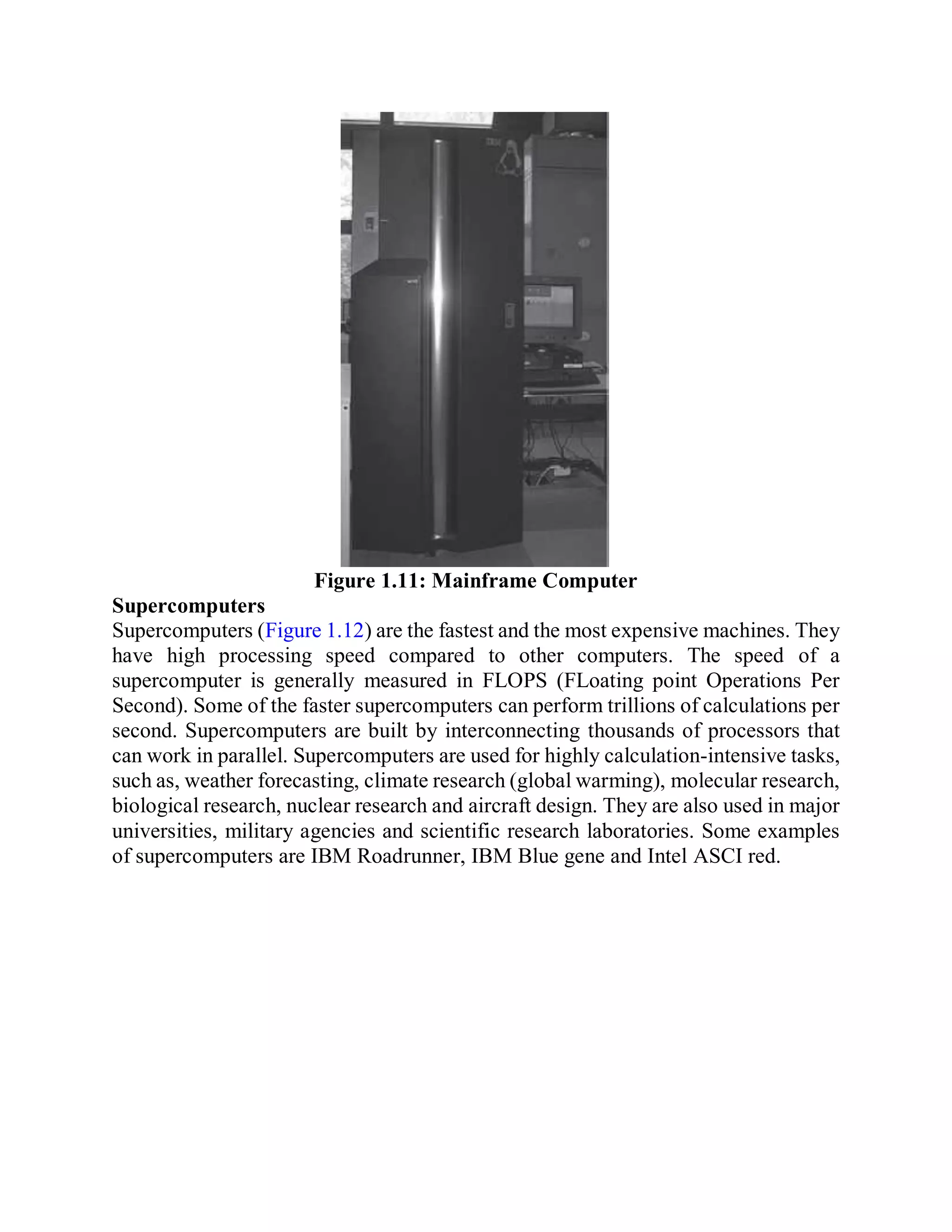
Mainframe computers (Figure 1.11) are multi-user, multi-programming and high
performance computers. They operate at a very high speed, have very large storage
capacity and can handle the workload of many users. Mainframe computers are large
and powerful systems generally used in centralized databases. Mainframe
computers are used in organizations like banks or companies, where many people
require frequent access to the same data. Some examples of mainframes are CDC
6600 and IBM ES000 series.
Figure 1.11: Mainframe Computer
Supercomputers
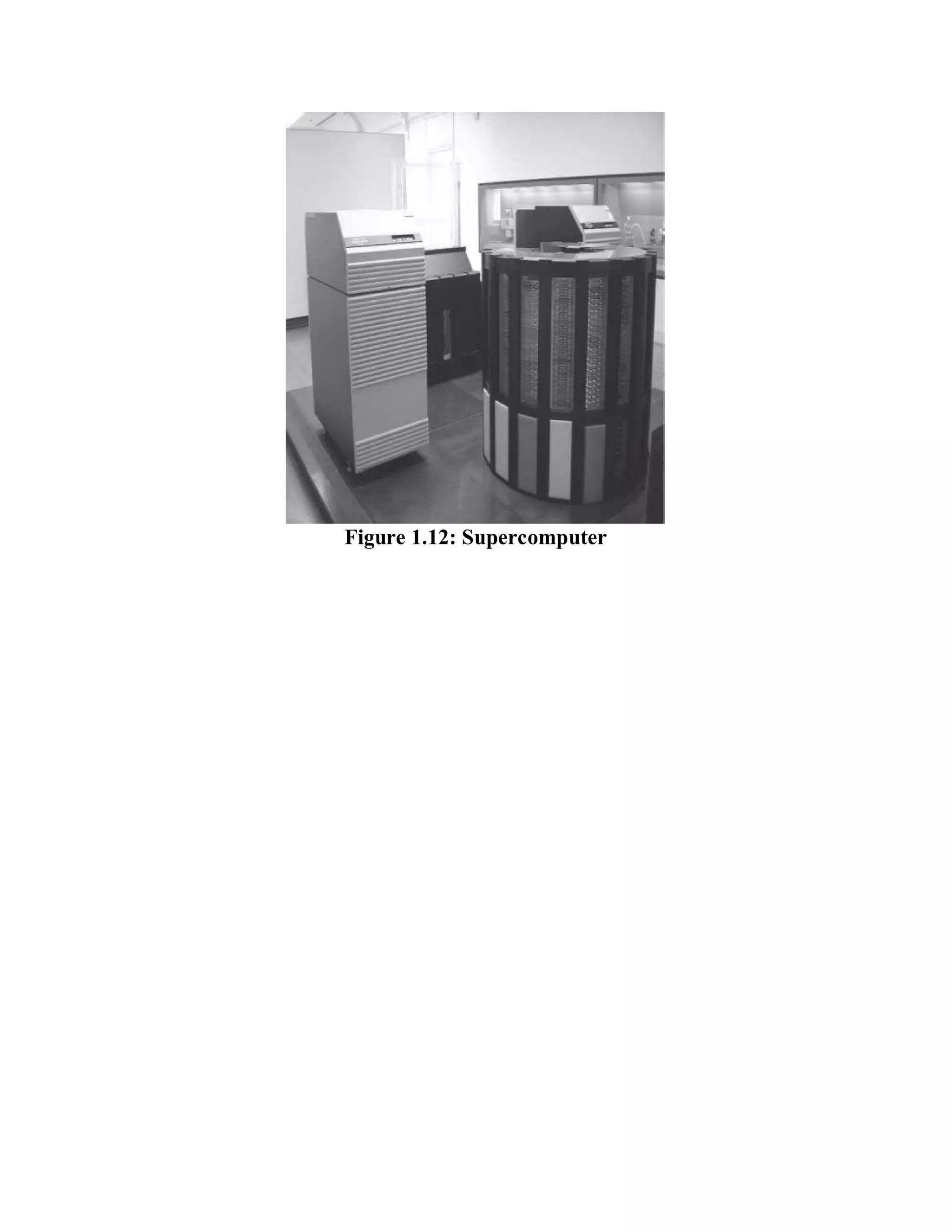
Supercomputers (Figure 1.12) are the fastest and the most expensive machines. They
have high processing speed compared to other computers. The speed of a
supercomputer is generally measured in FLOPS (FLoating point Operations Per
Second). Some of the faster supercomputers can perform trillions of calculations per
second. Supercomputers are built by interconnecting thousands of processors that
can work in parallel. Supercomputers are used for highly calculation-intensive tasks,
such as, weather forecasting, climate research (global warming), molecular research,
biological research, nuclear research and aircraft design. They are also used in major
universities, military agencies and scientific research laboratories. Some examples
of supercomputers are IBM Roadrunner, IBM Blue gene and Intel ASCI red.
Figure 1.12: Supercomputer

Computer Generation

  • 1.
    GENERATIONS OF COMPUTER Thecomputer has evolved from a large—sized simple calculating machine to a smaller but much more powerful machine. The evolution of computer to the current state is defined in terms of the generations of computer. Each generation of computer is designed based on a new technological development, resulting in better, cheaper and smaller computers that are more powerful, faster and efficient than their predecessors. In the following table, approximate dates against each generation has been mentioned, which are normally accepted. Following are the main five generations of computers. Sr. No. Generation & Description 1 First Generation The period of first generation: 1946-1959. Vacuum tube based. 2 Second Generation The period of second generation: 1959-1965. Transistor based. 3 Third Generation The period of third generation: 1965-1971. Integrated Circuit based. 4 Fourth Generation The period of fourth generation: 1971-1980. VLSI microprocessor based. 5 Fifth Generation The period of fifth generation: 1980-onwards. ULSI microprocessor based. First Generation Computers The period of first generation was from 1946-1959. The computers of first generation used vacuum tubes as the basic components for memory and circuitry for CPU (Central Processing Unit). These tubes, like electric bulbs, produced a lot of heat and the installations used to fuse frequently. Therefore, they were very expensive and only large organizations were able to afford it. In this generation, mainly batch processing operating system was used. Punch cards, paper tape, and magnetic tape was used as input and output devices. The computers in this generation used machine code as the programming language.
  • 2.
    The main featuresof the first generation are:  Vacuum tube technology  Unreliable  Supported machine language only  Very costly  Generated a lot of heat  Slow input and output devices  Huge size  Need of AC  Non-portable  Consumed a lot of electricity Some computers of this generation were:  ENIAC (Electronic Numerical Integrator And Calculator)  EDVAC (Electronic Discrete Variable Automatic Computer)  UNIVAC (UNIVersal Automatic Computer)  IBM-701  IBM-650 Second Generation Computers The period of second generation was from 1959-1965. In this generation, transistors were used that were cheaper, consumed less power, more compact in size, more reliable and faster than the first generation machines made of vacuum tubes. In this generation, magnetic cores were used as the primary memory and magnetic tape and magnetic disks as secondary storage devices.
  • 3.
    In this generation,assembly language and high-level programming languages like FORTRAN, COBOL were used. The computers used batch processing and multiprogramming operating system. The main features of second generation are:  Use of transistors  Reliable in comparison to first generation computers  Smaller size as compared to first generation computers  Generated less heat as compared to first generation computers  Consumed less electricity as compared to first generation computers  Faster than first generation computers  Still very costly  AC required  Supported machine and assembly languages Some computers of this generation were:  IBM 1620  IBM 7094  CDC 1604  CDC 3600  UNIVAC 1108 Third Generation Computers The period of third generation was from 1965-1971. The computers of third generation used Integrated Circuits (ICs) in place of transistors. A single IC has many transistors, resistors, and capacitors along with the associated circuitry. The IC was invented by Jack Kilby. This development made computers smaller in size, reliable, and efficient. In this generation remote processing, time-sharing, multi- programming operating system were used. High-level languages (FORTRAN-II TO
  • 4.
    IV, COBOL, PASCALPL/1, BASIC, ALGOL-68 etc.) were used during this generation. 17 The main features of third generation are:  IC used  More reliable in comparison to previous two generations  Smaller size  Generated less heat  Faster  Lesser maintenance  Costly  AC required  Consumed lesser electricity  Supported high-level language Some computers of this generation were:  IBM-360 series  Honeywell-6000 series  PDP (Personal Data Processor)  IBM-370/168  TDC-316 Fourth Generation Computers The period of fourth generation was from 1971-1980. Computers of fourth generation used Very Large Scale Integrated (VLSI) circuits. VLSI circuits having about 5000 transistors and other circuit elements with their associated circuits on a single chip made it possible to have microcomputers of fourth generation. Fourth generation computers became more powerful, compact, reliable, and affordable. As a result, it gave rise to Personal Computer (PC) revolution. In this generation, time sharing, real time networks, distributed operating system were used. All the high- level languages like C, C++, DBASE etc., were used in this generation.
  • 5.
    The main featuresof fourth generation are:  VLSI technology used  Very cheap  Portable and reliable  Use of PCs  Very small size  Pipeline processing  No AC required  Concept of internet was introduced  Great developments in the fields of networks  Computers became easily available Some computers of this generation were:  DEC 10  STAR 1000  PDP 11  CRAY-1(Super Computer)  CRAY-X-MP(Super Computer) Fifth Generation Computers The period of fifth generation is 1980-till date. In the fifth generation, VLSI technology became ULSI (Ultra Large Scale Integration) technology, resulting in the production of microprocessor chips having ten million electronic components. This generation is based on parallel processing hardware and AI (Artificial Intelligence) software. AI is an emerging branch in computer science, which interprets the means and method of making computers think like human beings. All the high-level languages like C and C++, Java, .Net etc., are used in this generation.
  • 6.
    The main featuresof fifth generation are:  ULSI technology  Development of true artificial intelligence  Development of Natural language processing  Advancement in Parallel Processing  Advancement in Superconductor technology  More user-friendly interfaces with multimedia features  Availability of very powerful and compact computers at cheaper rates Some computer types of this generation are:  Desktop  Laptop  NoteBook  UltraBook  ChromeBook
  • 7.
    CLASSIFICATION OF COMPUTER Thedigital computers that are available nowadays vary in their sizes and types. The computers are broadly classified into four categories (Figure 1.8) based on their size and type—(1) Microcomputers, (2) Minicomputers, (3) Mainframe computers, and (4) Supercomputer. Figure 1.8 Classification of computers based on size and type Microcomputers Microcomputers are small, low-cost and single-user digital computer. They consist of CPU, input unit, output unit, storage unit and the software. Although microcomputers are stand-alone machines, they can be connected together to create a network of computers that can serve more than one user. IBM PC based on Pentium microprocessor and Apple Macintosh are some examples of microcomputers. Microcomputers include desktop computers, notebook computers or laptop, tablet computer, handheld computer, smart phones and netbook.
  • 8.
    Figure 1.9: Microcomputer Minicomputers Minicomputers(Figure 1.10) are digital computers, generally used in multi-user systems. They have high processing speed and high storage capacity than the microcomputers. Minicomputers can support 4–200 users simultaneously. The users can access the minicomputer through their PCs or terminal. They are used for real- time applications in industries, research centers, etc. PDP 11, IBM (8000 series) are some of the widely used minicomputers. Figure 1.10: Minicomputer Mainframe Computers Mainframe computers (Figure 1.11) are multi-user, multi-programming and high performance computers. They operate at a very high speed, have very large storage capacity and can handle the workload of many users. Mainframe computers are large and powerful systems generally used in centralized databases. Mainframe computers are used in organizations like banks or companies, where many people require frequent access to the same data. Some examples of mainframes are CDC 6600 and IBM ES000 series.
  • 9.
    Figure 1.11: MainframeComputer Supercomputers Supercomputers (Figure 1.12) are the fastest and the most expensive machines. They have high processing speed compared to other computers. The speed of a supercomputer is generally measured in FLOPS (FLoating point Operations Per Second). Some of the faster supercomputers can perform trillions of calculations per second. Supercomputers are built by interconnecting thousands of processors that can work in parallel. Supercomputers are used for highly calculation-intensive tasks, such as, weather forecasting, climate research (global warming), molecular research, biological research, nuclear research and aircraft design. They are also used in major universities, military agencies and scientific research laboratories. Some examples of supercomputers are IBM Roadrunner, IBM Blue gene and Intel ASCI red.
  • 10.