2D Transformation in Computer Graphics-
In Computer graphics,
Transformation is a process of modifying and re-positioning the existing graphics.
 2D Transformations take place in a two dimensional plane.
 Transformations are helpful in changing the position, size, orientation, shape etc of the
object.
Coordinate Transformation: The object is held stationary while the coordinate system is
transformed relative to the object.
Geometric Transformation: The object itself is transformed relative to the coordinate system or
background.
Transformation Techniques-
In computer graphics, various transformation techniques are-
1. Translation
2. Rotation
3. Scaling
4. Reflection
5. Shear
Homogenous Coordinates
To perform a sequence of transformation such as translation followed by rotation and scaling, we
need to follow a sequential process −
 Translate the coordinates,
 Rotate the translated coordinates, and then
 Scale the rotated coordinates to complete the composite transformation.
To shorten this process, we have to use 3×3 transformation matrix instead of 2×2 transformation
matrix. To convert a 2×2 matrix to 3×3 matrix, we have to add an extra dummy coordinate W.
In this way, we can represent the point by 3 numbers instead of 2 numbers, which is
called Homogenous Coordinate system. In this system, we can represent all the transformation
equations in matrix multiplication.
What is the significance of 2D Transformation?
 Transformations are the building blocks of computer graphics.
 Positioning, shaping, viewing positions are done by transformations.
 Transformation is also used for determining the perspective views.
2D Translation in Computer Graphics-
In Computer graphics,
2D Translation is a process of moving an object from one position to another in a two dimensional
plane.
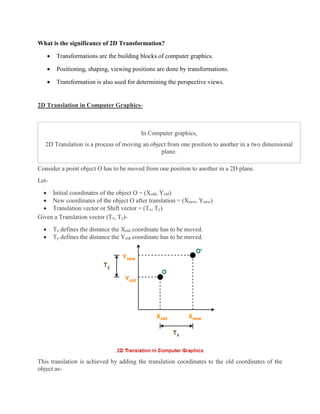
Consider a point object O has to be moved from one position to another in a 2D plane.
Let-
 Initial coordinates of the object O = (Xold, Yold)
 New coordinates of the object O after translation = (Xnew, Ynew)
 Translation vector or Shift vector = (Tx, Ty)
Given a Translation vector (Tx, Ty)-
 Tx defines the distance the Xold coordinate has to be moved.
 Ty defines the distance the Yold coordinate has to be moved.
This translation is achieved by adding the translation coordinates to the old coordinates of the
object as-
 Xnew = Xold + Tx (This denotes translation towards X axis)
 Ynew = Yold + Ty (This denotes translation towards Y axis)
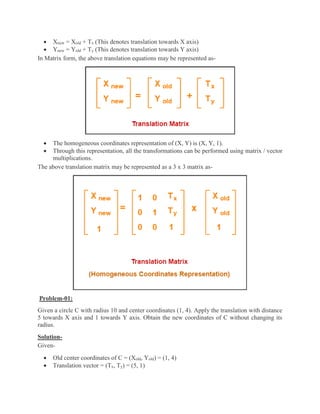
In Matrix form, the above translation equations may be represented as-
 The homogeneous coordinates representation of (X, Y) is (X, Y, 1).
 Through this representation, all the transformations can be performed using matrix / vector
multiplications.
The above translation matrix may be represented as a 3 x 3 matrix as-
Problem-01:
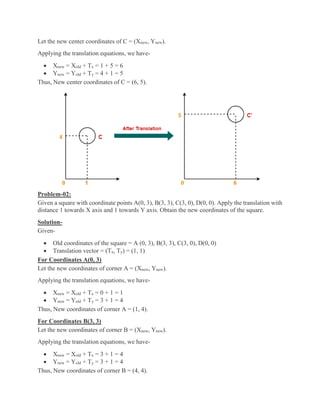
Given a circle C with radius 10 and center coordinates (1, 4). Apply the translation with distance
5 towards X axis and 1 towards Y axis. Obtain the new coordinates of C without changing its
radius.
Solution-
Given-
 Old center coordinates of C = (Xold, Yold) = (1, 4)
 Translation vector = (Tx, Ty) = (5, 1)
Let the new center coordinates of C = (Xnew, Ynew).
Applying the translation equations, we have-
 Xnew = Xold + Tx = 1 + 5 = 6
 Ynew = Yold + Ty = 4 + 1 = 5
Thus, New center coordinates of C = (6, 5).
Problem-02:
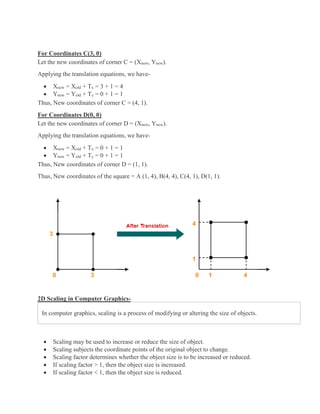
Given a square with coordinate points A(0, 3), B(3, 3), C(3, 0), D(0, 0). Apply the translation with
distance 1 towards X axis and 1 towards Y axis. Obtain the new coordinates of the square.
Solution-
Given-
 Old coordinates of the square = A (0, 3), B(3, 3), C(3, 0), D(0, 0)
 Translation vector = (Tx, Ty) = (1, 1)
For Coordinates A(0, 3)
Let the new coordinates of corner A = (Xnew, Ynew).
Applying the translation equations, we have-
 Xnew = Xold + Tx = 0 + 1 = 1
 Ynew = Yold + Ty = 3 + 1 = 4
Thus, New coordinates of corner A = (1, 4).
For Coordinates B(3, 3)
Let the new coordinates of corner B = (Xnew, Ynew).
Applying the translation equations, we have-
 Xnew = Xold + Tx = 3 + 1 = 4
 Ynew = Yold + Ty = 3 + 1 = 4
Thus, New coordinates of corner B = (4, 4).
For Coordinates C(3, 0)
Let the new coordinates of corner C = (Xnew, Ynew).
Applying the translation equations, we have-
 Xnew = Xold + Tx = 3 + 1 = 4
 Ynew = Yold + Ty = 0 + 1 = 1
Thus, New coordinates of corner C = (4, 1).
For Coordinates D(0, 0)
Let the new coordinates of corner D = (Xnew, Ynew).
Applying the translation equations, we have-
 Xnew = Xold + Tx = 0 + 1 = 1
 Ynew = Yold + Ty = 0 + 1 = 1
Thus, New coordinates of corner D = (1, 1).
Thus, New coordinates of the square = A (1, 4), B(4, 4), C(4, 1), D(1, 1).
2D Scaling in Computer Graphics-
In computer graphics, scaling is a process of modifying or altering the size of objects.
 Scaling may be used to increase or reduce the size of object.
 Scaling subjects the coordinate points of the original object to change.
 Scaling factor determines whether the object size is to be increased or reduced.
 If scaling factor > 1, then the object size is increased.
 If scaling factor < 1, then the object size is reduced.
Consider a point object O has to be scaled in a 2D plane.
Let-
 Initial coordinates of the object O = (Xold, Yold)
 Scaling factor for X-axis = Sx
 Scaling factor for Y-axis = Sy
 New coordinates of the object O after scaling = (Xnew, Ynew)
This scaling is achieved by using the following scaling equations-
 Xnew = Xold x Sx
 Ynew = Yold x Sy
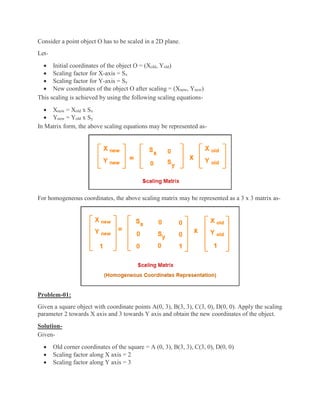
In Matrix form, the above scaling equations may be represented as-
For homogeneous coordinates, the above scaling matrix may be represented as a 3 x 3 matrix as-
Problem-01:
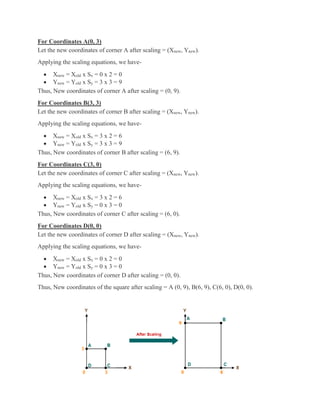
Given a square object with coordinate points A(0, 3), B(3, 3), C(3, 0), D(0, 0). Apply the scaling
parameter 2 towards X axis and 3 towards Y axis and obtain the new coordinates of the object.
Solution-
Given-
 Old corner coordinates of the square = A (0, 3), B(3, 3), C(3, 0), D(0, 0)
 Scaling factor along X axis = 2
 Scaling factor along Y axis = 3
For Coordinates A(0, 3)
Let the new coordinates of corner A after scaling = (Xnew, Ynew).
Applying the scaling equations, we have-
 Xnew = Xold x Sx = 0 x 2 = 0
 Ynew = Yold x Sy = 3 x 3 = 9
Thus, New coordinates of corner A after scaling = (0, 9).
For Coordinates B(3, 3)
Let the new coordinates of corner B after scaling = (Xnew, Ynew).
Applying the scaling equations, we have-
 Xnew = Xold x Sx = 3 x 2 = 6
 Ynew = Yold x Sy = 3 x 3 = 9
Thus, New coordinates of corner B after scaling = (6, 9).
For Coordinates C(3, 0)
Let the new coordinates of corner C after scaling = (Xnew, Ynew).
Applying the scaling equations, we have-
 Xnew = Xold x Sx = 3 x 2 = 6
 Ynew = Yold x Sy = 0 x 3 = 0
Thus, New coordinates of corner C after scaling = (6, 0).
For Coordinates D(0, 0)
Let the new coordinates of corner D after scaling = (Xnew, Ynew).
Applying the scaling equations, we have-
 Xnew = Xold x Sx = 0 x 2 = 0
 Ynew = Yold x Sy = 0 x 3 = 0
Thus, New coordinates of corner D after scaling = (0, 0).
Thus, New coordinates of the square after scaling = A (0, 9), B(6, 9), C(6, 0), D(0, 0).
2D Rotation in Computer Graphics-
In Computer graphics,
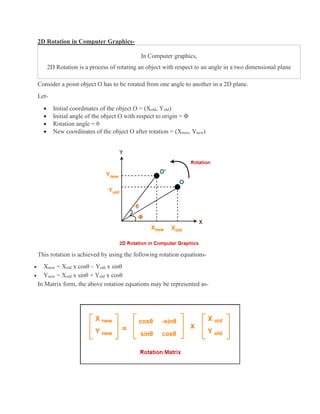
2D Rotation is a process of rotating an object with respect to an angle in a two dimensional plane
Consider a point object O has to be rotated from one angle to another in a 2D plane.
Let-
 Initial coordinates of the object O = (Xold, Yold)
 Initial angle of the object O with respect to origin = Φ
 Rotation angle = θ
 New coordinates of the object O after rotation = (Xnew, Ynew)
This rotation is achieved by using the following rotation equations-
 Xnew = Xold x cosθ – Yold x sinθ
 Ynew = Xold x sinθ + Yold x cosθ
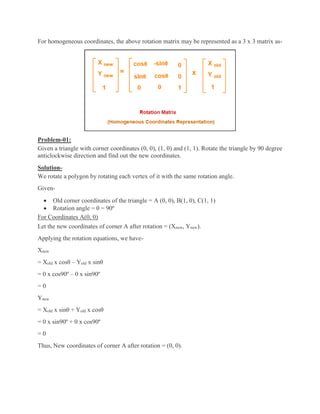
In Matrix form, the above rotation equations may be represented as-
For homogeneous coordinates, the above rotation matrix may be represented as a 3 x 3 matrix as-
Problem-01:
Given a triangle with corner coordinates (0, 0), (1, 0) and (1, 1). Rotate the triangle by 90 degree
anticlockwise direction and find out the new coordinates.
Solution-
We rotate a polygon by rotating each vertex of it with the same rotation angle.
Given-
 Old corner coordinates of the triangle = A (0, 0), B(1, 0), C(1, 1)
 Rotation angle = θ = 90º
For Coordinates A(0, 0)
Let the new coordinates of corner A after rotation = (Xnew, Ynew).
Applying the rotation equations, we have-
Xnew
= Xold x cosθ – Yold x sinθ
= 0 x cos90º – 0 x sin90º
= 0
Ynew
= Xold x sinθ + Yold x cosθ
= 0 x sin90º + 0 x cos90º
= 0
Thus, New coordinates of corner A after rotation = (0, 0).
For Coordinates B(1, 0)
Let the new coordinates of corner B after rotation = (Xnew, Ynew).
Xnew
= Xold x cosθ – Yold x sinθ
= 1 x cos90º – 0 x sin90º
= 0
Ynew
= Xold x sinθ + Yold x cosθ
= 1 x sin90º + 0 x cos90º
= 1 + 0
= 1
Thus, New coordinates of corner B after rotation = (0, 1).
For Coordinates C(1, 1)
Let the new coordinates of corner C after rotation = (Xnew, Ynew).
Xnew
= Xold x cosθ – Yold x sinθ
= 1 x cos90º – 1 x sin90º
= 0 – 1
= -1
Ynew
= Xold x sinθ + Yold x cosθ
= 1 x sin90º + 1 x cos90º
= 1 + 0
= 1
Thus, New coordinates of corner C after rotation = (-1, 1).
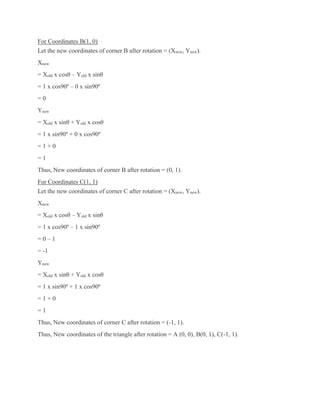
Thus, New coordinates of the triangle after rotation = A (0, 0), B(0, 1), C(-1, 1).
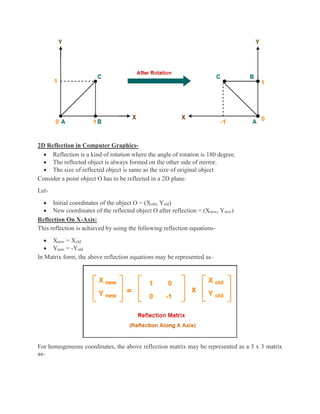
2D Reflection in Computer Graphics-
 Reflection is a kind of rotation where the angle of rotation is 180 degree.
 The reflected object is always formed on the other side of mirror.
 The size of reflected object is same as the size of original object
Consider a point object O has to be reflected in a 2D plane.
Let-
 Initial coordinates of the object O = (Xold, Yold)
 New coordinates of the reflected object O after reflection = (Xnew, Ynew)
Reflection On X-Axis:
This reflection is achieved by using the following reflection equations-
 Xnew = Xold
 Ynew = -Yold
In Matrix form, the above reflection equations may be represented as-
For homogeneous coordinates, the above reflection matrix may be represented as a 3 x 3 matrix
as-
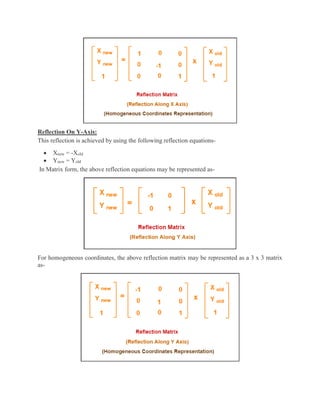
Reflection On Y-Axis:
This reflection is achieved by using the following reflection equations-
 Xnew = -Xold
 Ynew = Yold
In Matrix form, the above reflection equations may be represented as-
For homogeneous coordinates, the above reflection matrix may be represented as a 3 x 3 matrix
as-
Problem-01:
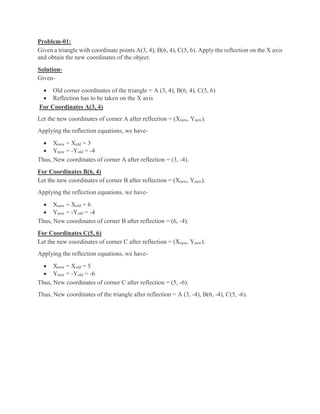
Given a triangle with coordinate points A(3, 4), B(6, 4), C(5, 6). Apply the reflection on the X axis
and obtain the new coordinates of the object.
Solution-
Given-
 Old corner coordinates of the triangle = A (3, 4), B(6, 4), C(5, 6)
 Reflection has to be taken on the X axis
For Coordinates A(3, 4)
Let the new coordinates of corner A after reflection = (Xnew, Ynew).
Applying the reflection equations, we have-
 Xnew = Xold = 3
 Ynew = -Yold = -4
Thus, New coordinates of corner A after reflection = (3, -4).
For Coordinates B(6, 4)
Let the new coordinates of corner B after reflection = (Xnew, Ynew).
Applying the reflection equations, we have-
 Xnew = Xold = 6
 Ynew = -Yold = -4
Thus, New coordinates of corner B after reflection = (6, -4).
For Coordinates C(5, 6)
Let the new coordinates of corner C after reflection = (Xnew, Ynew).
Applying the reflection equations, we have-
 Xnew = Xold = 5
 Ynew = -Yold = -6
Thus, New coordinates of corner C after reflection = (5, -6).
Thus, New coordinates of the triangle after reflection = A (3, -4), B(6, -4), C(5, -6).
Problem-02:
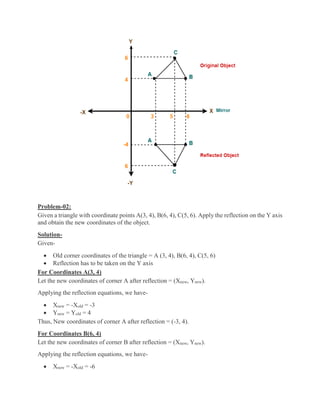
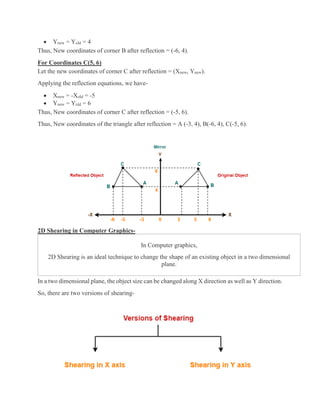
Given a triangle with coordinate points A(3, 4), B(6, 4), C(5, 6). Apply the reflection on the Y axis
and obtain the new coordinates of the object.
Solution-
Given-
 Old corner coordinates of the triangle = A (3, 4), B(6, 4), C(5, 6)
 Reflection has to be taken on the Y axis
For Coordinates A(3, 4)
Let the new coordinates of corner A after reflection = (Xnew, Ynew).
Applying the reflection equations, we have-
 Xnew = -Xold = -3
 Ynew = Yold = 4
Thus, New coordinates of corner A after reflection = (-3, 4).
For Coordinates B(6, 4)
Let the new coordinates of corner B after reflection = (Xnew, Ynew).
Applying the reflection equations, we have-
 Xnew = -Xold = -6
 Ynew = Yold = 4
Thus, New coordinates of corner B after reflection = (-6, 4).
For Coordinates C(5, 6)
Let the new coordinates of corner C after reflection = (Xnew, Ynew).
Applying the reflection equations, we have-
 Xnew = -Xold = -5
 Ynew = Yold = 6
Thus, New coordinates of corner C after reflection = (-5, 6).
Thus, New coordinates of the triangle after reflection = A (-3, 4), B(-6, 4), C(-5, 6).
2D Shearing in Computer Graphics-
In Computer graphics,
2D Shearing is an ideal technique to change the shape of an existing object in a two dimensional
plane.
In a two dimensional plane, the object size can be changed along X direction as well as Y direction.
So, there are two versions of shearing-
1. Shearing in X direction
2. Shearing in Y direction
Consider a point object O has to be sheared in a 2D plane.
Let-
 Initial coordinates of the object O = (Xold, Yold)
 Shearing parameter towards X direction = Shx
 Shearing parameter towards Y direction = Shy
 New coordinates of the object O after shearing = (Xnew, Ynew)
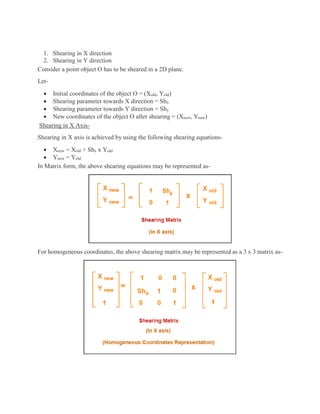
Shearing in X Axis-
Shearing in X axis is achieved by using the following shearing equations-
 Xnew = Xold + Shx x Yold
 Ynew = Yold
In Matrix form, the above shearing equations may be represented as-
For homogeneous coordinates, the above shearing matrix may be represented as a 3 x 3 matrix as-
Shearing in Y Axis-
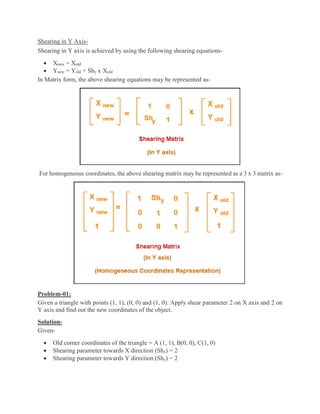
Shearing in Y axis is achieved by using the following shearing equations-
 Xnew = Xold
 Ynew = Yold + Shy x Xold
In Matrix form, the above shearing equations may be represented as-
For homogeneous coordinates, the above shearing matrix may be represented as a 3 x 3 matrix as-
Problem-01:
Given a triangle with points (1, 1), (0, 0) and (1, 0). Apply shear parameter 2 on X axis and 2 on
Y axis and find out the new coordinates of the object.
Solution-
Given-
 Old corner coordinates of the triangle = A (1, 1), B(0, 0), C(1, 0)
 Shearing parameter towards X direction (Shx) = 2
 Shearing parameter towards Y direction (Shy) = 2
Shearing in X Axis-
For Coordinates A(1, 1)
Let the new coordinates of corner A after shearing = (Xnew, Ynew).
Applying the shearing equations, we have-
 Xnew = Xold + Shx x Yold = 1 + 2 x 1 = 3
 Ynew = Yold = 1
Thus, New coordinates of corner A after shearing = (3, 1).
For Coordinates B(0, 0)
Let the new coordinates of corner B after shearing = (Xnew, Ynew).
Applying the shearing equations, we have-
 Xnew = Xold + Shx x Yold = 0 + 2 x 0 = 0
 Ynew = Yold = 0
Thus, New coordinates of corner B after shearing = (0, 0).
For Coordinates C(1, 0)
Let the new coordinates of corner C after shearing = (Xnew, Ynew).
Applying the shearing equations, we have-
 Xnew = Xold + Shx x Yold = 1 + 2 x 0 = 1
 Ynew = Yold = 0
Thus, New coordinates of corner C after shearing = (1, 0).
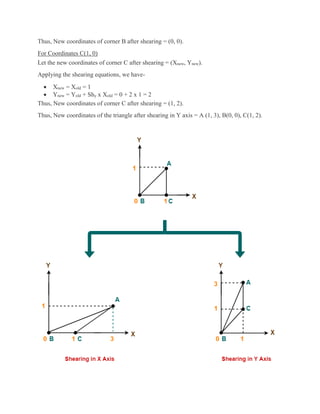
Thus, New coordinates of the triangle after shearing in X axis = A (3, 1), B(0, 0), C(1, 0).
Shearing in Y Axis-
For Coordinates A(1, 1)
Let the new coordinates of corner A after shearing = (Xnew, Ynew).
Applying the shearing equations, we have-
 Xnew = Xold = 1
 Ynew = Yold + Shy x Xold = 1 + 2 x 1 = 3
Thus, New coordinates of corner A after shearing = (1, 3).
For Coordinates B(0, 0)
Let the new coordinates of corner B after shearing = (Xnew, Ynew).
Applying the shearing equations, we have-
 Xnew = Xold = 0
 Ynew = Yold + Shy x Xold = 0 + 2 x 0 = 0
Thus, New coordinates of corner B after shearing = (0, 0).
For Coordinates C(1, 0)
Let the new coordinates of corner C after shearing = (Xnew, Ynew).
Applying the shearing equations, we have-
 Xnew = Xold = 1
 Ynew = Yold + Shy x Xold = 0 + 2 x 1 = 2
Thus, New coordinates of corner C after shearing = (1, 2).
Thus, New coordinates of the triangle after shearing in Y axis = A (1, 3), B(0, 0), C(1, 2).

2D Transformation

  • 1.
    2D Transformation inComputer Graphics- In Computer graphics, Transformation is a process of modifying and re-positioning the existing graphics.  2D Transformations take place in a two dimensional plane.  Transformations are helpful in changing the position, size, orientation, shape etc of the object. Coordinate Transformation: The object is held stationary while the coordinate system is transformed relative to the object. Geometric Transformation: The object itself is transformed relative to the coordinate system or background. Transformation Techniques- In computer graphics, various transformation techniques are- 1. Translation 2. Rotation 3. Scaling 4. Reflection 5. Shear Homogenous Coordinates To perform a sequence of transformation such as translation followed by rotation and scaling, we need to follow a sequential process −  Translate the coordinates,  Rotate the translated coordinates, and then  Scale the rotated coordinates to complete the composite transformation. To shorten this process, we have to use 3×3 transformation matrix instead of 2×2 transformation matrix. To convert a 2×2 matrix to 3×3 matrix, we have to add an extra dummy coordinate W. In this way, we can represent the point by 3 numbers instead of 2 numbers, which is called Homogenous Coordinate system. In this system, we can represent all the transformation equations in matrix multiplication.
  • 2.
    What is thesignificance of 2D Transformation?  Transformations are the building blocks of computer graphics.  Positioning, shaping, viewing positions are done by transformations.  Transformation is also used for determining the perspective views. 2D Translation in Computer Graphics- In Computer graphics, 2D Translation is a process of moving an object from one position to another in a two dimensional plane. Consider a point object O has to be moved from one position to another in a 2D plane. Let-  Initial coordinates of the object O = (Xold, Yold)  New coordinates of the object O after translation = (Xnew, Ynew)  Translation vector or Shift vector = (Tx, Ty) Given a Translation vector (Tx, Ty)-  Tx defines the distance the Xold coordinate has to be moved.  Ty defines the distance the Yold coordinate has to be moved. This translation is achieved by adding the translation coordinates to the old coordinates of the object as-
  • 3.
     Xnew =Xold + Tx (This denotes translation towards X axis)  Ynew = Yold + Ty (This denotes translation towards Y axis) In Matrix form, the above translation equations may be represented as-  The homogeneous coordinates representation of (X, Y) is (X, Y, 1).  Through this representation, all the transformations can be performed using matrix / vector multiplications. The above translation matrix may be represented as a 3 x 3 matrix as- Problem-01: Given a circle C with radius 10 and center coordinates (1, 4). Apply the translation with distance 5 towards X axis and 1 towards Y axis. Obtain the new coordinates of C without changing its radius. Solution- Given-  Old center coordinates of C = (Xold, Yold) = (1, 4)  Translation vector = (Tx, Ty) = (5, 1)
  • 4.
    Let the newcenter coordinates of C = (Xnew, Ynew). Applying the translation equations, we have-  Xnew = Xold + Tx = 1 + 5 = 6  Ynew = Yold + Ty = 4 + 1 = 5 Thus, New center coordinates of C = (6, 5). Problem-02: Given a square with coordinate points A(0, 3), B(3, 3), C(3, 0), D(0, 0). Apply the translation with distance 1 towards X axis and 1 towards Y axis. Obtain the new coordinates of the square. Solution- Given-  Old coordinates of the square = A (0, 3), B(3, 3), C(3, 0), D(0, 0)  Translation vector = (Tx, Ty) = (1, 1) For Coordinates A(0, 3) Let the new coordinates of corner A = (Xnew, Ynew). Applying the translation equations, we have-  Xnew = Xold + Tx = 0 + 1 = 1  Ynew = Yold + Ty = 3 + 1 = 4 Thus, New coordinates of corner A = (1, 4). For Coordinates B(3, 3) Let the new coordinates of corner B = (Xnew, Ynew). Applying the translation equations, we have-  Xnew = Xold + Tx = 3 + 1 = 4  Ynew = Yold + Ty = 3 + 1 = 4 Thus, New coordinates of corner B = (4, 4).
  • 5.
    For Coordinates C(3,0) Let the new coordinates of corner C = (Xnew, Ynew). Applying the translation equations, we have-  Xnew = Xold + Tx = 3 + 1 = 4  Ynew = Yold + Ty = 0 + 1 = 1 Thus, New coordinates of corner C = (4, 1). For Coordinates D(0, 0) Let the new coordinates of corner D = (Xnew, Ynew). Applying the translation equations, we have-  Xnew = Xold + Tx = 0 + 1 = 1  Ynew = Yold + Ty = 0 + 1 = 1 Thus, New coordinates of corner D = (1, 1). Thus, New coordinates of the square = A (1, 4), B(4, 4), C(4, 1), D(1, 1). 2D Scaling in Computer Graphics- In computer graphics, scaling is a process of modifying or altering the size of objects.  Scaling may be used to increase or reduce the size of object.  Scaling subjects the coordinate points of the original object to change.  Scaling factor determines whether the object size is to be increased or reduced.  If scaling factor > 1, then the object size is increased.  If scaling factor < 1, then the object size is reduced.
  • 6.
    Consider a pointobject O has to be scaled in a 2D plane. Let-  Initial coordinates of the object O = (Xold, Yold)  Scaling factor for X-axis = Sx  Scaling factor for Y-axis = Sy  New coordinates of the object O after scaling = (Xnew, Ynew) This scaling is achieved by using the following scaling equations-  Xnew = Xold x Sx  Ynew = Yold x Sy In Matrix form, the above scaling equations may be represented as- For homogeneous coordinates, the above scaling matrix may be represented as a 3 x 3 matrix as- Problem-01: Given a square object with coordinate points A(0, 3), B(3, 3), C(3, 0), D(0, 0). Apply the scaling parameter 2 towards X axis and 3 towards Y axis and obtain the new coordinates of the object. Solution- Given-  Old corner coordinates of the square = A (0, 3), B(3, 3), C(3, 0), D(0, 0)  Scaling factor along X axis = 2  Scaling factor along Y axis = 3
  • 7.
    For Coordinates A(0,3) Let the new coordinates of corner A after scaling = (Xnew, Ynew). Applying the scaling equations, we have-  Xnew = Xold x Sx = 0 x 2 = 0  Ynew = Yold x Sy = 3 x 3 = 9 Thus, New coordinates of corner A after scaling = (0, 9). For Coordinates B(3, 3) Let the new coordinates of corner B after scaling = (Xnew, Ynew). Applying the scaling equations, we have-  Xnew = Xold x Sx = 3 x 2 = 6  Ynew = Yold x Sy = 3 x 3 = 9 Thus, New coordinates of corner B after scaling = (6, 9). For Coordinates C(3, 0) Let the new coordinates of corner C after scaling = (Xnew, Ynew). Applying the scaling equations, we have-  Xnew = Xold x Sx = 3 x 2 = 6  Ynew = Yold x Sy = 0 x 3 = 0 Thus, New coordinates of corner C after scaling = (6, 0). For Coordinates D(0, 0) Let the new coordinates of corner D after scaling = (Xnew, Ynew). Applying the scaling equations, we have-  Xnew = Xold x Sx = 0 x 2 = 0  Ynew = Yold x Sy = 0 x 3 = 0 Thus, New coordinates of corner D after scaling = (0, 0). Thus, New coordinates of the square after scaling = A (0, 9), B(6, 9), C(6, 0), D(0, 0).
  • 8.
    2D Rotation inComputer Graphics- In Computer graphics, 2D Rotation is a process of rotating an object with respect to an angle in a two dimensional plane Consider a point object O has to be rotated from one angle to another in a 2D plane. Let-  Initial coordinates of the object O = (Xold, Yold)  Initial angle of the object O with respect to origin = Φ  Rotation angle = θ  New coordinates of the object O after rotation = (Xnew, Ynew) This rotation is achieved by using the following rotation equations-  Xnew = Xold x cosθ – Yold x sinθ  Ynew = Xold x sinθ + Yold x cosθ In Matrix form, the above rotation equations may be represented as-
  • 9.
    For homogeneous coordinates,the above rotation matrix may be represented as a 3 x 3 matrix as- Problem-01: Given a triangle with corner coordinates (0, 0), (1, 0) and (1, 1). Rotate the triangle by 90 degree anticlockwise direction and find out the new coordinates. Solution- We rotate a polygon by rotating each vertex of it with the same rotation angle. Given-  Old corner coordinates of the triangle = A (0, 0), B(1, 0), C(1, 1)  Rotation angle = θ = 90º For Coordinates A(0, 0) Let the new coordinates of corner A after rotation = (Xnew, Ynew). Applying the rotation equations, we have- Xnew = Xold x cosθ – Yold x sinθ = 0 x cos90º – 0 x sin90º = 0 Ynew = Xold x sinθ + Yold x cosθ = 0 x sin90º + 0 x cos90º = 0 Thus, New coordinates of corner A after rotation = (0, 0).
  • 10.
    For Coordinates B(1,0) Let the new coordinates of corner B after rotation = (Xnew, Ynew). Xnew = Xold x cosθ – Yold x sinθ = 1 x cos90º – 0 x sin90º = 0 Ynew = Xold x sinθ + Yold x cosθ = 1 x sin90º + 0 x cos90º = 1 + 0 = 1 Thus, New coordinates of corner B after rotation = (0, 1). For Coordinates C(1, 1) Let the new coordinates of corner C after rotation = (Xnew, Ynew). Xnew = Xold x cosθ – Yold x sinθ = 1 x cos90º – 1 x sin90º = 0 – 1 = -1 Ynew = Xold x sinθ + Yold x cosθ = 1 x sin90º + 1 x cos90º = 1 + 0 = 1 Thus, New coordinates of corner C after rotation = (-1, 1). Thus, New coordinates of the triangle after rotation = A (0, 0), B(0, 1), C(-1, 1).
  • 11.
    2D Reflection inComputer Graphics-  Reflection is a kind of rotation where the angle of rotation is 180 degree.  The reflected object is always formed on the other side of mirror.  The size of reflected object is same as the size of original object Consider a point object O has to be reflected in a 2D plane. Let-  Initial coordinates of the object O = (Xold, Yold)  New coordinates of the reflected object O after reflection = (Xnew, Ynew) Reflection On X-Axis: This reflection is achieved by using the following reflection equations-  Xnew = Xold  Ynew = -Yold In Matrix form, the above reflection equations may be represented as- For homogeneous coordinates, the above reflection matrix may be represented as a 3 x 3 matrix as-
  • 12.
    Reflection On Y-Axis: Thisreflection is achieved by using the following reflection equations-  Xnew = -Xold  Ynew = Yold In Matrix form, the above reflection equations may be represented as- For homogeneous coordinates, the above reflection matrix may be represented as a 3 x 3 matrix as-
  • 13.
    Problem-01: Given a trianglewith coordinate points A(3, 4), B(6, 4), C(5, 6). Apply the reflection on the X axis and obtain the new coordinates of the object. Solution- Given-  Old corner coordinates of the triangle = A (3, 4), B(6, 4), C(5, 6)  Reflection has to be taken on the X axis For Coordinates A(3, 4) Let the new coordinates of corner A after reflection = (Xnew, Ynew). Applying the reflection equations, we have-  Xnew = Xold = 3  Ynew = -Yold = -4 Thus, New coordinates of corner A after reflection = (3, -4). For Coordinates B(6, 4) Let the new coordinates of corner B after reflection = (Xnew, Ynew). Applying the reflection equations, we have-  Xnew = Xold = 6  Ynew = -Yold = -4 Thus, New coordinates of corner B after reflection = (6, -4). For Coordinates C(5, 6) Let the new coordinates of corner C after reflection = (Xnew, Ynew). Applying the reflection equations, we have-  Xnew = Xold = 5  Ynew = -Yold = -6 Thus, New coordinates of corner C after reflection = (5, -6). Thus, New coordinates of the triangle after reflection = A (3, -4), B(6, -4), C(5, -6).
  • 14.
    Problem-02: Given a trianglewith coordinate points A(3, 4), B(6, 4), C(5, 6). Apply the reflection on the Y axis and obtain the new coordinates of the object. Solution- Given-  Old corner coordinates of the triangle = A (3, 4), B(6, 4), C(5, 6)  Reflection has to be taken on the Y axis For Coordinates A(3, 4) Let the new coordinates of corner A after reflection = (Xnew, Ynew). Applying the reflection equations, we have-  Xnew = -Xold = -3  Ynew = Yold = 4 Thus, New coordinates of corner A after reflection = (-3, 4). For Coordinates B(6, 4) Let the new coordinates of corner B after reflection = (Xnew, Ynew). Applying the reflection equations, we have-  Xnew = -Xold = -6
  • 15.
     Ynew =Yold = 4 Thus, New coordinates of corner B after reflection = (-6, 4). For Coordinates C(5, 6) Let the new coordinates of corner C after reflection = (Xnew, Ynew). Applying the reflection equations, we have-  Xnew = -Xold = -5  Ynew = Yold = 6 Thus, New coordinates of corner C after reflection = (-5, 6). Thus, New coordinates of the triangle after reflection = A (-3, 4), B(-6, 4), C(-5, 6). 2D Shearing in Computer Graphics- In Computer graphics, 2D Shearing is an ideal technique to change the shape of an existing object in a two dimensional plane. In a two dimensional plane, the object size can be changed along X direction as well as Y direction. So, there are two versions of shearing-
  • 16.
    1. Shearing inX direction 2. Shearing in Y direction Consider a point object O has to be sheared in a 2D plane. Let-  Initial coordinates of the object O = (Xold, Yold)  Shearing parameter towards X direction = Shx  Shearing parameter towards Y direction = Shy  New coordinates of the object O after shearing = (Xnew, Ynew) Shearing in X Axis- Shearing in X axis is achieved by using the following shearing equations-  Xnew = Xold + Shx x Yold  Ynew = Yold In Matrix form, the above shearing equations may be represented as- For homogeneous coordinates, the above shearing matrix may be represented as a 3 x 3 matrix as-
  • 17.
    Shearing in YAxis- Shearing in Y axis is achieved by using the following shearing equations-  Xnew = Xold  Ynew = Yold + Shy x Xold In Matrix form, the above shearing equations may be represented as- For homogeneous coordinates, the above shearing matrix may be represented as a 3 x 3 matrix as- Problem-01: Given a triangle with points (1, 1), (0, 0) and (1, 0). Apply shear parameter 2 on X axis and 2 on Y axis and find out the new coordinates of the object. Solution- Given-  Old corner coordinates of the triangle = A (1, 1), B(0, 0), C(1, 0)  Shearing parameter towards X direction (Shx) = 2  Shearing parameter towards Y direction (Shy) = 2
  • 18.
    Shearing in XAxis- For Coordinates A(1, 1) Let the new coordinates of corner A after shearing = (Xnew, Ynew). Applying the shearing equations, we have-  Xnew = Xold + Shx x Yold = 1 + 2 x 1 = 3  Ynew = Yold = 1 Thus, New coordinates of corner A after shearing = (3, 1). For Coordinates B(0, 0) Let the new coordinates of corner B after shearing = (Xnew, Ynew). Applying the shearing equations, we have-  Xnew = Xold + Shx x Yold = 0 + 2 x 0 = 0  Ynew = Yold = 0 Thus, New coordinates of corner B after shearing = (0, 0). For Coordinates C(1, 0) Let the new coordinates of corner C after shearing = (Xnew, Ynew). Applying the shearing equations, we have-  Xnew = Xold + Shx x Yold = 1 + 2 x 0 = 1  Ynew = Yold = 0 Thus, New coordinates of corner C after shearing = (1, 0). Thus, New coordinates of the triangle after shearing in X axis = A (3, 1), B(0, 0), C(1, 0). Shearing in Y Axis- For Coordinates A(1, 1) Let the new coordinates of corner A after shearing = (Xnew, Ynew). Applying the shearing equations, we have-  Xnew = Xold = 1  Ynew = Yold + Shy x Xold = 1 + 2 x 1 = 3 Thus, New coordinates of corner A after shearing = (1, 3). For Coordinates B(0, 0) Let the new coordinates of corner B after shearing = (Xnew, Ynew). Applying the shearing equations, we have-  Xnew = Xold = 0  Ynew = Yold + Shy x Xold = 0 + 2 x 0 = 0
  • 19.
    Thus, New coordinatesof corner B after shearing = (0, 0). For Coordinates C(1, 0) Let the new coordinates of corner C after shearing = (Xnew, Ynew). Applying the shearing equations, we have-  Xnew = Xold = 1  Ynew = Yold + Shy x Xold = 0 + 2 x 1 = 2 Thus, New coordinates of corner C after shearing = (1, 2). Thus, New coordinates of the triangle after shearing in Y axis = A (1, 3), B(0, 0), C(1, 2).