Presented by
K u l d e e p s h a h
S M 0 5 / 1 6
GENERATION OF
COMPUTERS
 Generation in computer terminology is a change
in technology a computer is/was being used.
Initially, the generation term was used to
distinguish between varying hardware
technologies. But nowadays, generation includes
both hardware and software, which together
make up an entire computer system.
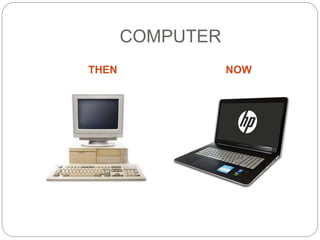
COMPUTER
THEN NOW
GENERATION OF
COMPUTER
 I Generation : 1945-55
 II Generation : 1955-65
 III Generation : 1965-75
 IV Generation : 1975-89
 V Generation : 1989 to present
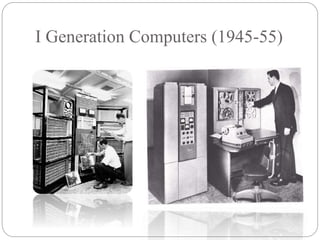
I Generation Computers (1945-55)
 During the period of 1945 to 1956 first generation of
computers were developed.
 The first generation computers used vacuum tubes for
circuitry and magnetic drums for memory, and were
often enormous, taking up entire rooms.
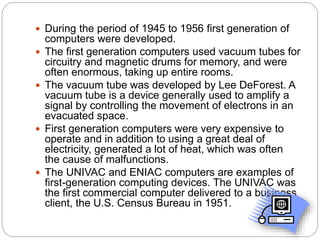
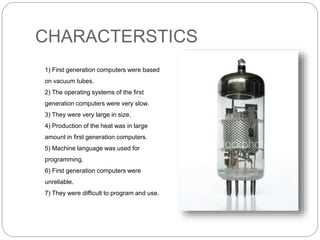
 The vacuum tube was developed by Lee DeForest. A
vacuum tube is a device generally used to amplify a
signal by controlling the movement of electrons in an
evacuated space.
 First generation computers were very expensive to
operate and in addition to using a great deal of
electricity, generated a lot of heat, which was often
the cause of malfunctions.
 The UNIVAC and ENIAC computers are examples of
first-generation computing devices. The UNIVAC was
the first commercial computer delivered to a business
client, the U.S. Census Bureau in 1951.
CHARACTERSTICS
1) First generation computers were based
on vacuum tubes.
2) The operating systems of the first
generation computers were very slow.
3) They were very large in size.
4) Production of the heat was in large
amount in first generation computers.
5) Machine language was used for
programming.
6) First generation computers were
unreliable.
7) They were difficult to program and use.
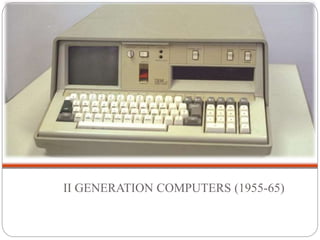
II GENERATION COMPUTERS (1955-65)
2nd Generation
 During the period of 1955 to 1965 second generation of
computers were developed
 The second generation computers emerged with development of
Transistors. The transistor was invented in 1947 by three
scientists J. Bardeen, H.W. Brattain and W. Shockley.
 Second generation computers used the low level language i.e.
machine level language and assembly language which made the
programmers easier to specify the instructions.
 Later on High level language programming were introduced
such as COBOL and FORTRAN.
 Magnetic core was used as primary storage. Second generation
computer has faster input /output devices which thus brought
improvement in the computer.
 IBM 7000, NCR 304, IBM 650, IBM 1401, ATLAS and
Mark III are the examples of second generation computers
CHARACTERSTICS
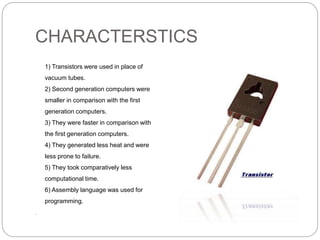
1) Transistors were used in place of
vacuum tubes.
2) Second generation computers were
smaller in comparison with the first
generation computers.
3) They were faster in comparison with
the first generation computers.
4) They generated less heat and were
less prone to failure.
5) They took comparatively less
computational time.
6) Assembly language was used for
programming.
.
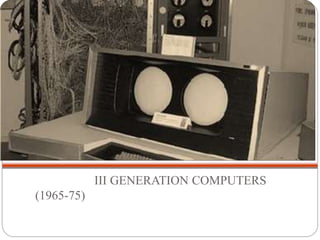
III GENERATION COMPUTERS
(1965-75)
3rd Generation
 During the period 1965-75, 3rd Generation computer was
developed.
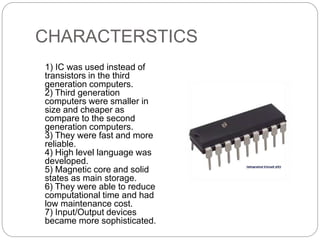
 The 3rd generation computer was emerged with the development
of IC (Integrated Circuits)
 IC was invented by Robert Noyce and Jack Kilby in 1958-59
 Transistors were miniaturized and placed on silicon chips, called
semiconductors, which drastically increased the speed and
efficiency of computers.
 Keyboards and monitors developed during the period of third
generation of computers. The third generation computers
interfaced with an operating system, which allowed the device to
run many different applications at one time with a central
program that monitored the memory.
 PDP-8, PDP-11, ICL 2900, IBM 360 and IBM 370 are the
examples of third generation computers.
CHARACTERSTICS
1) IC was used instead of
transistors in the third
generation computers.
2) Third generation
computers were smaller in
size and cheaper as
compare to the second
generation computers.
3) They were fast and more
reliable.
4) High level language was
developed.
5) Magnetic core and solid
states as main storage.
6) They were able to reduce
computational time and had
low maintenance cost.
7) Input/Output devices
became more sophisticated.
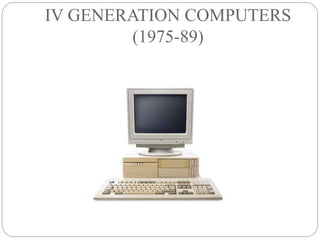
IV GENERATION COMPUTERS
(1975-89)
4th Generation
 After 1975, the fourth generation computers were
built.
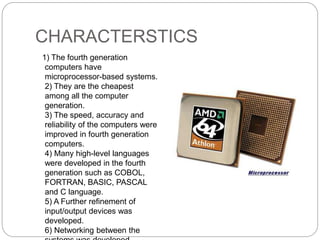
 The computers were designed by using
Microprocessor, as thousands of integrated circuits
were built onto a single silicon chip.
 The fourth generation computer doesn’t fill the room
like 1st generation computers. They are fitted on table
or on single palm hand.
 The fourth generation computers became more
powerful, compact, reliable and affordable. As a
result, they give rise to personal computer (PC)
revolution.
 For the first time in 1981 IBM introduced its computer
for the home user.
CHARACTERSTICS
1) The fourth generation
computers have
microprocessor-based systems.
2) They are the cheapest
among all the computer
generation.
3) The speed, accuracy and
reliability of the computers were
improved in fourth generation
computers.
4) Many high-level languages
were developed in the fourth
generation such as COBOL,
FORTRAN, BASIC, PASCAL
and C language.
5) A Further refinement of
input/output devices was
developed.
6) Networking between the
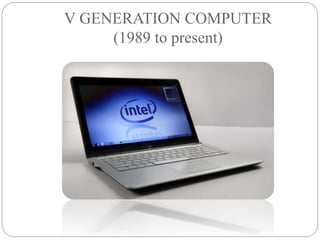
V GENERATION COMPUTER
(1989 to present)
5TH Generation Computer
 Fifth generation computers are in developmental
stage which is based on the artificial intelligence.
The goal of the fifth generation is to develop the
device which could respond to natural language
input and are capable of learning and self-
organization. Quantum computation and
molecular and nanotechnology will be used in this
technology. So we can say that the fifth
generation computers will have the power of
human intelligence.
CHARACTERSTICS
 The 5th generation
computer uses super
large scale integrated
chips.
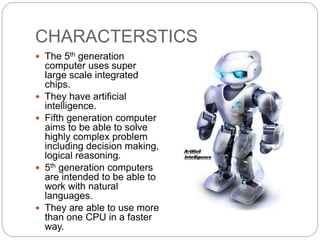
 They have artificial
intelligence.
 Fifth generation computer
aims to be able to solve
highly complex problem
including decision making,
logical reasoning.
 5th generation computers
are intended to be able to
work with natural
languages.
 They are able to use more
than one CPU in a faster
way.
FUTURE
T H A N K Y O U

Generation of computers

  • 1.
    Presented by K ul d e e p s h a h S M 0 5 / 1 6 GENERATION OF COMPUTERS
  • 2.
     Generation incomputer terminology is a change in technology a computer is/was being used. Initially, the generation term was used to distinguish between varying hardware technologies. But nowadays, generation includes both hardware and software, which together make up an entire computer system.
  • 3.
  • 4.
    GENERATION OF COMPUTER  IGeneration : 1945-55  II Generation : 1955-65  III Generation : 1965-75  IV Generation : 1975-89  V Generation : 1989 to present
  • 5.
  • 6.
     During theperiod of 1945 to 1956 first generation of computers were developed.  The first generation computers used vacuum tubes for circuitry and magnetic drums for memory, and were often enormous, taking up entire rooms.  The vacuum tube was developed by Lee DeForest. A vacuum tube is a device generally used to amplify a signal by controlling the movement of electrons in an evacuated space.  First generation computers were very expensive to operate and in addition to using a great deal of electricity, generated a lot of heat, which was often the cause of malfunctions.  The UNIVAC and ENIAC computers are examples of first-generation computing devices. The UNIVAC was the first commercial computer delivered to a business client, the U.S. Census Bureau in 1951.
  • 7.
    CHARACTERSTICS 1) First generationcomputers were based on vacuum tubes. 2) The operating systems of the first generation computers were very slow. 3) They were very large in size. 4) Production of the heat was in large amount in first generation computers. 5) Machine language was used for programming. 6) First generation computers were unreliable. 7) They were difficult to program and use.
  • 8.
  • 9.
    2nd Generation  Duringthe period of 1955 to 1965 second generation of computers were developed  The second generation computers emerged with development of Transistors. The transistor was invented in 1947 by three scientists J. Bardeen, H.W. Brattain and W. Shockley.  Second generation computers used the low level language i.e. machine level language and assembly language which made the programmers easier to specify the instructions.  Later on High level language programming were introduced such as COBOL and FORTRAN.  Magnetic core was used as primary storage. Second generation computer has faster input /output devices which thus brought improvement in the computer.  IBM 7000, NCR 304, IBM 650, IBM 1401, ATLAS and Mark III are the examples of second generation computers
  • 10.
    CHARACTERSTICS 1) Transistors wereused in place of vacuum tubes. 2) Second generation computers were smaller in comparison with the first generation computers. 3) They were faster in comparison with the first generation computers. 4) They generated less heat and were less prone to failure. 5) They took comparatively less computational time. 6) Assembly language was used for programming. .
  • 11.
  • 12.
    3rd Generation  Duringthe period 1965-75, 3rd Generation computer was developed.  The 3rd generation computer was emerged with the development of IC (Integrated Circuits)  IC was invented by Robert Noyce and Jack Kilby in 1958-59  Transistors were miniaturized and placed on silicon chips, called semiconductors, which drastically increased the speed and efficiency of computers.  Keyboards and monitors developed during the period of third generation of computers. The third generation computers interfaced with an operating system, which allowed the device to run many different applications at one time with a central program that monitored the memory.  PDP-8, PDP-11, ICL 2900, IBM 360 and IBM 370 are the examples of third generation computers.
  • 13.
    CHARACTERSTICS 1) IC wasused instead of transistors in the third generation computers. 2) Third generation computers were smaller in size and cheaper as compare to the second generation computers. 3) They were fast and more reliable. 4) High level language was developed. 5) Magnetic core and solid states as main storage. 6) They were able to reduce computational time and had low maintenance cost. 7) Input/Output devices became more sophisticated.
  • 14.
  • 15.
    4th Generation  After1975, the fourth generation computers were built.  The computers were designed by using Microprocessor, as thousands of integrated circuits were built onto a single silicon chip.  The fourth generation computer doesn’t fill the room like 1st generation computers. They are fitted on table or on single palm hand.  The fourth generation computers became more powerful, compact, reliable and affordable. As a result, they give rise to personal computer (PC) revolution.  For the first time in 1981 IBM introduced its computer for the home user.
  • 16.
    CHARACTERSTICS 1) The fourthgeneration computers have microprocessor-based systems. 2) They are the cheapest among all the computer generation. 3) The speed, accuracy and reliability of the computers were improved in fourth generation computers. 4) Many high-level languages were developed in the fourth generation such as COBOL, FORTRAN, BASIC, PASCAL and C language. 5) A Further refinement of input/output devices was developed. 6) Networking between the
  • 17.
  • 18.
    5TH Generation Computer Fifth generation computers are in developmental stage which is based on the artificial intelligence. The goal of the fifth generation is to develop the device which could respond to natural language input and are capable of learning and self- organization. Quantum computation and molecular and nanotechnology will be used in this technology. So we can say that the fifth generation computers will have the power of human intelligence.
  • 19.
    CHARACTERSTICS  The 5thgeneration computer uses super large scale integrated chips.  They have artificial intelligence.  Fifth generation computer aims to be able to solve highly complex problem including decision making, logical reasoning.  5th generation computers are intended to be able to work with natural languages.  They are able to use more than one CPU in a faster way.
  • 20.
    FUTURE T H AN K Y O U