Download to read offline
![It can be represented in gantt chart as follow:
Process Burst Time Priority
Waiting
Time
Completion
Time
Turnaround
Time
P1 9 5 19 – 0 = 19 28 9 + 19 = 28
P2 4 3 12 - 0 = 12 16 4 + 12 = 16
P3 5 1 0 - 0 = 0 5 5 + 0 = 5
P4 7 2 5 - 0 = 5 12 7 + 5 = 12
P5 3 4 16 - 0 = 16 19 3 + 16 = 19
Total 52 80 80
Average 10.4 16 16
Round-Robin Scheduling
Round Robin(RR) scheduling algorithm is mainly designed for time-sharing systems. This
algorithm is similar to FCFS scheduling, but in Round Robin(RR) scheduling, preemption is added
which enables the system to switch between processes.
1. A fixed time is allotted to each process, called a quantum, for execution.
2. Once a process is executed for the given time period that process is preempted and another
process executes for the given time period.
3. Context switching is used to save states of preempted processes.
4. This algorithm is simple and easy to implement and the most important is thing is this
algorithm is starvation-free as all processes get a fair share of CPU.
5. It is important to note here that the length of time quantum is generally from 10 to 100
milliseconds in length.
Steps to find waiting times of all processes:
1. Create an array rem_bt[] to keep track of remaining burst
time of processes. This array is initially a copy of bt[]
(burst times array)
2. Create another array wt[] to store waiting times of
processes. Initialize this array as 0.
3. Initialize time : t = 0
4. Keep traversing the all processes while all processes are
not done. Do following for i'th process if it is not done
yet.
a. If rem_bt[i] > quantum
(i) t = t + quantum
bt_rem[i] -= quantum;](https://image.slidesharecdn.com/rrandpriorityscheduling-210706152216/85/RR-and-priority-scheduling-2-320.jpg)
![b. Else // Last cycle for this process
t = t + bt_rem[i];
wt[i] = t - bt[i]
bt_rem[i] = 0; // This process is over
Once we have waiting times, we can compute turn around time tat[i]
of a process as sum of waiting and burst times, i.e., wt[i] +
bt[i]
Example
Process Burst Time
P1 5
P2 4
P3 1
P4 6
Time Slice=2ms
P1 P2 P3 P4 P1 P2 P4 P1 P4
0 2 4 5 7 9 11 13 14 16
Process Burst Time Waiting Time
Completion
Time
Turnaround
Time
P1 5
(0 - 0) + (7 - 2) +
(13 - 9) = 9
14 14
P2 4
(2 - 0) + (9 - 4) =
7
11 11
P3 1 (4 - 0) = 4 5 5
P4 6
(5 - 0) + (11 - 7)
+ (14 - 13) = 10
16 16
Total 30 46 46
Average 7.5 11.5 11.5](https://image.slidesharecdn.com/rrandpriorityscheduling-210706152216/85/RR-and-priority-scheduling-3-320.jpg)

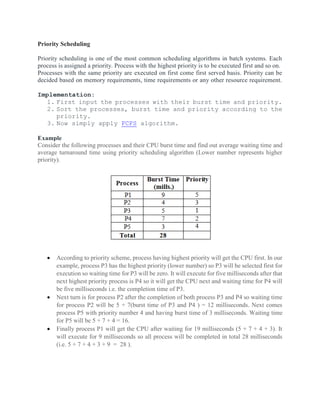
Priority scheduling assigns priorities to processes and executes the highest priority process first. If processes have equal priorities, they are executed in first come first served order. The example document shows how priority scheduling works by assigning priorities from 1 to 5 to five processes, then calculating their waiting times and turnaround times based on executing the highest priority processes first. Round robin scheduling assigns a fixed time quantum to each process, preempting and resuming processes to ensure all get CPU time and avoid starvation. The example shows how time is divided between processes using a 2ms time quantum.


